# supercells  [](https://CRAN.R-project.org/package=supercells)
[](https://github.com/Nowosad/supercells/actions)
[](https://app.codecov.io/gh/Nowosad/supercells?branch=main)
[](https://cran.r-project.org/package=supercells)
The goal of **supercells** is to bring the idea of superpixels into
spatial analysis - grouping raster cells (not just image pixels) into
meaningful, coherent regions. This package works on spatial data with
one variable (e.g., continuous raster), many variables (e.g., RGB
rasters), and spatial patterns (e.g., areas in categorical rasters). It
is based on the SLIC algorithm (Achanta et al. (2012)), adapted to work
with arbitrary dissimilarity measures and multidimensional data.
## Installation
You can install the released version of supercells from
[CRAN](https://CRAN.R-project.org) with:
``` r
install.packages("supercells")
```
You can install the development version with:
``` r
install.packages("supercells", repos = "https://nowosad.r-universe.dev")
```
## Example
``` r
library(supercells)
library(terra)
library(sf)
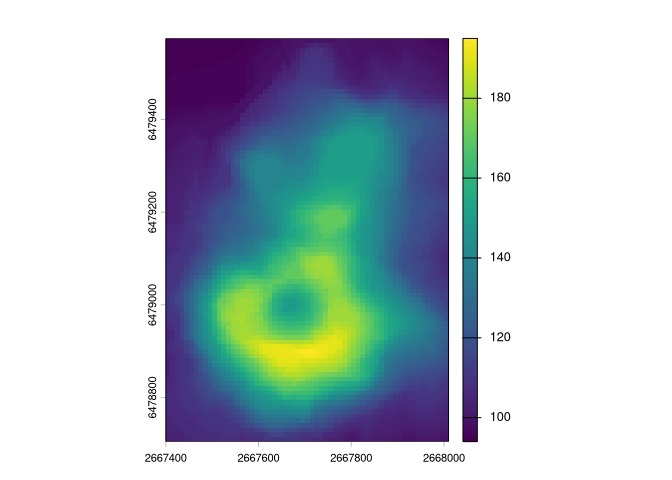
vol = rast(system.file("raster/volcano.tif", package = "supercells"))
plot(vol)
```
[](https://CRAN.R-project.org/package=supercells)
[](https://github.com/Nowosad/supercells/actions)
[](https://app.codecov.io/gh/Nowosad/supercells?branch=main)
[](https://cran.r-project.org/package=supercells)
The goal of **supercells** is to bring the idea of superpixels into
spatial analysis - grouping raster cells (not just image pixels) into
meaningful, coherent regions. This package works on spatial data with
one variable (e.g., continuous raster), many variables (e.g., RGB
rasters), and spatial patterns (e.g., areas in categorical rasters). It
is based on the SLIC algorithm (Achanta et al. (2012)), adapted to work
with arbitrary dissimilarity measures and multidimensional data.
## Installation
You can install the released version of supercells from
[CRAN](https://CRAN.R-project.org) with:
``` r
install.packages("supercells")
```
You can install the development version with:
``` r
install.packages("supercells", repos = "https://nowosad.r-universe.dev")
```
## Example
``` r
library(supercells)
library(terra)
library(sf)
vol = rast(system.file("raster/volcano.tif", package = "supercells"))
plot(vol)
```
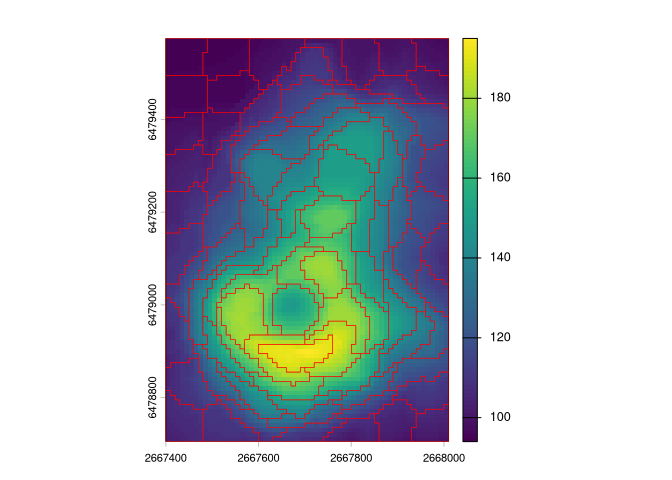
 Here, `step` controls the approximate spacing between supercell centers,
and `compactness` allows to balance spatial proximity versus value
similarity.
``` r
vol_slic1 = sc_slic(vol, step = 8, compactness = 7)
plot(vol)
plot(st_geometry(vol_slic1), add = TRUE, lwd = 0.5, border = "red")
```
Here, `step` controls the approximate spacing between supercell centers,
and `compactness` allows to balance spatial proximity versus value
similarity.
``` r
vol_slic1 = sc_slic(vol, step = 8, compactness = 7)
plot(vol)
plot(st_geometry(vol_slic1), add = TRUE, lwd = 0.5, border = "red")
```
 ## Documentation
Version 2 (in development) focuses on a clearer workflow, tools for
diagnostics, and more guidance on choosing parameters and interpreting
results. Start with these vignettes:
1. [Introduction to
supercells](https://jakubnowosad.com/supercells/articles/v2-intro.html)
2. [Choosing parameters for
supercells](https://jakubnowosad.com/supercells/articles/v2-parameters.html)
3. [Evaluation and
diagnostics](https://jakubnowosad.com/supercells/articles/v2-evaluation.html)
If you are already familiar with version 1.0.0, you can jump to the
summary of changes:
1. [Main changes since version
1.0.0](https://jakubnowosad.com/supercells/articles/v2-changes-since-v1.html)
Watch the presentations about this package and some related ideas:
1. *Spatial segmentation in R using the supercells package*,
2021-09-02, OpenGeoHub Summer School -
[slides](https://jakubnowosad.com/ogh2021/),
[video](https://doi.org/10.5446/54880)
2. *Generalizing the Simple Linear Iterative Clustering (SLIC)
superpixels*, 2021-09-28, GIScience 2021 -
[slides](https://jakubnowosad.com/giscience-2021/),
[video](https://www.youtube.com/watch?v=AlyEFkyKLUw&t=2018s)
Read the related article:
1. Nowosad, J., Stepinski, T. (2022). Extended SLIC superpixels
algorithm for applications to non-imagery geospatial rasters.
International Journal of Applied Earth Observation and
Geoinformation,
## Contribution
Contributions to this package are welcome – let us know if you need
other distance measures or transformations, have any suggestions, or
spotted a bug. The preferred method of contribution is through a GitHub
pull request. Feel also free to contact us by creating [an
issue](https://github.com/nowosad/supercells/issues).
## Documentation
Version 2 (in development) focuses on a clearer workflow, tools for
diagnostics, and more guidance on choosing parameters and interpreting
results. Start with these vignettes:
1. [Introduction to
supercells](https://jakubnowosad.com/supercells/articles/v2-intro.html)
2. [Choosing parameters for
supercells](https://jakubnowosad.com/supercells/articles/v2-parameters.html)
3. [Evaluation and
diagnostics](https://jakubnowosad.com/supercells/articles/v2-evaluation.html)
If you are already familiar with version 1.0.0, you can jump to the
summary of changes:
1. [Main changes since version
1.0.0](https://jakubnowosad.com/supercells/articles/v2-changes-since-v1.html)
Watch the presentations about this package and some related ideas:
1. *Spatial segmentation in R using the supercells package*,
2021-09-02, OpenGeoHub Summer School -
[slides](https://jakubnowosad.com/ogh2021/),
[video](https://doi.org/10.5446/54880)
2. *Generalizing the Simple Linear Iterative Clustering (SLIC)
superpixels*, 2021-09-28, GIScience 2021 -
[slides](https://jakubnowosad.com/giscience-2021/),
[video](https://www.youtube.com/watch?v=AlyEFkyKLUw&t=2018s)
Read the related article:
1. Nowosad, J., Stepinski, T. (2022). Extended SLIC superpixels
algorithm for applications to non-imagery geospatial rasters.
International Journal of Applied Earth Observation and
Geoinformation,
## Contribution
Contributions to this package are welcome – let us know if you need
other distance measures or transformations, have any suggestions, or
spotted a bug. The preferred method of contribution is through a GitHub
pull request. Feel also free to contact us by creating [an
issue](https://github.com/nowosad/supercells/issues).