A self-hosted control plane for security-learning events — one box, one free GitHub org.
Run it for a university, a high school, an OWASP chapter, a meetup.





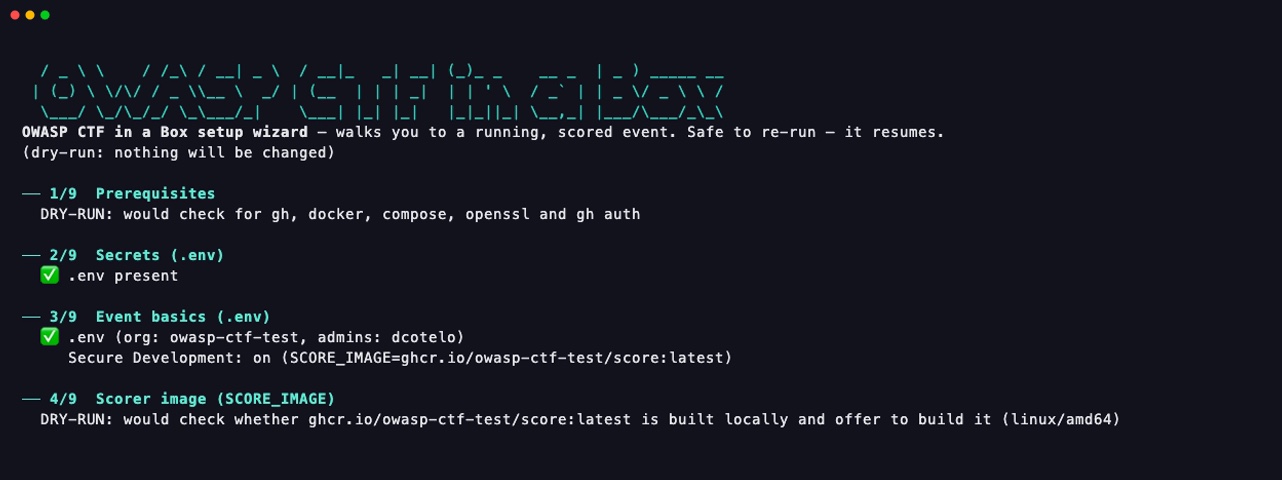
`
links; **Play solo** makes a team of one.
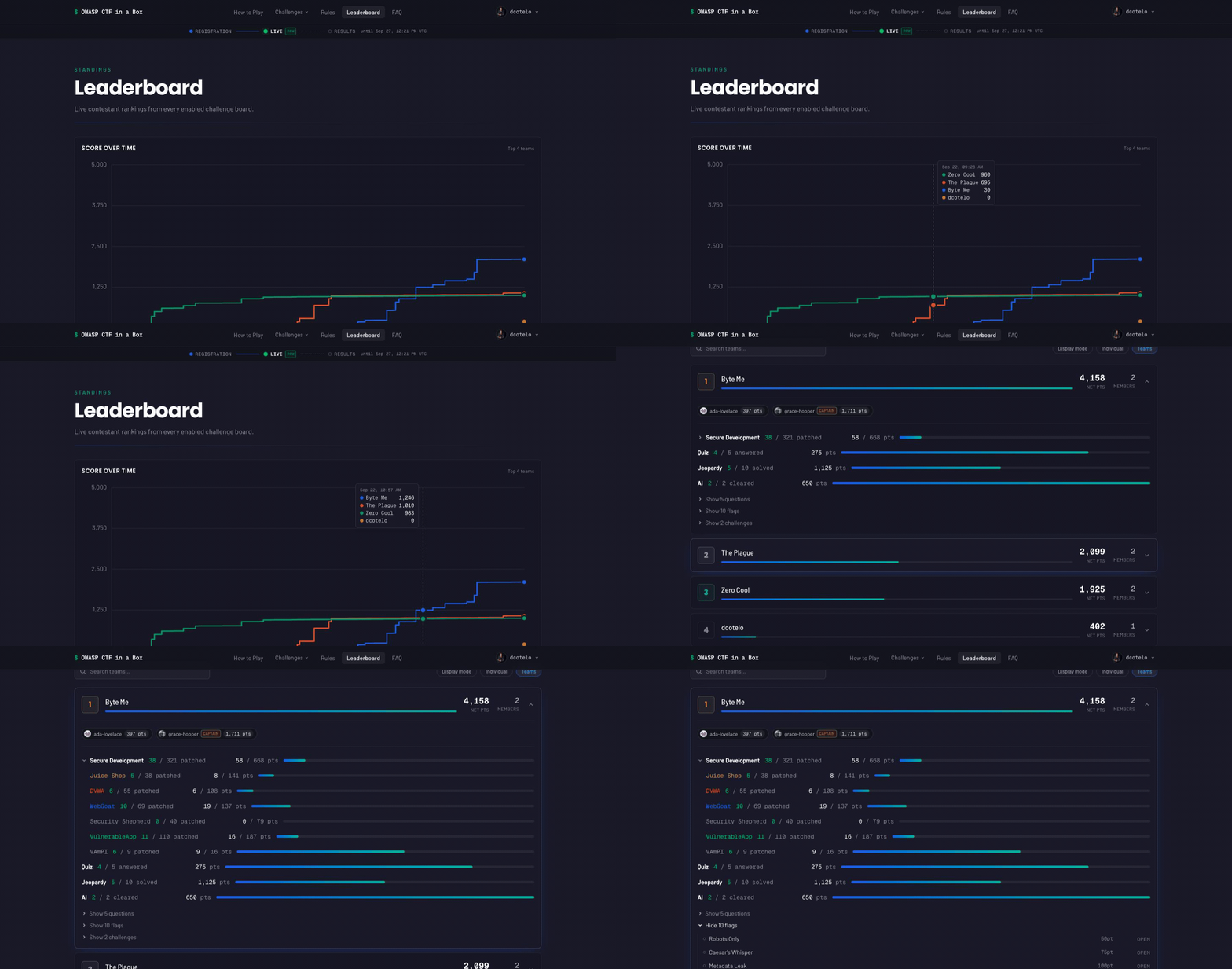
- **A live leaderboard** with a score-over-time graph from real solve times.
- **The `/admin` panel** — freeze, scoring and registration windows, hints,
team cap, cooldowns, module content, per-contestant support actions, an
activity stream, engagement metrics and an audit log. All of it changes at
runtime, with no rebuild.
- **Event archive** — export the event's content and settings, and import
them into another box. Contestant progress is not exported.
The archive holds every flag and quiz answer in plain text, so keep it as
private as `/admin`.
| Contestant breakdown | Challenge browser |
|---|---|
| 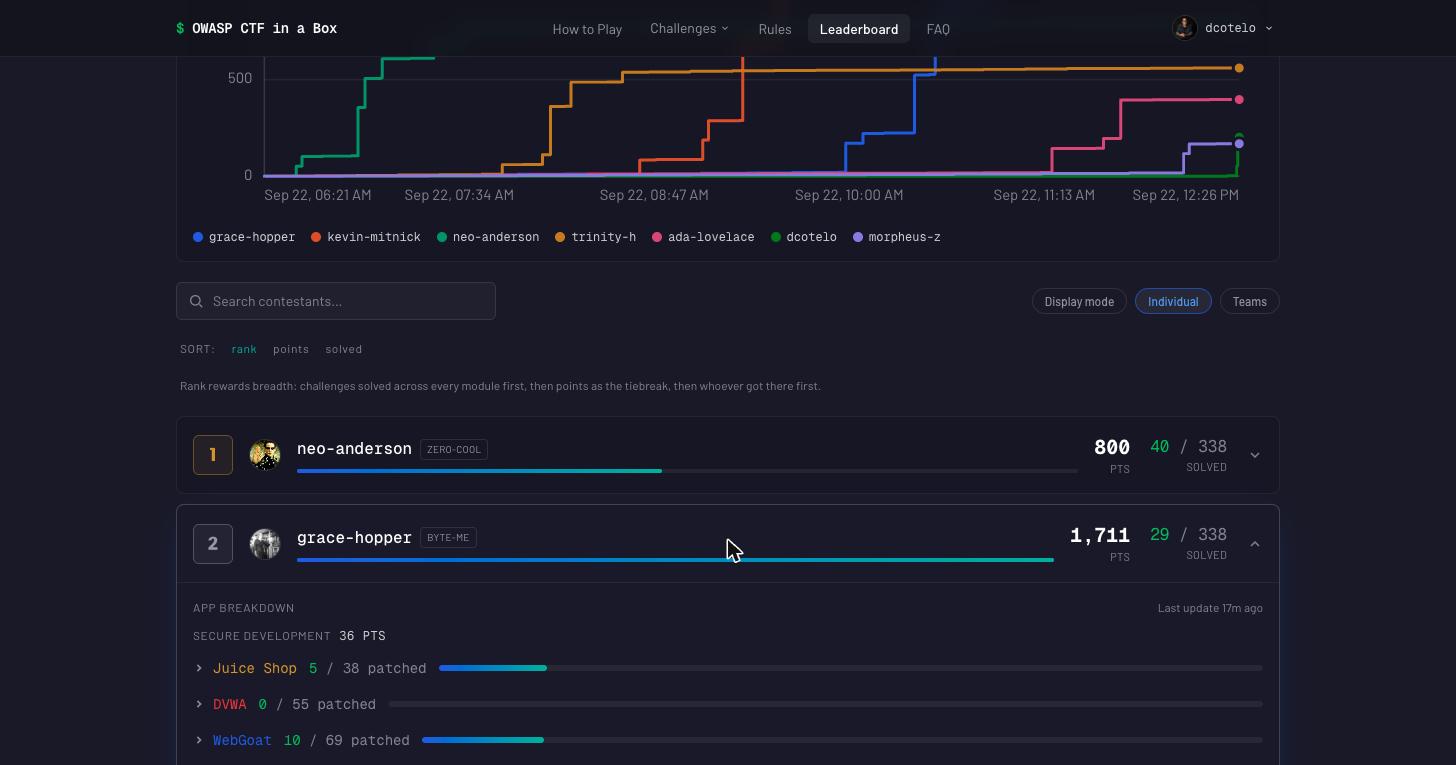 | 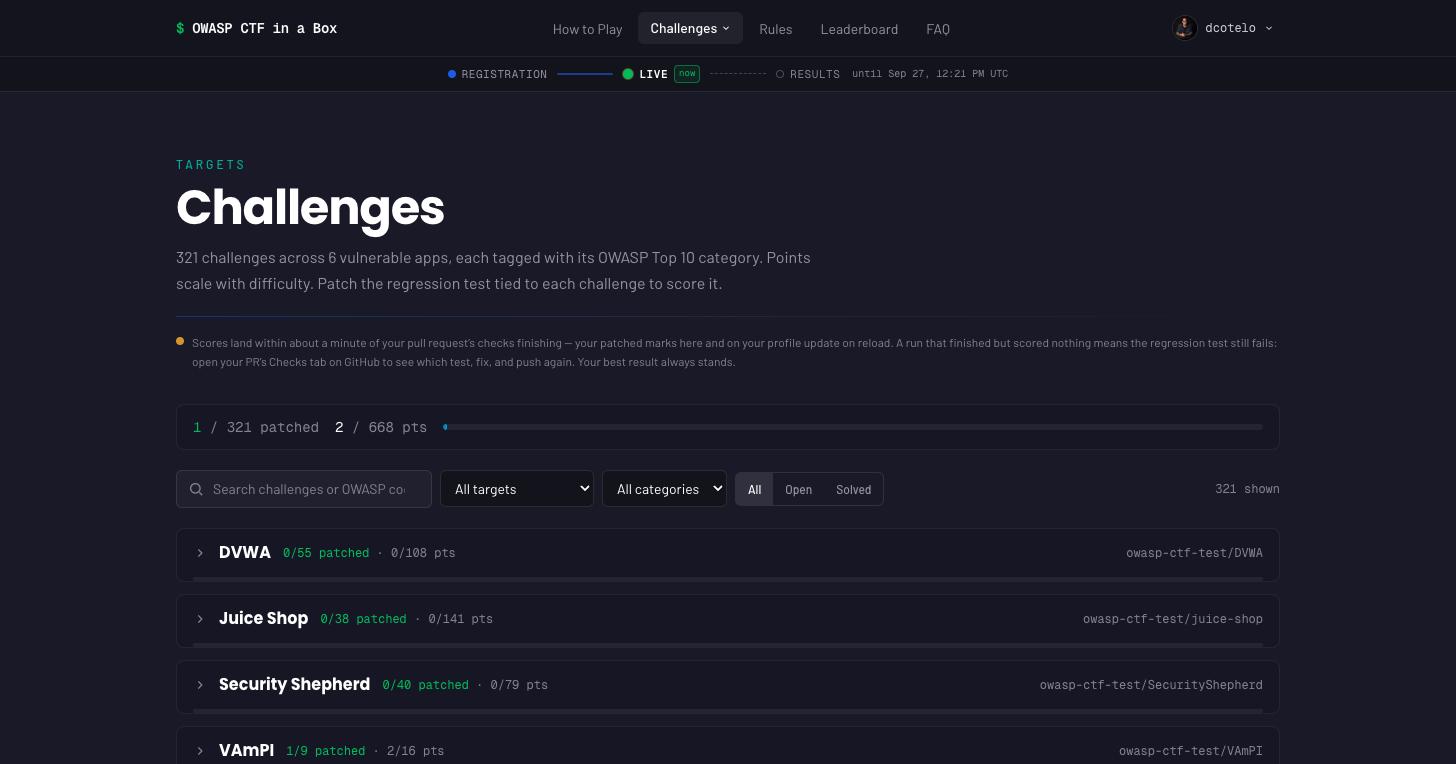 |
| Jeopardy flag board | Quiz |
|---|---|
| 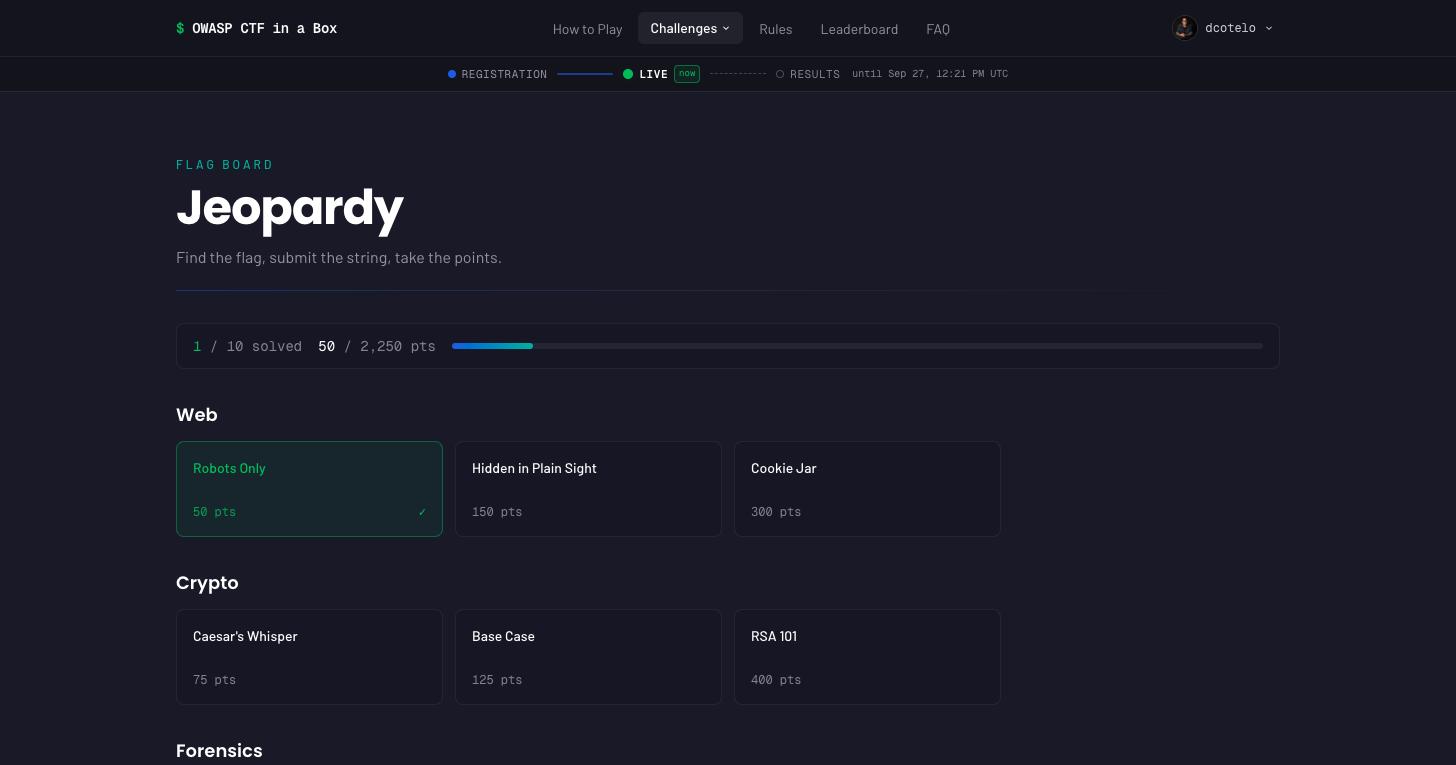 | 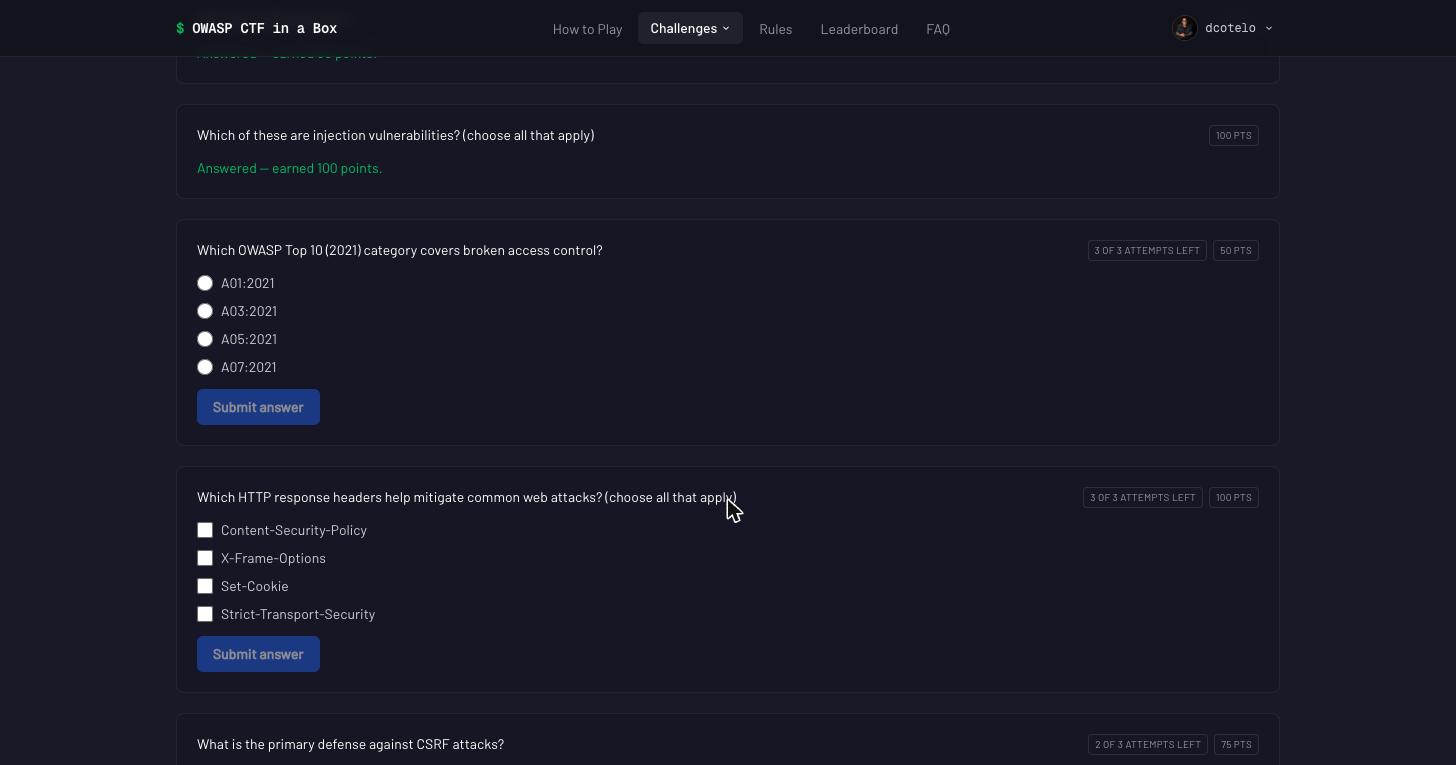 |
## Secure Development targets
| Target | Challenges | Points | Notes |
|---|---:|---:|---|
| `vulnerableapp` | 110 | 187 | Largest target |
| `webgoat` | 69 | 137 | Two-stage build: Maven, then the runtime image |
| `dvwa` | 55 | 108 | Needs a MariaDB sibling |
| `securityshepherd` | 40 | 79 | HTTPS, three-container stack |
| `juice-shop` | 38 | 141 | The only target with 6-star challenges |
| `vampi` | 9 | 16 | Small and quick — a good first target |
| **Total** | **321** | **668** | Setup forks all six; pick the live subset in `/admin` |
The rubrics live in `scorer/rubric.owasp/`, vendored from
[OWASP-CTF/dc34-owasp-secure-development-ctf](https://github.com/OWASP-CTF/dc34-owasp-secure-development-ctf).
They are public: the targets and their solutions are already published, so a
private rubric only protects against gaming the checks. To use your own, or
to write new ones, see [docs/scorer.md](docs/scorer.md).
## How it works
One Docker Compose stack. Caddy terminates TLS in front of the Next.js app,
and the app reaches Redis only through a REST proxy on a split network, so
nothing internet-facing can reach Redis directly. Quiz, Jeopardy and AI are
graded inside the app.
Secure Development is graded *outside* the box: the contestant's fork runs a
GitHub Action that boots the target, tests the patch, and posts a score
comment on the pull request. The box's `sync` service polls GitHub for those
comments, so nothing has to reach your box from outside — it works behind NAT,
on a campus network or on venue wifi. Scores only ever go up: a later failing
run never takes back a solve.
 Components, the score data flow and the security model:
[docs/architecture.md](docs/architecture.md). Why it is built this way:
[docs/decisions.md](docs/decisions.md).
## Running an event
- **Contestants** sign in with GitHub and form or join a team (a team is
required to score), then play whichever modules you enabled.
- **Organizers** run everything from `/admin`: the schedule, the freeze,
registration, content — and when one contestant gets stuck, they fix that
one contestant instead of resetting the event.
- **Before the doors open**, walk [the security checklist](docs/security-checklist.md).
- **When it's over**, `./setup/ctf-setup.sh teardown` archives the target
repos; then uninstall the GitHub App and delete the org's Actions secrets
yourself.
On a Compose box, all state lives in named Docker volumes, so a reboot loses
nothing; the AWS module keeps it in ElastiCache instead. The full
organizer guide is [docs/operations.md](docs/operations.md).
## What it is not
- **Not a general CTF platform.** For a conventional jeopardy or
attack-defense event with maximum flexibility, use
[CTFd](https://ctfd.io/). This kit's Jeopardy module is deliberately
smaller.
- **Not a hosted practice gym.** If you don't need to run your *own* event,
[picoCTF](https://picoctf.org/) needs zero operations.
- **Not an attack trainer.** The flagship module grades *patches*, not
exploits.
## Documentation
| Read this when you're… | Document |
|---|---|
| Standing the kit up | [docs/hosting.md](docs/hosting.md) — prerequisites, the wizard and every step, the GitHub OAuth app, the `.env` bootstrap |
| Deploying to a cloud | [docs/aws.md](docs/aws.md) (Terraform: ECS Fargate + ElastiCache + ALB) · [docs/fly.md](docs/fly.md) (one Fly machine) |
| About to open the doors | [docs/security-checklist.md](docs/security-checklist.md) — the one-page pre-event walk |
| Running the event | [docs/operations.md](docs/operations.md) — teams, the admin panel, the module guides, teardown |
| Fixing something | [docs/troubleshooting.md](docs/troubleshooting.md) — symptom by symptom |
| Understanding the system | [docs/architecture.md](docs/architecture.md) — diagram, score data flow, security model, testing |
| Writing a rubric | [docs/scorer.md](docs/scorer.md) — both rubric formats, authoring and building |
| Building a new module | [docs/modules.md](docs/modules.md) — the platform/module contract |
| Asking "why is it like this?" | [docs/decisions.md](docs/decisions.md) — numbered ADRs |
Rendered at **[owasp.github.io/owasp-ctf-in-a-box](https://owasp.github.io/owasp-ctf-in-a-box/)**.
## Contributing and security
Contributions are welcome. [CONTRIBUTING.md](CONTRIBUTING.md) covers the dev
environment, the CI gates and how to propose a module (start with an issue,
not a PR); [CODE_OF_CONDUCT.md](CODE_OF_CONDUCT.md) applies. Before opening
a PR for an issue, read
[Claiming an issue](CONTRIBUTING.md#claiming-an-issue). Questions and chat go to
[the project's channel](https://owasp.slack.com/archives/C0C2RKGSKD5) on the
OWASP Slack ([join](https://owasp.org/slack/invite)). Small,
well-specified work is tagged
[`good first issue`](https://github.com/OWASP/owasp-ctf-in-a-box/issues?q=is%3Aissue+is%3Aopen+label%3A%22good+first+issue%22).
Sign off every commit with `git commit -s`
([Developer Certificate of Origin](https://developercertificate.org/)).
Humans and AI agents alike should read [AGENTS.md](AGENTS.md) before writing
code: it lists the exact commands CI runs and the mistakes this repo has
already made. A change is ready when CI is green and every CodeRabbit review
thread on the latest commit is resolved.
Found a vulnerability in the kit itself? See **[SECURITY.md](SECURITY.md)**.
The targets' vulnerabilities are intentional and out of scope.
## License and credits
Code is **MIT** ([LICENSE](LICENSE)); the documentation — this README and
the Markdown under `docs/` — is **CC BY-SA 4.0** ([docs/LICENSE](docs/LICENSE)),
as the [OWASP Project Policy](https://policy.owasp.org/operational/projects)
requires.
This is an **OWASP Foundation** incubator project —
[owasp.org/projects/ctf-in-a-box](https://owasp.org/projects/ctf-in-a-box).
The rubrics come from the
[OWASP-CTF](https://github.com/OWASP-CTF/dc34-owasp-secure-development-ctf)
event; this kit exists because that event was worth running more than once.
The vulnerable targets are not vendored: events fork them from their own
upstreams, and each keeps its own license —
[Juice Shop](https://github.com/juice-shop/juice-shop),
[WebGoat](https://github.com/WebGoat/WebGoat),
[Security Shepherd](https://github.com/OWASP/SecurityShepherd) and
[VulnerableApp](https://github.com/SasanLabs/VulnerableApp) are OWASP
projects; [DVWA](https://github.com/digininja/DVWA) and
[VAmPI](https://github.com/erev0s/VAmPI) are community projects.
OWASP® is a registered trademark of the OWASP Foundation. OWASP does not
endorse or recommend any product or service, including the targets and
services this kit integrates with.