中文 | English |
💬Discord |
UltraEval-Audio Paper
> 🎉 We are delighted to announce that **UltraEval-Audio has been published at ACL 2026 **! Read the paper on the [ACL Anthology](https://aclanthology.org/2026.acl-demo.56/).
# v1.1 Highlights
> - **Popular model replication**: Added replication support for popular models, including **replication result showcases** and **one-click replication commands** (see `replication/`).
> - **Isolated Runtime**: Introduced an isolated inference mechanism. Model-specific dependencies are installed/managed automatically; inference runs in the isolated environment and communicates with the main evaluation process via **IPC**, eliminating dependency conflicts.
> - **Specialized model evaluation support**: Added specialized audio models for **TTS, ASR, and Audio Codec**, further expanding evaluation coverage.
# Overview
### 🚀Exceptional Experience with UltraEval-Audio🚀
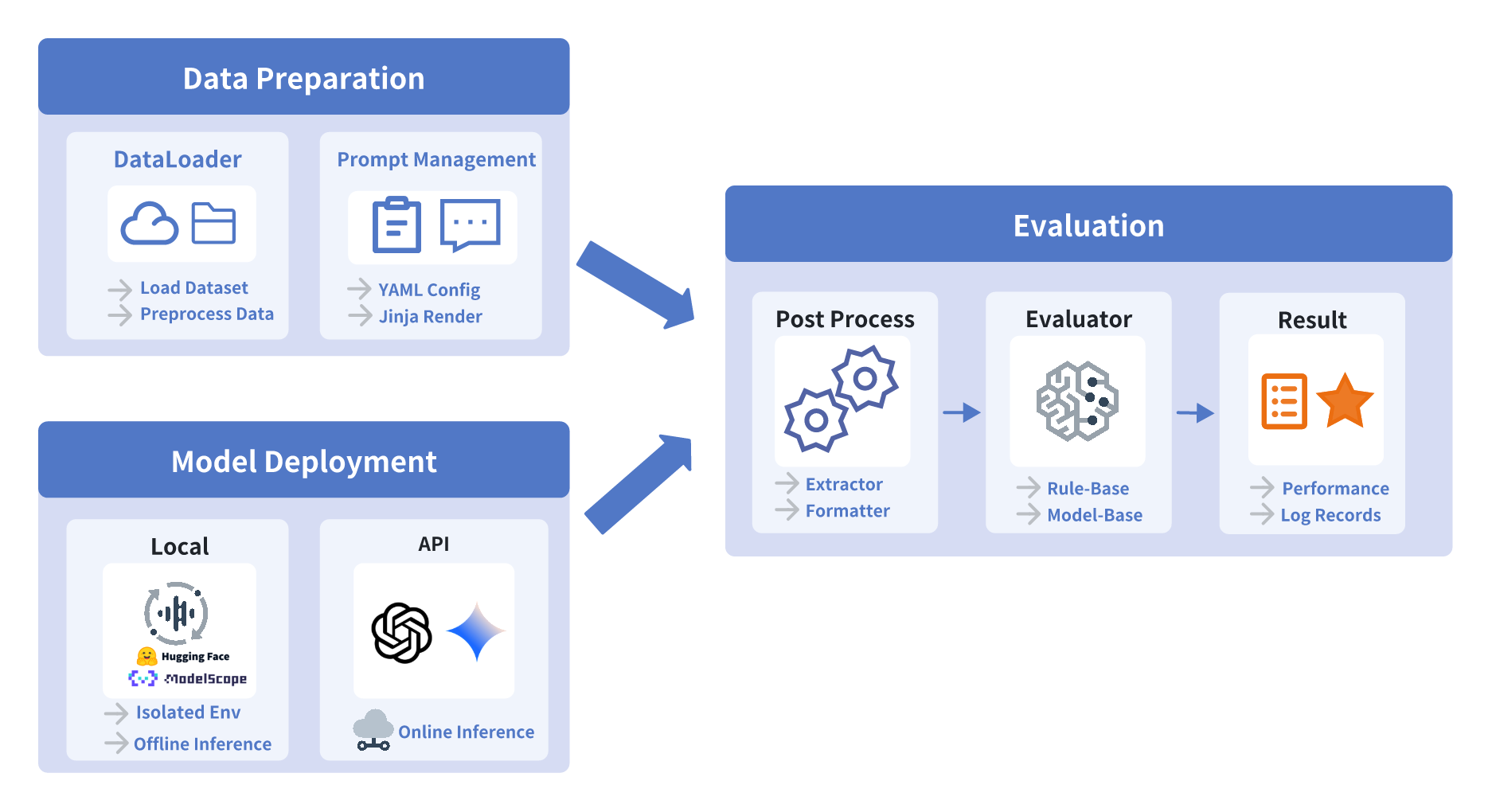
UltraEval-Audio — The world's first open-source framework supporting both speech understanding and speech generation evaluation, specifically designed for large audio models. It aggregates 34 authoritative benchmarks, covering four major domains: speech, sound, medicine, and music, supporting 10 languages and 12 task categories. With UltraEval-Audio, you will experience unprecedented convenience and efficiency:
- **Direct Replication of Popular Models 🔬**: Provides detailed [replication documentation and commands](./replication/), ensuring you can easily reproduce evaluation results of open-source models with complete transparency and reproducibility.
- **One-Click Benchmark Management 📥**: Say goodbye to tedious manual downloading and data processing. UltraEval-Audio automates it all, letting you easily acquire well-known benchmark datasets (e.g., Librispeech, TED-LIUM, Seed-TTS-Eval).
- **Built-in Evaluation Tools ⚙️**: No need to hunt for evaluation tools. UltraEval-Audio binds datasets with commonly used official evaluation methods (e.g., WER, WER-ZH, BLEU, G-Eval) to ensure alignment between datasets and metrics.
- **Powerful and Flexible 🛠️**: Supports preview testing, random sampling, error retries, and resume-from-breakpoint, ensuring a flexible and controllable evaluation process while boosting efficiency and accuracy.
- **Seamless Integration of Custom Datasets 💼**: Supports not only public benchmarks but also powerful custom dataset integration, allowing rapid application in various engineering scenarios.
- **Easy Integration with Existing Systems 🔗**: With excellent extensibility and standardized design, UltraEval-Audio seamlessly connects with your existing evaluation pipelines, simplifying project management and unifying output results.
# Changelog🔥
- [2026/07/13]
- Support **[InstructTTSEval](replication/InstructTTSEval.md)** for evaluating complex natural-language instruction following in TTS systems.
- Includes English and Chinese subsets and evaluates fine-grained acoustic control (APS), descriptive style following (DSD), and role-play/scenario style following (RP) with a Gemini judge.
- Provides reference-audio alignment results and one-command evaluation examples for the integrated benchmark.
- [2026/06/10]
- Support **[Qwen3-ASR](replication/qwen3_asr.md)** evaluation (`qwen3-asr-1.7b`, `qwen3-asr-0.6b`), with replication results and commands for English, Chinese, and Chinese dialect ASR benchmarks.
- [2026/04/20]
- Support **[Fish Speech S2 Pro](replication/fishaudio-s2-pro.md)** evaluation, including Seed-TTS-Eval and MiniMax multilingual TTS benchmarks (22 languages)
- [2026/02/03]
- Support **[Qwen3-TTS](replication/qwen3_tts.md)** evaluation
- GPU parallel acceleration for faster evaluation/inference
- Usage: add `--use_model_pool` and `--workers
Librispeech
dev-clean\|dev-other
test-clean\|test-other | ASR
TED-LIUM | ASR
CV-15
en\|zh | ASR
Aishell-1 | ASR
FLEURS | ASR
Wenet
-test-net | AST
covost2-en2zh | AST
covost2-zh2en | EMO
MELD | Avg. Score
($\uparrow$) |
| :------------------------------------ | :---------------------------------------------------------------------------------: | :------------------: | :------------------------------: | :-------------------: | :----------------: | :---------------------------------: | :-----------------------: | :-----------------------: | :--------------: | :-------------------------------: |
| **GPT-4o-Realtime** | 2.30\|5.60
2.60\|5.50 | 4.80 | 27.44\|37.44 | 7.30 | 5.40 | 28.90 | 37.10 | 15.70 | 33.20 | 73.75 |
| **Qwen3-Omni-30B-A3B-Instruct** | 1.25\|2.27
1.36\|2.57 | 2.82 | **6.00**\|**4.32** | 0.87 | 2.61 | **4.82** | 46.58 | **29.40** | 56.81 | **84.92** |
| **Qwen2.5-Omni** | 2.10\|4.20
2.40\|4.20 | 4.70 | 8.70\|5.20 | 1.10 | 4.60 | 6.00 | 42.50 | 11.50 | 53.60 | 81.88 |
| **MiniCPM-o 2.6** | 1.60\|3.40
1.70\|4.40 | 3.00 | 10.30\|9.60 | 1.60 | 4.40 | 6.90 | **48.20** | 27.20 | 52.40 | 83.15 |
| **Kimi-Audio-7B-Instruct** | **1.18\|2.34**
**1.28\|2.44** | 2.96 | 7.09\|5.72 | **0.60** | **2.53** | 5.55 | 36.61 | 18.30 | **59.23** | 83.27 |
| **Gemini-1.5-Flash** | 5.90\|7.20
21.90\|16.30 | 6.90 | 208.00\|84.37 | 9.00 | 85.90 | 279.90 | 33.40 | 8.20 | 45.20 | 27.80 |
| **Gemini-1.5-Pro** | 2.60\|4.40
2.90\|4.90 | 3.00 | 8.36\|13.26 | 4.50 | 5.90 | 14.30 | 47.30 | 22.60 | 48.40 | 81.09 |
| **Gemini-2.5-Flash** | 3.73\|6.71
3.28\|12.03 | 3.53 | 46.76\|36.15 | 6.40 | 6.45 | 126.07 | 3.67 | 10.61 | 51.53 | 62.67 |
| **Gemini-2.5-Pro** | 5.30\|4.51
2.84\|6.74 | **2.52** | 9.42\|11.04 | 3.36 | 4.25 | 16.83 | 41.75 | 27.84 | 46.59 | 80.72 |
| **Qwen2-Audio-7B** | 1.57\|3.50
1.60\|3.88 | 3.43 | 8.67\|7.03 | 1.52 | 5.89 | 8.09 | 45.30 | 24.84 | 42.87 | 82.14 |
| **Qwen2-Audio-7B-Instruct** | 2.90\|5.50
3.10\|5.70 | 5.90 | 10.68\|8.39 | 2.60 | 6.90 | 10.30 | 39.50 | 22.90 | 17.40 | 78.29 |
| **MiDaShengLM-7B** | 2.20\|4.75
2.21\|5.16 | 146.53 | 13.66\|29.13 | 1.23 | 3.28 | 16.56 | 38.52 | 22.68 | 53.96 | 68.50 |
## Audio Generation Leaderboard
> **Audio Generation Audio Foundation Models**: Speech → Speech
> Table: Audio generation performance ($\uparrow$). Acoustic metrics (UTMOS | DNSMOS P.835 | DNSMOS P.808, scores range from 0 to 5) are evaluated on the generated audio responses from the speech tasks. Best results are in bold.
>
> Note: The average score is computed as the average of 6 scores: five speech-task scores and normalized acoustic scores. For acoustic scores (UTMOS | DNSMOS P.835 | DNSMOS P.808), each value (0--5) is multiplied by 20 to map to 0--100, then averaged to obtain the normalized acoustic score.
| Models | Speech
WebQuestions | Speech
TriviaQA | Speech
AlpacaEval | Speech
CMMLU | Speech
HSK | Acoustics | Avg. Score
($\uparrow$) |
| :------------------------------------ | :------------------------: | :--------------------: | :----------------------: | :-----------------: | :---------------: | :----------------------------------: | :------------------------------: |
| **GPT-4o-Realtime** | **51.60** | **69.70** | **74.00** | 70.05 | **98.69** | 4.29\|3.44\|4.26 | **74.00** |
| **Qwen3-Omni-30B-A3B-Instruct** | 51.50 | 55.27 | 67.97 | 47.83 | 40.27 | **4.44**\|3.45\|4.12 | 57.15 |
| **Qwen2.5-Omni** | 38.89 | 39.94 | 54.00 | **73.72** | 95.65 | 4.23\|**3.48**\|**4.27** | 63.68 |
| **MiniCPM-o 2.6** | 40.00 | 40.20 | 51.00 | 49.22 | 80.68 | 4.12\|3.39\|4.02 | 56.69 |
| **Kimi-Audio-7B-Instruct** | 33.69 | 38.20 | 34.40 | 66.98 | 97.42 | 2.94\|3.22\|3.62 | 56.69 |
| **GLM-4-Voice** | 32.00 | 36.40 | 51.00 | 52.61 | 71.06 | 4.21\|3.46\|4.07 | 53.56 |
## Audio Codec Leaderboard
> **Audio Codec**: Speech → Speech.
> Table: Audio Codec Performance: ASR-WER ($\downarrow$), ASR-CER ($\downarrow$), SIM ($\uparrow$), and Acoustics (UTMOS\|DNSMOS P.835\|DNSMOS P.808, $\uparrow$). Note: The hyphen (-) indicates that UTMOS is not applicable to Chinese speech (AISHELL-1). Best results are in bold.
>
> Note: For acoustic scores we use UTMOS, DNSMOS P.835, and DNSMOS P.808 metrics. To calculate the average score, for ASR-WER and ASR-CER, we calculate \(100-\text{val}\). For acoustic scores, each available value (ranges from 0 to 5) is normalized by \(20\times\mathrm{val}\) (mapping to 0--100), and the acoustic score is their average (the hyphen `-' is ignored). The final score is the average of 9 metric scores.
| Models | Librispeech-dev-clean
ASR-WER | Librispeech-dev-clean
SIM | Librispeech-dev-clean
Acoustics | Librispeech-test-clean
ASR-WER | Librispeech-test-clean
SIM | Librispeech-test-clean
Acoustics | AISHELL-1
ASR-CER | AISHELL-1
SIM | AISHELL-1
Acoustics | Avg. Score
($\uparrow$) |
| :------------------------------ | :----------------------------------: | :------------------------------: | :------------------------------------: | :-----------------------------------: | :-------------------------------: | :-------------------------------------: | :----------------------: | :------------------: | :-------------------------------: | :------------------------------: |
| **Encodec-24k** | 4.56 | 59.40 | 1.58\|3.12\|2.36 | 4.32 | 59.40 | 1.57\|3.12\|2.36 | 13.95 | 47.48 | -\|2.93\|2.03 | 65.24 |
| **Encodec-48k** | 3.85 | 65.53 | 1.52\|2.88\|2.42 | 3.80 | 66.00 | 1.48\|2.87\|2.40 | 6.85 | 68.78 | -\|2.79\|2.21 | 69.59 |
| **ChatTTS-DVAE** | 7.49 | 34.83 | 1.30\|2.66\|2.11 | 6.75 | 36.21 | 1.29\|2.64\|2.12 | 32.36 | 32.36 | -\|2.24\|1.57 | 52.86 |
| **Mimi (32bit)** | **2.04** | **92.18** | 3.83\|2.87\|2.44 | **1.96** | **92.68** | 3.84\|2.92\|2.49 | **2.82** | **84.80** | -\|2.43\|1.89 | 80.96 |
| **Mimi (8bit)** | 2.76 | 72.15 | 3.52\|2.78\|2.37 | 2.83 | 73.13 | 3.53\|2.83\|2.43 | 6.82 | 60.63 | -\|2.42\|2.04 | 72.72 |
| **Mimi-streaming (8bit)** | 6.76 | 54.02 | 1.65\|2.78\|2.37 | 6.19 | 54.32 | 1.63\|2.83\|2.43 | 19.62 | 40.67 | -\|2.42\|2.04 | 61.37 |
| **WavTokenizer-large-75** | 4.31 | 69.97 | 4.01\|3.64\|**3.26** | 4.05 | 68.15 | 4.00\|3.63\|**3.27** | 8.97 | 64.27 | -\|3.11\|**2.85** | 76.67 |
| **WavTokenizer-large-40** | 8.13 | 60.26 | 3.78\|3.70\|3.13 | 7.73 | 56.63 | 3.77\|3.70\|3.16 | 25.52 | 49.21 | -\|3.13\|2.50 | 69.18 |
| **Spark** | 2.39 | 79.94 | **4.18**\|**3.85**\|3.24 | 2.53 | 79.53 | **4.18**\|**3.83**\|3.24 | 3.66 | 74.76 | -\|**3.63**\|**2.85** | **82.29** |
# Quick Start
## Environment Preparation
```shell
git clone https://github.com/OpenBMB/UltraEval-Audio.git
cd UltraEval-Audio
conda create -n env python=3.10 -y
conda activate env
pip install -e .
```
or use `uv` for faster installation:
```shell
uv venv env --python 3.10
source env/bin/activate
uv pip install -e .
```
## Run Examples
```bash
# For some regions, you may need to set: export HF_ENDPOINT=https://hf-mirror.com
# Test MiniCPM-o 2.6 speech understanding capability
CUDA_VISIBLE_DEVICES=0 python audio_evals/main.py --dataset sample --prompt mini-cpm-omni-asr-zh --model MiniCPMo2_6-audio
# Test MiniCPM-o 2.6 speech generation capability
CUDA_VISIBLE_DEVICES=0 python audio_evals/main.py --dataset llama-questions-s2t --model MiniCPMo2_6-speech
# Test GPT-4o-Realtime speech understanding capability
export OPENAI_API_KEY=$your-key
python audio_evals/main.py --dataset sample --model gpt4o_audio
# Test GPT-4o-Realtime speech generation capability
export OPENAI_API_KEY=$your-key
python audio_evals/main.py --dataset llama-questions-s2t --model gpt4o_speech
# Test gemini-1.5-pro speech understanding capability
export GOOGLE_API_KEY=$your-key
python audio_evals/main.py --dataset sample --model gemini-pro
# Test Qwen3-ASR speech recognition capability
CUDA_VISIBLE_DEVICES=0 python audio_evals/main.py --dataset librispeech-test-clean --model qwen3-asr-1.7b --prompt simple-asr
# See full replication results and commands: replication/qwen3_asr.md
# Test qwen2-audio-offline speech understanding capability
CUDA_VISIBLE_DEVICES=0 python audio_evals/main.py --dataset sample --model qwen2-audio-chat
```
If you encounter errors or cannot reproduce Mini-CPM-o 2.6 results, please check [FAQ](FAQ.md).
## Res
Evaluation complete, results are as follows:
```txt
- res
|-- $model-name
|-- $dataset
|-- $time.jsonl
|-- $time-overview.jsonl
```
## Usage
Evaluation command:
```bash
python audio_evals/main.py --dataset