MS-BART: Unified Modeling of Mass Spectra and Molecules for Structure Elucidation (NeurIPS 2025)

[Yang Han](https://csyanghan.github.io/)1,2, [Pengyu Wang](https://peng-yuwang.github.io/Pengyu-page/)1,2, [Kai Yu](https://x-lance.sjtu.edu.cn/~kaiyu/)1,2, [Xin Chen](https://openreview.net/profile?id=~xin_chen66)2, [Lu Chen](https://coai-sjtu.github.io/)1, 2 1 X-LANCE Lab, Shanghai Jiao Tong University, Shanghai 2 Suzhou Laboratory, Suzhou. arXiv

> **TL; DR:** MS-BART is the first to leverage language model for mass spectra structure elucidation by introducing a unified vocabulary and enabling end-to-end pretraining, fine-tuning, and alignment.
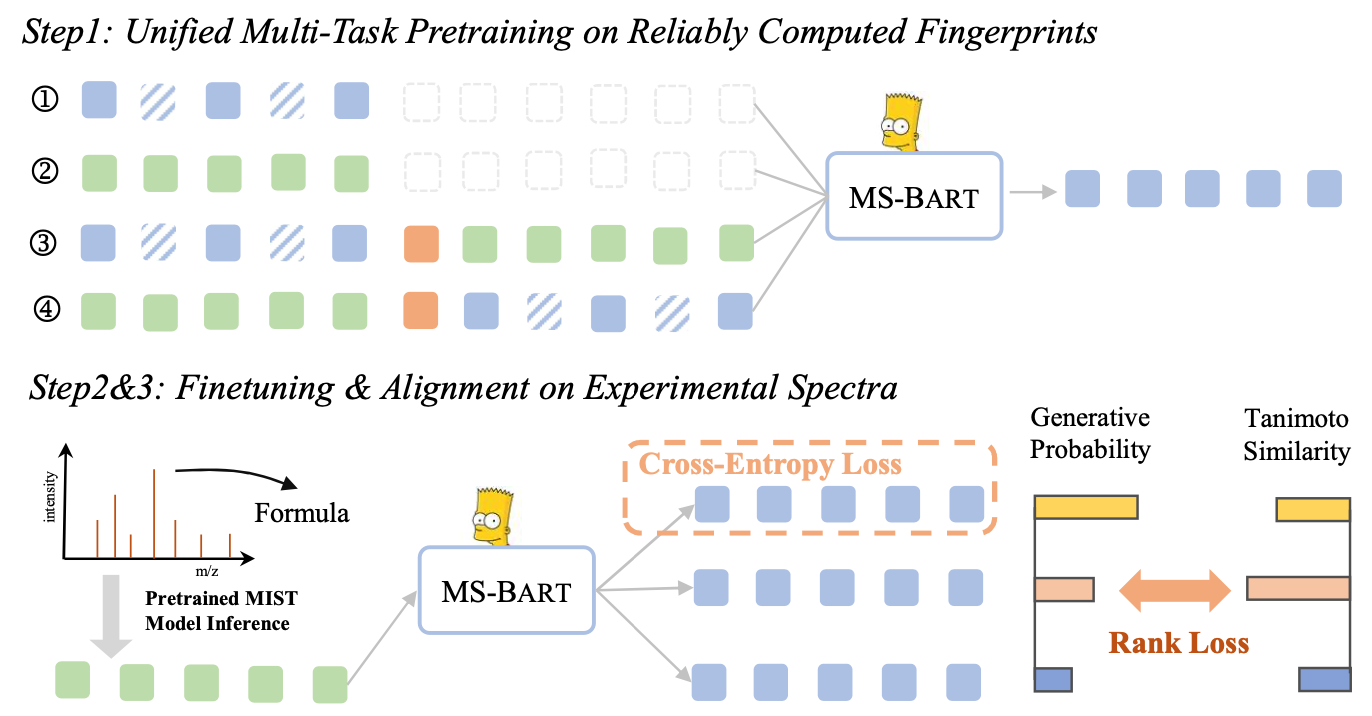
## Environment Setup ```bash uv python install 3.9 uv sync --managed-python source .venv/bin/activate ``` This creates a Python 3.9 environment in `.venv`. Run commands from the project root. ## Preprocessed Dataset and Model Weights Download the preprocessed datasets and original model weights from [Figshare](https://figshare.com/articles/dataset/MS-BART-Model-Weights-Data/30393544) and place them in `data/`. The original release uses the following directory layout: ``` data ├─ CANOPUS │ ├─ mist │ ├─ model-weights # The final MS-BART model on CANOPUS dataset | ├─ pretrain-data # clean pretrain data (filter Tanimoto similarity > 0.5) | ├─ pretrained-model # pretrain on clean 4M pretrain dataset │ ├─ train │ ├─ test │ ├─ val ├─ MassSpecGym │ ├─ mist # retrained with clean CANOPUS dataset │ ├─ model-weights # The final MS-BART model on MassSpecGym dataset | ├─ pretrain-data | ├─ pretrained-model │ ├─ train │ ├─ test │ ├─ val ``` ### Alternative MIST weights from FRIGID The fingerprint preprocessing script also supports the `mist_msg.pt` and `mist_canopus.pt` parameter dictionaries from [FRIGID](https://github.com/coleygroup/FRIGID). Download and extract its [pretrained checkpoint archive](https://zenodo.org/records/19685145) with `aria2c` installed: ```bash mkdir -p data aria2c -c -x 16 -s 16 -k 1M \ --auto-file-renaming=false \ -d data \ -o frigid_pretrained_checkpoints.tar.gz \ 'https://zenodo.org/records/19685145/files/frigid_pretrained_checkpoints.tar.gz?download=1' mkdir data/frigid_pretrained_checkpoints tar -xzf data/frigid_pretrained_checkpoints.tar.gz \ -C data/frigid_pretrained_checkpoints \ --keep-old-files --no-same-owner ``` The two MIST weights are extracted directly into `data/frigid_pretrained_checkpoints/`. The archive also contains DLM and ICEBERG weights, which are not needed by `preprocess/fp_pred_main.py`. | `--weight-type` | Default weight path | Loading configuration | | --- | --- | --- | | `checkpoint` (default) | `data//mist/mist.ckpt` | Hyperparameters and state dictionary from a full Lightning checkpoint | | `mist-msg` | `data/frigid_pretrained_checkpoints/mist_msg.pt` | MSG preset: hidden size 640, fragment output size 2048 | | `mist-canopus` | `data/frigid_pretrained_checkpoints/mist_canopus.pt` | CANOPUS preset: hidden size 512, fragment output size 512 | Both FRIGID presets predict 4096-bit Morgan fingerprints and use the official [MSG](https://github.com/coleygroup/FRIGID/blob/main/configs/spec2mol_benchmark_msg.yaml) and [CANOPUS](https://github.com/coleygroup/FRIGID/blob/main/configs/spec2mol_benchmark_canopus.yaml) inference settings. Use `--fp-ckpt PATH` to override the selected weight path. `--weight-type` selects the model; `--dataset-name` independently selects the input dataset format. Full checkpoint mode should only be used with trusted files because it loads pickled hyperparameters. ## Preprocessing from Raw Data ### Pretraining molecules Pretraining data generation reads `data/MassSpecGym/data/molecules/MassSpecGym_molecules_MCES2_disjoint_with_test_fold_4M.tsv` and writes generated data to `logs/datasets/MassSpecGym/`. The split files are `pubchem-4M/train.tsv` and `pubchem-4M/val.tsv` under that directory, as used by `scripts/pretrain.sh`. ```bash # Generate pretraining data and reserve 10,000 entries for validation. uv run --no-sync python preprocess/generate_pretrain_data.py uv run --no-sync python preprocess/split_pretrain_dataset.py ``` ### MassSpecGym spectra and fingerprints Place the raw table at `data/MassSpecGym/data/MassSpecGym.tsv`. The MGF generator uses `only_MH = False` by default and writes spectra and MIST labels to `logs/datasets/MassSpecGym-ALL/`: ```bash uv run --no-sync python preprocess/generate_mgf_and_lables.py ``` `MassSpecGym-ALL` denotes the input across adduct types. Generate fingerprints for this full input before applying the training-only adduct filter: ```bash OPENBLAS_NUM_THREADS=1 OMP_NUM_THREADS=1 MKL_NUM_THREADS=1 NUMEXPR_NUM_THREADS=1 \ uv run --no-sync python preprocess/fp_pred_main.py \ --weight-type mist-msg \ --dataset-name MassSpecGym \ --mgf-input logs/datasets/MassSpecGym-ALL/MassSpecGym-ALL.mgf \ --labels logs/datasets/MassSpecGym-ALL/MassSpecGym-ALL_labels.tsv \ --source-tsv data/MassSpecGym/data/MassSpecGym.tsv \ --res-dir logs/datasets/MassSpecGym/mist \ --output-dir logs/datasets/MassSpecGym \ --device cuda:0 \ --batch-size 32 \ --num-workers 8 ``` To use the CANOPUS encoder on the same input, change only `--weight-type` to `mist-canopus`. To use an original full checkpoint, select `--weight-type checkpoint --fp-ckpt /path/to/mist.ckpt` instead. ### CANOPUS spectra and fingerprints The CANOPUS generator expects `labels.tsv`, `splits/canopus_hplus_100_0.tsv`, and `spec_files/` under `data/canopus_train_export/`. ```bash uv run --no-sync python preprocess/generate_canopus_and_lables.py OPENBLAS_NUM_THREADS=1 OMP_NUM_THREADS=1 MKL_NUM_THREADS=1 NUMEXPR_NUM_THREADS=1 \ uv run --no-sync python preprocess/fp_pred_main.py \ --weight-type mist-canopus \ --dataset-name CANOPUS \ --mgf-input logs/datasets/CANOPUS/CANOPUS.mgf \ --labels logs/datasets/CANOPUS/CANOPUS_labels.tsv \ --source-tsv data/canopus_train_export/labels.tsv \ --split-tsv data/canopus_train_export/splits/canopus_hplus_100_0.tsv \ --res-dir logs/datasets/CANOPUS/mist \ --output-dir logs/datasets/CANOPUS \ --device cuda:0 \ --batch-size 32 \ --num-workers 8 ``` ### Train, validation, and test splits Preserve the original MassSpecGym `fold` assignments. Apply the adduct filter only when producing the training split: | Output | Fold selection | Adduct selection | | --- | --- | --- | | `MassSpecGym/train` | `fold == "train"` | `adduct == "[M+H]+"` only | | `MassSpecGym/val` | `fold == "val"` | All adducts in the processed input | | `MassSpecGym/test` | `fold == "test"` | All adducts in the processed input | Do not filter the full MGF or fingerprint table to `[M+H]+`, as this would also remove non-protonated spectra from validation and test. The MGF generator still accepts only its supported adduct list, and fingerprint/SELFIES processing drops records without predictions or with failed SELFIES conversion; "all adducts" does not imply that every raw record survives preprocessing. For CANOPUS, preserve the supplied `split` assignments. Split the generated MassSpecGym fingerprint table at threshold `0.2`: ```bash uv run --no-sync python preprocess/prepare_test_data.py \ --dataset-name MassSpecGym \ --threshold 0.2 ``` These are the defaults when no arguments are supplied. Use `--dataset-name CANOPUS` for CANOPUS or `--data-dir PATH` to override the input directory, which defaults to `logs/datasets/`. Outputs are written to `train/`, `val/`, and `test/` under that directory. `--threshold` selects an existing fingerprint TSV; it does not recompute fingerprints. The intended generated-data layout is shown below; `train/`, `val/`, and `test/` are produced by the splitting step, not by fingerprint prediction: ```text logs/datasets/ ├── MassSpecGym-ALL/ │ ├── MassSpecGym-ALL.mgf │ └── MassSpecGym-ALL_labels.tsv ├── MassSpecGym/ │ ├── mist/subforms_fp/ │ ├── MassSpecGym_fps_selfies_threshold_*.tsv │ ├── pubchem-4M/ │ │ ├── train.tsv │ │ └── val.tsv │ ├── train/ # [M+H]+ only │ ├── val/ # All processed adducts │ └── test/ # All processed adducts └── CANOPUS/ ├── CANOPUS.mgf ├── CANOPUS_labels.tsv ├── mist/subforms_fp/ ├── CANOPUS_fps_selfies_threshold_*.tsv ├── train/ ├── val/ └── test/ ``` ## Step1: Unified Multi-Task Pretraining on Reliably Computed Fingerprints The pretraining script loads the unified SELFIES/fingerprint tokenizer from `./ms-bart-tokenizer`. The SELFIES token vocabulary comes from [`moldata/vocab_list/zinc.npy`](https://github.com/zjunlp/MolGen/blob/main/moldata/vocab_list/zinc.npy) in MolGen (ICLR 2024). Pretraining saves checkpoints to `./logs/pretrained-model`. Finetuning and alignment save to `./logs/`, and downstream scripts load checkpoints from these directories. ```bash bash scripts/pretrain.sh ``` ## Step2: Finetuning on Experimental Spectra Before launching finetuning or alignment, set each script's model and data paths to the artifacts you intend to use. The preprocessing examples write to `logs/datasets/`, while some training and evaluation scripts still reference the original release under `data/`. The MSG finetuning and alignment scripts use threshold `0.2` under `logs/datasets/MassSpecGym/`. The CANOPUS finetuning and alignment scripts use threshold `0.2` under `logs/datasets/CANOPUS/`. ```bash bash scripts/msg/finetune.sh bash scripts/canopus/finetune.sh ``` ## Step3: Contrastive Alignment via Chemical Feedback ```bash bash scripts/msg/align.sh bash scripts/canopus/align.sh ``` ## Evaluation Check the evaluation paths against the selected split and trained checkpoint before launching. The current MSG evaluation script has a CANOPUS filename in its test path and uses `NUM_BEAMS` although it defines `NUM_BEAM`. The CANOPUS evaluation script reads from `data/CANOPUS/`. These data-path and MSG beam settings need to be corrected for the generated-data workflow; the entry points are: ```bash bash scripts/msg/eval.sh bash scripts/canopus/eval.sh ``` ## Citation ```bibtex @article{han2026ms, title={Ms-bart: Unified modeling of mass spectra and molecules for structure elucidation}, author={Han, Yang and Wang, Pengyu and Yu, Kai and Chen, Lu and others}, journal={Advances in Neural Information Processing Systems}, volume={38}, pages={111459--111481}, year={2026} } ``` ## Contact If you have any questions, please reach out to csyanghan@sjtu.edu.cn
