> [!IMPORTANT] > 🌟 Stay up to date at [opendrivelab.com](https://opendrivelab.com/#news)! # :earth_asia: UniVLA

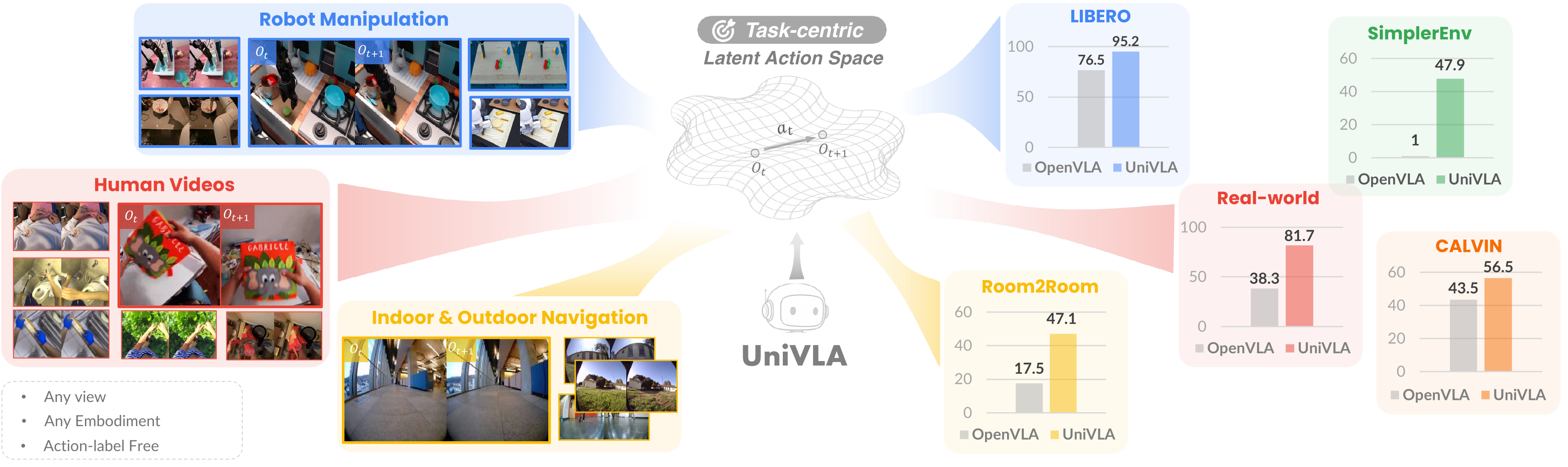
> #### :page_facing_up: [Paper](https://arxiv.org/pdf/2505.06111) | :rocket: Demo Page (Coming Soon) > :black_nib: Qingwen Bu, Y. Yang, J. Cai, S. Gao, G. Ren, M. Yao, P. Luo, H. Li \ > :e-mail: Primary Contact: Qingwen Bu (buqingwen@opendrivelab.com) ### :fire: Highlights - A recipe towards generalist policy by planning in a unified, embodiment-agnostic action space. - A novel approach for extracting task-centric latent actions from cross-embodiment videos. - A VLA that achieves state-of-the-art results on multiple benchmarks with compute-efficient training. ## Table of Contents - [:movie_camera: Demo](#movie_camera-demo) - [:loudspeaker: News](#loudspeaker-news) - [🤗 Model Zoo](#ckpts) - [:video_game: Getting Started](#installation) - [:fire: Training Recipe](#fire-training-recipe) - [Data Preparation](#zero-data-preparation) - [Task-centric Latent Action Learning](#one-task-centric-latent-action-learning) - [Pretraining of Generalist Policy](#two-pretraining-of-generalist-policy) - [Post-training for Deployment & Evaluations](#three-post-training-for-deployment--evaluations) - [Real-world Experiment](#mechanical_arm-real-world-experiment) - [LIBERO](#1-libero) - [CALVIN](#2-calvin) - [Room2Room](#3-room2room) - [SimplerEnv](#4-simplerenv) - [:rocket: UniVLA's Performance](#rocket-univlas-performance) - [:pencil: Citation](#pencil-citation) ## :movie_camera: Demo Real-world robot experiments.
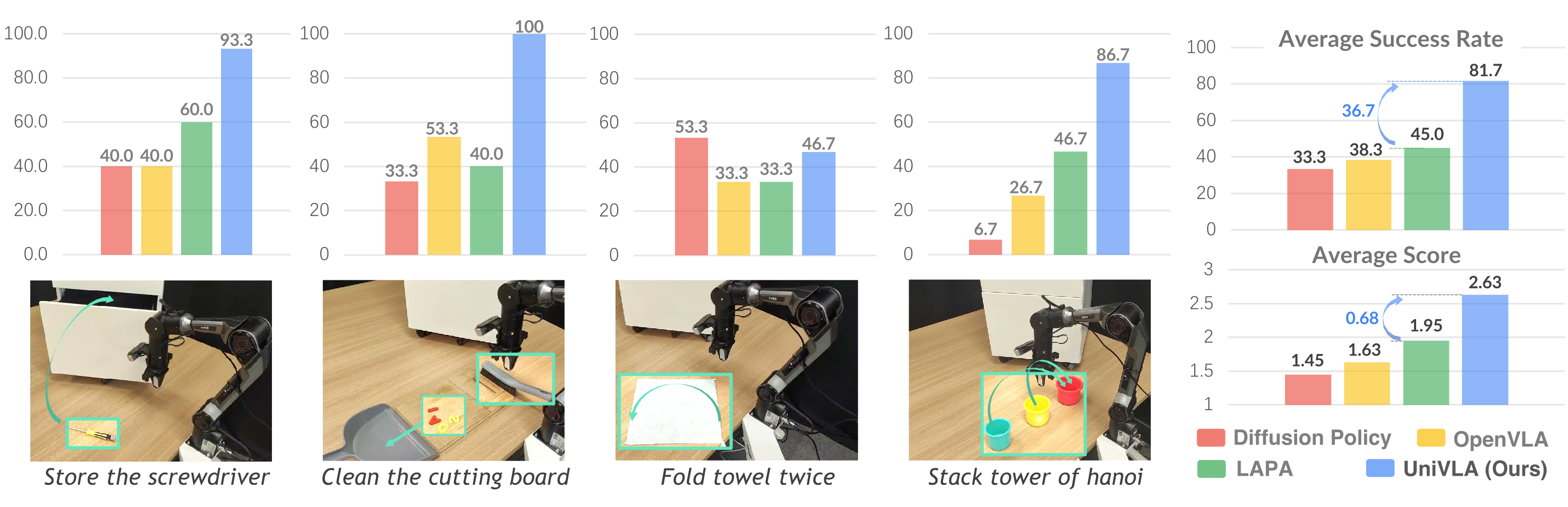
Store the screwdriver (1x speed) Clean the cutting board (1x speed) Fold towel twice (1x speed)
Stack the tower of hanoi (1x speed)
## :loudspeaker: News - **[2025/05]** The code of UniVLA v1.0 is released. Please check it out! ## 🤗 Model Zoo
Model Name Backbone HF Path Note
lam-stage-1 - univla-latent-action-model The stage-1 latent action model trained on OpenX and Ego4D.
lam-stage-2 - univla-latent-action-model The stage-2 latent action model trained on OpenX and Ego4D. (Generate task-centric latent actions.)
univla-7b TRI-ML/prismatic-vlms/prism-dinosiglip-224px+7b univla-7b UniVLA pretrained on our full data collection (Manip. + Navi. + Human).
univla-7b-bridge-pt TRI-ML/prismatic-vlms/prism-dinosiglip-224px+7b univla-7b-bridge-pt UniVLA pretrained only on BridgeV2 data.
univla-7b-human-pt TRI-ML/prismatic-vlms/prism-dinosiglip-224px+7b univla-7b-human-pt UniVLA pretrained only on Ego4D human videos.
univla-libero univla-7b univla-7b-224-sft-libero Finetuned on the LIBERO dataset
univla-calvin univla-7b univla-7b-224-sft-calvin Finetuned on the CALVIN dataset
univla-r2r univla-7b univla-7b-224-sft-r2r Finetuned on the R2R dataset
univla-bridge univla-7b univla-7b-224-sft-simpler-bridge Finetuned on the BridgeV2 (OXE ver.) dataset
## :video_game: Getting Started 1. (Optional) We use conda to manage the environment. ```bash conda create -n univla python=3.10 -y conda activate univla ``` 2. Install dependencies. ```bash # Install pytorch # Look up https://pytorch.org/get-started/previous-versions/ with your cuda version for a correct command # Our experiments are conducted with 'torch 2.2.0 + cuda 12.1' pip install torch torchvision # Clone our repo and pip install to download dependencies git clone git@github.com:OpenDriveLab/UniVLA.git cd univla pip install -e . # Install Flash Attention 2 for training (https://github.com/Dao-AILab/flash-attention) pip install packaging ninja ninja --version; echo $? # Verify Ninja --> should return exit code "0" pip install "flash-attn==2.5.5" --no-build-isolation ``` ## :fire: Training Recipe ### :zero: Data Preparation #### Please refer to [this script](https://github.com/moojink/rlds_dataset_mod/blob/ad83e6c0efad5823540c0f6d3a05529596ead0b5/prepare_open_x.sh) for an example of how to download datasets from OXE [optional] Please follow [this instruction](https://github.com/OpenDriveLab/UniVLA/blob/2b780a5992406262680c6c66150564b3d8befaf2/vla-scripts/extern/ego4d_rlds_dataset_builder/ego4d/README.md) if you'd like to convert Ego4D data into RLDS format for training UniVLA. ### :one: Task-centric Latent Action Learning > We hightly recommond directly using our pre-trained latent action model ckeckpoints to save your time and compute. > [!NOTE] > Our latent action model is trained on a comprehensive data collection, encompassing multiple robotic manipulation and navigation datasets from Open X-Embodiment, along with a curated subset of the Ego4D dataset (detailed data construction procedures are provided in the appendix of our [paper](https://www.roboticsproceedings.org/rss21/p014.pdf)). > > To adapt the model to additional datasets or custom data sources, users may refer to ```./prismatic/vla/datasets/rlds/oxe/mixtures.py``` to either utilize predefined data mixtures or define new ones. Subsequently, the ```data_mix``` parameter in the [configuration file](https://github.com/OpenDriveLab/UniVLA/blob/aab94fdf98221a19c0c9a114c921f069ed449265/latent_action_model/config/lam-stage-1.yaml#L27) should be updated accordingly. The latent action model is implemented based on [VQ-VAE](https://arxiv.org/abs/1711.00937). We train the latent action model on the collection of dataset comprising robot manipulation, navigation and human videos. In stage-1 training, we use an overall batch size of 512 and 100k optimization steps to construct the task-irrelevant latent actions: ```bash torchrun --standalone --nnodes 1 --nproc-per-node 8 main.py fit \ --config config/lam-stage-1.yaml \ 2>&1 | tee lam-stage-1.log ``` The following stage-2 then focuses on learning task-centric latent actions on the basis of stage-1 results. Please modify the ```stage_one_ckpt``` in ```latent_action_model/config/lam-stage-2.yaml``` to your local path of stage-1 checkpoint, then run training with: ```bash torchrun --standalone --nnodes 1 --nproc-per-node 8 main.py fit \ --config config/lam-stage-2.yaml \ 2>&1 | tee lam-stage-2.log ``` ### :two: Pretraining of Generalist Policy - **Latent Action Pseudo-Labeling for Policy Optimization:** The trained latent action model is employed to generate pseudo-labels for policy optimization via a next-token prediction objective. Specifically, the indices of inferred latent actions in the VQ-VAE codebook are mapped to dedicated tokens in the LLaMA tokenizer, denoted as ```{ACT_0, ACT_1, ..., ACT_C}```. - **Cost-effective Pre-Training:** The full-scale pre-training procedure, incorporating both OpenX and Ego4D datasets, was performed using a 32-GPU A100 cluster over 20,000 optimization steps. This training regimen required approximately 960 A100 GPU-hours, representing just 5% of the computational resources utilized by OpenVLA. Furthermore, experiments conducted on the 'Bridge' and 'Human' subsets demanded only 200 GPU-hours, demonstrating substantially reduced computational requirements compared to previous vision-language-action models. - To initiate pre-training, please refer to the following scipt or simply run ```bash ./vla-scripts/train.sh```: > [!NOTE] > For pretraining UniVLA only on BridgeV2 or Human (Ego4D) data, please modify ```vla.type``` to ```prism-dinosiglip-224px+mx-bridge(human)``` correspondingly. Detailed setups can be found in ```./prismatic/conf/vla.py```. ```bash ### Experiment on a 32-GPU cluster GPUS_PER_NODE=8 NNODES=4 MASTER_PORT=${MASTER_PORT:-28596} MASTER_ADDR=${MASTER_ADDR:-"127.0.0.1"} RANK=${RANK:-0} # Run your training script with torchrun torchrun --nproc_per_node ${GPUS_PER_NODE} --nnodes ${NNODES} --node_rank ${RANK} --master_addr ${MASTER_ADDR} --master_port ${MASTER_PORT} train.py \ --vla.type prism-dinosiglip-224px+mx-oxe-magic-soup-plus \ --run_root_dir "vla_log" \ ``` Once pretraining is complete, convert the UniVLA weights (default 'Prismatic' format) to HuggingFace AutoClasses with: ``` python vla-scripts/extern/convert_openvla_weights_to_hf.py \ --openvla_model_path_or_id /path/to/your/pretrained_ckpt_path \ --ckpt_name /path/to/your/specific_ckpt_name.pt \ --output_hf_model_local_path /path/to/your/output_model_path ``` The converted model is then compatible with HF AutoClasses 'AutoModelForVision2Seq'. ### :three: Post-training for Deployment & Evaluations - With the pretrained generalist policy trained to plan over an embodiment-agnostic action space, we then add embodiment-specific action decoder heads for downstream deployment. - Our action decoder is extremely lightwight with only around 12M parameters. Using parameter efficient fine-tuning with LoRA rank 32, the total trainable parameter is around 123M. #### :mechanical_arm: Real-world Experiment > Our guidelines are based on real-device testing conducted on the AgiLex platform. If you have code deployed on other platforms or in different data formats, we welcome pull requests! We provide a simple [guideline](https://github.com/OpenDriveLab/UniVLA/blob/3daa7e9a8f4ca92fdee960f8d6be73508344e81d/docs/real-world-deployment.md) to deploy UniVLA on your customized setups. #### 1) LIBERO > Please first download the [LIBERO datasets](https://huggingface.co/datasets/openvla/modified_libero_rlds/tree/main) that we used in experiments Start training with ```torchrun```: 1) You should first set the pretrained UniVLA and latent action model path in ```vla_path``` and ```lam_path``` of the [training config](https://github.com/OpenDriveLab/UniVLA/blob/b502b3eddc05fef9984d34932a41c96e5a9f21a3/vla-scripts/finetune_libero.py#L107). 2) Set your local LIBERO dataset path in [```data_root_dir```](https://github.com/OpenDriveLab/UniVLA/blob/b502b3eddc05fef9984d34932a41c96e5a9f21a3/vla-scripts/finetune_libero.py#L110). 3) You can choose ```dataset_name``` from ```libero_spatial_no_noops```, ```libero_object_no_noops```, ```libero_goal_no_noops```, and ```libero_10_no_noops``` > We trained on *'Spatial'*, *'Object'* and *'Goal'* for 30k steps and *'Long'* for 40k steps. Please first modify the ```max_steps``` in training config accordingly for reproduction. ```bash # Start training on LIBERO-10(long) with 8 GPUs torchrun --standalone --nnodes 1 --nproc-per-node 8 finetune_libero.py \ --dataset_name "libero_10_no_noops" \ --run_root_dir "libero_log" \ ``` Once you finished training and get the action decoder and UniVLA backbone, you can start evaluation with: ```bash # Start evaluation on LIBERO-10 # [Optional] Install LIBERO dependencies pip install -r experiments/robot/libero/libero_requirements.txt # By default, we test for 50 rollouts every task, totalling 500 independent trials. python experiments/robot/libero/run_libero_eval.py \ --task_suite_name libero_10 \ # Choose from [libero_spatial, libero_object, libero_goal, libero_10] --action_decoder_path /path/to/your/action_decoder_path.pt \ --pretrained_checkpoint /path/to/your/libero_10_finetuned_univla \ --save_video False # Whether to save rollout videos \ --num_trials_per_task 50 \ --seed 7 ``` #### 2) CALVIN > Please first follow [CALVIN](https://github.com/mees/calvin) to install relavent dependencies and prepare your dataset 1) You should first set the pretrained UniVLA and latent action model path in ```vla_path``` and ```lam_path``` of the training config. 2) Set your local CALVIN directory path in ```calvin_root```. 3) Start training with ```torchrun```: ```bash torchrun --standalone --nnodes 1 --nproc-per-node 8 finetune_calvin.py \ --vla_path /path/to/your/univla-7b \ --lam_path /path/to/your/lam-stage-2.ckpt \ --calvin_root /path/to/yout/calvin_root_path \ --max_steps 100000 \ --batch_size 8 \ --grad_accumulation_steps 2 \ --window_size 12 \ --run_root_dir "calvin_log" ``` Start evaluation on CALVIN: ```bash # Mutli-GPU evaluation is supported torchrun --standalone --nnodes 1 --nproc-per-node 8 experiments/robot/calvin/run_calvin_eval_ddp.py \ --calvin_root /path/to/yout/calvin_root_path \ --action_decoder_path /path/to/your/action_decoder_path.pt \ --pretrained_checkpoint /path/to/your/calvin_finetuned_univla \ --seed 7 ``` #### 3) Room2Room > [!NOTE] > Please refer to [this documentation](https://github.com/OpenDriveLab/UniVLA/blob/372722b346ae7bf24981404e1a9d227270043f50/docs/room2room.md) for detailed guidelines. #### 4) SimplerEnv > Our SimplerEnv evlauation is based on the [official repo](https://github.com/simpler-env/SimplerEnv/tree/maniskill3). 1. Clone and install SimplerEnv dependencies with ```bash # We used the Maniskill3 version git clone -b maniskill3 https://github.com/simpler-env/SimplerEnv.git cd SimplerEnv pip install --upgrade git+https://github.com/haosulab/ManiSkill.git pip install -e . ``` 2. Add ```experiments/robot/simpler-bridge/policies/univla``` to ```simpler_env/policies```, and replace ```simpler_env/real2sim_eval_maniskill3.py``` with ```experiments/robot/simpler-bridge/real2sim_eval_maniskill3.py```. 3. Run evaluation on SimplerEnv-Bridge "Put Spoon on Table Cloth" task: > Please refer to ```experiments/robot/simpler-bridge/eval_simpler_bridge_4task.sh``` for the evaluation on all tasks. ```bash ckpt_path="/path/to/your/univla-7b-224-sft-simpler-bridge" action_decoder_path="/path/to/your/univla-7b-224-sft-simpler-bridge/action_decoder.pt" CUDA_VISIBLE_DEVICES=0 XLA_PYTHON_CLIENT_PREALLOCATE=false python real2sim_eval_maniskill3.py \ --model="univla" -e "PutSpoonOnTableClothInScene-v1" -s 0 --num-episodes 24 --num-envs 1 \ --action_decoder_path ${action_decoder_path} \ --ckpt_path ${ckpt_path} \ ``` ## :rocket: UniVLA's Performance > [!NOTE] > LIBERO Simulation Benchmark Results.
Model LIBERO-Spatial LIBERO-Object LIBERO-Goal LIBERO-Long Average
SR (↑) Rank (↓) SR (↑) Rank (↓) SR (↑) Rank (↓) SR (↑) Rank (↓) SR (↑) Rank (↓)
Diffusion Policy 78.3 ± 1.1% 5 92.5 ± 0.7% 2 68.3 ± 1.2% 5 50.5 ± 1.3% 5 72.4 ± 0.7% 5
Octo 78.9 ± 1.0% 4 85.7 ± 0.9% 4 84.6 ± 0.9% 2 51.1 ± 1.3% 4 75.1 ± 0.6% 3
OpenVLA 84.7 ± 0.9% 2 88.4 ± 0.8% 3 79.2 ± 1.0% 3 53.7 ± 1.3% 3 76.5 ± 0.6% 2
TraceVLA 84.6 ± 0.2% 3 85.2 ± 0.4% 5 75.1 ± 0.3% 4 54.1 ± 1.0% 2 74.8 ± 0.5% 4
UniVLA (Ours) 96.5 ± 0.5% 1 96.8 ± 0.5% 1 95.6 ± 0.4% 1 92.0 ± 1.0% 1 95.2 ± 0.3% 1
> [!NOTE] > LIBERO Results with Limited Data. (Models are trained with 10%, 20%, 50%, and the full dataset)
Model LIBERO-Goal LIBERO-Long
10% 20% 50% 100% 10% 20% 50% 100%
ATM 64.3% 77.1% - - 36.5% 39.1% - -
OpenVLA 61.4% 66.0% 77.0% 79.2% 11.6% 22.4% 36.6% 53.7%
OpenVLA-OFT 76.8% 88.2% 91.1% 96.2% 43.0% 62.2% 77.8% 90.7%
UniVLA (Ours) 86.3% 90.4% 93.1% 95.6% 62.4% 71.4% 87.0% 92.0%
> [!NOTE] > SimplerEnv evaluation on WidowX Robot tasks. (Averaged across 3 seeds) > We fix a minor bug about input processing, so the UniVLA's results are higher than the numbers reported in our original paper.
Model Put Spoon on Towel Put Carrot on Plate Stack Green Block on Yellow Block Put Eggplant in Yellow Basket #Overall Average
Grasp Spoon Success Grasp Carrot Success Grasp Green Block Success Grasp Eggplant Success
RT-1-X 16.7% 0.0% 20.8% 4.2% 8.3% 0.0% 0.0% 0.0% 1.1%
Octo-Base 34.7% 12.5% 52.8% 8.3% 31.9% 0.0% 66.7% 43.1% 16.0%
Octo-Small 77.8% 47.2% 27.8% 9.7% 40.3% 4.2% 87.5% 56.9% 30.0%
OpenVLA 4.1% 0.0% 33.3% 0.0% 12.5% 0.0% 8.3% 4.1% 1.0%
RoboVLM 54.2% 29.2% 25.0% 25.0% 45.8% 12.5% 58.3% 58.3% 31.3%
UniVLA 76.4% ± 4.8% 52.8% ± 6.4% 79.2% ± 0.0% 55.6% ± 2.4% 66.7% ± 4.1% 2.8% ± 2.4% 93.0% ± 4.8% 80.6% ± 6.4% 47.9% ± 1.0%
> [!NOTE] > Real-world Experiments.

## :pencil: Citation If you find our code or models useful in your work, please cite [our paper](https://arxiv.org/pdf/2505.06111): ```bibtex @article{bu2025univla, title={Univla: Learning to act anywhere with task-centric latent actions}, author={Bu, Qingwen and Yang, Yanting and Cai, Jisong and Gao, Shenyuan and Ren, Guanghui and Yao, Maoqing and Luo, Ping and Li, Hongyang}, journal={arXiv preprint arXiv:2505.06111}, year={2025} } ``` ## Acknowledgements We thank [OpenVLA](https://github.com/openvla/openvla) for their open-sourced work!