





MOSS-Transcribe-Diarize 0.9B is an open-source SOTA end-to-end audio understanding model for long-form multi-speaker transcription, diarization, timestamps, and acoustic event awareness. [MOSS-Transcribe-Diarize Pro](https://platform.mosi.cn/app/playground) is a stronger model with higher overall performance and is available through the online playground.
MOSS-Transcribe-Diarize 0.9B supports 50+ languages.
## News
* 2026-07-22: The subtitle Web UI now supports both Simplified Chinese and English.
* 2026-07-14: 🏆 MOSS-Transcribe-Diarize won first place in the [2nd MLC-SLM Challenge](https://www.nexdata.ai/competition/mlc-slm) at INTERSPEECH 2026, covering 14 languages.
* 2026-07-09: Open-sourced MOSS-Transcribe-Diarize 0.9B.
## Contents
- [Introduction](#introduction)
- [Model Architecture](#model-architecture)
- [Evaluation](#evaluation)
- [Objective Evaluation](#objective-evaluation)
- [Quickstart](#quickstart)
- [Environment Setup](#environment-setup)
- [Python Usage](#python-usage)
- [Serve with SGLang Omni](#serve-with-sglang-omni)
- [Serve with vLLM](#serve-with-vllm)
- [Use in the FunASR Ecosystem](#use-in-the-funasr-ecosystem)
- [Custom Prompt and Hotwords](#custom-prompt-and-hotwords)
- [Subtitle Web App](#subtitle-web-app)
- [Citation](#citation)
- [Star History](#star-history)
## Introduction
MOSS-Transcribe-Diarize is our flagship SOTA model family for turning real-world long-form audio into structured, speaker-aware transcripts in one pass. Instead of stitching together separate ASR and diarization systems, these models jointly perform speech transcription and speaker diarization, producing time-aligned text with precise timestamps and consistent speaker labels such as `[S01]`, `[S02]`, and beyond.
Built for meetings, calls, podcasts, interviews, lectures, and video content, MOSS-Transcribe-Diarize is designed to handle long, messy, multi-speaker recordings where reliability matters. It can also emit optional acoustic event annotations, giving downstream systems a richer understanding of what happened, who spoke, and when.
The model accepts raw audio and emits a compact timestamped transcript. The canonical output format is:
```text
[start_time][Sxx]transcribed speech[end_time]
```
Timestamps are expressed in seconds, and adjacent segments are concatenated into a single stream, for example:
```text
[0.48][S01]Welcome everyone[1.66][12.26][S02]The new transcription pipeline is ready for evaluation[13.81][14.36][S01]Great, include the diarization results in the report[18.76]
```
## Model Architecture
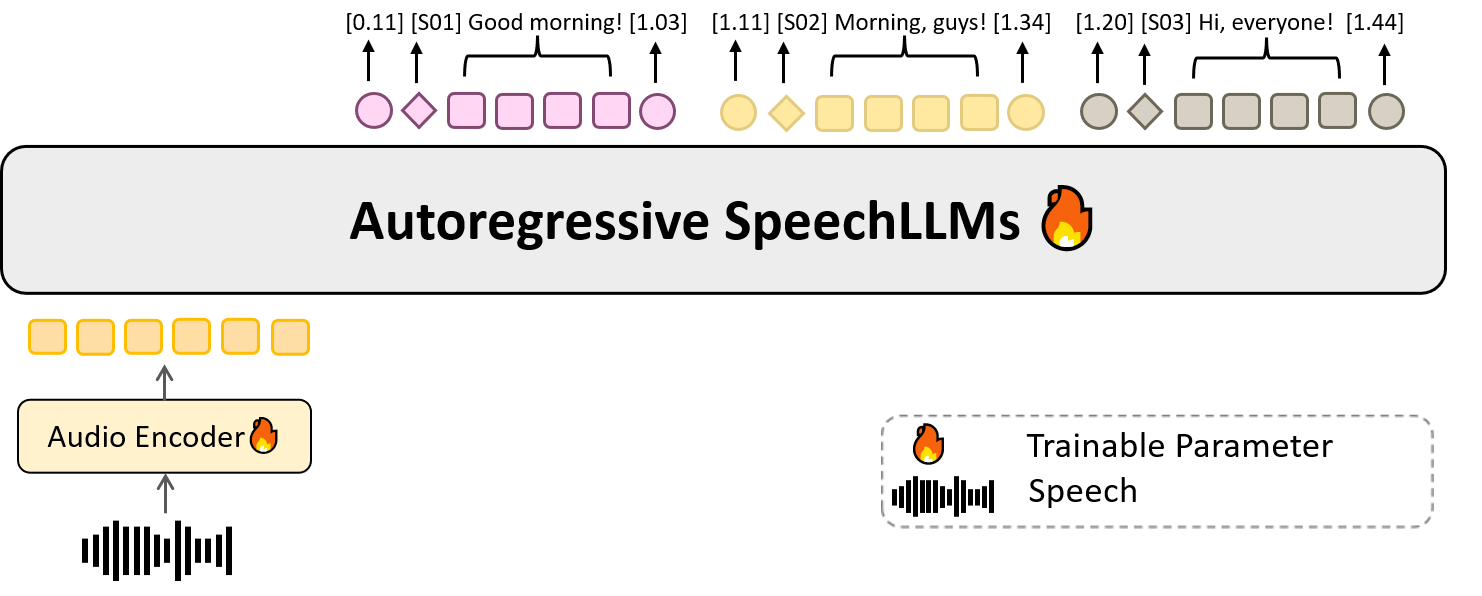
| Component | Specification |
|---|---|
| Text backbone | Qwen3-0.6B style causal decoder |
| Audio encoder | Whisper-Medium encoder configuration |
| Audio frontend | `WhisperFeatureExtractor`, 16 kHz, 80 mel bins, 30 s chunks |
| Audio-text bridge | 4x temporal merge + MLP adaptor |
| Fusion | Audio features replace <|audio_pad|> embeddings via `masked_scatter` |
| Output format | Compact `[start][Sxx]text[end]` transcript with speaker tags such as `[S01]` |
## Evaluation
### Objective Evaluation
We evaluate MOSS-Transcribe-Diarize using three objective metrics: Character Error Rate (CER), concatenated minimum-permutation Character Error Rate (cpCER), and Δcp. Lower is better for all metrics. Best results are bolded, second-best results are underlined. A dash (`-`) indicates that the result is unavailable.
Model
AISHELL‑4
Alimeeting
Podcast
Movies
CER↓
cpCER↓
Δcp↓
CER↓
cpCER↓
Δcp↓
CER↓
cpCER↓
Δcp↓
CER↓
cpCER↓
Δcp↓
Doubao
18.18
27.86
9.68
25.25
37.57
12.31
7.93
10.54
2.61
9.94
30.88
20.94
ElevenLabs
19.58
37.95
18.36
25.70
36.69
10.99
8.50
11.34
2.85
11.49
17.85
6.37
GPT-4o
-
-
-
-
-
-
-
-
-
14.37
23.67
9.31
Gemini 2.5 Pro
42.70
53.42
10.72
27.43
41.64
14.21
7.38
10.23
2.85
15.46
24.15
8.69
Gemini 3 Pro
22.75
27.43
4.68
26.75
32.84
6.09
-
-
-
8.62
14.73
6.11
VIBEVOICE ASR
21.40
24.99
3.59
27.40
29.33
1.93
27.94
48.30
20.36
14.59
42.54
27.94
MOSS Transcribe Diarize 0.9B
14.84
15.83
0.99
24.86
22.17
-2.69
5.97
7.37
1.40
6.36
12.76
6.40
MOSS Transcribe Diarize Pro
13.78
14.02
0.24
18.22
13.94
-4.27
4.46
6.97
2.51
5.86
11.78
5.92
## Quickstart
### Environment Setup
Use a clean Python environment. The project is tested with Python 3.12 and Transformers 5.x.
```bash
git clone https://github.com/OpenMOSS/MOSS-Transcribe-Diarize.git
cd MOSS-Transcribe-Diarize
uv venv --python 3.12 .venv
source .venv/bin/activate
uv pip install -e ".[torch-runtime]" --torch-backend=auto
```
On CUDA GPUs, the optional `flash-attn` package can be added for faster attention kernels:
```bash
uv pip install flash-attn
```
For fine-tuning, see [FINETUNING.md](FINETUNING.md).
### Python Usage
```python
import torch
from transformers import AutoModelForCausalLM, AutoProcessor
from moss_transcribe_diarize import parse_transcript
from moss_transcribe_diarize.inference_utils import (
build_transcription_messages,
generate_transcription,
resolve_device,
)
model_id = "OpenMOSS-Team/MOSS-Transcribe-Diarize"
audio_path = "audio.wav"
device = resolve_device("auto")
dtype = torch.bfloat16 if device.type == "cuda" else torch.float32
model = AutoModelForCausalLM.from_pretrained(
model_id,
trust_remote_code=True,
dtype="auto",
attn_implementation="sdpa", # or "flash_attention_2" with the flash-attn package installed
).to(dtype=dtype).to(device).eval()
processor = AutoProcessor.from_pretrained(model_id, trust_remote_code=True)
messages = build_transcription_messages(audio_path)
result = generate_transcription(
model,
processor,
messages,
max_new_tokens=2048,
do_sample=False,
device=device,
dtype=dtype,
)
print(result["text"])
for segment in parse_transcript(result["text"]):
print(segment.start, segment.end, segment.speaker, segment.text)
```
Pass `flash_attention_2` instead of `sdpa` when the flash-attn package is installed; `eager` is only a last resort, because its memory use grows quadratically with audio length and OOMs on long recordings. The loader used by the CLI and web app picks the best available backend in this order automatically.
The message flow follows the common Qwen multimodal pattern. The chat template is loaded from the model by `AutoProcessor`:
1. `processor.apply_chat_template(messages, tokenize=False)` renders text with audio placeholders.
2. `process_audio_info(messages, sampling_rate)` loads audio waveforms from the same messages.
3. `processor(text=text, audio=audios)` computes Whisper input features and expands audio placeholders.
4. `model.generate(...)` produces timestamped transcription and diarization text.
### Serve with SGLang Omni
[SGLang Omni](https://github.com/sgl-project/sglang-omni) is the recommended serving backend for MOSS-Transcribe-Diarize, providing optimized long-form audio inference through the OpenAI-compatible `/v1/audio/transcriptions` endpoint.
SGLang Omni currently targets CUDA 13 environments. Please follow the official [installation guide](https://github.com/sgl-project/sglang-omni/blob/main/docs/get_started/installation.md) for the supported setup. For CUDA 12 environments, the vLLM workflow is also available below.
Download the model:
```bash
hf download OpenMOSS-Team/MOSS-Transcribe-Diarize
```
Serve the model:
```bash
sgl-omni serve \
--model-path OpenMOSS-Team/MOSS-Transcribe-Diarize \
--port 8000 \
--max-running-requests 16 \
--cuda-graph-max-bs 16 \
--mem-fraction-static 0.80
```
Use `response_format=verbose_json` when you need parsed speaker segments. `json` returns the raw transcript text only.
```bash
curl -X POST http://localhost:8000/v1/audio/transcriptions \
-F model=OpenMOSS-Team/MOSS-Transcribe-Diarize \
-F file=@audio.wav \
-F response_format=verbose_json
```
```python
import requests
with open("audio.wav", "rb") as f:
resp = requests.post(
"http://localhost:8000/v1/audio/transcriptions",
data={
"model": "OpenMOSS-Team/MOSS-Transcribe-Diarize",
"response_format": "verbose_json",
},
files={"file": ("audio.wav", f, "audio/wav")},
timeout=300,
)
resp.raise_for_status()
payload = resp.json()
print(payload["text"])
for segment in payload.get("segments", []):
print(f"[{segment['start']:.2f}-{segment['end']:.2f}] {segment['text']}")
```
For longer multi-speaker audio, raise `max_new_tokens` so the decoder can finish the full diarized transcript:
```bash
curl -X POST http://localhost:8000/v1/audio/transcriptions \
-F model=OpenMOSS-Team/MOSS-Transcribe-Diarize \
-F file=@audio.wav \
-F response_format=verbose_json \
-F max_new_tokens=65536
```
| Parameter | Type | Default | Description |
|---|---|---|---|
| `file` | file | required | Audio file uploaded as multipart form data |
| `model` | string | server default | Model identifier |
| `language` | string | unset | Optional language hint |
| `response_format` | string | `json` | `json`, `verbose_json`, or `text` |
| `temperature` | float | model default (`0.0`) | Sampling temperature |
| `max_new_tokens` | int | `5120` | Max generated tokens; raise for long audio, for example `65536` |
| `prompt` | string | unset | Optional instruction override; omit to use the built-in transcribe+diarize prompt |
For benchmarking, performance numbers, and implementation details, see the [SGLang Omni cookbook](https://github.com/sgl-project/sglang-omni/blob/main/docs/cookbook/moss_transcribe_diarize.md). The following single-H100 results are reported for short- and long-sequence multi-speaker ASR tasks.
`movies` short-sequence ASR:
| Concurrency | Throughput (req/s) | Mean latency (s) | RTF mean | audio_s/s |
|---:|---:|---:|---:|---:|
| 1 | 2.57 | 0.388 | 0.0612 | 29.76 |
| 2 | 4.89 | 0.409 | 0.0659 | 56.55 |
| 4 | 6.62 | 0.513 | 0.0790 | 76.64 |
| 8 | 6.80 | 0.533 | 0.0810 | 78.70 |
| 16 | 7.08 | 0.659 | 0.0922 | 81.98 |
`aishell4_long` long-sequence ASR:
| Concurrency | Throughput (req/s) | Mean latency (s) | RTF mean | audio_s/s |
|---:|---:|---:|---:|---:|
| 1 | 0.022 | 45.2 | 0.0197 | 50.64 |
| 2 | 0.032 | 60.7 | 0.0265 | 74.25 |
| 4 | 0.036 | 105.6 | 0.0461 | 81.64 |
| 8 | 0.040 | 172.6 | 0.0754 | 90.62 |
| 16 | 0.043 | 282.8 | 0.1237 | 98.83 |
### Serve with vLLM
MOSS-Transcribe-Diarize supports vLLM serving through the OpenAI-compatible transcription API. Use a pinned vLLM nightly build that includes the MOSS-Transcribe-Diarize model registration. Choose one of the following commands: for CUDA 12 environments, use `cu129`; for CUDA 13 environments, use `cu130`.
```bash
uv pip install -U vllm \
--torch-backend=auto \
--extra-index-url https://wheels.vllm.ai/68b4a1d582818e67adc903bf1b8fc5a5447da2fa/cu129
```
or:
```bash
uv pip install -U vllm \
--torch-backend=auto \
--extra-index-url https://wheels.vllm.ai/68b4a1d582818e67adc903bf1b8fc5a5447da2fa/cu130
```
```bash
vllm serve OpenMOSS-Team/MOSS-Transcribe-Diarize --trust-remote-code
```
```bash
curl http://localhost:8000/v1/audio/transcriptions \
-F model="OpenMOSS-Team/MOSS-Transcribe-Diarize" \
-F file=@"audio.wav" \
-F response_format="json" \
-F temperature="0"
```
### Use in the FunASR Ecosystem
[FunASR](https://github.com/modelscope/FunASR) maintains a production-oriented
deployment guide for this third-party OpenMOSS model across vLLM, SGLang Omni,
and Transformers. Because MOSS-Transcribe-Diarize produces transcription,
timestamps, and speaker labels in one pass, applications do not need to attach
separate external VAD or speaker-diarization models.
FunASR 1.4.12 or newer can normalize an existing vLLM service's official
speaker-attributed response into the common `sentence_info` contract:
```bash
pip install "funasr>=1.4.12"
```
```python
from funasr import AutoModel
model = AutoModel(
model="OpenMOSS-Team/MOSS-Transcribe-Diarize",
backend="vllm",
vllm_base_url="http://127.0.0.1:8898/v1",
vllm_model="moss-transcribe-diarize",
vllm_response_format="diarized_json",
disable_update=True,
)
result = model.generate("audio.wav", max_completion_tokens=8192)[0]
for segment in result["sentence_info"]:
print(segment["start"], segment["end"], segment["spk"], segment["text"])
```
The guide pins the model and serving revisions, documents the response contract
of each backend, and includes an H100-verified vLLM smoke test. It also explains
the boundary between deployment issues handled in the FunASR ecosystem and
model or weight issues that belong in this repository:
- [FunASR deployment guide](https://github.com/modelscope/FunASR/blob/main/docs/moss_transcribe_diarize.md)
- [FunASR production deployment page](https://www.funasr.com/en/deploy/moss-transcribe-diarize.html)
- [FunClip 2.2.1: speaker-aware SRT and per-speaker clip export](https://github.com/modelscope/FunClip/releases/tag/v2.2.1)
MOSS-Transcribe-Diarize remains an OpenMOSS model under Apache-2.0; the FunASR
integration is an ecosystem deployment path, not a transfer of model ownership.
### Custom Prompt and Hotwords
The default prompt is optimized for timestamped transcription and speaker diarization:
```text
请将音频转写为文本,每一段需以起始时间戳和说话人编号([S01]、[S02]、[S03]…)开头,正文为对应的语音内容,并在段末标注结束时间戳,以清晰标明该段语音范围。
```
To add hotwords, append a short hint to the default prompt:
```text
请将音频转写为文本,每一段需以起始时间戳和说话人编号([S01]、[S02]、[S03]…)开头,正文为对应的语音内容,并在段末标注结束时间戳,以清晰标明该段语音范围。热词提示:热词1, 热词2, 热词3
```
More prompt recipes are available in [examples/prompts.md](examples/prompts.md). The same prompt can be passed to `build_transcription_messages`, `mtd-subtitle`, and `mtd-subtitle-web`.
### Subtitle Web App
The package also includes a local subtitle workflow for upload, review, subtitle export, and optional FFmpeg burn-in:
```bash
mtd-subtitle-web \
--model OpenMOSS-Team/MOSS-Transcribe-Diarize \
--host 127.0.0.1 \
--port 7860
```
Open `http://127.0.0.1:7860`, upload an audio/video file, review the parsed subtitle segments, then download JSON/SRT/ASS or burn an MP4 if `ffmpeg` and `ffprobe` are available on `PATH`.
The web interface supports Simplified Chinese and English. It follows the browser language on first use, and the language selector in the header applies changes immediately and remembers your choice.
For batch processing:
```bash
mtd-subtitle /path/to/input.mp4 \
--model OpenMOSS-Team/MOSS-Transcribe-Diarize \
--out-dir runs/example \
--render
```
## Citation
If you use MOSS-Transcribe-Diarize, please cite the technical report:
```bibtex
@misc{moss_transcribe_diarize_2026,
title={MOSS Transcribe Diarize Technical Report},
author={{MOSI.AI}},
year={2026},
eprint={2601.01554},
archivePrefix={arXiv},
primaryClass={cs.SD},
url={https://arxiv.org/abs/2601.01554}
}
```
## Star History