---
## 📖 Overview
**ScreenRef** and **Distillation-to-Reinforcement Learning (D2RL)** are the core contributions of **GroundGUI**. ScreenRef is a high-quality GUI grounding dataset spanning **desktop, web, and mobile** environments. It pairs diverse screenshots with referring expressions and localization annotations, covering text recognition, visual matching, spatial understanding, and refusal.
Building on ScreenRef, we train **GroundGUI-8B** from **Qwen3-VL-8B-Instruct** with supervised fine-tuning and **D2RL**, improving precise localization in complex interfaces.
### Key Features
#### 🗂️ High-Quality Cross-Platform Dataset
- **ScreenRef** provides **586K screenshots and 633K referring expressions** across desktop, web, and mobile interfaces.
- Two complementary collection pipelines combine screenshot crawling with tutorial video processing, followed by filtering and verification.
- Diverse supervision covers text recognition, visual matching, spatial understanding, and absent-target refusal.
#### 🧠 Distillation-to-Reinforcement Learning
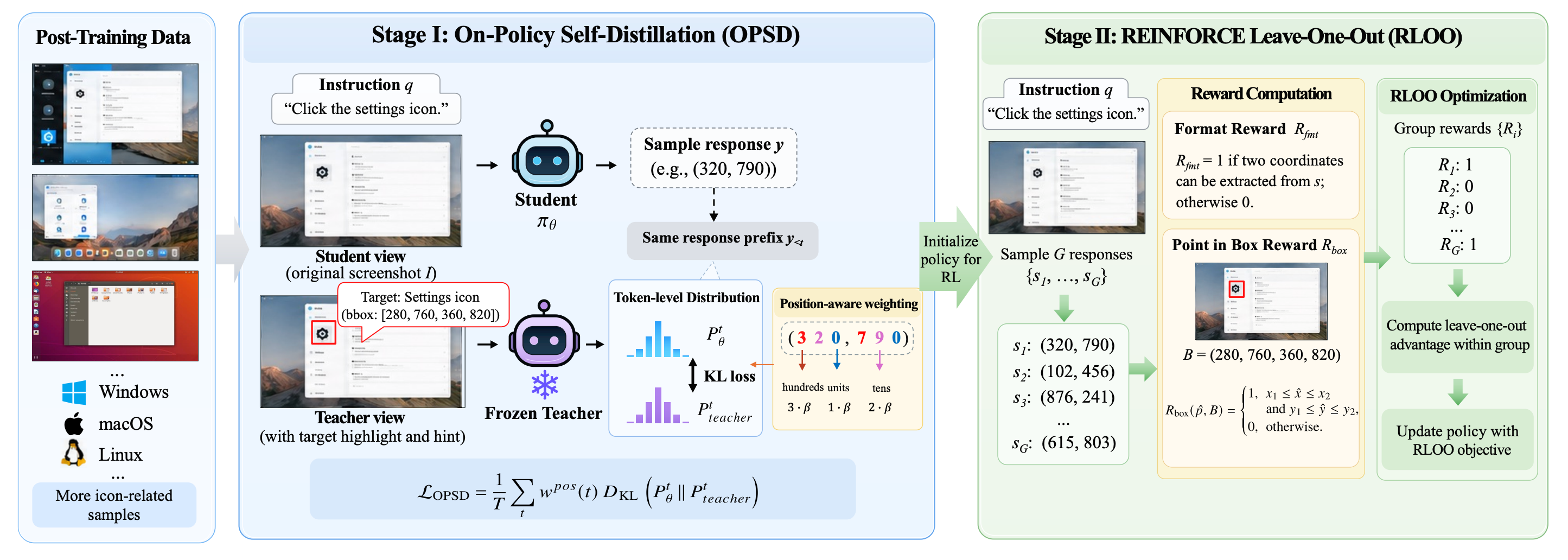
- **OPSD** provides dense guidance from a frozen teacher with privileged target information, preparing a stronger starting policy for RL.
- **RLOO** then optimizes click success with a binary point-in-box reward, completing the **SFT → OPSD → RLOO** training pipeline.
#### 🌐 Cross-Platform Grounding
- **GroundGUI-8B** is evaluated on five benchmarks spanning general interfaces, professional software, and spatial reasoning.
- Consistent gains over Qwen3-VL-8B include **+14.0 percentage points on ScreenSpot-Pro** and **+20.8 on UI-Vision**.
## 🗂️ ScreenRef Dataset
**ScreenRef (Screen Referring Grounding Dataset)** pairs GUI screenshots with natural language referring expressions and bounding-box or point annotations.
### Dataset Features
- 📊 **Scale:** 585,981 screenshots and 633,369 referring expressions.
- 🖥️ **Coverage:** Desktop, web, and mobile interfaces from both screenshots and tutorial videos.
- ✅ **Quality:** Multi-stage filtering and model-based verification of instruction–target consistency.
- 🎯 **Capabilities:** Text recognition, visual matching, spatial understanding, and refusal.
- 📐 **Resolution:** Images range from 0.1 to 8.3 megapixels.
- 🛑 **Refusal Support:** 22,475 absent-target examples teach the model when to abstain.
### Data construction
The data is built through two complementary pipelines: **screenshot crawling** with metadata filtering and instruction verification, and **tutorial video processing** with keyframe extraction, action annotation, and visual grounding.
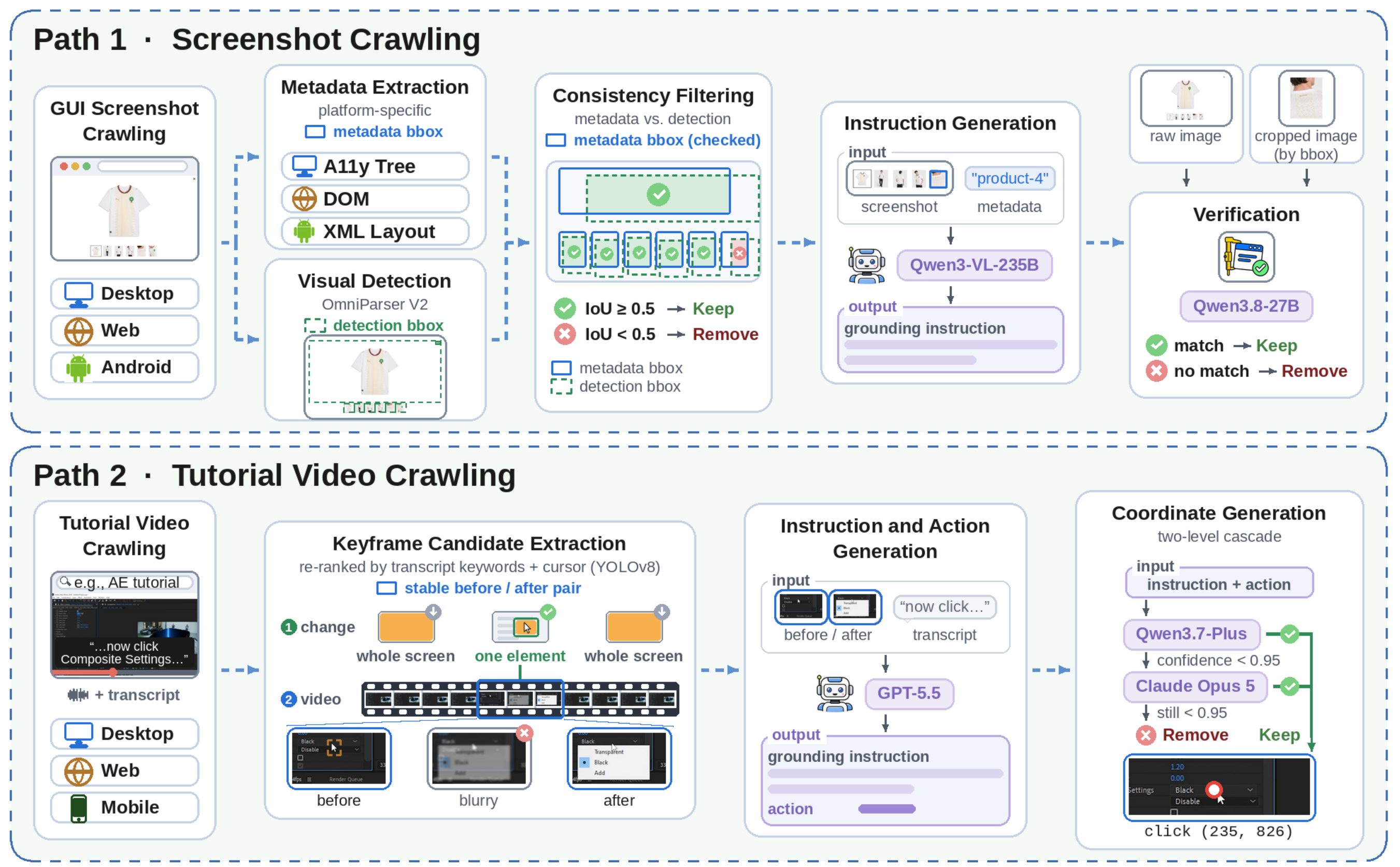
ScreenRef data construction through screenshot crawling and tutorial video crawling. Click the figure to view it at full resolution.
### Grounding capabilities
| Capability | What the model learns | Instances |
| :--- | :--- | ---: |
| **Text recognition** | Locate an element by its visible text. | 319,293 |
| **Visual matching** | Identify a target by its icon, shape, or color. | 136,771 |
| **Spatial understanding** | Resolve relative positions and layout relationships. | 154,830 |
| **Refusal** | Abstain when the requested target is absent. | 22,475 |
### Platform distribution
| Platform | Text | Visual | Spatial | Refusal | Total |
| :--- | ---: | ---: | ---: | ---: | ---: |
| Desktop | 128,018 | 61,951 | 63,291 | 13,912 | 267,172 |
| Web | 167,115 | 62,294 | 67,799 | 6,582 | 303,790 |
| Mobile | 24,160 | 12,526 | 23,740 | 1,981 | 62,407 |
| **Total** | **319,293** | **136,771** | **154,830** | **22,475** | **633,369** |
### Data comparison: ScreenRef, GroundCUA, and ScaleCUA
Qwen3-VL-8B is fine-tuned on each dataset under its recommended settings. UI-Vision is excluded from this comparison because of source overlap with GroundCUA.
| SFT data | ScreenSpot-Pro | OSWorld-G | MMBench-GUI L2 | ScreenSpot-V2 | Average |
| :--- | ---: | ---: | ---: | ---: | ---: |
| ScaleCUA | 52.8 | 61.7 | 83.6 | 93.6 | 72.9 |
| GroundCUA | 58.5 | 59.6 | **84.9** | 91.9 | 73.7 |
| **ScreenRef** | **62.4** | **64.9** | 84.5 | **93.9** | **76.4** |
**[Explore ScreenRef on Hugging Face →](https://huggingface.co/datasets/PrentisAI/ScreenRef)**
## 🧠 D2RL: Distillation-to-Reinforcement Learning
After supervised fine-tuning on ScreenRef, **D2RL** strengthens the grounding policy in two stages: **on-policy self-distillation (OPSD)** provides dense teacher guidance, then **REINFORCE Leave-One-Out (RLOO)** optimizes click success.
## 📊 Results
GroundGUI-8B improves over Qwen3-VL-8B on all five evaluated benchmarks and outperforms the larger Qwen3-VL-32B baseline in this comparison.
| Model | ScreenSpot-V2 | ScreenSpot-Pro | MMBench-GUI L2 | OSWorld-G | UI-Vision |
| :--- | ---: | ---: | ---: | ---: | ---: |
| Qwen3-VL-8B | 91.7 | 49.9 | 81.3 | 54.8 | 17.5 |
| Qwen3-VL-32B | 93.0 | 54.9 | 85.3 | 60.6 | 26.9 |
| **GroundGUI-8B** | **95.2** | **63.9** | **86.8** | **65.4** | **38.3** |
| **Gain over Qwen3-VL-8B** | **+3.5** | **+14.0** | **+5.5** | **+10.6** | **+20.8** |
## 🚀 Getting Started
### 1. Get the code and resources
```bash
git clone https://github.com/PrentisAI/GroundGUI.git
cd GroundGUI
```
| Resource | Link | Use |
| :--- | :--- | :--- |
| **GroundGUI-8B** | [Model weights](https://huggingface.co/PrentisAI/GroundGUI-8B) | Download a checkpoint for evaluation. |
| **ScreenRef** | [Dataset](https://huggingface.co/datasets/PrentisAI/ScreenRef) | Prepare the training data. |
| **Qwen3-VL-8B-Instruct** | [Base model](https://huggingface.co/Qwen/Qwen3-VL-8B-Instruct) | Starting point for SFT and tokenizer template for checkpoint conversion. |
### 2. Prepare the stage-specific environments
The recorded environments use **Python 3.12.13**. Prepare a separate environment for each stage using its `requirements.lock.txt` as the version reference. These are environment snapshots with CUDA-specific packages and builds; use wheel sources and CUDA tooling appropriate to your GPU system.
| Stage | Dependency snapshot | Transformers | Environment variable |
| :--- | :--- | :--- | :--- |
| **SFT** | [`sft/requirements.lock.txt`](./sft/requirements.lock.txt) | `5.12.1` | `CONDA_ENV`: environment prefix |
| **OPSD / RLOO** | [`rl/requirements.lock.txt`](./rl/requirements.lock.txt) | `4.57.6` | `ENV_BIN`: environment's `bin/` directory |
| **Evaluation** | [`eval/requirements.lock.txt`](./eval/requirements.lock.txt) | `4.57.6` | `ENV_PREFIX`: environment prefix |
> **Keep these environments separate.** SFT requires Transformers 5.x for correct sequence packing; using 4.x can silently produce incorrect training. The RL and evaluation stacks use 4.57.6. Use the lock files above as the reference for the tested versions.
### 3. Prepare the data paths
- **SFT:** download [ScreenRef](https://huggingface.co/datasets/PrentisAI/ScreenRef) and [ScreenRef-Annotations](https://huggingface.co/datasets/PrentisAI/ScreenRef-Annotations). Set `SCREENREF_PARQUET` to the ScreenRef directory and `DATA_ROOT` to the ScreenRef-Annotations directory; the screenshots are unpacked into `$DATA_ROOT/images/` on the first run (about 330 GB).
- **Post-training:** set `DATASET` to [the RL corpus](https://huggingface.co/datasets/PrentisAI/GroundGUI_RL), either its Parquet directory or a JSONL file. Parquet is converted once into `rl/data/`.
- **Evaluation:** organize the benchmarks according to [`eval/dataset_info.template.json`](./eval/dataset_info.template.json). The evaluation wrapper creates `eval/dataset_info.json` from this template on its first run.
## 🏋️ Training
Run the commands below from the repository root and replace `/path/to/...` with your local paths. The paper uses **4 B300 GPUs for SFT** and **8 B300 GPUs for D2RL**, with **12K grounding samples** for post-training.
### Stage 1 · Supervised fine-tuning
```bash
CONDA_ENV="/path/to/sft-env" \
DATA_ROOT="/path/to/ScreenRef-Annotations" \
SCREENREF_PARQUET="/path/to/ScreenRef" \
GPUS=4 \
bash scripts/sft.sh out/sft "/path/to/Qwen3-VL-8B-Instruct"
```
The default data configuration is `meta/meta_non_refusal.json` in ScreenRef-Annotations. Pass a custom configuration as the third argument to `scripts/sft.sh` if needed. The trained model is saved under `out/sft/`.
### Stages 2–3 · D2RL: OPSD followed by RLOO
```bash
export ENV_BIN="/path/to/rl-env/bin"
export DATASET="/path/to/rl-corpus"
# The SFT model from Stage 1.
SFT_MODEL="/path/to/sft-model"
# Stage 2: distill from the privileged teacher.
bash scripts/opsd.sh "$SFT_MODEL" groundgui-opsd
# Stage 3: optimize click success from the OPSD model.
OPSD_MODEL="/path/to/opsd-model"
bash scripts/rloo.sh "$OPSD_MODEL" groundgui-d2rl
```
Trained models are saved under `rl/output/opsd_rloo//`. By default, the SFT model also initializes the frozen OPSD teacher.
## 📏 Evaluation
The evaluation wrapper runs **ScreenSpot-V2, ScreenSpot-Pro, MMBench-GUI L2, UI-Vision, and OSWorld-G** sequentially with **vLLM at temperature 0**.
```bash
ENV_PREFIX="/path/to/eval-env" \
DATA_ROOT="/path/to/benchmarks" \
TP=2 \
bash scripts/eval.sh "/path/to/GroundGUI-8B" out/eval/groundgui-8b
```
Replace the checkpoint path with a downloaded GroundGUI-8B model directory or a locally trained model. For an SFT model, also set `INSTRUCT_DIR="/path/to/Qwen3-VL-8B-Instruct"`; RL models are evaluated as is. Results are saved to `out/eval/groundgui-8b//`.
To evaluate the D2RL run above:
```bash
D2RL_MODEL="/path/to/d2rl-model"
ENV_PREFIX="/path/to/eval-env" \
DATA_ROOT="/path/to/benchmarks" \
bash scripts/eval.sh "$D2RL_MODEL" out/eval/groundgui-d2rl
```
## 📂 Repository Structure
```text
GroundGUI/
├── assets/ # ScreenRef construction and D2RL method figures
├── scripts/ # Entry points: SFT, OPSD, RLOO, refusal SFT, evaluation
├── sft/ # Supervised fine-tuning and data configurations
├── rl/ # OPSD / RLOO training, based on GUI-SD and ms-swift
├── eval/ # Grounding benchmarks, prompts, and re-scoring
├── tools/ # Checkpoint conversion and serving utilities
├── LICENSE # Apache-2.0 code license
└── NOTICE # Third-party attribution and modified-file inventory
```
## 🙏 Acknowledgements
Our implementation builds on the following projects:
- [**Qwen3-VL**](https://github.com/QwenLM/Qwen3-VL) for the foundation vision-language model.
- [**ScaleCUA**](https://github.com/OpenGVLab/ScaleCUA) for the SFT codebase.
- [**GUI-SD**](https://github.com/zhangyan-ucas/GUI-SD-code) and [**ms-swift**](https://github.com/modelscope/ms-swift) for the post-training infrastructure.
- [**GroundCUA**](https://github.com/ServiceNow/GroundCUA) for the evaluation framework.
See [NOTICE](./NOTICE) for full attribution and the inventory of modified files.
## ⚖️ License
The code is licensed under [**Apache-2.0**](./LICENSE), except where noted in [NOTICE](./NOTICE). **ScreenRef is distributed under its own license** and is not covered by the repository's code license. Refer to the model and dataset pages for their respective terms.
## 📚 Citation
If you find GroundGUI or ScreenRef useful, please cite our [paper](https://arxiv.org/abs/2610.19100):
```bibtex
@misc{xie2026groundguiguigroundinghighquality,
title={GroundGUI: GUI Grounding by High-Quality Data and Distillation-to-Reinforcement Learning},
author={Qingsong Xie and Jiahao Tian and Jiacheng Tang and Zhifeng Li and Madalina Ciobanu and Navan Preet Singh and Qingqing Mao and Ritankar Das},
year={2026},
eprint={2610.19100},
archivePrefix={arXiv},
primaryClass={cs.AI},
url={https://arxiv.org/abs/2610.19100},
}
```
---
🤗 GroundGUI-8B ·
🗂️ ScreenRef ·
Back to top ↑



