




```bash
pip install jarviscore-framework
```
**JarvisCore** is a runtime where AI agents operate as a fleet of equal peers. Agents
discover one another by capability, execute tasks from a shared ledger, and authenticate
to every external service through a zero-trust broker, never with their own keys.
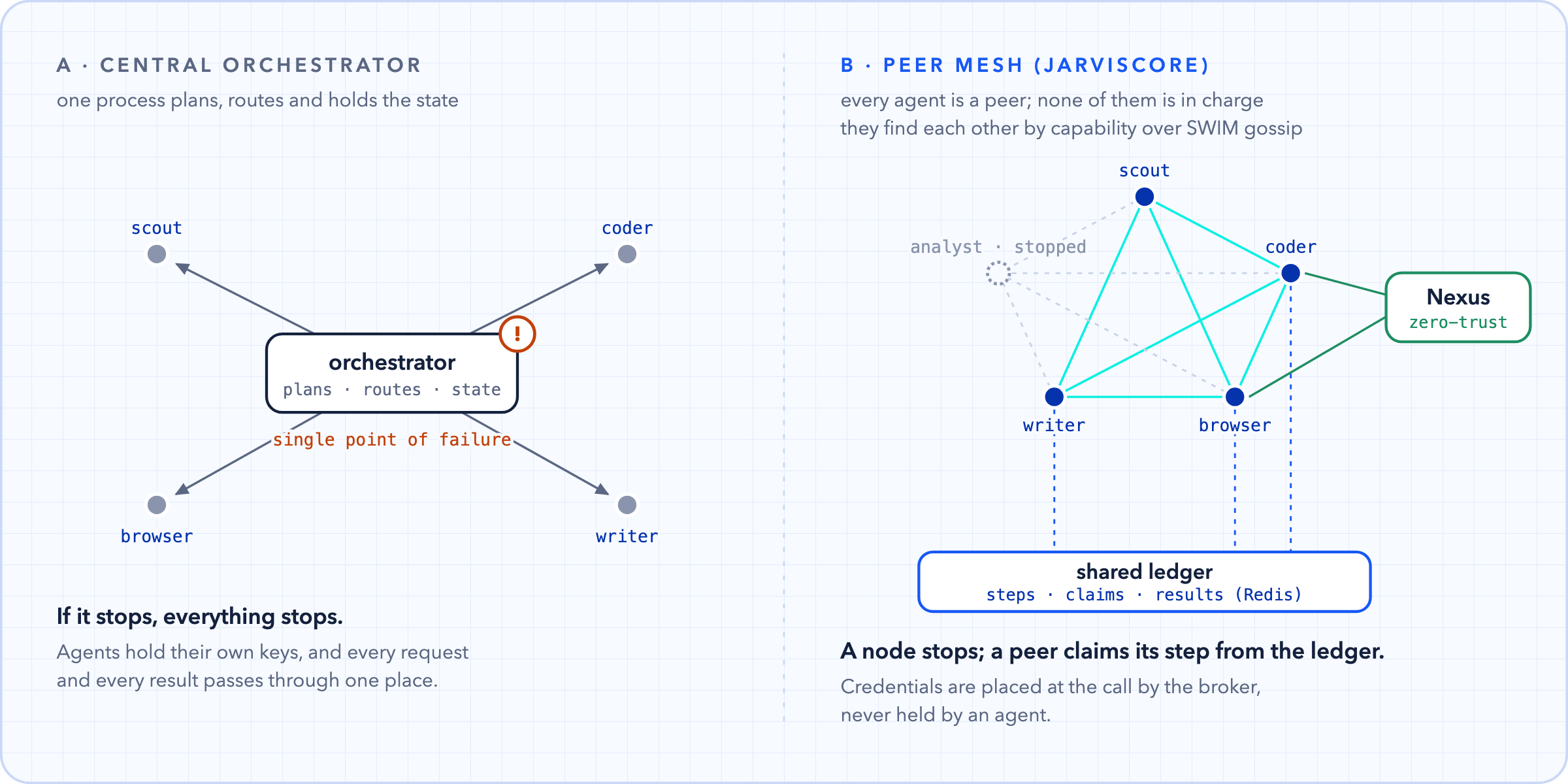
Most agent frameworks put one **orchestrator** in charge: it plans, routes every request
and holds the state, so the system is only as available as that one process. On a
JarvisCore **mesh**, every agent is a **peer**. Peers find each other by what they can
do (SWIM gossip), take steps from a shared **ledger** (Redis) and record what they did
there, so when one stops, another claims its step and the work goes on. None of them
holds a credential: the **Nexus** broker places it at the call.
## Video overview
The whole idea in two minutes: discovery by capability, the shared ledger, and the zero-trust broker, on a real mesh.
## Contents
- [Video overview](#video-overview)
- [Components](#components)
- [Start in two minutes](#start-in-two-minutes)
- [What people build with it](#what-people-build-with-it)
- [What you can count on](#what-you-can-count-on)
- [Go further](#go-further)
- [Community](#community)
- [License](#license)
## Components
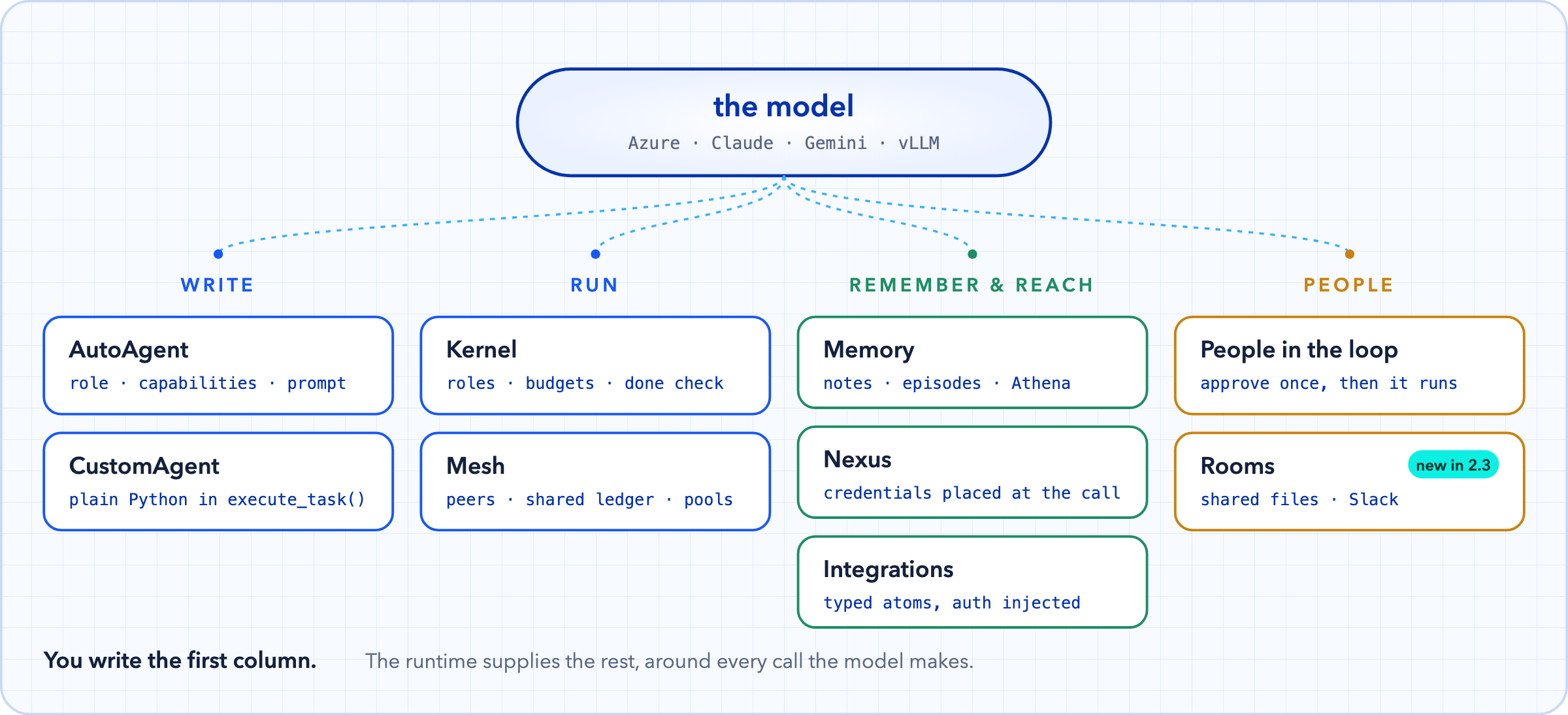
JarvisCore puts eight components around the model: **AutoAgent, CustomAgent, the
Kernel, the mesh, memory, Nexus, integrations, and people in the loop**, with
[rooms](https://jarviscore.developers.prescottdata.io/concepts/multiplayer/) for teams. You write the agents; the rest
handles context, tools, credentials, durable state, coordination and approvals around
every call the model makes.
## Start in two minutes
Use **Python 3.10 or later** and one model key. In a new folder:
```bash
pip install jarviscore-framework
jarviscore init
cp .env.example .env # add AZURE_API_KEY, CLAUDE_API_KEY, GEMINI_API_KEY or LLM_ENDPOINT
jarviscore check --validate-llm
```
Then run your first agent. It needs no database, broker or Docker:
```python
import asyncio
from jarviscore import AutoAgent, Mesh
class Researcher(AutoAgent):
role = "researcher"
capabilities = ["research"]
system_prompt = "You find primary sources, read them, and cite every fact."
async def main():
mesh = Mesh()
mesh.add(Researcher)
await mesh.start()
result = await mesh.run_task(
agent="researcher",
task="What changed in the EU AI Act's final text for open-source models?",
)
print(result["result_summary"]) # the answer
print(result["evidence"]) # what the tools actually saw
await mesh.stop()
asyncio.run(main())
```
Add capabilities as you need them: a [browser](https://jarviscore.developers.prescottdata.io/guides/browser-automation/)
(`[browser]`), [durable workflows and crash recovery](https://jarviscore.developers.prescottdata.io/guides/workflows/)
(`[redis]` with `REDIS_URL`), [agents on several machines](https://jarviscore.developers.prescottdata.io/concepts/p2p/)
(`[p2p]`), or everything (`[full]`). Prefer plain Python? A
[`CustomAgent`](https://jarviscore.developers.prescottdata.io/guides/customagent/) runs on the same mesh. See
[Getting Started](https://jarviscore.developers.prescottdata.io/getting-started/) for the full walkthrough.
## What people build with it
### A research team, live in the Desk

Three agents on one mesh: a scout reads official docs on the live web, an analyst compares, a writer delivers the brief
with its sources. A real run, idle time trimmed. Play the video to pause and scrub.
The Desk ships with JarvisCore Agents, with four complete blueprints to run in it.
The whole team is [30 lines of Python](https://github.com/Prescott-Data/jarviscore-framework/blob/main/examples/showcase/desk/research_desk.py):
```python
class Scout(AutoAgent):
role = "scout"
capabilities = ["web_research"]
default_kernel_role = "researcher"
system_prompt = "You find primary sources on the live web, read them, and cite every fact."
class Analyst(AutoAgent):
role = "analyst"
capabilities = ["analysis"]
default_kernel_role = "communicator"
system_prompt = "You compare options strictly on the evidence."
class Writer(AutoAgent):
role = "writer"
capabilities = ["writing"]
default_kernel_role = "communicator"
system_prompt = "You write short, decisive briefs for engineering leads, citing sources."
results = await mesh.workflow("vector-db-brief", [
{"agent": "scout", "task": "Gather the facts this request turns on, from official docs: ..."},
{"agent": "analyst", "task": "Compare the options on the scout's evidence.", "depends_on": [0]},
{"agent": "writer", "task": "Write a decision brief of at most eight lines.", "depends_on": [1]},
])
```
### Read a whole website
One `goal_oriented` agent opens the catalogue, walks every page, computes the figures
with code and saves a report: 32 books, 2 pages, every figure correct.
[`browse_a_whole_site.py`](https://github.com/Prescott-Data/jarviscore-framework/blob/main/examples/showcase/browse_a_whole_site.py) · real time 1m 56s ·
needs `jarviscore-framework[browser]` and `BROWSER_ENABLED=true`.
Watch it run in a terminal

Watch it run in a terminal

Watch it run in a terminal

Watch it run in a terminal

More, end to end
| Demo | What it shows |
|---|---|
| [Research team, in a terminal](https://github.com/Prescott-Data/jarviscore-framework/blob/main/examples/showcase/research_team.py) | The same kind of team without the Desk: a scout and an analyst, one workflow, a cited brief. [Recording](https://raw.githubusercontent.com/Prescott-Data/jarviscore-framework/main/jarviscore/docs/assets/readme/research.gif). |
| [Investment committee](https://github.com/Prescott-Data/jarviscore-framework/tree/main/examples/investment_committee) | Seven agents deliberate a $1.5M position on live market data; the process is killed mid-deliberation and finishes without re-running the analysts. [Recording](https://raw.githubusercontent.com/Prescott-Data/jarviscore-framework/main/jarviscore/docs/assets/demo.gif). |
| [Four-process research mesh](https://github.com/Prescott-Data/jarviscore-framework/releases/download/v1.5.1/mesh_demo_full.mp4) | Four agents in four processes find each other over SWIM, claim steps from a shared ledger, and deliver to Slack through the credential vault. Reproduce with `examples/demo_synthesizer.py` and `demo_node_1/2/3.py`. |
| [Demo film](https://www.youtube.com/watch?v=4IOpKZgjXIw) | Agents as a fleet of equal peers: discovery by capability, a shared ledger, and every external call through the credential broker, in two minutes. |
## What you can count on
| Promise | What the runtime does |
|---|---|
| **An honest status** | An agent that could not do the task returns `failure` with its own reason, never a success with empty figures. |
| **Evidence you can check** | `result["evidence"]` holds each cited tool's input and output. A receipt the agent did not earn is refused. |
| **Work that survives** | Finished workflow steps are recovered from Redis after a crash, not re-run and not re-billed. Long steps continue across execution epochs. |
| **Memory that lasts** | Facts an agent keeps are recalled in later runs, keyed to its role, and kept apart per tenant with `memory_scope_field`. |
| **Credentials out of reach** | Tokens are placed at the call by Nexus, only for agents that declare `requires_auth`. They never appear in prompts, generated code or traces. |
| **A person in the loop** | Irreversible actions wait for an approval through `Mesh.resolve_hitl()`, then run exactly once. |
| **Scale without rewrites** | `Pool(max=8)` turns one agent into several workers, and every model call is paced to the provider's real limits. Verifying 196 claims took 9.4 minutes with pools, against 202 with fixed workers. |
| **Integrations without wiring** | Typed atoms for CRMs, payments, messaging, storage and more, with auth injected at runtime. See what your installed version ships with [`jarviscore atom list`](https://jarviscore.developers.prescottdata.io/reference/cli/#atom-list). |
## Go further
| Guide | What it covers |
|---|---|
| [Getting started](https://jarviscore.developers.prescottdata.io/getting-started/) | Install, first agent, first multi-agent workflow |
| [AutoAgent](https://jarviscore.developers.prescottdata.io/guides/autoagent/) · [CustomAgent](https://jarviscore.developers.prescottdata.io/guides/customagent/) | The two ways to write an agent |
| [Workflows](https://jarviscore.developers.prescottdata.io/guides/workflows/) · [Goals](https://jarviscore.developers.prescottdata.io/guides/goal-execution/) | Steps you know in advance, and goals that plan their own |
| [Browser](https://jarviscore.developers.prescottdata.io/guides/browser-automation/) · [People in the loop](https://jarviscore.developers.prescottdata.io/guides/hitl/) | Reading and acting on real sites, with approvals |
| [Memory](https://jarviscore.developers.prescottdata.io/concepts/memory/) · [Nexus](https://jarviscore.developers.prescottdata.io/guides/nexus/) | What agents keep, and how they reach your accounts |
| [Production](https://jarviscore.developers.prescottdata.io/guides/production/) · [Configuration](https://jarviscore.developers.prescottdata.io/reference/configuration/) | Pools, pacing, Redis, sandboxes and every setting |
| [Changelog](https://jarviscore.developers.prescottdata.io/changelog/) | What changed, release by release |
## Community
Every other week we debug real agents live in [office hours on Discord](https://discord.gg/B2aJV5BJmb).
If JarvisCore saves you time, a ⭐ helps other developers find it.
## License
Apache 2.0. See [LICENSE](https://github.com/Prescott-Data/jarviscore-framework/tree/main/LICENSE). You can build and sell products with it; there is
no revenue or user threshold that requires a commercial agreement. Separately licensed
enterprise modules have their own terms; see
[JarvisCore Enterprise](https://jarviscore.developers.prescottdata.io/infrastructure/enterprise/).
Building with JarvisCore? An optional
[Built with JarvisCore](https://developers.prescottdata.io) credit on your About page
or docs is appreciated; the [trademark policy](https://github.com/Prescott-Data/jarviscore-framework/blob/main/TRADEMARK.md) applies.