PhyEditBench: A Real-World Multi-Stage Benchmark for Physics-Aware Image Editing
[Shengbin Guo*](https://previsior.github.io/) [Shaokang He*](https://openreview.net/profile?id=~Shaokang_He2) [Chaoyue Meng](https://openreview.net/profile?id=~Chaoyue_Meng1) [Shengpeng Xiao](https://openreview.net/profile?id=~Shengpeng_Xiao2)
[Xunzhi Xiang](https://xbxsxp9.github.io/) [Shaofeng Zhang](https://sherrylone.github.io/) [Qi Fan†](https://fanq15.github.io/)
* equal contribution † corresponding author
📖 Project Page | 🤗 PhyEditBench | 🤗 PhyEditVideo | 📑 Arxiv
## 🪧 News
- **[2026.7.5]** GPT-Image-2 evaluation results have been added. It won first place on the list of normal data!
- **[2026.6.26]** Our paper is released on arxiv!
- **[2026.6.24]** The benchmark and evaluation code have been released!
- **[2026.6.19]** 🎉 PhyEditBench is accepted by ECCV 2026!
## 📌 Overview
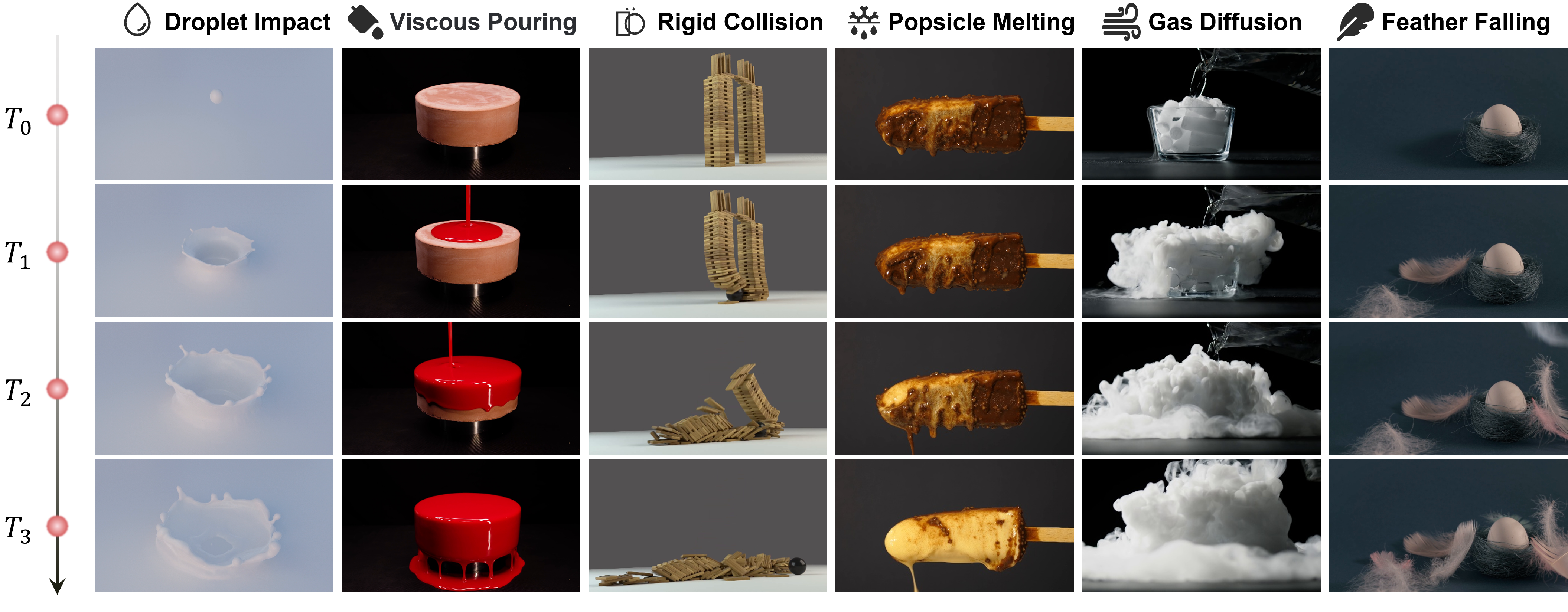
**PhyEditBench** is a real-world multi-stage benchmark for evaluating physics-aware image editing. It contains **238 high-quality real-world instances** and **35 synthetic Anti-Physics instances**, covering **4 primary physical classes** and **12 subclasses**, including deformation and fracture, fluid dynamics, rigid-body interactions, and state change with environmental effects.
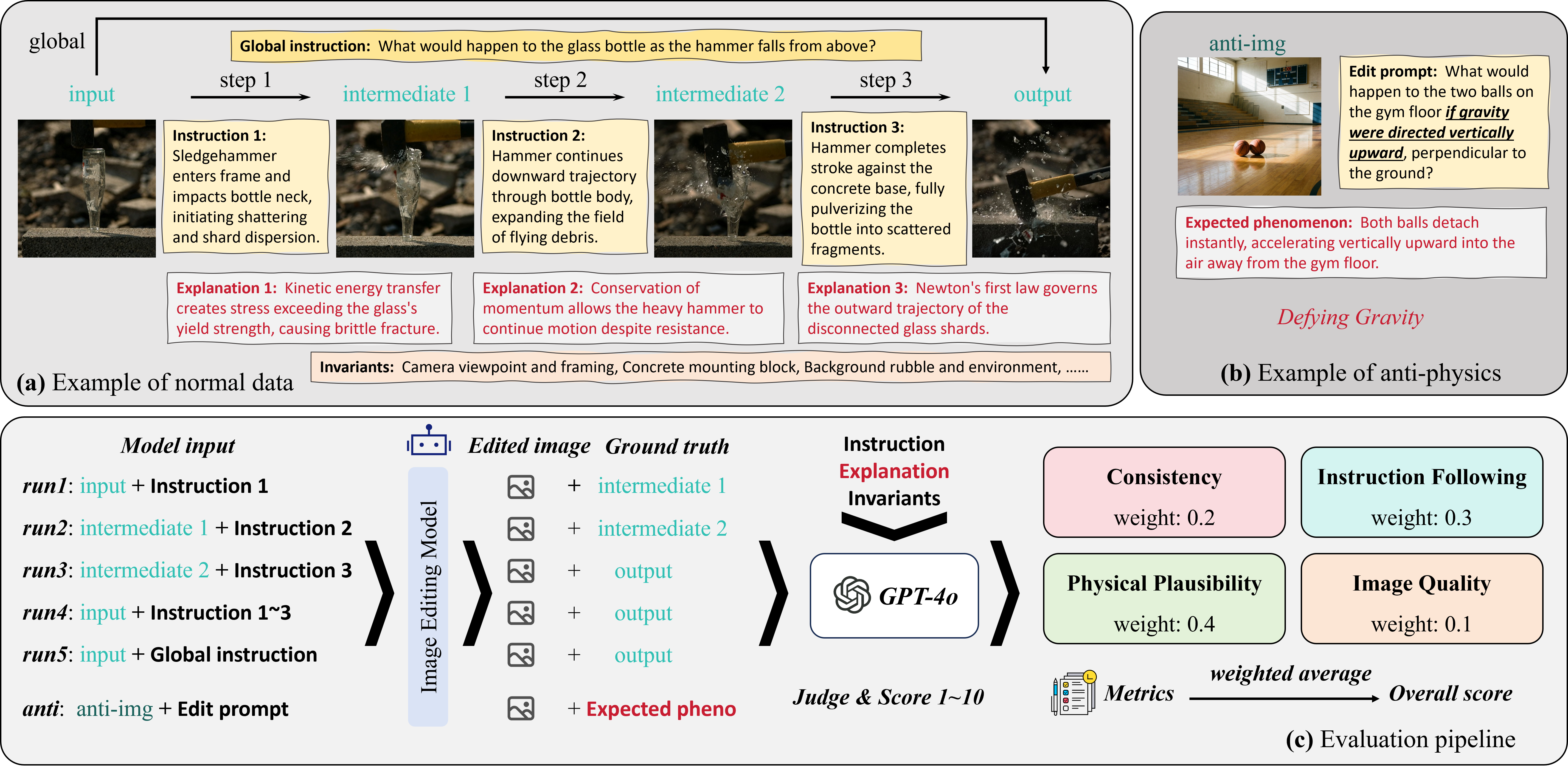
Each real-world instance is organized as a four-state physical trajectory—input, intermediate state 1, intermediate state 2, and output—enabling both fine-grained step-wise evaluation and holistic global editing evaluation. Specifically, models are tested under five settings: three step-wise edits between consecutive states, one multi-step edit using aggregated instructions, and one global edit from the initial state to the final state.
Anti-Physics cases further test whether models can follow counterfactual physical rules rather than relying on common visual priors. We evaluate model outputs with a unified VLM-based judge across four metrics: **Consistency**, **Instruction Following**, **Physical Plausibility**, and **Image Quality**, with Physical Plausibility receiving the highest weight to emphasize physically coherent editing.
## 🔥 Benchmark Performance
We evaluate representative image editing models on **PhyEditBench** using a unified VLM-based scoring protocol. Each output is scored from 1 to 10 across four dimensions: **Consistency**, **Instruction Following**, **Physical Plausibility**, and **Image Quality**. The overall score is computed as a weighted average of these metrics. We also report the model performance across four major physical categories: **Deformation & Fracture**, **Fluid Dynamics**, **Rigid Body & Interaction**, and **State Change & Environment**.
📊 Overall performance and metric breakdown
| Rank | Model | Overall | Consistency | Instruction Following | Physical Plausibility | Image Quality |
|:---:|:---|:---:|:---:|:---:|:---:|:---:|
| 🥇 1 | GPT-Image-2 | **9.34** | **9.99** | **9.57** | **9.13** | **8.19** |
| 🥈 2 | ChronoEdit-14B | 8.51 | 9.67 | 7.98 | 8.42 | 8.13 |
| 🥉 3 | Seedream4.0 | 8.47 | 9.69 | 8.22 | 8.22 | 7.75 |
| 4 | GPT-Image-1.5 | 8.23 | 8.84 | 8.21 | 8.30 | 6.78 |
| 5 | UniWorld-V2 | 7.08 | 8.53 | 6.78 | 6.73 | 6.45 |
| 6 | Step1X-Edit | 6.79 | 9.24 | 5.93 | 6.19 | 6.87 |
| 7 | Qwen-Image-Edit | 6.71 | 8.41 | 6.35 | 6.37 | 5.79 |
| 8 | Gemini-2.5 | 6.51 | 7.21 | 6.13 | 6.64 | 5.72 |
| 9 | BAGEL-Think | 6.43 | 8.53 | 5.72 | 5.96 | 6.26 |
| 9 | PhyWorld | 6.43 | 7.58 | 5.89 | 6.30 | 6.26 |
| 11 | BAGEL | 6.09 | 7.82 | 5.47 | 5.69 | 6.04 |
| 12 | InstructPix2Pix | 5.61 | 7.08 | 4.16 | 5.58 | 7.12 |
| 13 | Frame2Frame | 5.38 | 7.96 | 4.08 | 4.73 | 6.65 |
| 14 | OmniGen2 | 5.36 | 6.35 | 4.23 | 5.54 | 5.96 |
| 15 | FLUX.1-Kontext-dev | 5.27 | 7.03 | 4.56 | 4.81 | 5.71 |
🧩 Performance across physical categories
| Rank | Model | Overall | Deformation & Fracture | Fluid Dynamics | Rigid Body & Interaction | State Change & Environment |
|:---:|:---|:---:|:---:|:---:|:---:|:---:|
| 🥇 1 | GPT-Image-2 | **9.34** | **9.31** | **9.38** | **9.34** | **9.33** |
| 🥈 2 | ChronoEdit-14B | 8.51 | 8.38 | 8.74 | 8.32 | 8.79 |
| 🥉 3 | Seedream4.0 | 8.47 | 7.43 | 9.04 | 8.65 | 8.84 |
| 4 | GPT-Image-1.5 | 8.23 | 8.36 | 8.30 | 7.91 | 8.51 |
| 5 | UniWorld-V2 | 7.08 | 6.60 | 7.43 | 6.99 | 7.44 |
| 6 | Step1X-Edit | 6.79 | 3.16 | 7.20 | 6.77 | 7.13 |
| 7 | Qwen-Image-Edit | 6.71 | 6.41 | 7.38 | 6.10 | 7.33 |
| 8 | Gemini-2.5 | 6.51 | 7.36 | 6.79 | 5.87 | 6.07 |
| 9 | BAGEL-Think | 6.43 | 5.77 | 6.82 | 6.55 | 6.59 |
| 9 | PhyWorld | 6.43 | 6.29 | 6.55 | 6.10 | 6.94 |
| 11 | BAGEL | 6.09 | 5.55 | 6.43 | 6.21 | 6.14 |
| 12 | InstructPix2Pix | 5.61 | 4.24 | 6.41 | 5.49 | 6.67 |
| 13 | Frame2Frame | 5.38 | 5.25 | 5.43 | 5.17 | 5.86 |
| 14 | OmniGen2 | 5.36 | 3.71 | 6.32 | 5.51 | 6.05 |
| 15 | FLUX.1-Kontext-dev | 5.27 | 5.40 | 5.37 | 4.99 | 5.44 |
🧩 Performance on anti-physics subset
| Rank | Model | Overall | Consistency | Instruction Following | Physical Plausibility | Image Quality |
| :--: | :----------------- | :------: | :---------: | :-------------------: | :-------------------: | :-----------: |
| 🥇 1 | Gemini-2.5 | **7.07** | **8.71** | **7.03** | **5.91** | **8.54** |
| 🥈 2 | GPT-Image-1.5 | 7.04 | 9.03 | 7.20 | 5.51 | 8.71 |
| 🥉 3 | Seedream4.0 | 6.95 | 8.20 | 7.29 | 5.78 | 8.11 |
| 4 | GPT-Image-2 | 6.87 | 8.74 | 7.67 | 4.85 | 8.85 |
| 5 | PhyWorld | 6.39 | 7.91 | 6.34 | 5.29 | 7.86 |
| 6 | Qwen-Image-Edit | 6.16 | 7.74 | 6.29 | 4.83 | 7.91 |
| 6 | BAGEL-Think | 6.16 | 7.89 | 6.34 | 5.00 | 6.83 |
| 8 | FLUX.1-Kontext-dev | 6.07 | 8.60 | 5.71 | 4.43 | 8.63 |
| 9 | UniWorld-V2 | 5.79 | 8.17 | 5.77 | 4.06 | 8.06 |
| 10 | Step1X-Edit | 5.34 | 8.23 | 4.83 | 3.51 | 8.40 |
| 11 | BAGEL | 5.11 | 7.77 | 4.86 | 3.29 | 7.83 |
| 12 | ChronoEdit-14B | 4.99 | 6.89 | 4.66 | 3.63 | 7.69 |
| 13 | OmniGen2 | 4.74 | 8.17 | 4.09 | 2.89 | 7.23 |
| 14 | InstructPix2Pix | 4.45 | 7.60 | 3.69 | 2.54 | 8.09 |
| 15 | Frame2Frame | 3.81 | 6.80 | 2.51 | 2.51 | 6.89 |
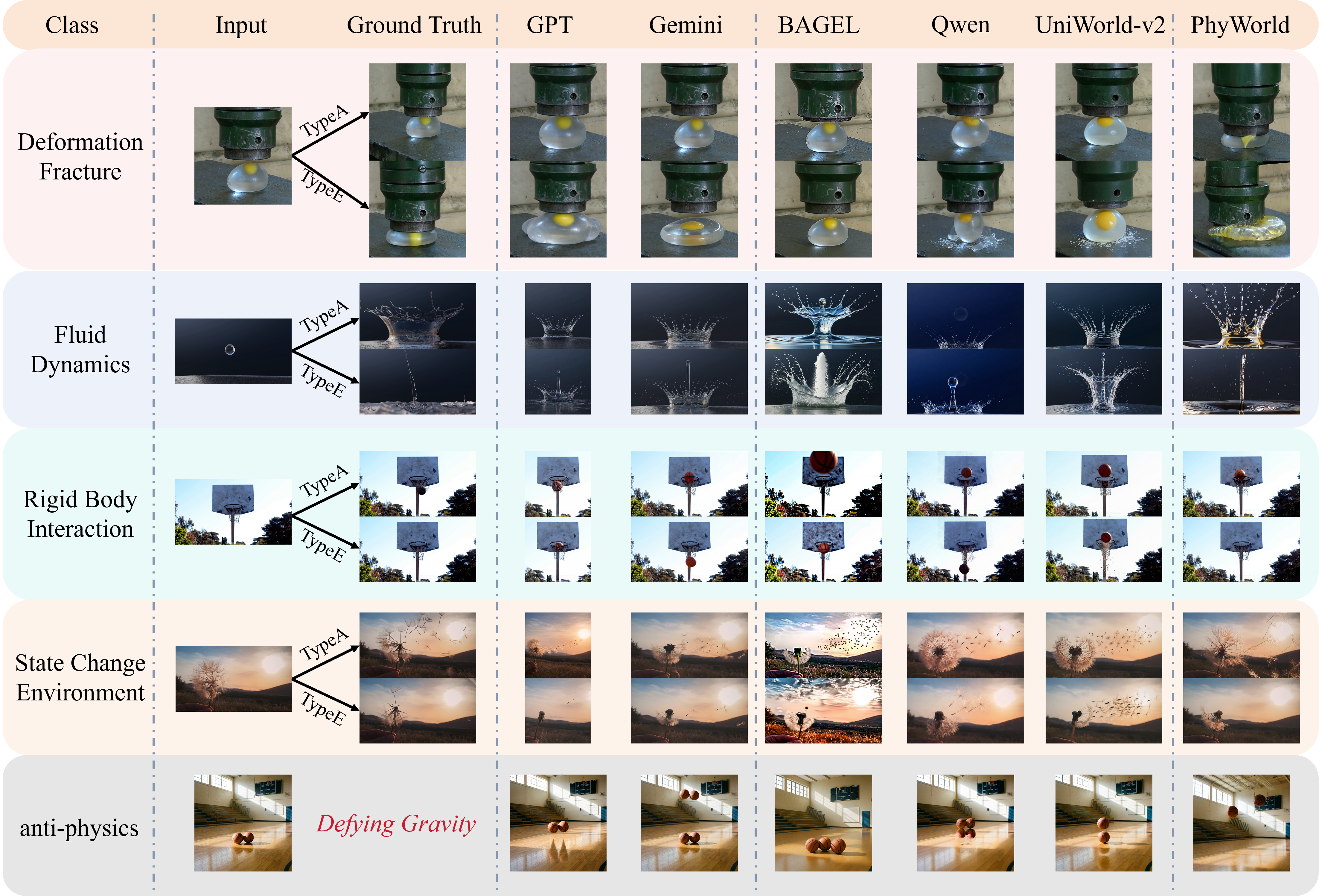
Qualitative results of some models.
## ⚙️ Usage
The benchmark data are stored in [`bench`](bench). Normal samples are organized by physical category and subclass; each `meta.json` item contains four trajectory states (`input`, `intermediate_1`, `intermediate_2`, `output`), three step-wise instructions, one global instruction, physical explanations, and invariants. Anti-Physics samples are stored in `bench/anti-physic` with `meta.jsonl`, `input_data/`, and the provided `checklists.jsonl`.
### Requirements
Use Python 3.10 or newer and install the evaluation dependencies:
```bash
pip install openai pillow tqdm
```
### Evaluation
Set your OpenAI API key:
```bash
export OPENAI_API_KEY="YOUR_API_KEY"
```
Generated outputs should be saved in the following structure. Use the numeric sample id as the filename, without the `data_` prefix.
```text
bench_generated/