# Protocol
## Device Register
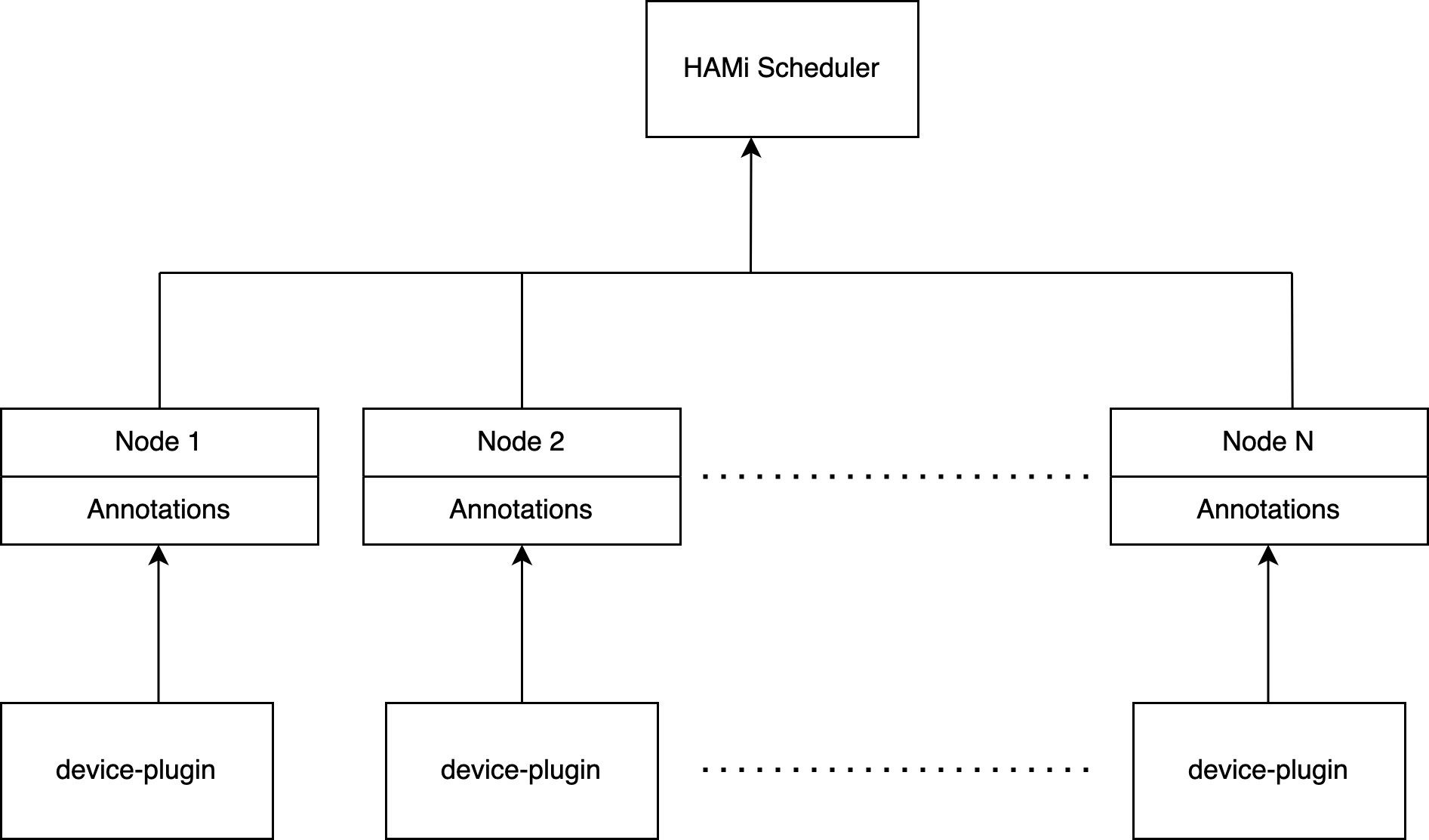 HAMi needs to know the spec of each AI devices in the cluster in order to schedule properly. During device registration, device-plugin needs to keep patching the spec of each device into node annotations every 30 seconds, in the format of the following:
```text
hami.io/node-handshake-{device-type}: Reported_{device_node_current_timestamp}
hami.io/node-{device-type}-register: {Device 1}:{Device2}:...:{Device N}
```
The definition of each device is in the following format:
```text
{Device UUID},{device split count},{device memory limit},{device core limit},{device type},{device numa},{healthy}
```
An example is shown below:
```text
hami.io/node-handshake-nvidia: Reported 2024-01-23 04:30:04.434037031 +0000 UTC m=+1104711.777756895
hami.io/node-handshake-mlu: Requesting_2024.01.10 04:06:57
hami.io/node-mlu-register: MLU-45013011-2257-0000-0000-000000000000,10,23308,0,MLU-MLU370-X4,0,false:MLU-54043011-2257-0000-0000-000000000000,10,23308,0,
hami.io/node-nvidia-register: GPU-00552014-5c87-89ac-b1a6-7b53aa24b0ec,10,32768,100,NVIDIA-Tesla V100-PCIE-32GB,0,true:GPU-0fc3eda5-e98b-a25b-5b0d-cf5c855d1448,10,32768,100,NVIDIA-Tesla V100-PCIE-32GB,0,true:
```
In this example, this node has two different AI devices, 2 Nvidia-V100 GPUs, and 2 Cambricon 370-X4 MLUs
Note that a device node may become unavailable due to hardware or network failure, if a node hasn't registered in last 5 minutes, scheduler will mark that node as 'unavailable'.
Since system clock on scheduler node and 'device' node may not align properly, scheduler node will patch the following device node annotations every 30s
```text
hami.io/node-handshake-{device-type}: Requesting_{scheduler_node_current_timestamp}
```
If hami.io/node-handshake annotations remains in "Requesting_xxxx" and {scheduler current timestamp} > 5 mins + {scheduler timestamp in annotations}, then this device on that node will be marked "unavailable" in scheduler.
## Schedule Decision
HAMi needs to know the spec of each AI devices in the cluster in order to schedule properly. During device registration, device-plugin needs to keep patching the spec of each device into node annotations every 30 seconds, in the format of the following:
```text
hami.io/node-handshake-{device-type}: Reported_{device_node_current_timestamp}
hami.io/node-{device-type}-register: {Device 1}:{Device2}:...:{Device N}
```
The definition of each device is in the following format:
```text
{Device UUID},{device split count},{device memory limit},{device core limit},{device type},{device numa},{healthy}
```
An example is shown below:
```text
hami.io/node-handshake-nvidia: Reported 2024-01-23 04:30:04.434037031 +0000 UTC m=+1104711.777756895
hami.io/node-handshake-mlu: Requesting_2024.01.10 04:06:57
hami.io/node-mlu-register: MLU-45013011-2257-0000-0000-000000000000,10,23308,0,MLU-MLU370-X4,0,false:MLU-54043011-2257-0000-0000-000000000000,10,23308,0,
hami.io/node-nvidia-register: GPU-00552014-5c87-89ac-b1a6-7b53aa24b0ec,10,32768,100,NVIDIA-Tesla V100-PCIE-32GB,0,true:GPU-0fc3eda5-e98b-a25b-5b0d-cf5c855d1448,10,32768,100,NVIDIA-Tesla V100-PCIE-32GB,0,true:
```
In this example, this node has two different AI devices, 2 Nvidia-V100 GPUs, and 2 Cambricon 370-X4 MLUs
Note that a device node may become unavailable due to hardware or network failure, if a node hasn't registered in last 5 minutes, scheduler will mark that node as 'unavailable'.
Since system clock on scheduler node and 'device' node may not align properly, scheduler node will patch the following device node annotations every 30s
```text
hami.io/node-handshake-{device-type}: Requesting_{scheduler_node_current_timestamp}
```
If hami.io/node-handshake annotations remains in "Requesting_xxxx" and {scheduler current timestamp} > 5 mins + {scheduler timestamp in annotations}, then this device on that node will be marked "unavailable" in scheduler.
## Schedule Decision
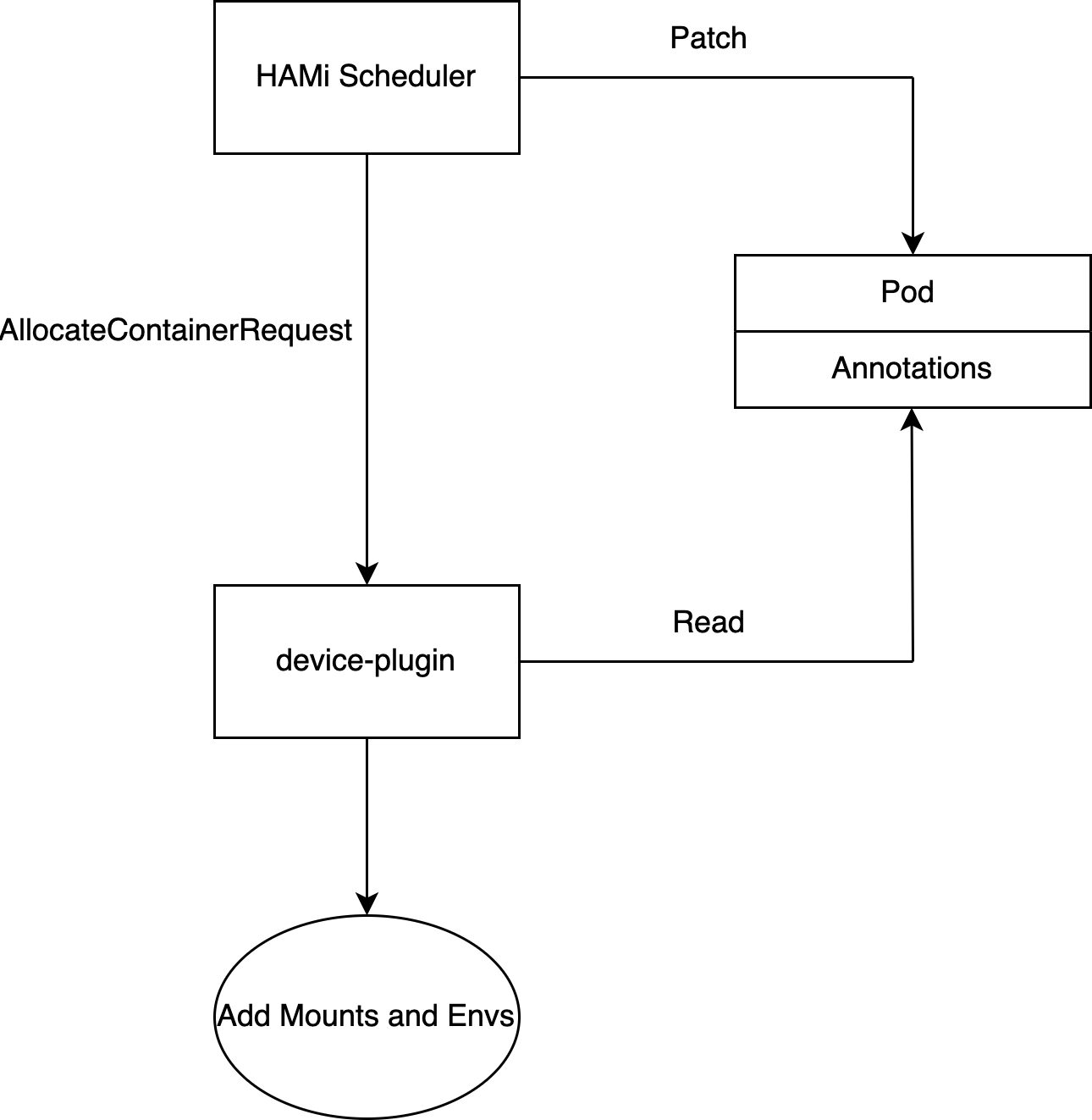 HAMi scheduler needs to patch schedule decisions into pod annotations, in the format of the following:
```text
hami.io/vgpu-devices-to-allocate: {ctr1 request};{ctr2 request};...{Last ctr request};
hami.io/vgpu-node: {schedule decision node}
hami.io/vgpu-time: {timestamp}
```
`hami.io/vgpu-devices-to-allocate` is the key for NVIDIA GPUs. Each device backend registers its own key in `InRequestDevices`, and the names do not follow a single `{device-type}` pattern. For example, Cambricon MLU uses `hami.io/cambricon-mlu-devices-to-allocate`, Moore Threads uses `hami.io/mthreads-vgpu-devices-to-allocate`, and Hygon HCU uses `hami.io/hcu-devices-to-allocate`.
The scheduler writes one `-devices-to-allocate` annotation per device type. A pod that asks for more than one device type, for example NVIDIA and MLU, gets one annotation per type, and each annotation lists only the devices of that type.
Each container request lists that container's devices. Every device is four comma-separated fields terminated by `:`, and every container is terminated by `;`:
```text
{device UUID},{device type keyword},{device memory request},{device core request}:
```
for example:
A pod with 2 containers, first container requests 1 GPU with 3G device Memory, second container requests 1 GPU with 5G device Memory, then the patched annotations will be like this:
```text
hami.io/vgpu-devices-to-allocate: GPU-0fc3eda5-e98b-a25b-5b0d-cf5c855d1448,NVIDIA,3000,0:;GPU-0fc3eda5-e98b-a25b-5b0d-cf5c855d1448,NVIDIA,5000,0:;
hami.io/vgpu-node: node67-4v100
hami.io/vgpu-time: 1705054796
```
HAMi scheduler needs to patch schedule decisions into pod annotations, in the format of the following:
```text
hami.io/vgpu-devices-to-allocate: {ctr1 request};{ctr2 request};...{Last ctr request};
hami.io/vgpu-node: {schedule decision node}
hami.io/vgpu-time: {timestamp}
```
`hami.io/vgpu-devices-to-allocate` is the key for NVIDIA GPUs. Each device backend registers its own key in `InRequestDevices`, and the names do not follow a single `{device-type}` pattern. For example, Cambricon MLU uses `hami.io/cambricon-mlu-devices-to-allocate`, Moore Threads uses `hami.io/mthreads-vgpu-devices-to-allocate`, and Hygon HCU uses `hami.io/hcu-devices-to-allocate`.
The scheduler writes one `-devices-to-allocate` annotation per device type. A pod that asks for more than one device type, for example NVIDIA and MLU, gets one annotation per type, and each annotation lists only the devices of that type.
Each container request lists that container's devices. Every device is four comma-separated fields terminated by `:`, and every container is terminated by `;`:
```text
{device UUID},{device type keyword},{device memory request},{device core request}:
```
for example:
A pod with 2 containers, first container requests 1 GPU with 3G device Memory, second container requests 1 GPU with 5G device Memory, then the patched annotations will be like this:
```text
hami.io/vgpu-devices-to-allocate: GPU-0fc3eda5-e98b-a25b-5b0d-cf5c855d1448,NVIDIA,3000,0:;GPU-0fc3eda5-e98b-a25b-5b0d-cf5c855d1448,NVIDIA,5000,0:;
hami.io/vgpu-node: node67-4v100
hami.io/vgpu-time: 1705054796
```