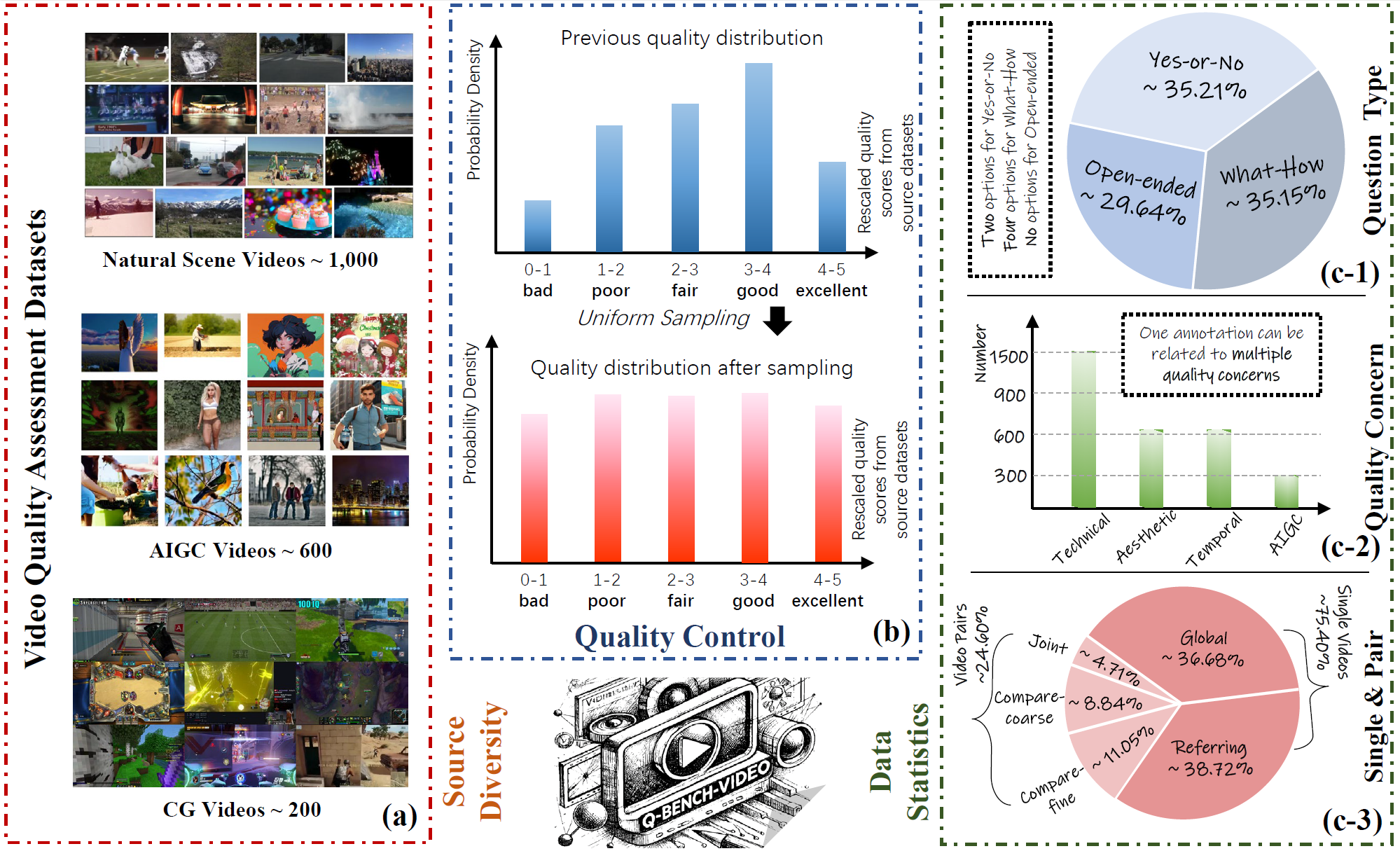
We introduce **Q-Bench-Video**, a new benchmark specifically designed to evaluate LMMs' proficiency in discerning video quality.
A. To ensure the diversity of video sources, Q-Bench-Video encompasses videos from natural scenes, computer graphics (CG), and AI-generated content (AIGC).
B. Building on the traditional multiple-choice questions format with the *Yes-or-No* and *What-How* categories, we include *Open-ended* questions to better evaluate complex scenarios. Additionally, we incorporate the **video pair quality comparison** question to enhance comprehensiveness.
C. Beyond the traditional *Technical*, *Aesthetic*, and *Temporal* distortions, we have expanded our evaluation aspects to include the dimension of *AIGC* distortions, which addresses the increasing demand for video generation.
Finally, we collect a total of 2,378 question-answer pairs and test them on 12 open-source \& 5 proprietary LMMs. Our findings indicate that **while LMMs have a foundational understanding of video quality, their performance remains incomplete and imprecise, with a notable discrepancy compared to human-level performance**.
## Release
- [2025/3] 🔥 The single video tasks of **Q-Bench-Video** are merged to [VLMEvalKit](https://github.com/open-compass/VLMEvalKit/blob/main/docs/zh-CN/Quickstart.md). Test your video LMM via one line command (`python run.py --data QBench_Video --model GPT4o`)!
- [2025/2] 🔥 **Q-Bench-Video** is accepted by CVPR 2025! See you in Nashville.
- [2024/10/2] 🔥 Release the [technical report](https://www.arxiv.org/abs/2409.20063) for **Q-Bench-Video**.
- [2024/9/24] 🔥 Release the sample script for testing on **Q-Bench-Video**.
- [2024/9/20] 🔥 [Github repo](https://github.com/Q-Future/Q-Bench-Video) for **Q-Bench-Video** is online. Do you want to find out how your LMM performs on video quality understanding? Come and test on **Q-Bench-Video** !! [Dataset Download](https://huggingface.co/datasets/zhangzicheng/Q-Bench-Video)
## Q-Bench-Video Construction
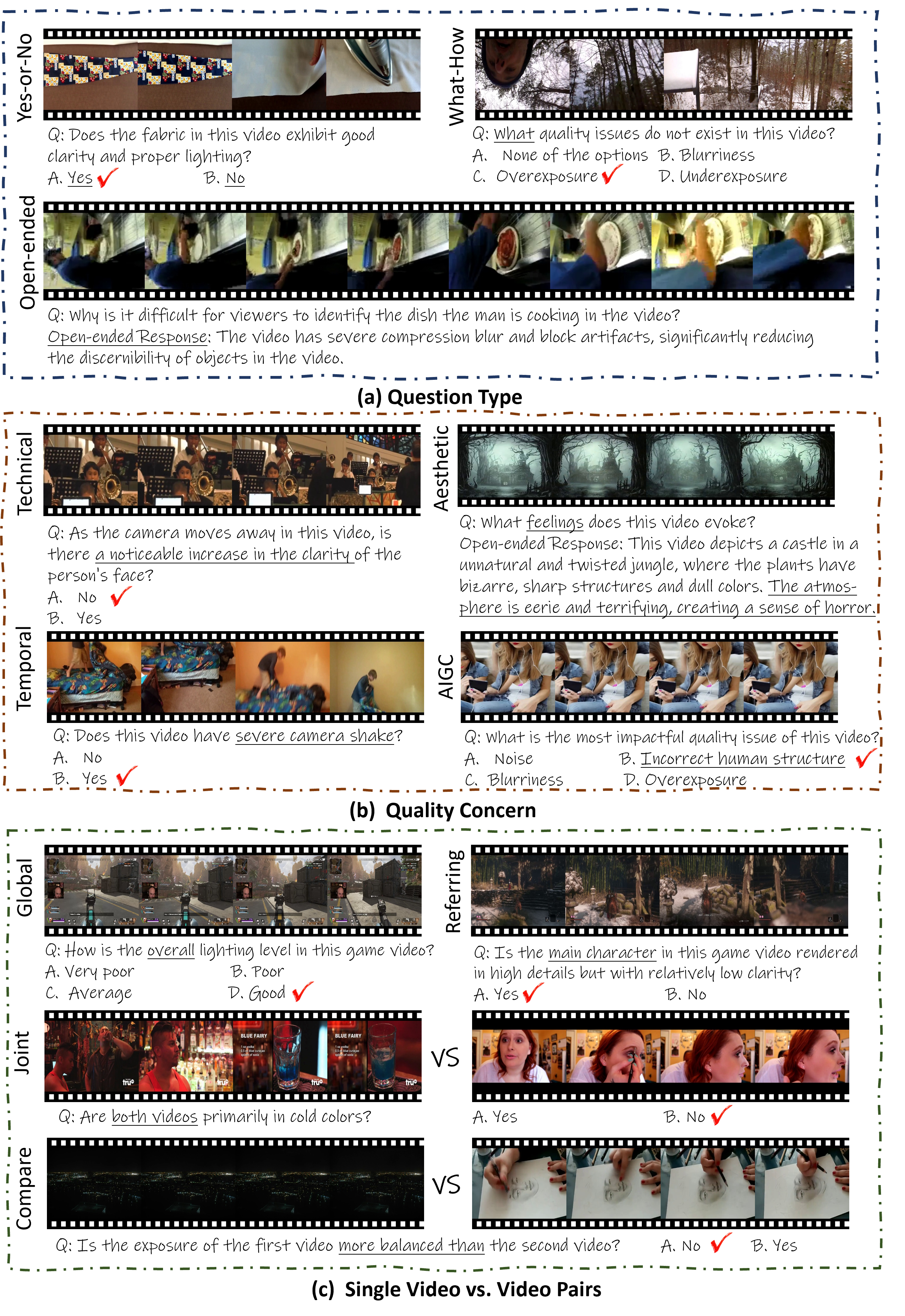
In this benchmark, the meta-structure tuple **(V,Q,A,C)** of each data item can be decomposed into several components: the video object **V** (which can be a single video or a pair of videos), the video quality query **Q**, the set of possible answers **A**, and the correct answer **C**.
The subcategories are organized as follows:
1. **Question Types**: Yes-or-No Questions, What-How Questions, Open-ended Questions
2. **Quality Concerns**: Technical, Aesthetic, Temporal, and AIGC
3. **Single Videos \& Video Pairs**: Single-Global, Single-referring, Pair-Compare-Coarse, Pair-Compare-Fine
## Glance at Q-Bench-Video Performance
For *open-source* models, **mPLUG-Owl3** takes the first place. For *closed-source* models, **GPT-4o** takes the first place.
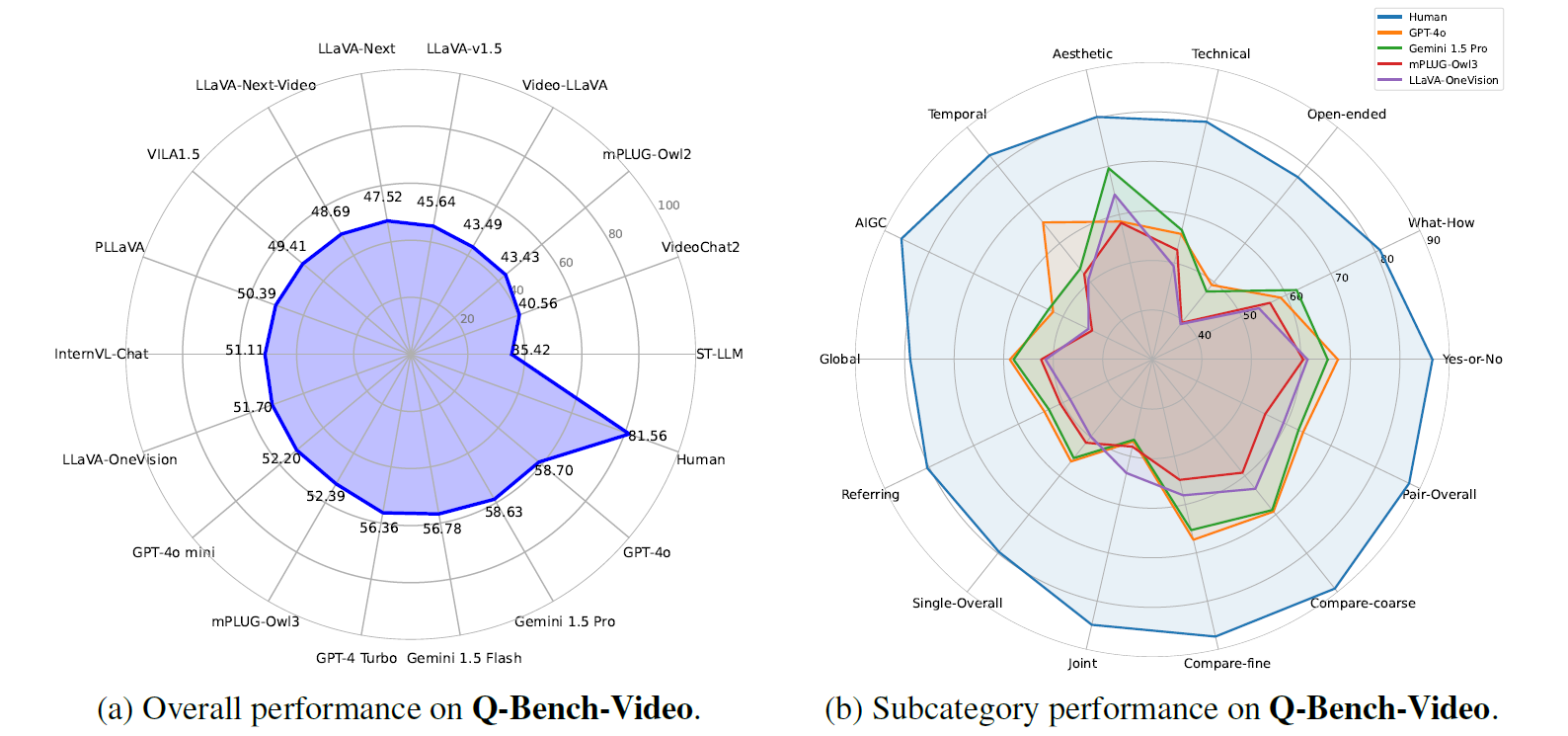
**A Quick Look of the Q-Bench-Video Outcomes.**
| Model | Yes-or-No | What-How | Open-ended | Technical | Aesthetic | Temporal | AIGC | Overall |
|----------------------------------------|-----------|-----------|-----------|-----------|-----------|-----------|-----------|-----------|
| **Random guess** *w/o Open-ended* | 50.00% | 25.00% | / | 37.10% | 37.31% | 37.25% | 37.22% | 37.79% |
| **Human** | 86.57% | 81.00% | 77.11% | 79.22% | 80.23% | 82.72% | 86.21% | 81.56% |
| *Open-source Image LMMs* | | | | | | | | |
| LLaVA-Next (*Mistral-7B*) | 62.83% | 45.14% | 33.69% | 46.38% | 57.86% | 47.84% | 48.46% | 47.52% |
| LLaVA-v1.5 (*Vicuna-v1.5-13B*) | 52.98% | 46.44% | 37.01% | 45.77% | 58.12% | 45.30% | 46.48% | 45.64% |
| mPLUG-Owl2 (*LLaMA2-7B*) | 59.19% | 39.07% | 31.19% | 42.07% | 52.38% | 41.71% | 39.37% | 43.43% |
| *Open-source Video LMMs* | | | | | | | | |
| mPLUG-Owl3 (*Qwen2-7B*) | 60.48% | **56.39%**| _39.48%_ | **52.68%**| 58.31% | **52.05%**| 43.49% | **52.39%**|
| LLaVA-OneVision (*Qwen2-7B*) | 61.34% | _53.88%_ | 39.15% | 49.35% | **64.15%**| 50.68% | 44.30% | _51.70%_ |
| InternVL-Chat (*Vicuna-7B*) | **66.02%**| 52.13% | 33.93% | 48.42% | 52.73% | 50.59% | _53.12%_ | 51.11% |
| VILA1.5 (*LLaMA3-8B*) | 61.95% | 46.00% | **39.60%**| 47.85% | 57.85% | 45.65% | 42.57% | 49.41% |
| PLLaVA (*Mistral-7B*) | _65.63%_ | 52.33% | 32.23% | _49.69%_ | _61.32%_ | _50.96%_ | **53.64%**| 50.39% |
| LLaVA-Next-Video (*Mistral-7B*) | 61.34% | 45.95% | 38.10% | 49.03% | 60.94% | 46.97% | 49.40% | 48.69% |
| ST-LLM (*Vicuna-v1.1-7B*) | 44.63% | 28.50% | 32.78% | 34.99% | 46.11% | 34.28% | 34.02% | 35.42% |
| Video-LLaVA (*Vicuna-v1.5-7B*) | 64.67% | 40.79% | 29.11% | 43.25% | 54.04% | 42.38% | 42.76% | 43.49% |
| VideoChat2 (*Mistral-7B*) | 56.09% | 29.98% | 34.99% | 39.26% | 50.02% | 38.25% | 35.88% | 40.56% |
| *Proprietary LMMs* | | | | | | | | |
| **Gemini 1.5 Flash** | 65.48% | 56.79% | 47.51% | 54.11% | _66.58%_ | 53.51% | 50.22% | 56.78% |
| **Gemini 1.5 Pro** | 65.42% | **62.35%**| _47.57%_ | **56.80%**| **69.61%**| 53.38% | **53.26%**| _58.63%_ |
| **GPT-4o mini** | 62.95% | 50.93% | 42.10% | 49.38% | 60.90% | 48.43% | 41.71% | 52.20% |
| **GPT-4o** | **67.48%**| _58.79%_ | **49.25%**| _56.01%_ | 58.57% | **65.39%**| _52.22%_ | **58.70%**|
| **GPT-4 Turbo** | _66.93%_ | 58.33% | 40.15% | 54.23% | 66.23% | _54.00%_ | 52.04% | 56.36% |
We release the performance of LMMs against humans.
Several conclusions can be obtained:
1) **General Performance. Human>Proprietary LMMs>Open-source LMMs>Random guess.**
2) **Open-ended questions are more challenging for LMMs.**
3) **MMs exhibit unbalanced performance across different types of distortions.**
## Evaluate your model on Q-Bench-Video
1. Test on Q-Bench-Video
Assume that you have downloaded the [Q-Bench-Video](https://huggingface.co/datasets/zhangzicheng/Q-Bench-Video).
We provide a sample [GPT_test.py](https://github.com/Q-Future/Q-Bench-Video/blob/main/GPT_test.py) of testing GPT API format on **Q-Bench-Video**
Use the following command or make necessary modifications to quickly test GPT and your LMM models.
```
python GPT_test.py --json_file path/to/Q_Bench_Video_dev.json --video_dir path/to/video/directory --output_file path/to/Q_Bench_Video_dev_response.json --api_key your_openai_api_key
```
2. Evaluating open-ended responses:
We provide a sample function to rate the open-ended responses, `result' is the list of scores while `score' is the standardized score.
```
from openai import OpenAI
client = OpenAI(api_key = "your_api_key")
import timeout_decorator
def judge_open(question, answer, correct_ans):
result = []
msg = f'''Given the question [{question}], evaluate whether the response [{answer}] completely matches the correct answer [{correct_ans}].
First, check the response and please rate score 0 if the response is not a valid answer.
Please rate score 2 if the response completely or almost completely matches the correct answer on completeness, accuracy, and relevance.
Please rate score 1 if the response partly matches the correct answer on completeness, accuracy, and relevance.
Please rate score 0 if the response doesn't match the correct answer on completeness, accuracy, and relevance at all.
Please only provide the result in the following format: Score:'''
print(msg)
@timeout_decorator.timeout(5)
def get_completion(msg):
completion = client.chat.completions.create(
model="gpt-4o",
messages=[
{"role": "system", "content": "You are a helpful assistant that grades answers related to visual video quality. There are a lot of special terms or keywords related to video processing and photography. You will pay attention to the context of `quality evaluation' when grading."},
{"role": "user", "content": msg}
]
)
return completion.choices[0].message.content
for i in range(5):
try:
response = get_completion(msg)
print(response)
score = response.split(": ")[-1]
result.append(score)
except timeout_decorator.TimeoutError:
result.append("N/A")
except Exception as e:
result.append("N/A")
for i in result:
if i in ['0','1','2']:
cnt = cnt + 1
score = score + float(i)/2
score = score / cnt
return result, score
```
## Contact
Please contact any of the first authors of this paper for queries.
- Zicheng Zhang, `zzc1998@sjtu.edu.cn`, @zzc-1998