English | 한국어 | 简体中文
◯ ─────────── ◯
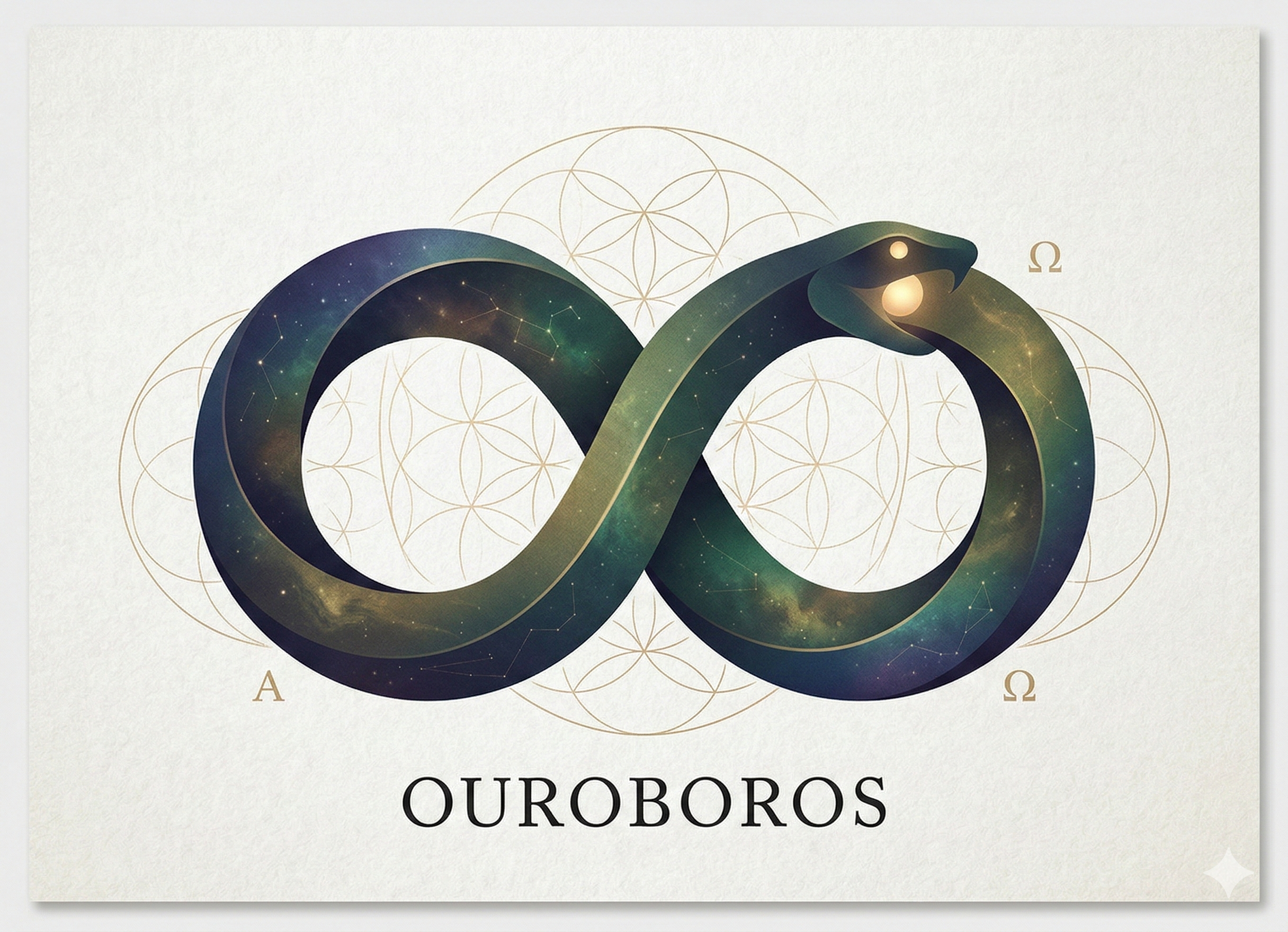
O U R O B O R O S
◯ ─────────── ◯
Stop prompting. Start specifying.
Agent OS for replayable, specification-first AI coding workflows


Quick Start ·
Why ·
Results ·
How It Works ·
Commands ·
Philosophy
**Turn a vague idea into a verified, working codebase -- across Claude Code, Codex CLI, OpenCode, and Hermes.**
Ouroboros is an Agent OS for AI coding: a local-first runtime layer that turns
non-deterministic agent work into a replayable, observable, policy-bound
execution contract. It replaces ad-hoc prompting with a structured
specification-first workflow: interview, crystallize, execute, evaluate,
evolve.
---
## Why Ouroboros?
Most AI coding fails at the **input**, not the output. The bottleneck is not AI capability -- it is human clarity.
| Problem | What Happens | Ouroboros Fix |
| :------------ | :------------------------------- | :-------------------------------------------- |
| Vague prompts | AI guesses, you rework | Socratic interview exposes hidden assumptions |
| No spec | Architecture drifts mid-build | Immutable seed spec locks intent before code |
| Manual QA | "Looks good" is not verification | 3-stage automated evaluation gate |
---
## Quick Start
**Install** — one command, everything auto-detected:
```bash
curl -fsSL https://raw.githubusercontent.com/Q00/ouroboros/main/scripts/install.sh | bash
```
**Build** — open your AI coding agent and go:
```
> ooo interview "I want to build a task management CLI"
```
> Works with Claude Code, Codex CLI, OpenCode, Hermes, and Kiro CLI. The installer detects Claude Code, Codex CLI, and Hermes CLI automatically and registers the MCP server. For OpenCode, run `ouroboros setup --runtime opencode` after installation.
Kiro CLI quick start
```bash
pip install 'ouroboros-ai[claude]'
ouroboros setup # detects Kiro CLI and registers MCP server
```
Set runtime in `.env`:
```
OUROBOROS_RUNTIME=kiro
```
Then use `ooo` commands inside a Kiro CLI session.
Other install methods
**Claude Code plugin only** (no system package):
```bash
claude plugin marketplace add Q00/ouroboros && claude plugin install ouroboros@ouroboros
```
Then run `ooo setup` inside a Claude Code session.
**pip / uv / pipx**:
```bash
pip install ouroboros-ai # base
pip install ouroboros-ai[claude] # + Claude Code deps
pip install ouroboros-ai[litellm] # + LiteLLM multi-provider
pip install ouroboros-ai[mcp] # + MCP server/client support
pip install ouroboros-ai[tui] # + Textual terminal UI
pip install ouroboros-ai[all] # everything (claude + litellm + mcp + tui + dashboard)
ouroboros setup # configure runtime
```
Legacy compatibility: `ouroboros-ai[dashboard]` is still accepted as a compatibility alias while extras migrate.
See runtime guides: [Claude Code](./docs/runtime-guides/claude-code.md) · [Codex CLI](./docs/runtime-guides/codex.md) · [Hermes](./docs/runtime-guides/hermes.md) · [OpenCode](./docs/runtime-guides/opencode.md)
Uninstall
```bash
ouroboros uninstall
```
Removes all configuration, MCP registration, and data. See [UNINSTALL.md](./UNINSTALL.md) for details.
> **Python >= 3.12 required.** See [pyproject.toml](./pyproject.toml) for the full dependency list.
---
## What You Get
After one loop of the Ouroboros cycle, a vague idea becomes a verified codebase:
| Step | Before | After |
| :------------ | :---------------------- | :---------------------------------------------------------------------- |
| **Interview** | *"Build me a task CLI"* | 12 hidden assumptions exposed, ambiguity scored to 0.19 |
| **Seed** | No spec | Immutable specification with acceptance criteria, ontology, constraints |
| **Evaluate** | Manual review | 3-stage gate: Mechanical (free) -> Semantic -> Multi-Model Consensus |
What just happened?
```
interview -> Socratic questioning exposed 12 hidden assumptions
seed -> Crystallized answers into an immutable spec (Ambiguity: 0.15)
run -> Executed via Double Diamond decomposition
evaluate -> 3-stage verification: Mechanical -> Semantic -> Consensus
```
> Use `ooo ` inside your AI coding agent session, or `ouroboros init start`, `ouroboros run seed.yaml`, etc. from the terminal.
The serpent completed one loop. Each loop, it knows more than the last.
---
## How It Compares
AI coding tools are powerful -- but they solve the **wrong problem** when the input is unclear.
| | Vanilla AI Coding | Ouroboros |
| :------------------ | :--------------------------------------- | :------------------------------------------------------------------------------ |
| **Vague prompt** | AI guesses intent, builds on assumptions | Socratic interview forces clarity *before* code |
| **Spec validation** | No spec -- architecture drifts mid-build | Immutable seed spec locks intent; Ambiguity gate (<= 0.2) blocks premature code |
| **Evaluation** | "Looks good" / manual QA | 3-stage automated gate: Mechanical -> Semantic -> Multi-Model Consensus |
| **Rework rate** | High -- wrong assumptions surface late | Low -- assumptions surface in the interview, not in the PR review |
---
## The Loop
The ouroboros -- a serpent devouring its own tail -- is not decoration. It IS the architecture:
```
Interview -> Seed -> Execute -> Evaluate
^ |
+---- Evolutionary Loop ----+
```
Each cycle does not repeat -- it **evolves**. The output of evaluation feeds back as input for the next generation, until the system truly knows what it is building.
| Phase | What Happens |
| :------------ | :-------------------------------------------------------------------- |
| **Interview** | Socratic questioning exposes hidden assumptions |
| **Seed** | Answers crystallize into an immutable specification |
| **Execute** | Double Diamond: Discover -> Define -> Design -> Deliver |
| **Evaluate** | 3-stage gate: Mechanical ($0) -> Semantic -> Multi-Model Consensus |
| **Evolve** | Wonder *("What do we still not know?")* -> Reflect -> next generation |
> *"This is where the Ouroboros eats its tail: the output of evaluation*
> *becomes the input for the next generation's seed specification."*
> -- `reflect.py`
Convergence is reached when ontology similarity >= 0.95 -- when the system has questioned itself into clarity.
### Ralph: The Loop That Never Stops
`ooo ralph` runs the evolutionary loop persistently -- across session boundaries -- until convergence is reached. Each step is **stateless**: the EventStore reconstructs the full lineage, so even if your machine restarts, the serpent picks up where it left off.
```
Ralph Cycle 1: evolve_step(lineage, seed) -> Gen 1 -> action=CONTINUE
Ralph Cycle 2: evolve_step(lineage) -> Gen 2 -> action=CONTINUE
Ralph Cycle 3: evolve_step(lineage) -> Gen 3 -> action=CONVERGED
+-- Ralph stops.
The ontology has stabilized.
```
---
## Commands
Inside AI coding agent sessions, use `ooo ` skills. From the terminal, use the `ouroboros` CLI.
| Skill (`ooo`) | CLI equivalent | What It Does |
| :--------------- | :---------------------------------------------------------------- | :----------------------------------------------------------- |
| `ooo setup` | `ouroboros setup` | Register runtime and configure project (one-time) |
| `ooo interview` | `ouroboros init start` | Socratic questioning -- expose hidden assumptions |
| `ooo auto` | `ouroboros auto` | Goal → A-grade Seed → execution handoff with bounded loops |
| `ooo seed` | *(generated by interview)* | Crystallize into immutable spec |
| `ooo run` | `ouroboros run seed.yaml` | Execute via Double Diamond decomposition |
| `ooo evaluate` | *(via MCP)* | 3-stage verification gate |
| `ooo evolve` | *(via MCP)* | Evolutionary loop until ontology converges |
| `ooo unstuck` | *(via MCP)* | 5 lateral thinking personas when you are stuck |
| `ooo status` | `ouroboros status executions` / `ouroboros status execution ` | Session tracking + (MCP-only) drift detection |
| `ooo resume-session` | `ouroboros resume` | List in-flight sessions and re-attach commands |
| `ooo cancel` | `ouroboros cancel execution [\|--all]` | Cancel stuck or orphaned executions |
| `ooo ralph` | *(via MCP)* | Persistent loop until verified |
| `ooo tutorial` | *(interactive)* | Interactive hands-on learning |
| `ooo help` | `ouroboros --help` | Full reference |
| `ooo pm` | *(via MCP)* | PM-focused interview + PRD generation |
| `ooo qa` | *(via skill)* | General-purpose QA verdict for any artifact |
| `ooo update` | `ouroboros update` | Check for updates + upgrade to latest |
| `ooo brownfield` | *(via skill)* | Scan and manage brownfield repo/worktree defaults |
| `ooo publish` | *(skill/runtime surface; uses `gh` CLI)* | Publish a Seed as GitHub Epic/Task issues for team workflows |
> Not all skills have direct CLI equivalents. Some (`evaluate`, `evolve`, `unstuck`, `ralph`, `publish`) are available through agent skills, runtime rules, or MCP tools rather than a direct `ouroboros ` shell command.
> `/resume` is reserved for Claude Code's built-in session picker; use `ooo resume-session` for Ouroboros in-flight sessions.
See the [CLI reference](./docs/cli-reference.md) for full details.
---
## The Nine Minds
Nine agents, each a different mode of thinking. Loaded on-demand, never preloaded:
| Agent | Role | Core Question |
| :----------------------- | :--------------------------------- | :-------------------------------------------------- |
| **Socratic Interviewer** | Questions-only. Never builds. | *"What are you assuming?"* |
| **Ontologist** | Finds essence, not symptoms | *"What IS this, really?"* |
| **Seed Architect** | Crystallizes specs from dialogue | *"Is this complete and unambiguous?"* |
| **Evaluator** | 3-stage verification | *"Did we build the right thing?"* |
| **Contrarian** | Challenges every assumption | *"What if the opposite were true?"* |
| **Hacker** | Finds unconventional paths | *"What constraints are actually real?"* |
| **Simplifier** | Removes complexity | *"What's the simplest thing that could work?"* |
| **Researcher** | Stops coding, starts investigating | *"What evidence do we actually have?"* |
| **Architect** | Identifies structural causes | *"If we started over, would we build it this way?"* |
---
## Under the Hood
Architecture overview -- Python >= 3.12
```
src/ouroboros/
+-- bigbang/ Interview, ambiguity scoring, brownfield explorer
+-- routing/ PAL Router -- 3-tier cost optimization (1x / 10x / 30x)
+-- execution/ Double Diamond, hierarchical AC decomposition
+-- evaluation/ Mechanical -> Semantic -> Multi-Model Consensus
+-- evolution/ Wonder / Reflect cycle, convergence detection
+-- resilience/ 4-pattern stagnation detection, 5 lateral personas
+-- observability/ 3-component drift measurement, auto-retrospective
+-- persistence/ Event sourcing (SQLAlchemy + aiosqlite), checkpoints
+-- orchestrator/ Runtime abstraction layer (Claude Code, Codex CLI, OpenCode, Hermes)
+-- core/ Types, errors, seed, ontology, security
+-- providers/ LiteLLM adapter (100+ models)
+-- mcp/ MCP client/server integration
+-- plugin/ Plugin system (skill/agent auto-discovery)
+-- tui/ Terminal UI dashboard
+-- cli/ Typer-based CLI
```
**Key internals:**
- **PAL Router** -- Frugal (1x) -> Standard (10x) -> Frontier (30x) with auto-escalation on failure, auto-downgrade on success
- **Drift** -- Goal (50%) + Constraint (30%) + Ontology (20%) weighted measurement, threshold <= 0.3
- **Brownfield** -- Auto-detects config files across multiple language ecosystems
- **Evolution** -- Up to 30 generations, convergence at ontology similarity >= 0.95
- **Stagnation** -- Detects spinning, oscillation, no-drift, and diminishing returns patterns
- **Agent OS runtime** -- Replayable execution contract across capability discovery, policy, directives, event journal, and agent processes
- **Runtime backends** -- Pluggable abstraction layer (`orchestrator.runtime_backend` config) with first-class support for Claude Code, Codex CLI, OpenCode, and Hermes; same workflow spec, different execution engines
See [Architecture](./docs/architecture.md) for the full design document.
---
## From Wonder to Ontology
The philosophical engine behind Ouroboros
> *Wonder -> "How should I live?" -> "What IS 'live'?" -> Ontology*
> -- Socrates
Every great question leads to a deeper question -- and that deeper question is always **ontological**: not *"how do I do this?"* but *"what IS this, really?"*
```
Wonder Ontology
"What do I want?" -> "What IS the thing I want?"
"Build a task CLI" -> "What IS a task? What IS priority?"
"Fix the auth bug" -> "Is this the root cause, or a symptom?"
```
This is not abstraction for its own sake. When you answer *"What IS a task?"* -- deletable or archivable? solo or team? -- you eliminate an entire class of rework. **The ontological question is the most practical question.**
Ouroboros embeds this into its architecture through the **Double Diamond**:
```
* Wonder * Design
/ (diverge) / (diverge)
/ explore / create
/ /
* ------------ * ------------ *
\ \
\ define \ deliver
\ (converge) \ (converge)
* Ontology * Evaluation
```
The first diamond is **Socratic**: diverge into questions, converge into ontological clarity. The second diamond is **pragmatic**: diverge into design options, converge into verified delivery. Each diamond requires the one before it -- you cannot design what you have not understood.
Ambiguity Score: The Gate Between Wonder and Code
The Interview does not end when you feel ready -- it ends when the **math** says you are ready. Ouroboros quantifies ambiguity as the inverse of weighted clarity:
```
Ambiguity = 1 - Sum(clarity_i * weight_i)
```
Each dimension is scored 0.0-1.0 by the LLM (temperature 0.1 for reproducibility), then weighted:
| Dimension | Greenfield | Brownfield |
| :------------------------------------------------------------ | :--------: | :--------: |
| **Goal Clarity** -- *Is the goal specific?* | 40% | 35% |
| **Constraint Clarity** -- *Are limitations defined?* | 30% | 25% |
| **Success Criteria** -- *Are outcomes measurable?* | 30% | 25% |
| **Context Clarity** -- *Is the existing codebase understood?* | -- | 15% |
**Threshold: Ambiguity <= 0.2** -- only then can a Seed be generated.
```
Example (Greenfield):
Goal: 0.9 * 0.4 = 0.36
Constraint: 0.8 * 0.3 = 0.24
Success: 0.7 * 0.3 = 0.21
------
Clarity = 0.81
Ambiguity = 1 - 0.81 = 0.19 <= 0.2 -> Ready for Seed
```
Why 0.2? Because at 80% weighted clarity, the remaining unknowns are small enough that code-level decisions can resolve them. Above that threshold, you are still guessing at architecture.
Ontology Convergence: When the Serpent Stops
The evolutionary loop does not run forever. It stops when consecutive generations produce ontologically identical schemas. Similarity is measured as a weighted comparison of schema fields:
```
Similarity = 0.5 * name_overlap + 0.3 * type_match + 0.2 * exact_match
```
| Component | Weight | What It Measures |
| :--------------- | :----: | :------------------------------------------------- |
| **Name overlap** | 50% | Do the same field names exist in both generations? |
| **Type match** | 30% | Do shared fields have the same types? |
| **Exact match** | 20% | Are name, type, AND description all identical? |
**Threshold: Similarity >= 0.95** -- the loop converges and stops evolving.
But raw similarity is not the only signal. The system also detects pathological patterns:
| Signal | Condition | What It Means |
| :---------------------- | :----------------------------------------------- | :--------------------------------- |
| **Stagnation** | Similarity >= 0.95 for 3 consecutive generations | Ontology has stabilized |
| **Oscillation** | Gen N ~ Gen N-2 (period-2 cycle) | Stuck bouncing between two designs |
| **Repetitive feedback** | >= 70% question overlap across 3 generations | Wonder is asking the same things |
| **Hard cap** | 30 generations reached | Safety valve |
```
Gen 1: {Task, Priority, Status}
Gen 2: {Task, Priority, Status, DueDate} -> similarity 0.78 -> CONTINUE
Gen 3: {Task, Priority, Status, DueDate} -> similarity 1.00 -> CONVERGED
```
Two mathematical gates, one philosophy: **do not build until you are clear (Ambiguity <= 0.2), do not stop evolving until you are stable (Similarity >= 0.95).**
---
## Contributing
```bash
git clone https://github.com/Q00/ouroboros
cd ouroboros
uv sync --all-groups && uv run pytest
```
[Issues](https://github.com/Q00/ouroboros/issues) · [Discussions](https://github.com/Q00/ouroboros/discussions) · [Contributing Guide](./CONTRIBUTING.md)
---
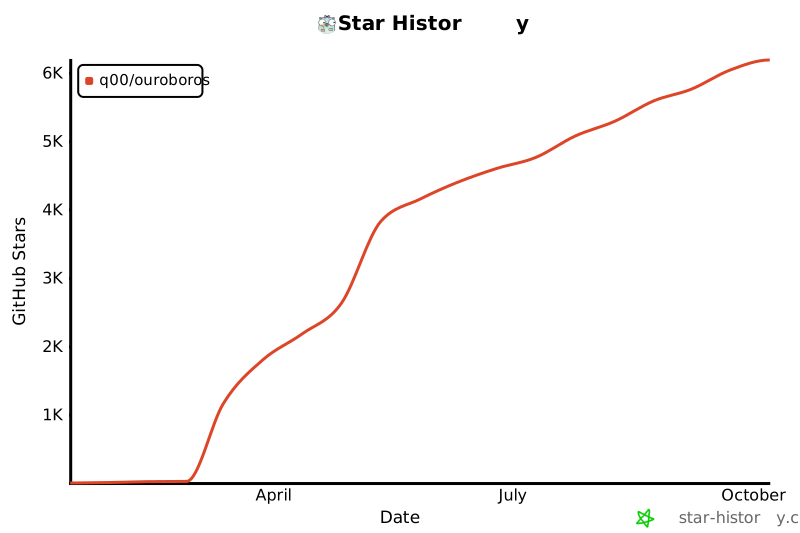
## Star History
 ---
---
"The beginning is the end, and the end is the beginning."
The serpent does not repeat -- it evolves.
MIT License