[English](README.md) | [简体中文](README.zh-CN.md)
# OpenASR
**Turn speech into text, entirely on your device.**
[](LICENSE)

[](https://github.com/QuintinShaw/openasr/actions/workflows/ci.yml)
[](https://github.com/QuintinShaw/openasr/releases)

[](https://github.com/QuintinShaw/openasr/releases)

[Website](https://openasr.org) · [Documentation](docs/DOCS_INDEX.md) · [License](LICENSE)
Pre-v1 — under active development. CLI flags, API surface, and pack format may change between 0.x releases.
---
macOS (Apple Silicon) · Windows (x64, Windows 10+) · Linux desktop coming soon
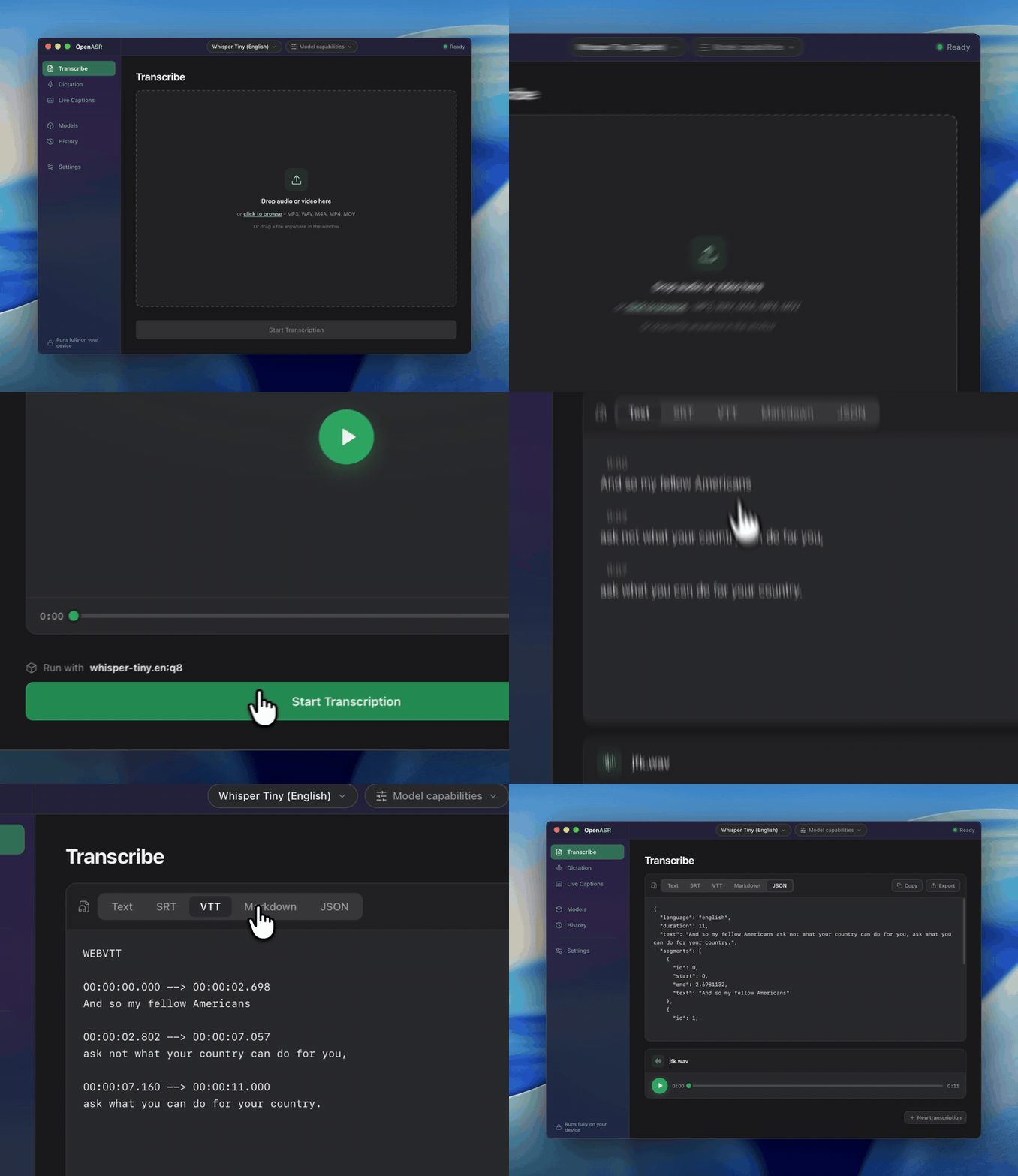
No terminal needed. Install the app, drop in an audio file, and get your transcript — everything runs on your machine.
> This repository is the Apache-2.0 open core behind the desktop app: a Rust CLI, a local OpenAI-compatible HTTP API, and the ggml inference engine. The desktop app wraps the same engine in a native GUI — no hidden network calls.
---
## What it does
- **Transcribe audio files** — single files or entire folders, output as plain text, SRT/VTT subtitles, or JSON with word-level timestamps
- **Live captions** — real-time transcription from your microphone with streaming partial results
- **System audio capture** — caption meetings, lectures, and podcasts by recording what your computer plays
- **Speaker separation** — automatically label who said what
- **Translation** — transcribe and translate to English in one step
- **Local API** — OpenAI-compatible `/v1/audio/transcriptions` endpoint, works with existing SDKs
## Why OpenASR
**Private.** In the default local mode, audio stays on your machine. Remote compute is available only when you explicitly pair and enable it; see [SECURITY.md](SECURITY.md#local-first-security-notes). No telemetry, no silent uploads, and no silent network fallback. The engine either produces a real transcript or tells you why it can't.
**Broad.** 30 models across 16 families — Whisper, Qwen3-ASR, Parakeet, SenseVoice, FireRed, Dolphin, Moonshine, Granite Speech, Fun-ASR-Nano, and more. Pick the one that fits your language and workload. All run through one binary on CPU and Apple Metal.
**Open.** The engine is Apache-2.0. Each model pack ships under its own upstream license as recorded in the registry and pack metadata. Every model download is verified against a signed catalog before it runs.
---
## For developers
### CLI quickstart
```bash
# Option A: Homebrew (macOS / Linux)
brew install quintinshaw/tap/openasr
# Option B: one-line installer (macOS / Linux)
curl -fsSL https://dl.openasr.org/install.sh | sh
# Option C: grab a prebuilt binary from Releases
# https://github.com/QuintinShaw/openasr/releases
# Transcribe a file (first run offers to download a model — you confirm first)
openasr transcribe recording.wav
# Live mic captions
openasr live
# SRT subtitles with speaker labels
openasr transcribe meeting.wav -f srt --diarize
```
See [Quickstart](docs/QUICKSTART.md) for a guided walkthrough, or run `openasr --help`.
### Local API
```bash
openasr serve
curl http://127.0.0.1:8080/v1/audio/transcriptions \
-F file=@audio.wav -F model=qwen3-asr-0.6b
```
Drop-in compatible with OpenAI SDKs (`base_url="http://127.0.0.1:8080/v1"`). Offline native requests are serial by default. Operators can set `--max-native-sessions-per-model N`; `N` is both the admission limit and, for eligible direct-GPU Cohere, Moonshine, Qwen, and Whisper jobs, the source for an internal batch width capped at 8. CPU, scheduler, adapter, realtime, FireRed-AED, and FireRed2 paths remain serial; translations follow the offline policy. See [Agent Integration](docs/AGENT_INTEGRATION.md) for API key setup and agent workflows.
### Docker
Published images track each core release on
[Docker Hub](https://hub.docker.com/r/quintinshaw/openasr) (binary +
model-registry metadata only; pull models at runtime into a volume mounted at
`/data`). The HTTP server never auto-downloads a pack — install one first:
```bash
docker pull quintinshaw/openasr:latest
docker run --rm -d --name openasr \
-p 8080:8080 -v openasr-data:/data quintinshaw/openasr:latest
docker exec openasr openasr pull whisper-small --yes
# NVIDIA GPU (requires NVIDIA Container Toolkit; sm_75 / Turing+)
docker pull quintinshaw/openasr:cuda-latest
docker run --rm -d --name openasr-cuda --gpus all \
-p 8080:8080 -v openasr-data:/data quintinshaw/openasr:cuda-latest
```
| Tag | Platforms | Notes |
| --- | --- | --- |
| `latest`, ``, `sha-` | `linux/amd64`, `linux/arm64` | CPU |
| `cuda-latest`, `cuda-`, `cuda-sha-` | `linux/amd64` | CUDA 13.2 runtime; fail-closed if no GPU is visible |
Vulkan, ROCm, and musl builds ship as GitHub Release archives only (not as
images). Local source builds: `Dockerfile` / `Dockerfile.cuda` and
`compose.yaml`. Longer guide (tags, compose, networking):
[openasr.org/docs/docker](https://openasr.org/docs/docker/).
### Building from source
```bash
git clone --recurse-submodules https://github.com/QuintinShaw/openasr.git
cd openasr
cargo build --release -p openasr-cli
```
Requires Rust (pinned via `rust-toolchain.toml`), CMake, and a C/C++ toolchain. Full build setup and development workflow in [CONTRIBUTING.md](CONTRIBUTING.md).
## Models
30 models across 16 families, from tiny English-only models that run faster than real-time to large multilingual models covering 100+ languages. Browse them at [openasr.org/models](https://openasr.org/models/) or from the CLI:
```bash
openasr search # browse available models
openasr pull whisper-small # install one
```
Benchmarks from the committed performance baseline are in [Performance](perf/PERFORMANCE.md).
## Documentation
| | |
|---|---|
| [Docs Index](docs/DOCS_INDEX.md) | Full documentation map |
| [Quickstart](docs/QUICKSTART.md) | First transcript in three commands |
| [FAQ](docs/FAQ.md) | Common questions answered |
| [Known Limitations](docs/KNOWN_LIMITATIONS.md) | What works and what does not yet |
| [Roadmap](docs/ROADMAP.md) | What is planned next |
| [Architecture](ARCHITECTURE.md) | Crate map and transcription pipeline |
## Contributing
Contributions welcome. See [CONTRIBUTING.md](CONTRIBUTING.md) for build setup, branch naming, the PR checklist, and DCO sign-off.
## License
[Apache License 2.0](LICENSE). See [NOTICE](NOTICE) for attribution.
The ggml inference backend is MIT-licensed. Each model pack's license is defined by its registry entry and pack metadata; packs may use Apache-2.0, MIT, CC-BY, FunASR, or other upstream terms. This is not an exhaustive license guarantee. See [ACKNOWLEDGMENTS.md](ACKNOWLEDGMENTS.md) for the projects and model authors OpenASR builds on.
## Trademarks and branding
The OpenASR name, logo, and official app icons are reserved. Apache-2.0 covers the code, not the brand. Third-party products may say **“Powered by OpenASR”** and must not use OpenASR as their primary product name or imply official endorsement. Official apps are published only by the project operators.
- [TRADEMARKS.md](TRADEMARKS.md) — name, logo, and official-app reservation
- [BRANDING.md](BRANDING.md) — practical product-identity checklist
- [XCFRAMEWORK-DISTRIBUTION.md](XCFRAMEWORK-DISTRIBUTION.md) — shipping iOS/macOS apps that embed the SDK