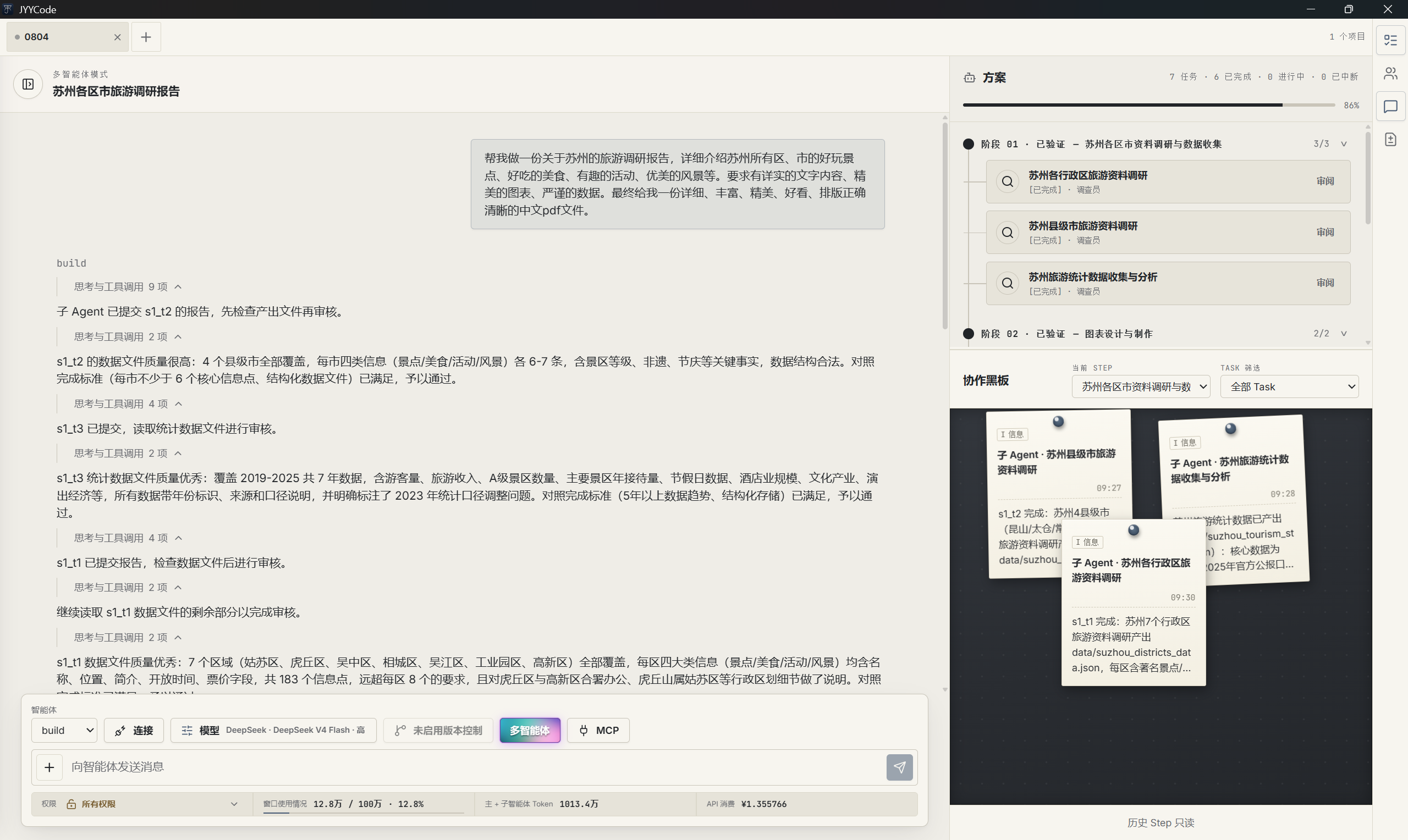
The desktop app in multi-agent mode: the root agent reviews child reports one by one while the plan panel tracks step progress and the blackboard collects findings and handoffs from every sub-agent.
**Desktop install:** https://github.com/Reon-Jin/JYY-Code/releases ## Why JYY-Code is different JYY-Code does not assume an LLM will reliably remember the plan, coordinate peers, enforce quality, isolate concurrent edits, or recover itself after a crash. Those responsibilities are moved into the **runtime**. | Problem | JYY-Code moves it out of the prompt and into... | | -------------------- | ---------------------------------------------------------------------------------------- | | Planning | A revisioned Plan with staged Steps, explicit dependencies and judgeable `done_criteria` | | Execution | A strict Task state machine and protocol-enforced dispatch | | Parallelism | Batched waves of isolated sub-agents, up to 20 per wave | | Quality control | Report → review → reject/redispatch as a mandatory gate | | Integration | Worktree/snapshot isolation plus explicit `Merge.apply` | | Coordination | A typed shared blackboard with read cursors and event wakeups | | Route selection | Candidate competition with blind proposals, cross-review and final synthesis | | Long-task continuity | Layered context, episodic digests and structured persistent memory | | Crash recovery | Durable events, rebuildable projections, activation leases and reconciliation | The result is not “one agent with more tools”. It is an **engineering runtime that gives agents boundaries, shared state, recovery semantics and a reviewable execution protocol**. ## 1. Protocol-enforced engineering loop The core workflow is enforced by tools and state transitions, not by asking agents to cooperate in natural language. ```text Plan_create → Plan_update(add_task) → Dispatch_dispatch → Report → review_task(approve) → Merge.apply → merged → cleanup ↑ ↓ └──────────── reject + concrete feedback → redispatch ──────────┘ ``` - **Plans evolve with understanding.** Work is organized into Steps. Each Step has observable `done_criteria`; later Steps expand only after the current one is reviewed. - **Task state is not conversational.** A Task moves through a controlled lifecycle such as `pending → dispatched → running → reported → approved / rejected / dismissed`; illegal transitions are rejected by the runtime. - **Review is a gate, not a suggestion.** The root agent must check the report and relevant artifacts against `done_criteria`. Rejection requires a concrete gap, and that feedback is automatically injected into the next dispatch. - **Children cannot rewrite orchestration state.** Standard child sessions report results; they do not mutate the parent Plan. - **Exceptions are durable work items.** Failed pre-checks, cancelled children and runtime failures enter the Inbox instead of disappearing inside model text. This turns “agent collaboration” from a prompt convention into a stateful protocol. ## 2. Parallelism without workspace chaos JYY-Code is designed to parallelize real engineering work without letting concurrent agents overwrite one another. - **Protocol-level parallelization.** Ready Tasks in the same wave are batch-dispatched instead of being slowly trickled out one by one. A wave can run **up to 20 sub-agents in parallel**. - **Forced decomposition check.** For medium and large tasks, the planner must inspect independent deliverables, modules, research questions, verification surfaces and role expertise before accepting a mostly-serial plan. - **Isolated execution.** Git projects use isolated Worktrees for standard Tasks; non-Git projects use writable snapshot workspaces. Shared-main-workspace execution is an explicit compatibility mode, not the default. - **Review does not imply integration.** An approved child result still does not silently rewrite the parent workspace. The root agent explicitly integrates it through `Merge.apply`. - **Conflicts remain decisions.** Non-overlapping changes can merge automatically; real conflicts are surfaced for explicit resolution instead of applying a hidden “prefer child” policy. - **Zero polling while children run.** The root suspends after dispatch and wakes on Report, Inbox or blackboard events, avoiding token-burning wait loops. Parallel execution, isolation, review and merge are one continuous protocol rather than separate best-effort behaviors. ## 3. A durable runtime, not a fragile process Long-running agent systems fail when process memory is treated as the source of truth. JYY-Code separates **durable state** from **live process activity**. - **EventV2 is the durable session source of truth.** Session changes are written to a versioned event log; projections are derived, versioned views that can be rebuilt by replay. - **A child session is a durable identity.** A running process is only the current activation of that child. Ownership is guarded by `owner_id + generation + lease`, so a stale process cannot continue settling or mutating a child after takeover. - **Restart recovery is explicit.** On cold start, the runtime distinguishes persisted rows from actually live workers, reconciles child state, resumes what is safe, and turns unrecoverable work into visible rejection/Inbox state. - **Runtime streams are not mistaken for persistence.** In-memory subscriptions and notifications can disappear; durable events remain the recovery boundary. - **Recovery paths are designed for replay and audit.** Projection watermarks, bounded recovery metadata and copy-first/resumable storage operations make corruption and migration failures inspectable instead of silent. This matters most on the tasks where coding agents usually become least reliable: long sessions, many children, crashes, restarts and partial failures. ## 4. Shared blackboard: agents can actually coordinate Parallel agents are not isolated chat windows. Each Step has a shared blackboard used by the user, root agent and sub-agents. - Typed messages: `info / risk / blocker / decision / help` - @mentions, attachments, threaded replies and Task links - Independent read cursors and live unread state for every participant - Event-driven wakeups when another agent posts something relevant - Protocol rules against heartbeat/progress spam: the board is for findings, dependencies, handoffs and requests for help The root can see child-to-child discussion, intervene directly, and keep coordination outside private prompt histories. ## 5. Candidate mode: compete before committing When the correct route is genuinely uncertain, JYY-Code can run a controlled competition instead of letting the root agent make an early guess. 1. **Blind declaration** — 2–3 candidates independently state their approach, assumptions, risks and differentiator. 2. **Cross-review** — candidates critique each other through the blackboard before execution. 3. **Independent proposal** — each candidate develops its route in isolation. 4. **Synthesis and verdict** — the root produces a synthesis artifact, chooses exactly one winner and records the rationale plus useful contributions from runners-up. Candidate mode turns architectural uncertainty into an auditable search process rather than a hidden chain of guesses. ## 6. Context and memory built for long tasks JYY-Code separates short-term working context from durable knowledge instead of treating the entire chat transcript as memory. - **Working context stays bounded.** Full compaction, micro-compaction of completed tool output, reactive emergency compaction and media-aware context estimation prevent long tool-heavy runs from expanding without control. - **Older turns become episodic memory.** Completed turns are recorded and periodically condensed into cumulative digests that can be re-injected or searched later. - **Persistent memory is structured by purpose.** Task state, stable user facts and reusable experience are stored separately rather than mixed into one free-form summary. - **Memory is calibrated before and after execution.** The user-input phase updates what the system currently understands; the assistant-completion phase corrects that state with what actually happened and extracts reusable lessons. - **Persistent writes are controlled.** Root sessions own task/user memory writes; child agents can read relevant context and experience without racing to rewrite shared long-term memory. - **Capacity is a system property.** Entries have schema, importance, keywords, deduplication and deterministic compaction instead of unbounded “remember everything” accumulation. The objective is not maximum history retention. It is **stable reasoning state across long sessions and new sessions without letting old noise dominate the prompt**. ## 7. Capability boundaries instead of blind trust JYY-Code deliberately limits what different actors can mutate. - Child agents cannot rewrite the parent Plan. - Task output paths are constrained to the intended workspace and checked against traversal/escape cases. - Standard child work is isolated until an explicit merge. - Sub-agent tool access is governed independently from the root agent. - Durable session state is owned by the privileged runtime; external extensions may consume documented events but cannot append to the durable event log or directly mutate projection tables. These boundaries reduce the blast radius of a bad sub-agent decision and make orchestration state harder to corrupt accidentally. ## Quick Start ### Install End users only need Node.js 20+ and npm; Bun is required only for source development. ```bash npm install -g jyycode-ai cd /path/to/your/project jyy ``` Inside JYY-Code, run `/connect` to configure a model provider. `jyy` and `jyycode` are the same CLI. The terminal directory you launch from becomes the agent workspace. ### Configuration Global config: `~/.config/jyycode/jyycode.jsonc` ```jsonc { "$schema": "https://jyycode.ai/config.json", "model": "openai/gpt-5", "provider": { "openai": { "options": { "apiKey": "sk-...", }, }, }, } ``` Project config lives at `.jyycode/jyycode.jsonc`. Core extension points include `provider`, `permission`, `subagents`, `mcp`, `skills` and `plugin`. ## Architecture at a glance ```text packages/jyycode/ Agent runtime, plans, sessions, memory, tools and TUI packages/core/ Filesystem, providers and shared runtime utilities packages/llm/ LLM protocol and runtime adapters packages/plugin/ Plugin SDK and extension interfaces packages/sdk/ HTTP/OpenAPI client SDK packages/app/ Desktop web UI packages/desktop/ Tauri desktop shell and sidecar packaging packages/relay/ End-to-end-encrypted mobile relay packages/mobile-web/ Mobile web / PWA client .jyycode/ Project agents, skills, commands, themes and config ``` Foundation: Bun + TypeScript, Effect-based services, Drizzle ORM + SQLite (WAL), Turbo monorepo and oxlint. Useful architecture references: - [Session EventV2 source of truth](docs/architecture/session-event-source.md) - [Process runtime](docs/architecture/process-runtime.md) - [Session storage operations](docs/operations/session-storage.md) - [Plan workspace operations](docs/operations/plan-workspaces.md) - [Testing and replay](docs/architecture/testing-and-replay.md) ## Develop from Source ```bash git clone https://github.com/Reon-Jin/JYY-Code.git cd JYY-Code bun install bun run dev ``` For source validation: ```bash bun run check:ci && bun run verify:generated ``` ## Downloads Windows installers, checksums and update manifests are published on the [GitHub Releases page](https://github.com/Reon-Jin/JYY-Code/releases). ## Privacy JYY-Code stores application data locally and connects only to services you explicitly configure or invoke. See the [privacy policy](PRIVACY.md). ## License MIT © [JYYCode](https://github.com/Reon-Jin/JYY-Code)