# HAMCTRL
**[English](#english) | [Polski](#polski)**
---
## English
A free, self-hosted web application for remote control of an amateur
radio transceiver — tuning, modes, PTT, rotator, DX cluster, QSO log —
**plus a complete, independent FT8/FT4 digital-mode engine (decoder and
encoder) built from scratch, with no dependency on WSJT-X or JTDX.**
Runs on a Windows PC connected to the radio (reference/tested model:
**Icom IC-7300**) and serves a web UI to any browser on the local network
or, with tunneling configured, over the internet — multiple operators can
share one physical radio, with an ownership/lock system so only one
person transmits at a time.
### Screenshots
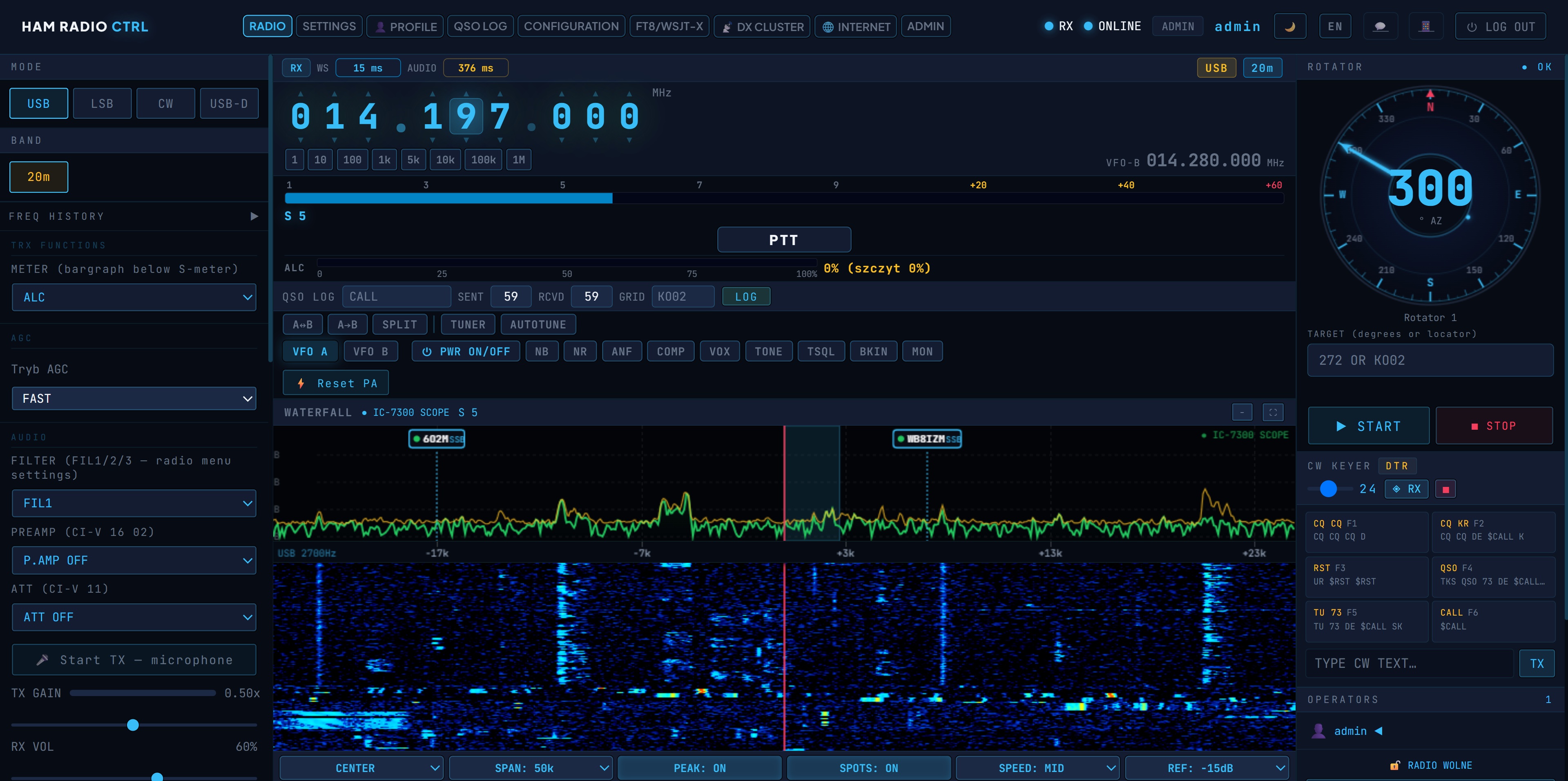
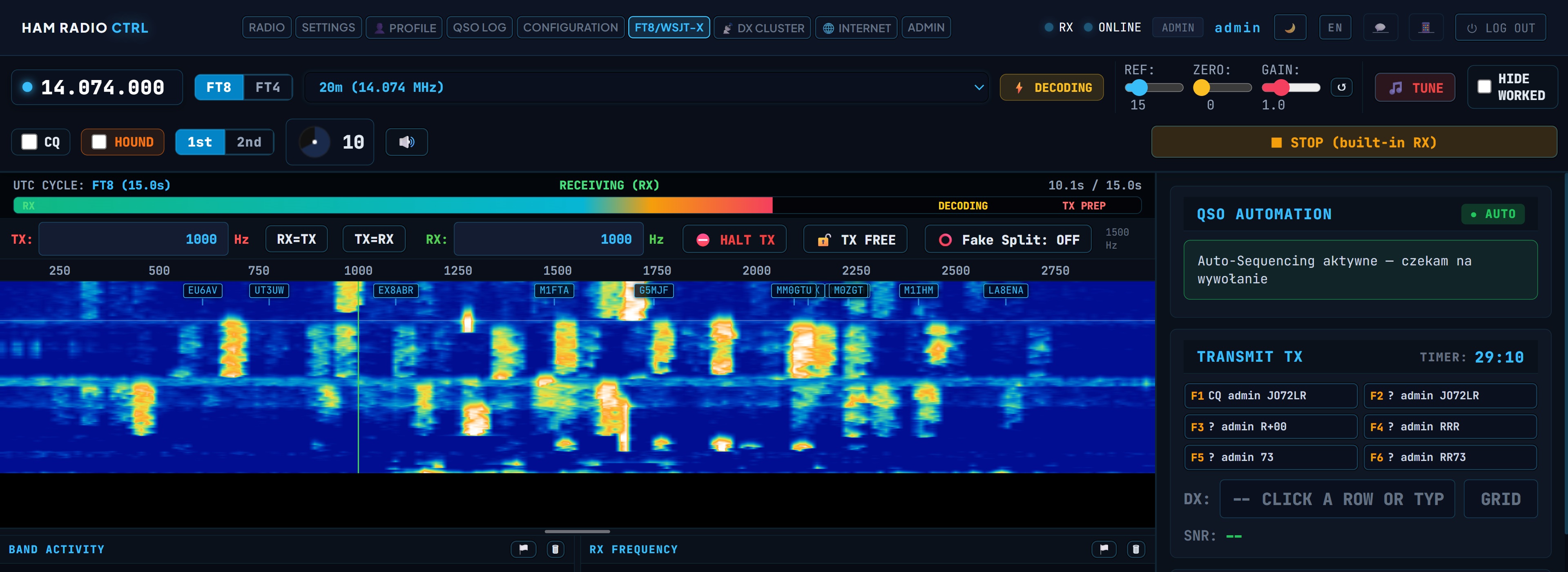
| Radio control | FT8/FT4 |
|---|---|
|  |  |
| QSO log |
|---|
| 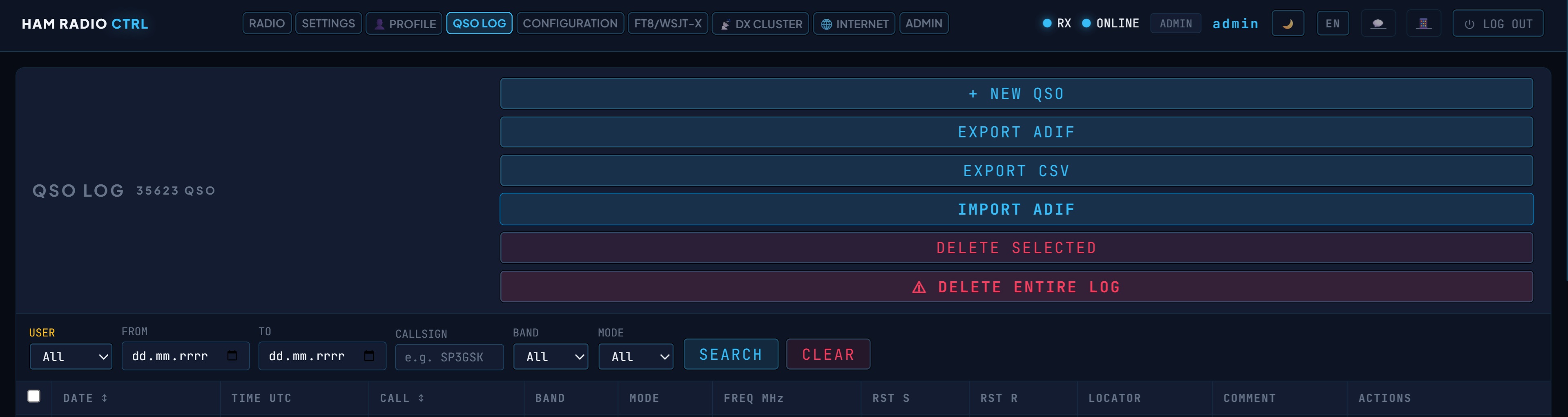 |
*(Live session with a real IC-7300 connected — current UI as of October 2026.)*
### Features
- CI-V radio control: VFO A/B, mode, filters, sliders, band scope + waterfall
- Own FT8/FT4 decoder (Rust, real-time) and encoder (Python) — no WSJT-X/JTDX
- Full auto-QSO engine: Call 1st queue, Hound mode (for working Fox/DXpedition stations), MSHV multistream support
- CW keyer with a DeepCW audio-to-text assist layer
- Rotator control (Yaesu GS-232A / SPID protocol)
- DX cluster client
- QSO log with CloudLog/WaveLog push, ADIF import/export
- COM-port bridge for third-party CI-V software (CW Skimmer, Ham Radio Deluxe, Logger32)
- Low-latency WebRTC audio for SSB voice
- Multi-user accounts, role-based permissions, shared-radio lock/queue
- Automatic desktop / mobile web UI — a phone browser gets a
touch-optimized layout (VFO, FT8/FT4 with waterfall, CW, QSO log,
rotator, radio-lock/operators panel) at the *same* URL, detected from
the User-Agent; a manual `?ui=mobile` / `?ui=desktop` override is
remembered per browser
- Polish / English UI, auto-detected from the browser's language on
first visit
### System requirements
- **OS: Windows 10 or newer** (64-bit). Not Windows 7/8/8.1 — the bundled
Rust audio/decode engine is compiled with a modern toolchain whose
binaries require Windows 10+ to even start.
- **CPU/RAM:** modest. Measured on a 2012-era 4-core/8-thread laptop CPU
(i7-3612QM @ 2.1GHz) with FT8 decoding and the CW decoder both running
at once: ~17% total CPU, ~250MB total RAM across both HAMCTRL
processes. Any PC from the last ~10 years handles this comfortably.
- A radio with a CI-V (or compatible) interface, connected by USB or a
serial/CAT cable (reference/tested model: Icom IC-7300).
### Quick start
1. Download the installer from the [latest release](../../releases/latest).
2. Run it, follow [INSTALL.md](INSTALL.md) — first-run setup (admin password, radio connection, CI-V settings on the transceiver) is a few steps, not entirely obvious the first time.
3. Log in, connect your radio, open the RADIO or FT8/WSJT-X tab.
### For developers (and AI coding assistants)
See [ARCHITECTURE.md](ARCHITECTURE.md) for the codebase layout, the
FT8/FT4 pipeline, CI-V driver conventions, and the build/release
pipeline — written specifically so a new contributor (human or AI) can
get oriented without reading every file first.
### License
**AGPL-3.0** — free and open source, and it stays that way: anyone can
use, study, and modify this code, but a modified version *run as a
network service* must also make its source available under the same
license. (The plain GPL only requires this when you *distribute* the
software; AGPL closes that gap for a server application like this one —
which is exactly what this is.) See [LICENSE](LICENSE).
### Credits & thanks
- **The FT8/FT4 protocol** was designed by Joe Taylor, K1JT, and the
[WSJT-X](https://wsjt.sourceforge.io/wsjtx.html) development team, and
published openly. HAMCTRL's decoder and encoder are an independent
implementation from that published specification — no WSJT-X/JTDX
source code is used anywhere in this project.
- **Icom** for the publicly documented CI-V protocol this project
controls the radio through.
- **CW decoding** uses the ONNX model from
[e04/web-deep-cw-decoder](https://github.com/e04/web-deep-cw-decoder) —
downloaded on demand, not bundled in this repo.
- Built on: [aiohttp](https://github.com/aio-libs/aiohttp),
[aiortc](https://github.com/aiortc/aiortc) (WebRTC),
[PyInstaller](https://pyinstaller.org/),
[Inno Setup](https://jrsoftware.org/isinfo.php),
and, on the real-time audio side (Rust):
[cpal](https://github.com/RustAudio/cpal),
[tokio](https://github.com/tokio-rs/tokio),
[RustFFT](https://github.com/ejmahler/RustFFT),
[rayon](https://github.com/rayon-rs/rayon), and the
[opus](https://crates.io/crates/opus) codec crate.
- **Written entirely by AI.** Every line of code in this repository —
backend, frontend, the Rust audio engine, this documentation — was
written by Claude (Anthropic), working directly with SQ3MZM, who
operates the station, tests every change on real hardware, and calls
the AI "Franek." No other codebase this project's author has worked on
was built quite like this one.
---
## Polski
Darmowa aplikacja webowa do zdalnego sterowania radiostacją
amatorską — strojenie, tryby pracy, PTT, rotor, DX cluster, log QSO —
**oraz kompletny, własny tor FT8/FT4 (dekoder i enkoder) napisany od
zera, bez żadnej zależności od WSJT-X czy JTDX.**
Działa na komputerze z Windows podłączonym do radia (referencyjny,
przetestowany model: **Icom IC-7300**) i udostępnia panel WWW dowolnej
przeglądarce w sieci lokalnej, a po skonfigurowaniu tunelu — także przez
internet. Kilku operatorów może dzielić jedno fizyczne radio dzięki
systemowi blokady/przejęcia TRX, tak że nadaje zawsze tylko jedna osoba.
### Zrzuty ekranu
| Sterowanie radiem | FT8/FT4 |
|---|---|
|  |  |
| Log QSO |
|---|
|  |
*(Żywa sesja z podłączonym IC-7300 — aktualny interfejs, październik 2026.)*
### Funkcje
- Sterowanie radiem po CI-V: VFO A/B, tryb, filtry, suwaki, scope + wodospad
- Własny dekoder FT8/FT4 (Rust, czas rzeczywisty) i enkoder (Python) — bez WSJT-X/JTDX
- Pełna automatyka QSO: kolejka Call 1st, tryb Hound (do pracy ze stacjami Fox/DXpedycjami), obsługa multistream MSHV
- Klucz CW z warstwą DeepCW (rozpoznawanie CW na tekst wspomagane audio)
- Sterowanie rotorem (protokół Yaesu GS-232A / SPID)
- Klient DX cluster
- Log QSO z wysyłką do CloudLog/WaveLog, import/eksport ADIF
- Mostek COM dla programów CI-V innych producentów (CW Skimmer, Ham Radio Deluxe, Logger32)
- Audio SSB o niskim opóźnieniu przez WebRTC
- Konta wielu użytkowników, uprawnienia wg roli, blokada/kolejka współdzielonego radia
- Automatyczny wybór interfejsu desktop / mobile — przeglądarka na
telefonie dostaje dotykowy layout (VFO, FT8/FT4 z wodospadem, CW, log
QSO, rotor, panel blokady radia/operatorów) pod *tym samym* adresem,
wykrywany po User-Agent; ręczne wymuszenie `?ui=mobile` / `?ui=desktop`
zapamiętywane per przeglądarka
- Interfejs w języku polskim i angielskim, wykrywany automatycznie z
języka przeglądarki przy pierwszej wizycie
### Wymagania systemowe
- **System: Windows 10 lub nowszy** (64-bit). Nie Windows 7/8/8.1 —
dołączony silnik audio/dekodera w Rust jest budowany nowoczesnym
toolchainem, którego pliki .exe wymagają Windows 10+ żeby w ogóle
wystartować.
- **CPU/RAM:** niewiele. Zmierzone na 4-rdzeniowym/8-wątkowym laptopie
sprzed ~13 lat (i7-3612QM @ 2.1GHz) przy jednoczesnym dekodowaniu FT8 i
pracy dekodera CW: ~17% CPU łącznie, ~250MB RAM łącznie dla obu
procesów HAMCTRL. Każdy komputer z ostatnich ~10 lat poradzi sobie bez
problemu.
- Radio z interfejsem CI-V (lub kompatybilnym), podłączone przez USB lub
kabel szeregowy/CAT (model referencyjny/testowany: Icom IC-7300).
### Szybki start
1. Pobierz instalator z [najnowszego wydania](../../releases/latest).
2. Uruchom, postępuj wg [INSTALL.md](INSTALL.md) — pierwsze uruchomienie (hasło admina, podłączenie radia, ustawienia CI-V w samym radiu) to kilka kroków, niekoniecznie oczywistych za pierwszym razem.
3. Zaloguj się, podłącz radio, otwórz zakładkę RADIO albo FT8/WSJT-X.
### Dla programistów (i AI wspomagających programowanie)
Zobacz [ARCHITECTURE.md](ARCHITECTURE.md) (po angielsku, zgodnie z
resztą kodu) — układ repozytorium, tor FT8/FT4, konwencje sterownika
CI-V, pipeline buildu i wydania.
### Licencja
**AGPL-3.0** — w pełni otwarty kod, i tak ma zostać: każdy może używać,
czytać i modyfikować ten kod, ale zmodyfikowana wersja **uruchomiona jako
usługa sieciowa** też musi udostępniać swoje źródło na tej samej
licencji. (Zwykła GPL wymaga tego tylko przy dystrybucji software'u —
AGPL domyka tę lukę dla aplikacji serwerowej, a tym właśnie jest
HAMCTRL). Zobacz [LICENSE](LICENSE).
### Podziękowania
- **Protokół FT8/FT4** zaprojektował Joe Taylor, K1JT, wraz z zespołem
[WSJT-X](https://wsjt.sourceforge.io/wsjtx.html), i opublikował go
otwarcie. Dekoder i enkoder w HAMCTRL to niezależna implementacja na
podstawie tej opublikowanej specyfikacji — w tym projekcie nie ma ani
linijki kodu z WSJT-X/JTDX.
- **Icom** za publicznie udokumentowany protokół CI-V, przez który ten
projekt steruje radiem.
- **Dekodowanie CW** korzysta z modelu ONNX z
[e04/web-deep-cw-decoder](https://github.com/e04/web-deep-cw-decoder) —
pobieranego na żądanie, nie dołączonego do tego repozytorium.
- Zbudowane na: [aiohttp](https://github.com/aio-libs/aiohttp),
[aiortc](https://github.com/aiortc/aiortc) (WebRTC),
[PyInstaller](https://pyinstaller.org/),
[Inno Setup](https://jrsoftware.org/isinfo.php),
a po stronie audio czasu rzeczywistego (Rust):
[cpal](https://github.com/RustAudio/cpal),
[tokio](https://github.com/tokio-rs/tokio),
[RustFFT](https://github.com/ejmahler/RustFFT),
[rayon](https://github.com/rayon-rs/rayon) oraz kodek
[opus](https://crates.io/crates/opus).
- **Napisane w całości przez AI.** Każda linijka kodu w tym repozytorium —
backend, frontend, silnik audio w Rust, ta dokumentacja — została
napisana przez Claude (Anthropic), pracującego bezpośrednio z SQ3MZM,
który prowadzi stację, testuje każdą zmianę na żywym sprzęcie i nazywa
AI "Frankiem". Żaden inny projekt, przy którym pracował autor tego
repozytorium, nie powstał w ten sposób.