# Moirai-MoE-1.0-R
Our paper [Moirai-MoE: Empowering Time Series Foundation Models with Sparse Mixture of Experts](https://arxiv.org/abs/2410.10469) introduces the first mixture-of-experts time series foundation model.
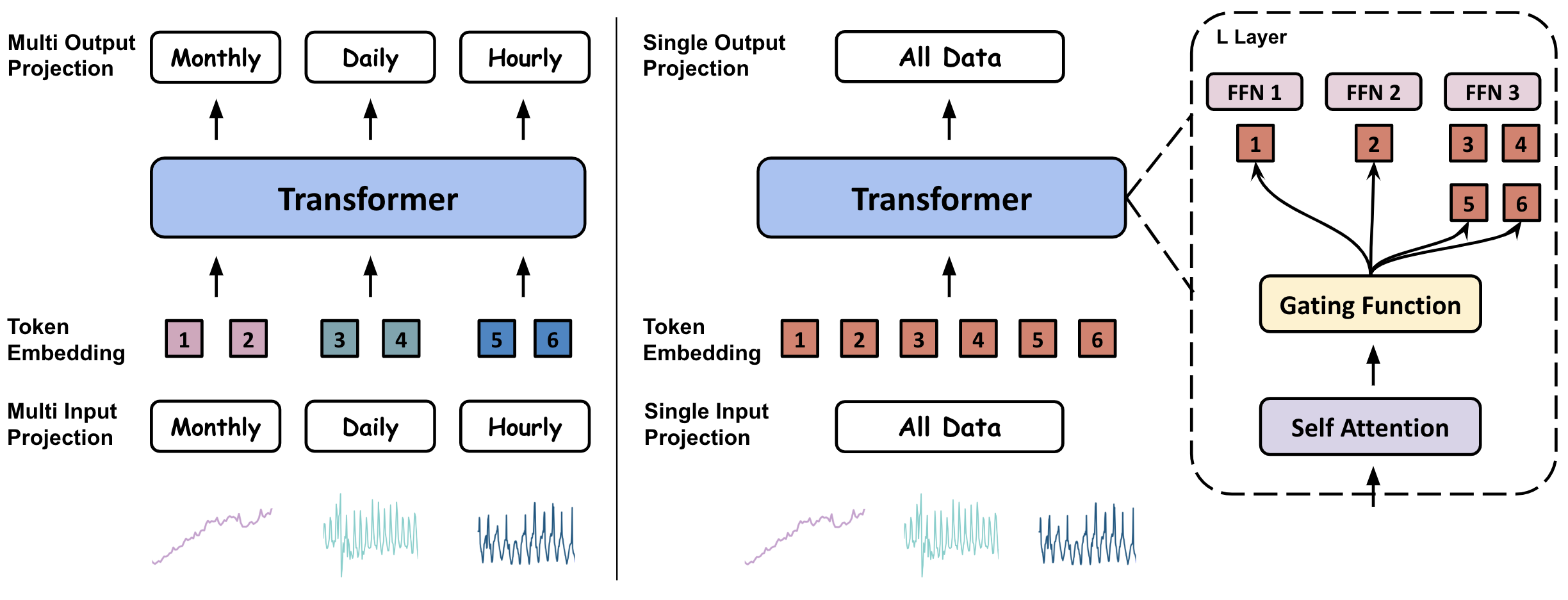
The figure below presents the major difference between Moirai-MoE and Moirai. Compared to Moirai using multi-heuristic-defined input/output projection layers to model time series with different frequencies, Moirai-MoE utilizes a single input/output projection layer while delegating the task of capturing diverse time series patterns to the sparse mixture of experts Transformers. With these designs, the specialization of Moirai-MoE is achieved in a data-driven manner and operates at the token level.
## Models
The pre-trained weights of Moirai-MoE can be found in the following table.
| Model | # Activated Parameters | # Total Parameters |
| :---: | :---: | :---: |
| [Moirai-MoE-1.0-R-Small](https://huggingface.co/Salesforce/moirai-moe-1.0-R-small) | 11m | 117m |
| [Moirai-MoE-1.0-R-Base](https://huggingface.co/Salesforce/moirai-moe-1.0-R-base) | 86m | 935m |
## Usage
Let's see a simple example below on how to use pre-trained Moirai-MoE models to make forecasts. See also the notebooks in the [example folder](https://github.com/SalesforceAIResearch/uni2ts/tree/main/example) to try out Moirai-MoE.
```python
import matplotlib.pyplot as plt
from gluonts.dataset.repository import dataset_recipes
from uni2ts.eval_util.data import get_gluonts_test_dataset
from uni2ts.eval_util.plot import plot_next_multi
from uni2ts.model.moirai_moe import MoiraiMoEForecast, MoiraiMoEModule
SIZE = "small" # model size: choose from {'small', 'base'}
CTX = 1000 # context length: any positive integer
BSZ = 32 # batch size: any positive integer
# Load dataset
test_data, metadata = get_gluonts_test_dataset(
"electricity", prediction_length=None, regenerate=False
)
# Uncomment the below line to find other datasets
# print(sorted(dataset_recipes.keys()))
# Prepare model
model = MoiraiMoEForecast(
module=MoiraiMoEModule.from_pretrained(
f"Salesforce/moirai-moe-1.0-R-{SIZE}",
),
prediction_length=metadata.prediction_length,
context_length=CTX,
patch_size=16,
num_samples=100,
target_dim=metadata.target_dim,
feat_dynamic_real_dim=metadata.feat_dynamic_real_dim,
past_feat_dynamic_real_dim=metadata.past_feat_dynamic_real_dim,
)
predictor = model.create_predictor(batch_size=BSZ)
forecasts = predictor.predict(test_data.input)
input_it = iter(test_data.input)
label_it = iter(test_data.label)
forecast_it = iter(forecasts)
# Visualize forecasts
fig, axes = plt.subplots(nrows=2, ncols=3, figsize=(25, 10))
plot_next_multi(
axes,
input_it,
label_it,
forecast_it,
context_length=200,
intervals=(0.5, 0.9),
dim=None,
name="pred",
show_label=True,
)
```
## Results
Extensive experiments on 39 datasets demonstrate the superiority of Moirai-MoE over existing foundation models in both in-distribution and zero-shot scenarios.
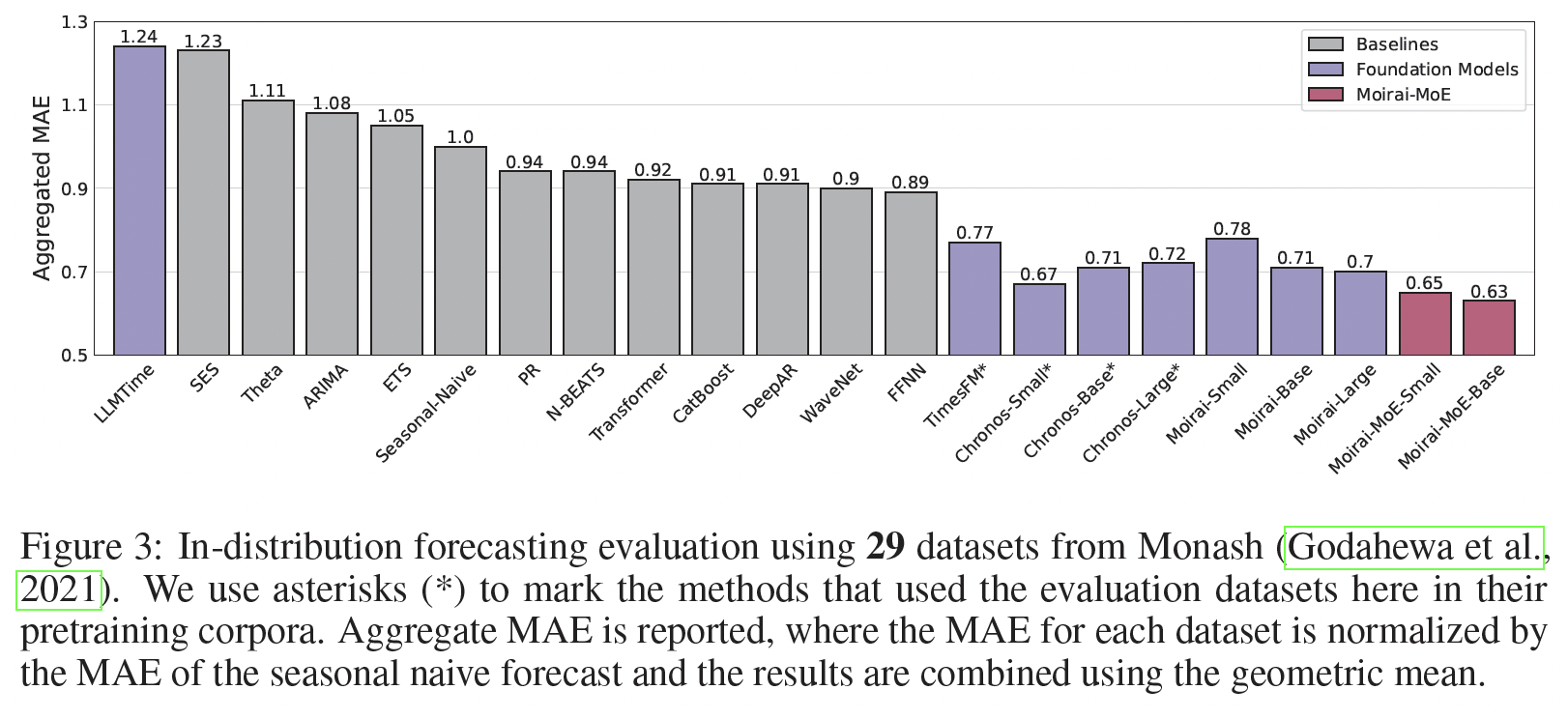
The above figure presents the in-distribution evaluation using a total of 29 datasets from the Monash benchmark. The evaluation results show that Moirai-MoE beats all competitors.
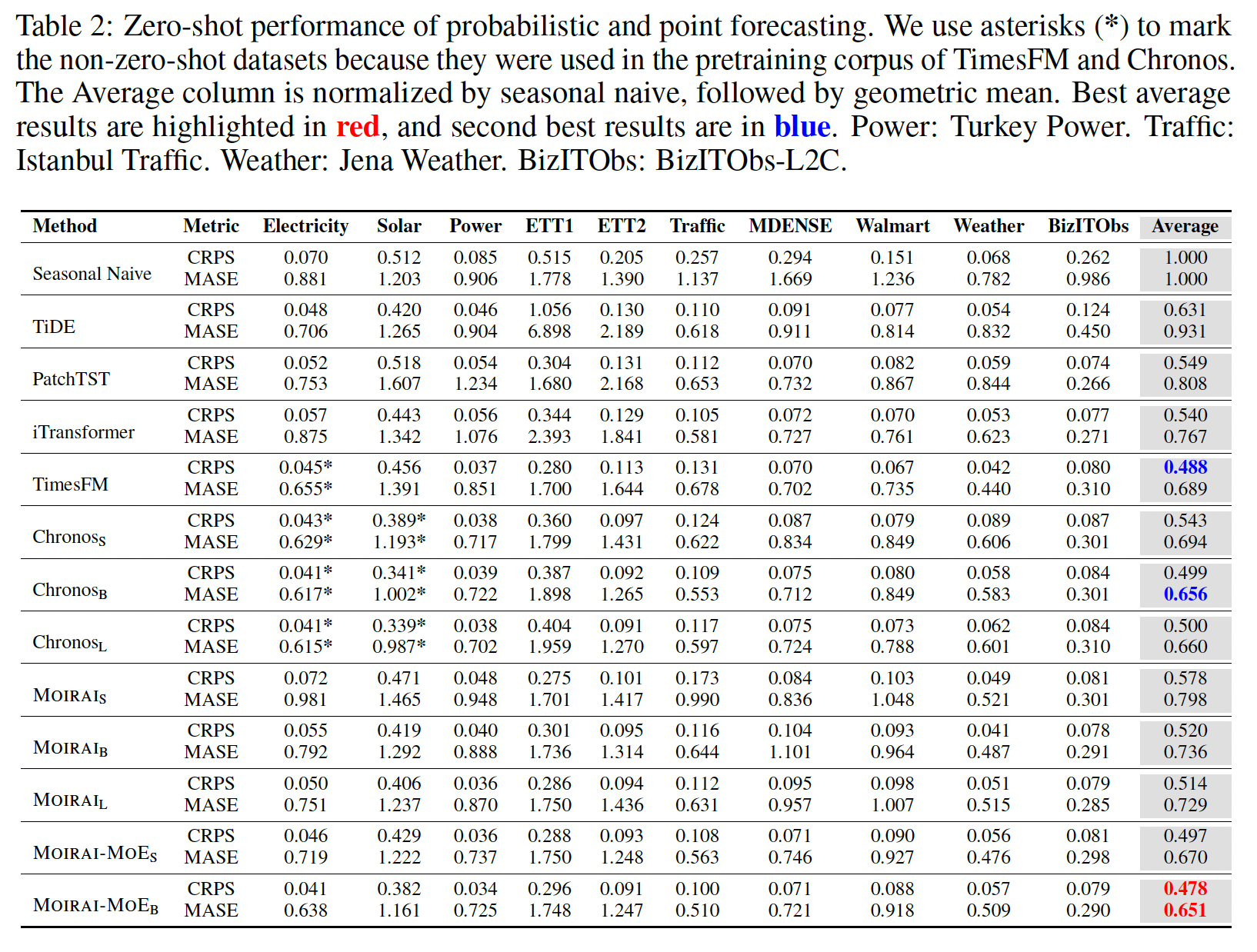
The above table shows a zero-shot forecasting evaluation on 10 datasets and Moirai-MoE-Base achieves the best zero-shot performance.
We will soon release scripts to reproduce the results.