# Meissa: Multi-modal Medical Agentic Intelligence




> [Paper](https://arxiv.org/abs/2603.09018) | [Model (HuggingFace)](https://huggingface.co/CYX1998/Meissa-4B) | [Dataset (HuggingFace)](https://huggingface.co/datasets/CYX1998/Meissa-SFT)
---
## Overview
Multi-modal large language models (MM-LLMs) have shown strong performance in medical image understanding and clinical reasoning. Recent medical agent systems extend them with tool use and multi-agent collaboration, enabling complex decision-making beyond single-pass inference. However, these systems rely on proprietary frontier models (GPT, Gemini), whose API-based deployment incurs high cost, high latency, and privacy risks.
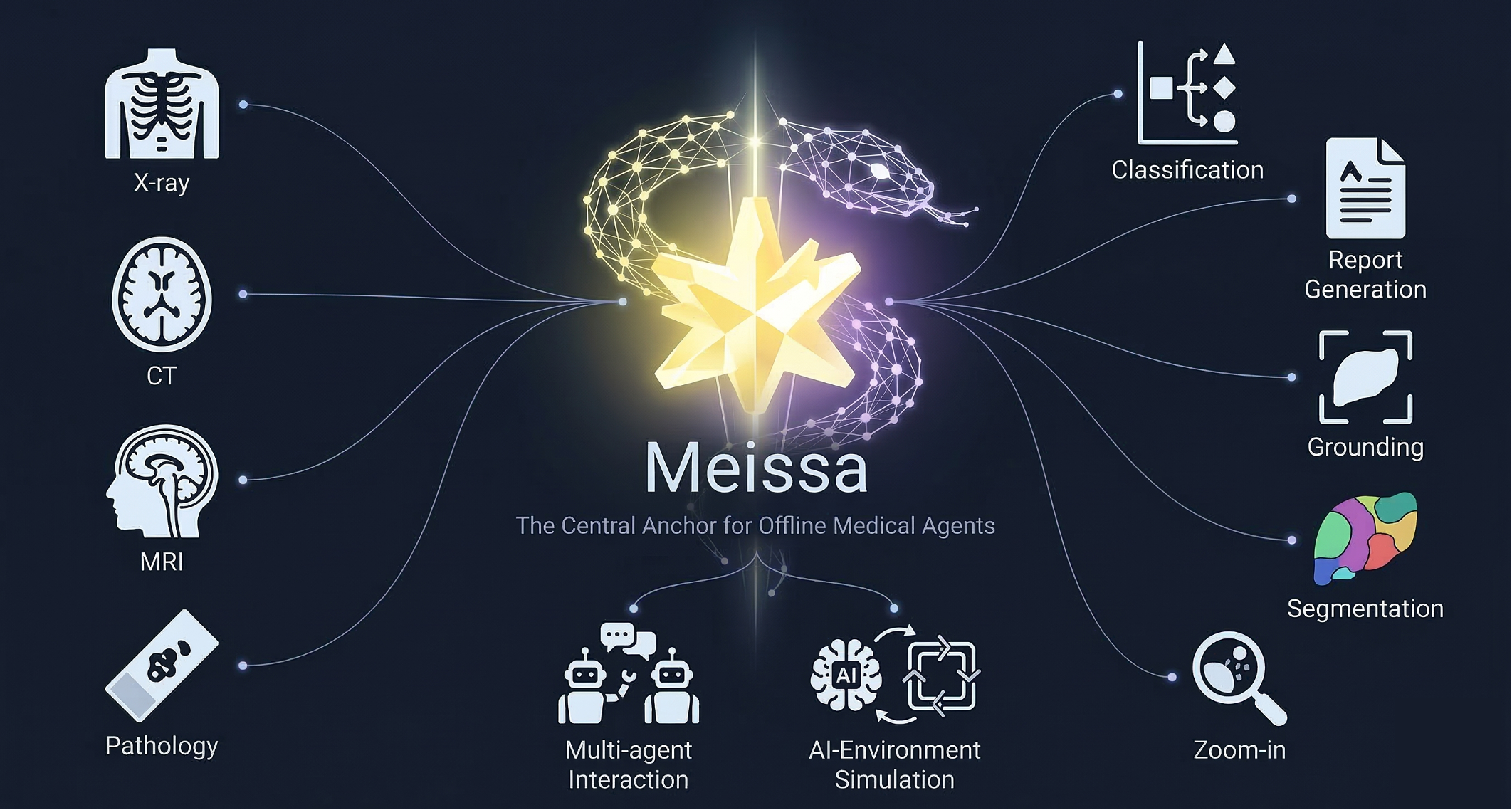
**Meissa** is a lightweight **4B-parameter** medical MM-LLM that brings full agentic capability **offline**. Instead of imitating static answers, Meissa learns both *when* to engage external interaction (strategy selection) and *how* to execute multi-step interaction (strategy execution) by distilling structured trajectories from frontier agent systems.
**Three core contributions:**
1. **Unified trajectory modeling**: trajectories (reasoning and action traces) are represented within a single state–action–observation formalism, allowing one model to generalize across heterogeneous medical environments.
2. **Three-tier stratified supervision**: the model's own errors trigger progressive escalation from direct reasoning to tool-augmented and multi-agent interaction, explicitly learning difficulty-aware strategy selection.
3. **Prospective–retrospective supervision**: pairing exploratory forward traces with hindsight-rationalized execution traces enables stable learning of effective interaction policies.
Trained on ~40K curated trajectories, Meissa **matches or exceeds proprietary frontier agents in 10 of 16 evaluation settings** across 13 medical benchmarks spanning radiology, pathology, and clinical reasoning. With **~25× fewer parameters** than Gemini-3, Meissa operates fully offline with **~22× lower end-to-end latency** compared to API-based deployment.
---
## News
- **[2026-03-12]** Code, model, and data released.
---
## Agent Environments
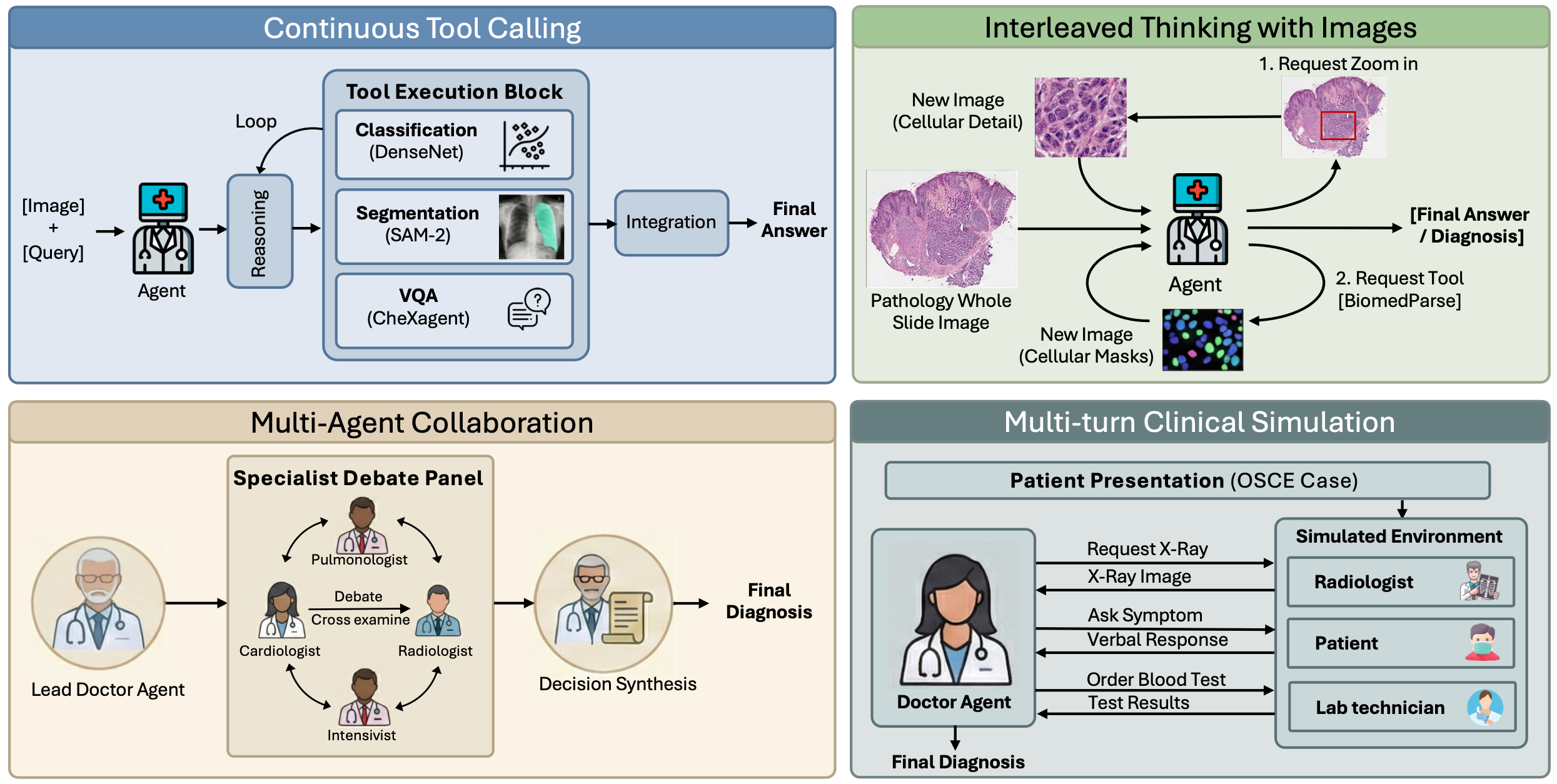
Meissa unifies four heterogeneous medical agent paradigms:
| Framework | Paradigm | Key Benchmark | Related Work |
|-----------|----------|---------------|--------------|
| **I. Continuous Tool Calling** | Sequential invocation of 8 radiology tools | MIMIC-CXR-VQA | MedRAX (ICML 2025) |
| **II. Interleaved Thinking with Images** | Multi-round visual tool use with image injection | PathVQA | Ophiuchus, OpenThinkIMG |
| **III. Multi-Agent Collaboration** | Adaptive difficulty routing + multi-agent debate | PubMedQA | MDAgents (NeurIPS 2024 Oral) |
| **IV. Multi-turn Clinical Simulation** | Doctor-patient simulation with exam/test ordering | MIMIC-IV | AgentClinic, MedAgentSim (MICCAI 2025) |
---
## Quickstart
### 1. Installation
```bash
git clone https://github.com/Schuture/Meissa.git
cd Meissa
```
Each framework requires its own conda environment due to conflicting dependencies:
```bash
# Framework I: Continuous Tool Calling
conda create -n medrax python=3.10 && conda activate medrax
pip install -r environments/continuous_tool_calling/requirements.txt
# Framework II: Interleaved Thinking with Images
conda create -n tool-server python=3.10 && conda activate tool-server
pip install -r environments/interleaved_thinking_images/requirements.txt
# Framework III: Multi-Agent Collaboration
conda create -n mdagents python=3.10 && conda activate mdagents
pip install -r environments/multi_agent_collaboration/requirements.txt
# Framework IV: Multi-turn Clinical Simulation
conda create -n medagentsim python=3.10 && conda activate medagentsim
pip install -r environments/clinical_simulation/requirements.txt
# vLLM (shared model server for all frameworks)
conda create -n vllm python=3.10 && conda activate vllm
pip install vllm
```
### 2. Download the Model
```python
from transformers import AutoModelForImageTextToText, AutoProcessor
import torch
model = AutoModelForImageTextToText.from_pretrained("CYX1998/Meissa-4B", torch_dtype=torch.bfloat16, device_map="auto")
processor = AutoProcessor.from_pretrained("CYX1998/Meissa-4B")
```
### 3. Serve the Model with vLLM
Meissa uses [vLLM](https://github.com/vllm-project/vllm) as the inference backend. The `--tool-call-parser hermes` flag is **required** to enable the model's tool-calling ability.
```bash
python -m vllm.entrypoints.openai.api_server \
--model CYX1998/Meissa-4B \
--port 8877 \
--max-model-len 8192 \
--gpu-memory-utilization 0.85 \
--dtype bfloat16 \
--enable-auto-tool-choice \
--tool-call-parser hermes
# Set the endpoint for all frameworks
export OPENAI_BASE_URL="http://127.0.0.1:8877/v1"
export OPENAI_API_KEY="dummy"
```
### 4. (Framework I only) Start External Tool Servers
Framework I's XRayVQATool and XRayPhraseGroundingTool call [CheXagent](https://huggingface.co/StanfordAIMI/CheXagent-2-3b) and [MAIRA-2](https://huggingface.co/microsoft/maira-2) as remote HTTP servers. These are large models that run on separate GPUs. You can deploy them using any standard model serving framework (e.g., vLLM, FastAPI), then point Meissa to them:
```bash
export CHEXAGENT_SERVER_URL="http://:19101"
export MAIRA2_SERVER_URL="http://:19102"
```
If these environment variables are not set, Framework I will fall back to loading the models locally (requires sufficient GPU memory).
### 5. Run Demos
```bash
# Run all 4 frameworks end-to-end (starts vLLM automatically, requires SLURM)
sbatch scripts/test_demo_all.sh
# Or run individual frameworks:
bash scripts/demo_continuous_tool_calling.sh # Framework I
bash scripts/demo_interleaved_thinking_images.sh # Framework II
bash scripts/demo_multi_agent_collaboration.sh # Framework III
bash scripts/demo_clinical_simulation.sh # Framework IV
```
---
## Repository Structure
```
Meissa/
├── meissa/ # Python package
│ └── __init__.py
│
├── environments/
│ ├── continuous_tool_calling/ # Framework I (8 radiology tools)
│ ├── interleaved_thinking_images/ # Framework II (vision tool server)
│ ├── multi_agent_collaboration/ # Framework III (multi-agent debate)
│ └── clinical_simulation/ # Framework IV (doctor-patient sim)
│
├── data/
│ └── sft_samples/ # MIMIC reconstruction instructions (READMEs)
│ ├── continuous_tool_calling/ # MIMIC-CXR-VQA reconstruction
│ └── clinical_simulation/ # MIMIC-IV reconstruction
│
├── training/
│ └── configs/ # LLaMA-Factory training configs
│
├── scripts/ # Demo and evaluation shell scripts
│
│ # Each directory contains its own README.md with detailed documentation
```
---
## Main Results
> Full results with standard deviations and per-category breakdowns are in the [paper](https://arxiv.org/abs/2603.09018).
### Framework I: Continuous Tool Calling
| Model | MIMIC-CXR-VQA | ChestAgentBench |
|-------|:---:|:---:|
| GPT-4o (Direct) | 40.0 | 56.4 |
| Gemini-3-flash (Direct) | 43.6 | 76.2 |
| GPT-4o + MedRAX | 55.6 | 63.1 |
| Gemini-3-flash + MedRAX | 65.0 | 72.7 |
| Qwen3-VL-4B (Agent) | 51.4 | 46.6 |
| **Meissa (Ours)** | **65.2** | **62.8** |
### Framework II: Interleaved Thinking with Images
| Model | PathVQA | SLAKE | VQA-RAD | OmniMedVQA | MedXpertQA |
|-------|:---:|:---:|:---:|:---:|:---:|
| GPT-5 (Direct) | 60.0 | 73.2 | 64.5 | 75.4 | 40.4 |
| Gemini-3-flash (Direct) | 64.3 | 77.7 | 58.8 | 78.0 | 54.4 |
| Gemini-3-flash + OpenThinkIMG | 74.3 | 73.9 | 52.0 | 77.4 | 69.2 |
| Ophiuchus-7B (Agent) | 74.3 | 83.9 | 73.6 | 78.6 | 39.3 |
| Qwen3-VL-4B (Agent) | 65.3 | 55.6 | 51.8 | 38.1 | 23.9 |
| **Meissa (Ours)** | **78.2** | **82.0** | **70.1** | **82.8** | **36.0** |
### Framework III: Multi-Agent Collaboration
| Model | MedQA | PubMedQA | PathVQA | MIMIC-CXR-VQA |
|-------|:---:|:---:|:---:|:---:|
| GPT-4V (Direct) | 75.0 | 61.5 | 57.9 | 40.0 |
| Gemini-3-flash (Direct) | 75.5 | 66.7 | 64.3 | 43.6 |
| GPT-4V + MDAgents | 88.7 | 75.0 | 65.3 | 55.9 |
| Gemini-3-flash + MDAgents | 75.5 | 71.9 | 56.3 | 64.0 |
| Qwen3-VL-4B (Agent) | 59.8 | 57.3 | 65.5 | 54.9 |
| **Meissa (Ours)** | **57.2** | **77.9** | **67.9** | **59.4** |
### Framework IV: Multi-turn Clinical Simulation
| Model | NEJM | NEJM Ext. | MedQA | MedQA Ext. | MIMIC-IV |
|-------|:---:|:---:|:---:|:---:|:---:|
| GPT-4o | 26.7 | 25.8 | 52.8 | 52.3 | 34.4 |
| Gemini-3-flash | 40.0 | 33.3 | 97.9 | 92.3 | 70.6 |
| Llama-3.3-70B | 20.0 | 24.2 | 54.7 | 53.3 | 36.8 |
| Qwen3-VL-4B | 40.0 | 20.8 | 50.5 | 50.0 | 61.1 |
| **Meissa (Ours)** | **46.7** | **23.3** | **49.5** | **46.7** | **84.4** |
---
## Reproduce Main Results
See [scripts/EVALUATION.md](scripts/EVALUATION.md) for full instructions. Quick commands:
```bash
# Evaluate Framework II on PathVQA (no restricted data needed)
bash scripts/eval_interleaved_thinking_images_pathvqa.sh
# Evaluate Framework III on PubMedQA (no restricted data needed)
bash scripts/eval_multi_agent_collaboration_pubmedqa.sh
# For MIMIC-CXR-VQA and MIMIC-IV: see data/README.md for PhysioNet access
bash scripts/eval_continuous_tool_calling_mimic_cxr_vqa.sh # requires MIMIC-CXR
bash scripts/eval_clinical_simulation_mimic_iv.sh # requires MIMIC-IV
```
**GPU requirements:**
| Component | GPU Memory | Notes |
|-----------|-----------|-------|
| vLLM serving (Meissa-4B) | ~16GB | 1 GPU, shared across all frameworks |
| CheXagent server | ~20GB | 1 GPU, Framework I only |
| MAIRA-2 server | ~28GB | 1 GPU, Framework I only |
| Training (LoRA SFT) | 8×48GB | ~12h on A6000 |
---
## Data
See [data/README.md](data/README.md) for complete instructions.
### Evaluation Benchmarks
| Dataset | Domain | Link | Access |
|---------|--------|------|--------|
| [MIMIC-CXR-VQA](https://physionet.org/content/mimic-ext-mimic-cxr-vqa/) | Radiology VQA | PhysioNet | Credentialed |
| [ChestAgentBench](https://github.com/bowang-lab/MedRAX) | Radiology (multi-task) | GitHub | Open |
| [PathVQA](https://huggingface.co/datasets/flaviagiammarino/path-vqa) | Pathology VQA | HuggingFace | Open |
| [SLAKE](https://huggingface.co/datasets/mdwiratathya/SLAKE-vqa-english) | Medical VQA | HuggingFace | Open |
| [VQA-RAD](https://huggingface.co/datasets/flaviagiammarino/vqa-rad) | Radiology VQA | HuggingFace | Open |
| [OmniMedVQA](https://huggingface.co/datasets/OpenGVLab/OmniMedVQA) | Medical VQA | HuggingFace | Open |
| [MedXpertQA](https://huggingface.co/datasets/TsinghuaMedInfo/MedXpertQA) | Expert medical QA | HuggingFace | Open |
| [MedQA](https://huggingface.co/datasets/bigbio/med_qa) | USMLE-style QA | HuggingFace | Open |
| [PubMedQA](https://huggingface.co/datasets/qiaojin/PubMedQA) | Biomedical research QA | HuggingFace | Open |
| [NEJM / MedQA / MIMIC-IV for Simulation](https://huggingface.co/ItsMaxNorm/MedAgentSim-datasets) | Clinical simulation | Huggingface | Open |
### Training Data
| Data Type | Source | Access |
|-----------|--------|--------|
| SFT trajectories (25,018 samples) | [CYX1998/Meissa-SFT](https://huggingface.co/datasets/CYX1998/Meissa-SFT) | Open |
| SFT trajectories (MIMIC, 18,192 samples) | Reconstructible via scripts | Requires PhysioNet |
**Total training samples:** 43,210 (three-tier stratified: 8.2K direct + 9.8K enhanced + 23.9K agentic)
---
## Training
See [training/README.md](training/README.md) for full instructions.
The released model is trained with [LLaMA-Factory](https://github.com/hiyouga/LLaMA-Factory) using LoRA on Qwen3-VL-4B-Instruct.
```bash
# Requires LLaMA-Factory installation and dataset_info.json registered datasets
llamafactory-cli train training/configs/train_qwen3vl_meissa_combined.yaml
```
---
## Medical Disclaimer
**Meissa is a research prototype and is NOT intended for clinical use.** The model may produce incorrect or hallucinated medical information. Do not use it for diagnosis, treatment, or any clinical decision-making.
---
## License
- **Code**: [Apache 2.0](LICENSE)
- **Model weights**: Subject to the [Qwen License](https://huggingface.co/Qwen/Qwen3-VL-4B-Instruct/blob/main/LICENSE) in addition to Apache 2.0
- **SFT data**: Subject to the original dataset licenses (PathVQA, PubMedQA, SLAKE, VQArad)
---
## Citation
If you find Meissa useful, please cite:
```bibtex
@article{chen2026meissa,
title={Meissa: Multi-modal Medical Agentic Intelligence},
author={Chen, Yixiong and Bai, Xinyi and Pan, Yue and Zhou, Zongwei and Yuille, Alan},
journal={arXiv preprint arXiv:2603.09018},
year={2026}
}
```
Related works:
```bibtex
@inproceedings{fallahpour2025medrax,
title={MedRAX: Medical Reasoning Agent for Chest X-ray},
author={Fallahpour, Adibvafa and Ma, Jun and Munim, Alif and Lyu, Hongwei and Wang, Bo},
booktitle={International Conference on Machine Learning},
pages={15661--15676},
year={2025},
organization={PMLR}
}
@article{su2025openthinkimg,
title={Openthinkimg: Learning to think with images via visual tool reinforcement learning},
author={Su, Zhaochen and Li, Linjie and Song, Mingyang and Hao, Yunzhuo and Yang, Zhengyuan and Zhang, Jun and Chen, Guanjie and Gu, Jiawei and Li, Juntao and Qu, Xiaoye and others},
journal={arXiv preprint arXiv:2505.08617},
year={2025}
}
@article{kim2024mdagents,
title={Mdagents: An adaptive collaboration of llms for medical decision-making},
author={Kim, Yubin and Park, Chanwoo and Jeong, Hyewon and Chan, Yik S and Xu, Xuhai and McDuff, Daniel and Lee, Hyeonhoon and Ghassemi, Marzyeh and Breazeal, Cynthia and Park, Hae W},
journal={Advances in Neural Information Processing Systems},
volume={37},
pages={79410--79452},
year={2024}
}
@inproceedings{almansoori2025medagentsim,
title={MedAgentSim: Self-evolving Multi-agent Simulations for Realistic Clinical Interactions},
author={Almansoori, Mohammad and Kumar, Komal and Cholakkal, Hisham},
booktitle={International Conference on Medical Image Computing and Computer-Assisted Intervention},
pages={362--372},
year={2025},
organization={Springer}
}
@article{jiang2025incentivizing,
title={Incentivizing Tool-augmented Thinking with Images for Medical Image Analysis},
author={Jiang, Yankai and Zhang, Yujie and Zhang, Peng and Li, Yichen and Chen, Jintai and Shi, Xiaoming and Zhen, Shihui},
journal={arXiv preprint arXiv:2512.14157},
year={2025}
}
```
---
## Acknowledgements
We thank the teams behind [Qwen3-VL](https://github.com/QwenLM/Qwen3-VL), [LLaMA-Factory](https://github.com/hiyouga/LLaMA-Factory), [MedRAX](https://github.com/bowang-lab/MedRAX), [OpenThinkIMG](https://github.com/OpenThinkIMG/OpenThinkIMG) [MDAgents](https://github.com/mitmedialab/MDAgents), and [MedAgentSim](https://github.com/MohammadAlmansoori/MedAgentSim) for their open-source contributions.