dsh-ofm-balance # dsh-ofm-balance **Per-channel credit balances for the [Our Free Model](https://github.com/Ebony-Vinyl/dsh-our-free-model) (OFM) gateway, shown in the DSH sidebar.** > One small always-on card that lays out "which channel still has how much left". [![简体中文](https://img.shields.io/badge/lang-%E7%AE%80%E4%BD%93%E4%B8%AD%E6%96%87-red.svg)](README.md) [![English](https://img.shields.io/badge/lang-English-blue.svg)](README.en.md) [![DSH](https://img.shields.io/badge/DSH-%3E%3D0.2.0--rc.2-4c6ef5?style=flat-square&labelColor=454a54)](package.json) [![license](https://img.shields.io/badge/license-MIT-2EA44F?style=flat-square)](LICENSE) [![GitHub stars](https://img.shields.io/github/stars/Shen-18/dsh-ofm-balance?style=flat-square&label=%E2%98%85&color=08C)](https://github.com/Shen-18/dsh-ofm-balance) [![dependencies](https://img.shields.io/badge/dependencies-0-success?style=flat-square)](package.json)

--- ## Preview
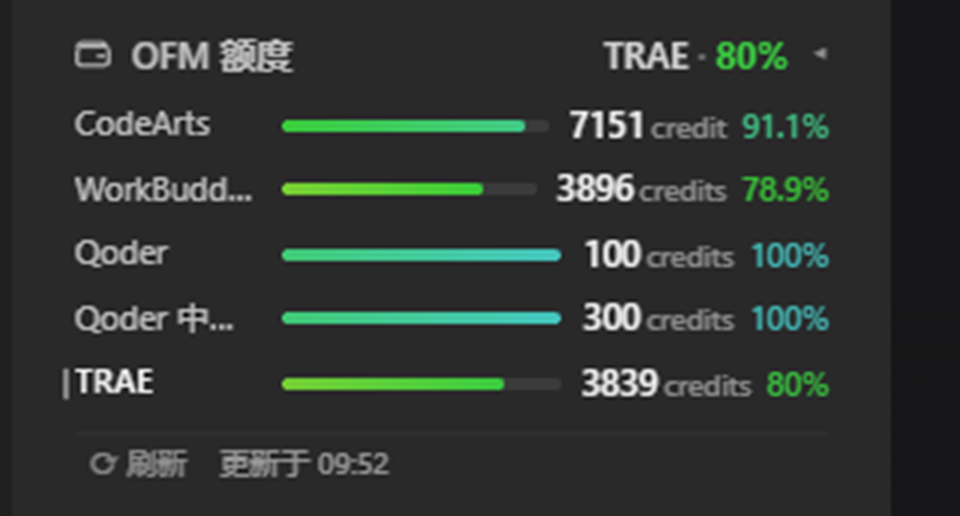
Collapsed: channel name plus remaining percentage
Collapsed — the channel your current conversation is using, and what is left
Expanded: one row per channel with bar, remaining amount and percentage
Expanded — one row per channel: bar · remaining · percentage
- **Collapsed**: the channel your current conversation is using, with its remaining percentage, as `channel · pct`. When the current channel cannot be resolved it falls back to the channel with the least left — usually the one you actually want to look at. - **Expanded**: one row per channel with a bar, the remaining amount and the percentage, read from the gateway's real quota endpoint. - **Refresh**: click to probe immediately; when the page is visible the card polls on an interval. ## What it is for OFM puts a dozen channels (CodeArts, TRAE, Qoder, …) behind a single gateway. Each one carries its own quota, and the gateway only tells you when you go ask. Two questions follow: - "Which channel did that request just spend?" — the collapsed card answers it. - "Which channel is about to run out?" — sorted by remaining, one glance. The card puts both in the sidebar: no conversation space, no click, no interruption. ## Which channels are shown The plugin lists **every channel the gateway supports**, not just the ones that currently have a routable model. This matters. `GET /v1/models` **only reports channels that have a model available right now**: a channel with no logged-in account, or with no model currently servable, simply will not appear there — yet it is still a supported channel, and its balance endpoint still answers. So the channel source here is a full catalogue, with `/v1/models` used only as a supplement: | Source | Where it comes from | Meaning | | --- | --- | --- | | **configured** | the DSH profile's route entries: model ids declared under that route | you have models going through this channel | | **catalogue** | the plugin's built-in list (matching the gateway console, 13 today) | which channels the gateway supports | | **advertised** | `GET /v1/models` → `data[].channel` | a model is available right now | | **readable** | the gateway's `credits.balances` returned numbers | a balance is readable right now | > **The catalogue is a floor, not a filter.** A channel the gateway advertises but the catalogue has > never heard of is still listed, under a title-cased display name. The plugin keeps working when the > gateway adds a channel — and a unit test guards exactly that: > `a channel outside the catalogue still appears when the gateway advertises it`. ### Defaults | Situation | Default behaviour | | --- | --- | | Configured channel | **Shown.** Even when the gateway cannot read a balance, the row stays and says why — you configured it, so hiding it would mislead | | In the catalogue but not configured | **Hidden.** Can be turned on by hand to inspect those balances | | Configured but unreadable | **Shown**, labelled honestly (e.g. "the gateway does not provide this channel") | | Channel with no logged-in account | The query succeeds but returns an empty account list; shown as **"not signed in to this channel"** | | Not configured but manually revealed | **Shown**, annotated "no models configured for this channel yet — inspection only" | A channel with no account is labelled honestly rather than reported as an error or left blank: "could not read" and "nothing there" are different facts, and the card keeps them apart. ### Adjusting it (GUI) Open the plugin's detail page on DSH's **Plugins** page; the **channel visibility** block at the top of the body is the toggle panel. Channels are split into two groups: - **Configured** — your DSH has models going through these - **Other channels the gateway supports** — in the catalogue, not configured by you Each row has: - a checkbox on the left controlling visibility - the channel name plus a one-line note (configured / no models configured in DSH / not currently offered by the gateway) - a status chip on the right **Revealing an unconfigured channel asks for confirmation**, because such a channel can only be inspected, not used through this harness. Changes apply immediately and are written to `$DSH_HOME/dsh-ofm-balance/settings.json`. > **Why not the host's generated settings form?** DSH derives a settings page from the plugin's > `Config` schema, but it renders scalar fields only; an `array` channel list gets no usable > checkboxes there, and it cannot ask the confirmation question when revealing an unconfigured > channel. So this plugin ships its own panel. #### Why the block can sit above "Source information" The panel registers through the `plugins.detail.section` slot, which is **appended after** the official page's own blocks (source information, current version, updates) — the `order` given at registration sorts within the slot only and cannot change the position relative to official blocks. So the position is guaranteed by two things together: 1. the detail page body is `flex-direction: column`, and the panel's root carries `order: -1`, which sorts it first at the CSS level; 2. the render callback performs one conservative prepend (only when the parent really is a flex column), as a fallback for when CSS is unavailable. Neither depends on the host's internal ordering. If the host changes its layout the panel falls back to the position the slot gave it, rather than erroring. ### Adjusting it (config file) You can also edit `$DSH_HOME/dsh-ofm-balance/settings.json` directly: ```json { "version": 1, "hidden": ["qoder"], "revealed": ["moonshot"] } ``` | Field | Effect | | --- | --- | | `hidden` | **Configured** channels to hide | | `revealed` | **Unconfigured** channels to additionally show | Delete the file to restore defaults (all configured shown, all unconfigured hidden). **Hidden channels are not probed, so they cost no requests.** ## Colour The bars and percentages follow the **remaining** ratio as a continuous gradient — not the consumed ratio, and not a stepped scale. The hue was tuned against real data. The first version spread the hue linearly across the whole range, which produced an indistinguishable band of green through the healthy end (80% → 100% spanned only 23°). It now uses anchors that push the top of the range toward cyan: | Remaining | Hue | Reading | | ---: | ---: | --- | | 100% | 178° | cyan | | 90% | 147° | spring green | | 80% | 123° | green | | 60% | 78° | yellow-green | | 40° | 48° | amber | | 20° | 25° | orange | | 0% | 0° | red | Saturation and lightness vary with the value too, so the scale reads as a continuous gauge rather than a colour wheel. **The semantics never invert**: 100% is always healthy cyan, 0% always red. In the collapsed summary, the channel name keeps the default text colour and **only the percentage is tinted** — colouring both makes the name read like a status label and competes with the number. ## Install ```bash dsh plugin --profile add github:Shen-18/dsh-ofm-balance ``` A repository URL or a local path works just as well: ```bash dsh plugin --profile add https://github.com/Shen-18/dsh-ofm-balance dsh plugin --profile add link:/absolute/path/to/dsh-ofm-balance ``` > Your profile may not be called `web`; substitute your own (desktop builds commonly use `desktop`). ### Prebuilt package (skips the build approval) Every release carries a prebuilt archive so storefronts can offer it directly: ``` https://github.com/Shen-18/dsh-ofm-balance/releases/latest/download/dsh-ofm-balance.tgz ``` The asset name carries **no version**, so `latest/download/` keeps working after every release instead of silently 404ing the way a versioned filename does once you cut the next one. Installing from that tgz needs no source build, which also skips the `allowBuilds` approval step. Manual install: 1. add this directory to the profile's `package.json` → `dependencies` 2. append the package name `dsh-ofm-balance` to `dsh.profile.bundles` 3. run `pnpm install` in the profile directory 4. restart the host Host-half changes need a restart; browser-half changes need only a page refresh. ## Configuration Deployment-level settings on the host side (in the profile patch or the plugin's config): | Key | Default | Meaning | | --- | --- | --- | | `enabled` | `true` | Master switch; when off, nothing is probed and no route is registered | | `baseUrl` | `http://127.0.0.1:18900` | gateway address | | `credentialRoute` | `ourfreemodel` | the provider route the credential and configuration belong to | | `pollIntervalSec` | `60` | poll interval (30–3600 s) | | `timeoutMs` | `20000` | per-channel timeout. Cold start measured around 10.5 s; do not lower it much | | `hiddenChannels` | `[]` | (initial value) configured channels to hide | | `revealedChannels` | `[]` | (initial value) unconfigured channels to additionally show | > The **live** toggle values live in `$DSH_HOME/dsh-ofm-balance/settings.json`, maintained by the > detail-page panel. `hiddenChannels` / `revealedChannels` in the config are first-run initial values. ## HTTP API Every route is **loopback-only** (anything other than `127.0.0.1` / `::1` gets a `403`). The API key is resolved by the host and never sent to the browser. | Method | Path | Purpose | | --- | --- | --- | | `GET` | `/api/dsh-ofm-balance/overview` | current snapshot and probe report | | `POST` | `/api/dsh-ofm-balance/refresh` | probe now and return a fresh snapshot | | `GET` | `/api/dsh-ofm-balance/channels` | the channel classification (with display labels) for the settings panel | | `POST` | `/api/dsh-ofm-balance/visibility` | persist the channel toggles, body `{ hidden, revealed }` | ## Where the data comes from The host side talks to the local gateway directly: | Purpose | Endpoint | | --- | --- | | discover channels | `GET {baseUrl}/v1/models` → `data[].channel` | | query a balance | `POST {baseUrl}/api/management/channels/rpc`, method `credits.balances`, params `{ provider }` | The credential is read from the host credential service as `OURFREEMODEL_API_KEY` and **used only inside the host process**. ## Cold start The plugin mounts before the credential service is ready. How it handles that: - when no credential is available the failure is **not cached**; channels are marked "reading" and retried after 1 second; - only after three consecutive misses is a channel treated as genuinely unconfigured, and the card then gives an actionable hint (which environment variable to set); - the gateway's first cold probe takes about 10.5 s, so the first request returns placeholder rows that already carry channel names, with the numbers filled in afterwards — never a blank card. The result: **balances appear on their own after DSH opens**, with no manual refresh. ## Known limitations - The gateway has **no batch endpoint**, so each probe fans out per channel; hidden channels are not requested at all. - `gemini`'s quota query needs the machine to reach Google. Without a proxy that channel returns `balance: null` with a network-failure note, is shown as "unavailable", and **does not affect other channels**; it recovers on the next round once a proxy is available. - Two properties of the gateway's credit bundles make the percentage go wrong, both corrected against measured data: 1. **Overlapping `used`**. The same `used` figure appears in both an aggregate bundle and its children (codearts' 总积分包 and 赠送积分包 both report 349.31), so summing every bundle's `used` inflates the divisor from the true **7500** to 7849.31. The fix identifies the bundle whose `remaining` equals `balance.total` — the aggregate — and uses **that bundle's own** `used`. 2. **Lapsed bundles**. The gateway marks expired bundles `active: false` (buddy carries four lapsed 裂变包 at `total` 100 / `used` 100 / `remaining` 0). They are no longer part of the current cycle's allowance, and counting them inflates 4539 to 4939. Together these move codearts from 91.1% to the correct **95.3%** and buddy from 78.9% to **85.8%**. When the gateway returns no bundle detail at all — or a shape the plugin cannot explain — the percentage is omitted rather than fabricated, because there is no denominator to trust and a made-up 100% would show a mostly-spent balance as never used. - When no account is signed in for a channel, the balance endpoint **still answers** and simply returns an empty account list; the plugin labels it honestly rather than counting it as a failure. ## Design notes | Decision | Why | | --- | --- | | Split host / browser halves | the API key stays inside the host process; the browser only sees a normalised snapshot | | `Promise.allSettled` fan-out | one slow or failing channel must not drag the others down | | Cache-first with a warm-up state | cold start is ~10.5 s; the first request returns placeholder rows to avoid a blank first paint | | A missing credential is not cached | at cold start the credential service comes up after the plugin, so caching "no key" turns one transient state into a permanent error | | Classification rules extracted to `lib/channels.js` | pure functions, no I/O: that is where the policy lives and what is most worth testing | | Channel toggles go through `plugins.detail.section` | the host's generated form cannot render array fields, nor ask the "unconfigured channel" confirmation | | Toggles stored in their own JSON rather than the profile patch | the plugin is mounted by a bundle patch, so there is no row in the profile to edit; writing its own file cannot damage the user's config | | Display labels come from the host | the plugin still names channels correctly on gateway deployments that offer unknown ones, falling back to title-casing | ## File layout | File | Responsibility | | --- | --- | | `lib/gateway.js` | gateway protocol: channel discovery, balance queries, normalisation | | `lib/channels.js` | channel classification and visibility policy (pure functions) | | `lib/service.js` | cache, polling, credential-readiness retry, snapshot building | | `lib/patch.js` | persistence of the channel toggles (atomic: temp file then rename) | | `lib/index.js` | host mounting, routes, configuration, session events | | `lib/client.js` | the sidebar card and the detail-page channel toggle panel | Zero runtime dependencies. `@deepseek-ai/*` is entirely host-provided and never declared as a `dependency`. ## Supported channels The built-in catalogue (matching the gateway console): | id | Name | Vendor | | --- | --- | --- | | `codearts` | CodeArts | Huawei Cloud | | `buddy` | WorkBuddy (CN) | Tencent | | `workbuddy` | WorkBuddy (intl.) | Tencent | | `lobsterai` | LobsterAI | Youdao | | `qoder` | Qoder | Alibaba | | `qodercn` | Qoder (CN) | Alibaba | | `trae` | TRAE | ByteDance | | `cline` | Cline | — | | `loomy` | Loomy | — | | `raccoon` | Raccoon | — | | `minimax` | MiniMax Code | — | | `zcode` | ZCode | — | | `gemini` | Gemini | Google | That catalogue is a **floor rather than a filter**: channels with no logged-in account are shown honestly, and channels outside the catalogue appear as usual. ## Development ```bash npm run check # syntax check (node --check) npm test # unit tests: channel classification + settings persistence (node --test) ``` The tests cover the classification policy and the boundary cases of settings persistence (missing file, corrupt file, atomic write, tolerance of unknown shapes). They need no network and spend no quota. ## Version - **0.8.4** — fixed the **collapsed strip showing another session's channel**. The sidebar card is one element **shared by every conversation**, but the route memory was a single global value: the `session/event` callback is `(session, event)` and the session argument was ignored (named `_session`). With two sessions open, the card therefore named the channel of **whichever session had sent a request most recently**, not the one on screen — measured: the strip said `buddy` while the transcript was on `codearts`. Routes are now recorded per session from `session.id`, and the client reads the main-view session (`retainedBy.mainView`) from the shell's `sessions` service and reports it via `POST /view-session`, so the strip only names that session's channel. A viewed session that has not sent a request yet shows nothing rather than another session's channel. A shell without the `sessions` service falls back to the old global behaviour instead of going blank (`sessions` is deliberately not listed in `inject` — Cordis treats those as required dependencies, and a missing one would deactivate the plugin). 6 new tests (102 total). - **0.8.3** — **the plugin is now the default source** (`source` default `auto` → `plugin`). The plugin runs inside DSH, so its accounts are the ones configured there and reading it needs no separate process; a fresh install is therefore no longer asked "which one?". A machine without the plugin still falls back to the desktop app rather than showing an empty card, and `auto` remains available for anyone who wants to be asked. This also exposed and fixed a regression: a plain `source !== 'auto'` check meant that once the default became `plugin`, a **saved choice was skipped** — picking the desktop app and restarting silently read the plugin again. Precedence is now "explicit non-default setting → the choice saved by the UI → the plugin default". Cross-source routes no longer light up a channel either: the two products keep separate account pools behind overlapping channel names, so a desktop route while reading the plugin (and the reverse) clears the highlight instead of showing another account's number; switching source clears the remembered route too. 7 new tests (96 total). - **0.8.2** — fixed the **collapsed strip naming the wrong channel on the plugin source**. The two products announce a route in different shapes: the desktop app reports `provider: ourfreemodel` with `model: buddy/deepseek-v4.1-flash` (channel in the model prefix), while the official plugin registers **one LLM provider route per channel** and reports `provider: workbuddy` with `model: deepseek-v4.1-flash` (no channel prefix at all). The old code only read the model prefix, so in plugin mode it produced `deepseek-v4.1-flash`, matched no row, and `currentChannel` stayed undefined — the strip then fell back to "whichever channel is closest to running out" instead of the one being spent. A provider that is itself a known channel now wins (plugin source only, so a user-configured provider of the same name cannot light up a row); the plugin's own `our-free-model` free lane clears the channel rather than leaving the previous one on screen; otherwise the model prefix is still used. Added `lib/route.test.js` (8 tests). - **0.8.1** — fixed **reading no balances on DSH 0.2.0**: the `connection` service's "owner Peer" field was renamed from `operator` to `browserPeer` in DSH 0.2.1, and this plugin only read the new name. On 0.2.0 it therefore threw `connection service has no browser peer` every time, the whole `plugin` source was judged unreachable, and the card settled on `active: none` ("no usable Our Free Model found"). Both names are now accepted (they are the same owner principal), with 5 new tests pinning both kernel shapes. `engines.dsh` widened from `>=0.2.1-rc.2` to `>=0.2.0-rc.2` to match reality. - **0.8.0** — the source question is asked **once**. Dismissing the notice also counts as answered (recorded as `sourcePromptSeen`), but "dismissed" and "chosen" are two different states: dismissing does **not** pin a source, so `auto` keeps falling back to whichever one is live. The notice names where to switch later ("plugin detail page → Data source"). Singular and plural spellings of one unit now fold together (credit/credits → credits), and wording like "view only" was removed. - **0.7.0** — channel visibility now keys off **"is an account signed in"** (`provider.status` → `accounts.total > 0`) instead of the model ids the DSH profile declares. The old rule was wrong in both directions: the profile is a stale snapshot that keeps naming channels whose accounts are gone (so the card filled with rows that could never show a number), while a freshly signed-in channel might not be in it yet (so real accounts were hidden). Both products answer `provider.status` with the same shape, so one rule covers both. Removed the profile reader and the 60-second poller. - **0.6.0** — supports **two Our Free Model data sources**. Previously the card always read the desktop app at `127.0.0.1:18900`; after installing the official DSH plugin the two account pools turned out to be separate, so the card showed the other one's accounts. It now probes `plugin` (the official plugin, via the DSH kernel's `channel-pack` RPC) and `desktop` (the app, over HTTP), uses the single reachable one directly, asks once only when both are live, and can be switched on the plugin detail page; a choice that becomes unreachable falls back automatically. Both sources share one normalization and denominator-correction path. Added `lib/sources.js`, `lib/plugin-source.js`, and 23 tests (56 total). - **0.5.1** — fixed two errors in the percentage denominator. (1) The same `used` figure appears in both an aggregate bundle and its children (codearts' 总积分包 and 赠送积分包 both report 349.31), and summing them inflates the divisor; the denominator now finds the bundle whose `remaining` equals `balance.total` and uses **that bundle's own** `used`. (2) Bundles marked `active: false` are expired and no longer part of the cycle's allowance (buddy carries four), and counting them inflated 4539 to 4939. codearts moves from 91.1% to **95.3%** and buddy from 78.9% to **85.8%**. When the gateway returns no bundle detail the percentage is omitted rather than fabricated as 100%. Added `lib/gateway.test.js`, pinning these readings against real gateway responses. - **0.5.0** — lists **every channel the gateway supports** (rather than only those with a routable model), completed by the built-in catalogue; channels with a signed-in account report balances normally, those without are labelled honestly. Configured-channel detection gained a file fallback (some hosts do not expose the route settings namespace to plugins, which previously made every channel look unconfigured). The settings panel moved to a grouped layout with roomier rows. - **0.4.3** — the settings block genuinely moved above "Source information". The previous version relied on the registration `order`, but that slot is appended after the official blocks, so `order` only sorted within the slot; now it uses CSS `order: -1` (the detail body is a flex column) plus a conservative JS prepend fallback. - **0.4.2** — the sidebar card is now fully transparent (the sidebar itself is transparent, so any fill showed up as a bolted-on box), with a very faint hover response; radius tightened to 8px. - **0.4.1** — the sidebar card lost its border and moved to a sidebar-adjacent background to reduce visual weight. - **0.4.0** — added the channel toggle panel to the plugin detail page (`plugins.detail.section`); fixed the cold-start "missing credential" state that never recovered; channel labels now come from the host; documentation restructured. - **0.3.0** — support channels beyond the built-in catalogue. - **0.2.0** — collapsed state became `channel · remaining pct` (tinting the percentage only); the colour scale became continuous; the collapsed state shows the current conversation's channel. - **0.1.0** — first release. ## License [MIT](LICENSE)