# SAM3-LoRA: Efficient Fine-Tuning with Low-Rank Adaptation
[](https://github.com/Sompote/SAM3_LoRA)
[](https://www.python.org/downloads/)
[](https://pytorch.org/)
[](LICENSE)
**Train SAM3 segmentation models with 99% fewer trainable parameters**
[Quick Start](#quick-start) • [Architecture](#architecture) • [Training](#training) • [Validation](#validation) • [Inference](#inference) • [Examples](#real-world-example-concrete-crack-detection) • [Configuration](#configuration) • [Troubleshooting](#troubleshooting)
---
## Overview
Fine-tune SAM3 (Segment Anything Model 3) on your own dataset using **LoRA (Low-Rank Adaptation)** — a parameter-efficient method that reduces trainable parameters from 100% to ~1% while maintaining performance. Train on a standard COCO-format dataset with text prompts taken from your category names, while preserving SAM3's open-vocabulary behavior: the fine-tuned model segments your target classes (e.g. `crack`, `hole`) and still returns **nothing** for unrelated prompts (e.g. `car`).
### Recent Updates
**2026-08-01 (v0.3.0)**:
- **Guaranteed cross-class hard negatives** — negatives are now two-tier: every dataset category absent from an image is **always** added as a must-return-nothing prompt (previously it was only randomly sampled, far too rare to separate confusable classes like `crack` vs `water ingress` — all prompts ended up segmenting the same defect). `num_negatives` now controls only the extra generic out-of-domain prompts sampled per image. Generic negatives that share a word with a dataset category (e.g. `water` vs `water ingress`) are removed automatically — training them to return nothing contradicts the related positive class. See [Preserving prompt discrimination](#preserving-prompt-discrimination-important)
- **Fixed baseline validation scoring ~0 mAP** — `validate_sam3_lora.py` scored detections with raw `pred_logits` only, but SAM3's image model keeps the **presence score** separate (the official `PostProcessImage` multiplies it in). Without it, the zero-shot baseline floods every prompt with confident false detections and its mAP collapses to 0. Validation now uses the joint score `sigmoid(logit) × sigmoid(presence)` by default (`--no-presence` restores the old behavior). LoRA numbers also change slightly — rerun both sides for a fair comparison
- **New: pixel-level metrics** (`--pixel-metrics`, default on) — reports semantic IoU / precision / recall on the union of masks per prompt, alongside mAP/cgF1. Instance matching triple-penalizes a single GT crack predicted as several fragments (missed GT + each fragment a false positive); pixel metrics measure coverage regardless of fragmentation. See [Fragmented predictions](#fragmented-predictions-and-pixel-level-metrics-cracks)
- **New: proximity merging** (`--merge-dilate N`) — `--merge` only fused *overlapping* fragments (disjoint crack portions have mask IoU 0 and never merged). With a dilation radius, fragments whose dilated masks touch are joined into one instance before matching
- **New: box/score display options in evaluation scripts** — `compare_lora_base.py` / `compare_lora_base_batch.py` gain `--boundingbox True/False` and `--score True/False` (per-detection confidence labels, no boxes required); `infer_sam.py` gains `--score` so confidence shows independently of `--boundingbox`
**2026-07-05 (v0.2.0)**:
- **Fixed loss of prompt discrimination after fine-tuning** — previously the model detected trained objects regardless of the text prompt (e.g. segmenting cracks when prompted `car`). Root cause: positive-only training queries. See [Preserving prompt discrimination](#preserving-prompt-discrimination-important)
- **Automatic hard-negative text prompts** — new `num_negatives` config option; the trainers now add per-image prompts that must return zero detections, drawn from your other dataset categories plus a built-in generic pool. New `generic_negatives` config option overrides the pool when a default concept (e.g. `road`) can genuinely appear in your images. Validation loss includes the negative prompts, so it tracks discrimination during training
- **Text encoder frozen by default** (`apply_to_text_encoder: false`) to preserve SAM3's text↔image alignment
- **Fixed `apply_to_mask_decoder` having no effect** (#28) — SAM3's mask module is named `segmentation_head`, which the component filter didn't match, so the flag was silently ignored (and the head's cross-attention was always adapted regardless of the setting). The flag now correctly controls LoRA on the segmentation head
- **New: merge LoRA into the base model** (#30) — `merge_lora_weights.py` folds a trained adapter into the base weights, producing a single checkpoint that loads into stock SAM3 with no LoRA code. See [Merging LoRA weights](#merging-lora-weights-into-the-base-model)
- **New: RefCOCO / RRSIS-D support** (#26) — `convert_refcoco_to_coco.py` converts referring-expression datasets to the trainers' COCO layout, with expression-level (`--mode ref`) or class-level (`--mode category`) prompts. See [Prepare Your Data](#1-prepare-your-data)
**2026-02-03**:
- **Fixed multi-class category assignment bug** in training/validation
- Previously, images with multiple categories incorrectly assigned all objects to the mode (most frequent) category
- Now creates separate queries per category, mapping each object to its actual class
- Affected files: `train_sam3_lora_native.py`, `train_sam3_lora_with_categories.py`, `validate_sam3_lora.py`
**2026-01-31**:
- **Replaced `--no-boxes` with `--boundingbox` option** in `infer_sam.py`
- New `--boundingbox True/False` flag for explicit bounding box control (default: False)
- Updated README documentation and inference examples
**2026-01-04**:
- **Added Multi-GPU training support** using DistributedDataParallel (DDP)
- New `--device` argument for easy GPU selection: `--device 0 1 2 3`
- Automatic torchrun launch when multiple GPUs specified
- Linear scaling of effective batch size across GPUs
### Why Use This?
- ✅ **Train on Consumer GPUs**: 16GB VRAM instead of 80GB
- ✅ **Tiny Checkpoints**: 10-50MB LoRA weights vs 3GB full model
- ✅ **Fast Iterations**: Less memory = faster training
- ✅ **Easy to Use**: standard COCO dataset + YAML configs + simple CLI
- ✅ **Keeps Prompt Discrimination**: automatic hard-negative prompts, so the tuned model doesn't fire on unrelated words
- ✅ **Production Ready**: Complete train + inference pipeline
- ✅ **Real Applications**: Crack detection, defect inspection, and more
- ✅ **Multi-GPU Support**: Scale training across multiple GPUs with `--device 0 1 2 3`
### What is LoRA?
Instead of fine-tuning all model weights, LoRA injects small trainable matrices:
```
W' = W_frozen + B×A (where rank << model_dim)
```
**Result**: Only ~1% of parameters need training!
### Architecture
SAM3-LoRA applies Low-Rank Adaptation to key components of the SAM3 architecture:
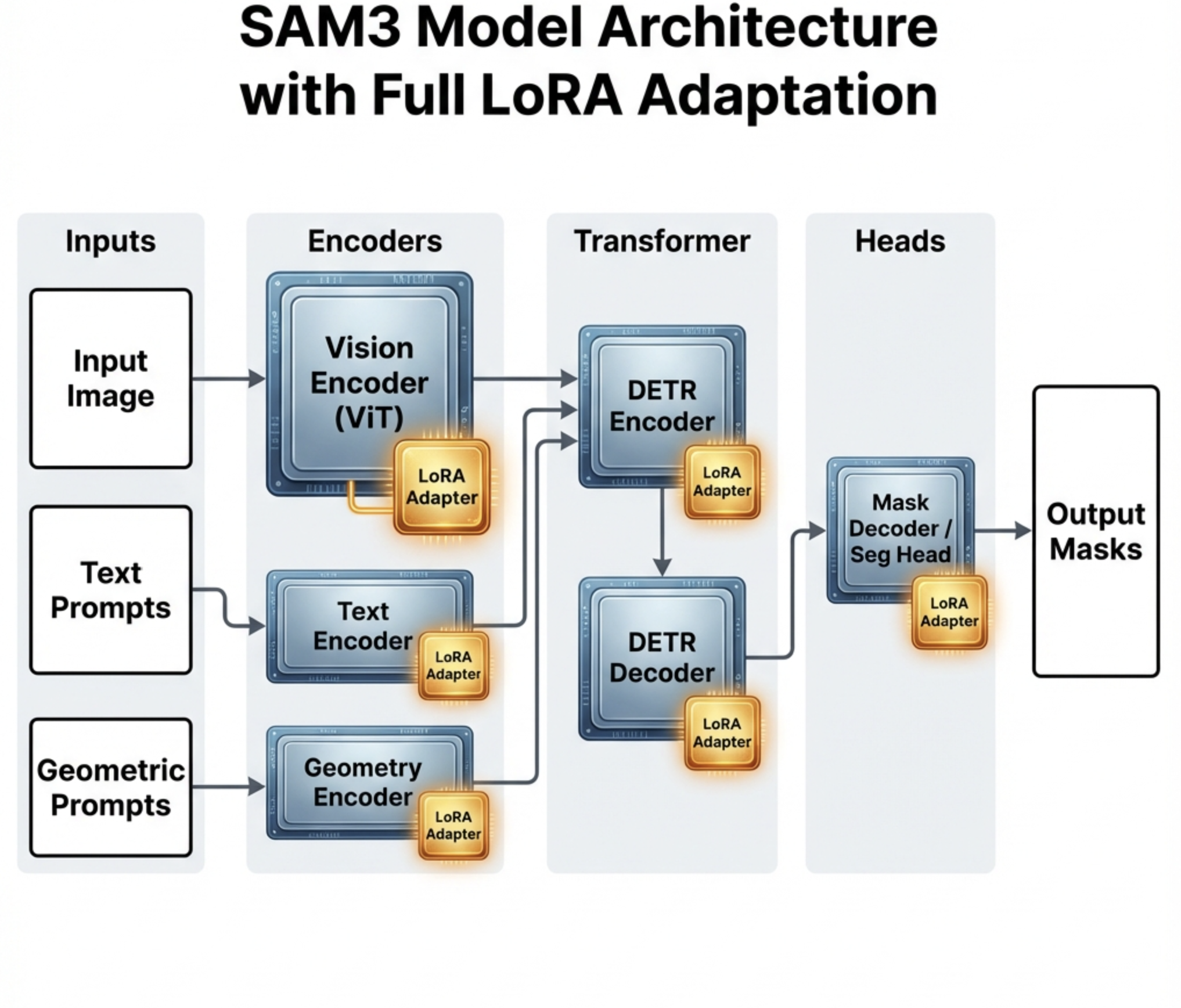 SAM3 Model Architecture with Full LoRA Adaptation
**LoRA Adapters Applied To:**
| Component | Description | Default | Notes |
|-----------|-------------|---------|-------|
| **Vision Encoder (ViT)** | Extracts visual features from input images | LoRA ✅ | High impact - primary feature learning |
| **Text Encoder** | Processes text prompts for guided segmentation | **Frozen** ❄️ | Keep frozen — adapting it erodes prompt discrimination |
| **Geometry Encoder** | Handles geometric prompts (boxes, points) | Frozen | Enable if using box/point prompts |
| **DETR Encoder** | Transformer encoder for object detection | LoRA ✅ | High impact - vision-text fusion |
| **DETR Decoder** | Transformer decoder for object queries | LoRA ✅ | High impact - object localization |
| **Mask Decoder** | Generates segmentation masks | Frozen | Enable for fine-grained mask quality (on in `light_lora_config`) |
**Data Flow:**
1. **Input**: Image + Text/Geometric prompts
2. **Encoding**: Multiple encoders process different modalities
3. **Transformation**: DETR encoder-decoder refines representations
4. **Output**: High-quality segmentation masks
**LoRA Benefits:**
- ✅ Only ~1% parameters trainable (frozen base + small adapters)
- ✅ Adapters can be swapped for different tasks
- ✅ Original model weights preserved
- ✅ Efficient storage (10-50MB vs 3GB full model)
---
## Installation
### Prerequisites
Before installing, you need to:
1. **Request SAM3 Access on Hugging Face**
- Go to [facebook/sam3 on Hugging Face](https://huggingface.co/facebook/sam3)
- Click "Request Access" and accept the license terms
- Wait for approval (usually instant to a few hours)
2. **Get Your Hugging Face Token**
- Go to [Hugging Face Settings > Tokens](https://huggingface.co/settings/tokens)
- Create a new token or use existing one
- Copy the token (you'll need it in the next step)
### Install
```bash
# Clone repository
git clone https://github.com/Sompote/SAM3_LoRA.git
cd SAM3_LoRA
# Install dependencies
pip install -e .
# Login to Hugging Face
hf auth login
# Paste your token when prompted
```
**Alternative login method:**
```bash
# Or set token as environment variable
export HF_TOKEN="your_token_here"
```
**Requirements**: Python 3.8+, PyTorch 2.0+, CUDA (optional), Hugging Face account with SAM3 access
### Verification
Verify your setup is complete:
```bash
# Test Hugging Face login
huggingface-cli whoami
# Test SAM3 access (should not give access error)
python3 -c "from transformers import AutoModel; print('✓ SAM3 accessible')"
```
If you see errors, review the [Troubleshooting](#troubleshooting) section.
---
## Quick Start
> **⚠️ Important**: Make sure you've completed the [Installation](#installation) steps, including Hugging Face login, before proceeding.
**Example Result**: Train a model to detect concrete cracks with just ~1% trainable parameters!
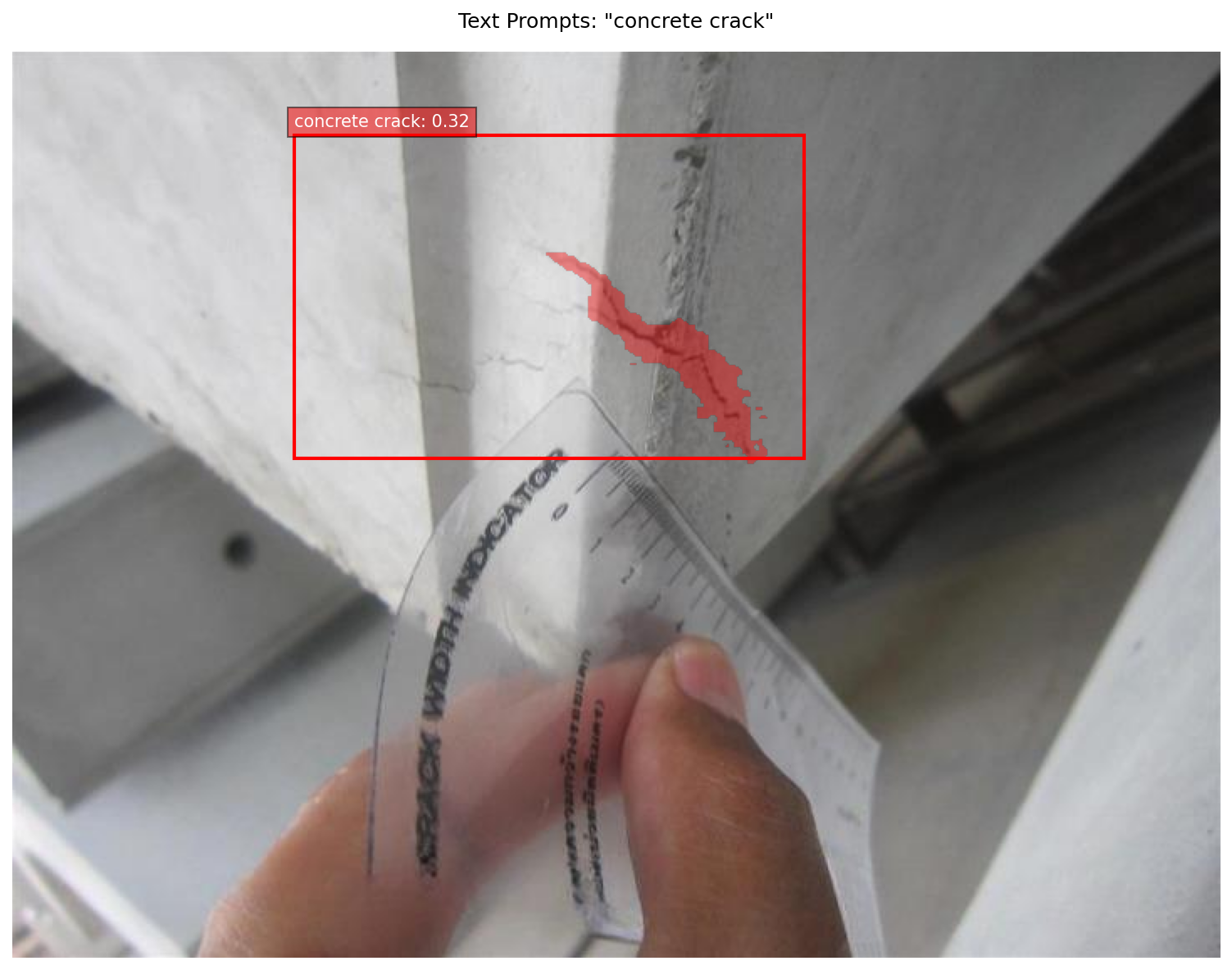 Detection: "concrete crack" with 0.32 confidence • Precise segmentation mask
### 1. Prepare Your Data
Organize your dataset in **COCO format** with a single annotation file per split:
```
data/
├── train/ # Required
│ ├── img001.jpg
│ ├── img002.jpg
│ └── _annotations.coco.json
├── valid/ # Optional but recommended
│ ├── img001.jpg
│ ├── img002.jpg
│ └── _annotations.coco.json
└── test/ # Optional
├── img001.jpg
└── _annotations.coco.json
```
> **Note**: Validation data (`data/valid/`) is **optional** but strongly recommended for monitoring training progress and preventing overfitting.
**COCO Annotation Format** (`_annotations.coco.json`):
```json
{
"images": [
{
"id": 0,
"file_name": "img001.jpg",
"height": 480,
"width": 640
}
],
"annotations": [
{
"id": 1,
"image_id": 0,
"category_id": 1,
"bbox": [x, y, width, height],
"area": 1234,
"segmentation": [[x1, y1, x2, y2, ...]],
"iscrowd": 0
}
],
"categories": [
{"id": 1, "name": "defect"}
]
}
```
**Supported Segmentation Formats:**
- **Polygon**: `"segmentation": [[x1, y1, x2, y2, ...]]` (list of polygons)
- **RLE**: `"segmentation": {"counts": "...", "size": [h, w]}` (run-length encoded)
**Using RefCOCO-format datasets (RefCOCO, RRSIS-D, ...):** referring-expression
datasets ship as `instances.json` + a `refs(*).p` pickle instead of per-split
COCO files. Convert them with:
```bash
python3 convert_refcoco_to_coco.py \
--refcoco-dir RRSIS-D/rrsisd \
--images-dir RRSIS-D/images/rrsisd/JPEGImages \
--output-dir data/rrsisd_coco \
--mode ref
```
`--mode ref` (default) turns each referring expression into a text prompt for
exactly the one instance it refers to — true referring segmentation; keep
`num_negatives` enabled so other expressions serve as hard negatives.
`--mode category` ignores the expressions and produces plain class-level
detection data from the original COCO categories. Use `--symlink` to link
images instead of copying.
### 2. Train Your Model
```bash
# Train with default config
python3 train_sam3_lora_native.py
# Or specify custom config
python3 train_sam3_lora_native.py --config configs/full_lora_config.yaml
```
**Expected output:**
```
Building SAM3 model...
Applying LoRA...
Applied LoRA to 64 modules
Trainable params: 11,796,480 (1.38%)
Loading training data from /workspace/data2...
Loaded COCO dataset: train split
Images: 778
Annotations: 1631
Categories: {0: 'CRACKS', 1: 'CRACKS', 2: 'JOINT', 3: 'LOCATION', 4: 'MARKING'}
Loading validation data from /workspace/data2...
Loaded COCO dataset: valid split
Images: 152
Annotations: 298
Found validation data: 152 images
Starting training for 100 epochs...
Training samples: 778, Validation samples: 152
Epoch 1: 100%|████████| 98/98 [07:47<00:00, loss=140]
Validation: 100%|████████| 19/19 [00:32<00:00, val_loss=23.7]
Epoch 1/100 - Train Loss: 156.234567, Val Loss: 17.032280
✓ New best model saved (val_loss: 17.032280)
Epoch 2: 100%|████████| 98/98 [07:24<00:00, loss=167]
Validation: 100%|████████| 19/19 [00:31<00:00, val_loss=20.1]
Epoch 2/100 - Train Loss: 142.891234, Val Loss: 15.641912
✓ New best model saved (val_loss: 15.641912)
...
```
**Validation Strategy** (mirrors how SAM3's own training/eval code is organized — see note below):
- **During training**: Only validation **loss** is computed (fast, no NMS or metrics)
- **After training**: Run `validate_sam3_lora.py` for full metrics (mAP, cgF1) with NMS
This approach significantly speeds up training while still monitoring overfitting via validation loss.
> **Note on "mirrors SAM3":** this is *not* a documented policy quoted from the SAM3
> repo — it's a design choice in this repo that follows how SAM3's code is
> structured. Two concrete sources motivate it: (1) SAM3's trainer runs a periodic
> validation pass that accumulates **loss/meters** on a configurable cadence
> (`sam3/train/trainer.py`, e.g. `val_epoch_freq` / `Phase.VAL`); and (2) full
> COCO mAP / cgF1 live in **separate offline evaluators**
> (`sam3/eval/coco_eval_offline.py`, `sam3/eval/cgf1_eval.py`) that are run as a
> distinct step — the COCO evaluator's own docstring notes category mAP requires
> predicting over every `(image, class)` pair, which is why it's kept out of the
> training loop. If you have an official SAM3 statement on eval cadence, a pointer
> is welcome so we can cite it directly.
### 3. Run Inference
```bash
# Basic inference (automatically uses best model)
python3 infer_sam.py \
--config configs/full_lora_config.yaml \
--image test_image.jpg \
--output predictions.png
# With text prompt for better accuracy
python3 infer_sam.py \
--config configs/full_lora_config.yaml \
--image test_image.jpg \
--prompt "yellow school bus" \
--output predictions.png
# Multiple prompts to detect different objects
python3 infer_sam.py \
--config configs/full_lora_config.yaml \
--image test_image.jpg \
--prompt "crack" "defect" "damage" \
--output predictions.png
```
---
## Training
### Basic Training
```bash
# Use default configuration (single GPU)
python3 train_sam3_lora_native.py
# Or specify custom config
python3 train_sam3_lora_native.py --config configs/full_lora_config.yaml
```
### Preserving prompt discrimination (important)
A common issue after fine-tuning is that the model **detects the trained objects
regardless of the text prompt** — e.g. after training on `crack`/`hole` it still
segments cracks when you prompt `"car"`. This happens because SAM3 is an
open-vocabulary detector, but the dataset only ever provides **positive**
prompts (every prompt has matching boxes). The presence head then decouples from
the text condition and learns to "always fire."
Two settings fix this:
1. **Hard-negative text queries** — prompts that must return **nothing** for an
image. The dataloader adds them in two tiers:
- **In-domain negatives (always added).** Every dataset category absent from
an image becomes a zero-detection query on that image. These are the
confusable prompts — on a water-ingress image, `crack` and
`concrete spalling` are told to return nothing, every single epoch. When
these were only randomly sampled, the signal was too rare for the model to
keep visually similar classes apart: after fine-tuning, all three prompts
segmented the same defect.
- **Generic out-of-domain negatives (sampled).** `num_negatives` prompts per
image drawn from a built-in pool (`car`, `person`, `dog`, …). `2`–`4`
works well; `0` disables this tier only. The shipped configs set `3`.
```yaml
training:
num_negatives: 3 # generic tier only; absent dataset categories are always added
```
If a concept from the default generic pool can genuinely appear in your
images (e.g. `road` in pavement-crack photos — teaching "no road here" on a
picture of a road is wrong supervision), replace the pool with objects that
never appear in your data:
```yaml
training:
generic_negatives: ["car", "person", "dog", "bicycle", "bottle"]
```
Pool entries that share a word with one of your dataset categories are
removed automatically (e.g. `water` is dropped when a category is named
`water ingress`) — training `water` to return nothing on images full of
water ingress would contradict the positive class.
2. **Keep the text encoder frozen** (`apply_to_text_encoder: false`). Adapting
the text encoder distorts SAM3's text↔image alignment — the very thing that
separates `crack` from `car`. Leave it frozen unless you have a strong reason
not to.
```yaml
lora:
apply_to_text_encoder: false
```
Also avoid over-training on small datasets (hundreds of epochs amplifies the
collapse); prefer a lower learning rate and fewer epochs, and watch the
validation loss, which now includes the negative prompts.
#### Do negatives generalize to prompts outside the pool?
Yes — the negative pool is **not a blocklist**. If you train with
`generic_negatives: ["car", "person", "dog", "bicycle", "bottle"]` and later
prompt `plane`, the model should still return nothing, even though `plane` was
never a training negative.
The negatives don't teach the model "don't fire on the word car" — they retrain
the presence head's general decision rule: *fire only when the text embedding
actually matches the visual features*. Each negative is one demonstration of
that rule; the model relearns the rule, not the word list. The frozen text
encoder is what makes this work: SAM3's pretrained encoder already places
`plane` near `car`/`bicycle` and far from `crack`, and freezing it
(`apply_to_text_encoder: false`) keeps that concept space intact — the
negatives just re-anchor the presence head to use it again. A more diverse pool
generalizes further, which is why the built-in one spans 20 varied concepts.
**The caveat is near-synonyms of your target classes.** After training on
`crack`/`hole`/`deep crack`, prompts like `scratch`, `fracture`, `gap`, or
`line` sit close to `crack` in the text encoder's space and may still trigger
detections. That's the model honestly saying "this concept looks like what I
was trained to find" — whether that's desired depends on your use case. If a
specific nearby word must return nothing, add exactly that word to
`generic_negatives`.
After retraining, spot-check three rings of prompts:
1. **Trained classes** (`crack`, `hole`) — should segment correctly.
2. **Clearly unrelated words, including ones NOT in your pool** (`plane`,
`banana`, `keyboard`) — should return nothing. This verifies generalization
rather than memorization.
3. **Near-synonyms** (`scratch`, `gap`) — check the behavior matches what you
want; add problem words to the pool if not.
If ring 2 still fires, increase `num_negatives`, diversify the pool, or reduce
over-training (fewer epochs / lower LR) — don't try to enumerate every English
word.
### Multi-GPU Training
Train on multiple GPUs using the `--device` argument. The script automatically handles distributed training setup.
```bash
# Single GPU (default - GPU 0)
python3 train_sam3_lora_native.py --config configs/full_lora_config.yaml
# Single GPU (specific GPU)
python3 train_sam3_lora_native.py --config configs/full_lora_config.yaml --device 1
# Multi-GPU (2 GPUs)
python3 train_sam3_lora_native.py --config configs/full_lora_config.yaml --device 0 1
# Multi-GPU (4 GPUs)
python3 train_sam3_lora_native.py --config configs/full_lora_config.yaml --device 0 1 2 3
# Multi-GPU (specific GPUs, e.g., 0, 2, 3)
python3 train_sam3_lora_native.py --config configs/full_lora_config.yaml --device 0 2 3
```
**Multi-GPU Features:**
- ✅ Automatic `torchrun` launch when multiple GPUs specified
- ✅ DistributedDataParallel (DDP) for efficient gradient synchronization
- ✅ DistributedSampler for proper data sharding
- ✅ Synchronized validation loss across all GPUs
- ✅ Model saving only on rank 0 (no file conflicts)
**Effective Batch Size:**
With multi-GPU, your effective batch size scales linearly:
```
effective_batch_size = batch_size × num_gpus
```
| Config batch_size | GPUs | Effective Batch Size |
|-------------------|------|---------------------|
| 4 | 1 | 4 |
| 4 | 2 | 8 |
| 4 | 4 | 16 |
**Expected Output (Multi-GPU):**
```
Launching distributed training on GPUs: [0, 1]
Number of processes: 2
Multi-GPU training enabled with 2 GPUs
Building SAM3 model...
Applying LoRA...
Trainable params: 11,796,480 (1.38%)
Model wrapped with DistributedDataParallel
Effective batch size: 4 x 2 = 8
Starting training for 100 epochs...
```
### Custom Configuration
Create a config file (e.g., `configs/my_config.yaml`):
```yaml
lora:
rank: 16 # LoRA rank (higher = more capacity)
alpha: 32 # Scaling factor (typically 2×rank)
dropout: 0.1 # Dropout for regularization
target_modules: # Which layers to adapt
- "q_proj" # Query projection
- "k_proj" # Key projection
- "v_proj" # Value projection
- "fc1" # MLP layer 1
- "fc2" # MLP layer 2
# Which model components to apply LoRA to
apply_to_vision_encoder: true
apply_to_mask_decoder: true
apply_to_detr_encoder: false
apply_to_detr_decoder: false
training:
data_dir: "/path/to/data" # Root directory with train/valid/test folders
batch_size: 8 # Adjust based on GPU memory
num_epochs: 100 # Training epochs
learning_rate: 5e-5 # Learning rate (5e-5 recommended for SAM3 fine-tuning)
weight_decay: 0.01 # Weight decay
gradient_accumulation_steps: 8 # Effective batch = batch_size × accumulation
output:
output_dir: "outputs/my_model"
```
**Important Notes:**
- **Category-aware prompts**: The training automatically uses category names as text prompts (e.g., "crack", "joint") extracted from COCO annotations
- Each training image is prompted with its specific object categories (in lowercase)
- This approach improves performance by using task-specific vocabulary while leveraging SAM3's pre-trained text understanding
Then train:
```bash
python3 train_sam3_lora_native.py --config configs/my_config.yaml
```
### Model Checkpointing
During training, two models are automatically saved:
- **`best_lora_weights.pt`**: Best model based on validation loss (saved only when validation loss improves)
- **`last_lora_weights.pt`**: Model from the last epoch (saved after every epoch)
**With validation data**: Training monitors validation **loss only** (fast). Best model is saved when validation loss decreases.
**Without validation data**: Training continues normally but saves the last epoch as both files. You'll see:
```
⚠️ No validation data found - training without validation
...
ℹ️ No validation data - consider adding data/valid/ for better model selection
```
### Merging LoRA weights into the base model
If you don't want to load the LoRA adapter separately at inference time, you
can fold it into the base weights and get a single checkpoint that loads into
the **original SAM3 architecture** — no LoRA code or config needed:
```bash
python3 merge_lora_weights.py \
--config configs/full_lora_config.yaml \
--lora-weights outputs/sam3_lora_full/best_lora_weights.pt \
--output sam3_merged.pt
```
`--config` must be the **same config used for training** (the adapter file
stores only the low-rank matrices, so the model is rebuilt with the same LoRA
structure before merging). `--lora-weights` defaults to
`/best_lora_weights.pt` from the config. Merging runs on CPU — no
GPU needed.
Load the result with stock SAM3 code:
```python
from sam3.model_builder import build_sam3_image_model
model = build_sam3_image_model(load_from_HF=True, eval_mode=True,
bpe_path="sam3/assets/bpe_simple_vocab_16e6.txt.gz")
model.load_state_dict(torch.load("sam3_merged.pt", map_location="cpu"))
```
The merged model computes `W' = W + B^T A^T · (alpha/rank)` for every adapted
layer, so its predictions are **numerically identical** to base + adapter.
Trade-offs: the checkpoint is full model size (~3 GB) instead of a 10–50 MB
adapter, and the adaptation is baked in — you can no longer swap adapters on
one shared base model.
---
## Validation
### Overview
SAM3-LoRA uses a **two-stage validation approach** following SAM3's original design:
1. **During Training**: Only validation **loss** is computed (fast, no expensive metrics)
2. **After Training**: Run full evaluation with mAP, cgF1 metrics and NMS filtering
This approach **significantly speeds up training** while still monitoring overfitting via validation loss.
### Quick Validation
After training completes, evaluate your model:
```bash
# Validate LoRA-adapted model (uses best model automatically)
python3 validate_sam3_lora.py \
--config configs/full_lora_config.yaml \
--weights outputs/sam3_lora_full/best_lora_weights.pt \
--val_data_dir /workspace/data2/valid
# Evaluate on test set
python3 validate_sam3_lora.py \
--config configs/full_lora_config.yaml \
--weights outputs/sam3_lora_full/best_lora_weights.pt \
--val_data_dir /workspace/data2/test
# Baseline: Validate with original SAM3 model (no LoRA) for comparison
python3 validate_sam3_lora.py \
--val_data_dir /workspace/data2/valid \
--use-base-model
```
> **Presence scoring (v0.3.0):** detections are ranked by the joint score
> `sigmoid(pred_logit) × sigmoid(presence_logit)`, matching SAM3's official
> `PostProcessImage`. This matters most for the `--use-base-model` baseline:
> the pretrained model's raw query logits are confident even for absent
> concepts, and scoring them alone floods the eval with false positives
> (baseline mAP reads as 0.0000). If your baseline scored ~0 with an older
> version, rerun — and rerun the LoRA side too, since the scoring change
> applies to both. `--no-presence` restores the old raw-logit behavior.
**Expected Output:**
```
Running SAM3 LoRA Validation
Building SAM3 model...
Loading LoRA weights from outputs/sam3_lora_full/best_lora_weights.pt
Loaded COCO dataset: valid split
Images: 152
Annotations: 298
Processing: 100%|████████| 152/152 [02:15<00:00]
Validation Results:
================================================================================
Total predictions: 946 (after NMS from 1353 initial detections)
Total ground truth: 298
COCO Evaluation Metrics:
--------------------------------------------------------------------------------
mAP (IoU 0.50:0.95): 0.245
mAP@50 (IoU 0.50): 0.287
mAP@75 (IoU 0.75): 0.198
Category-agnostic F1 Scores:
--------------------------------------------------------------------------------
cgF1 (avg): 0.135
cgF1@50: 0.149
cgF1@75: 0.089
--------------------------------------------------------------------------------
Pixel-level metrics (union of masks per prompt; robust to
a single crack being predicted as multiple fragments):
Pixel IoU: 0.412
Pixel Precision: 0.573
Pixel Recall: 0.598
Mean per-prompt IoU: 0.387
================================================================================
```
### Multi-class validation
The validator fully supports datasets with **multiple categories per image**. SAM3
is prompt-based: for each image it issues one text prompt per category, and the
model returns a separate set of predictions for every prompt. The validator
treats each `(image, prompt)` pair as its own evaluation unit and scores each
prompt **only against the ground-truth objects of that category** — so a `crack`
prediction is never matched against `hole` boxes, and prompts that should find
nothing are evaluated as empty units.
No extra flags are needed — multi-class COCO files (multiple entries under
`categories`) are handled automatically. The category names in your
`_annotations.coco.json` are used verbatim as the text prompts, so make sure
they read like natural concepts (e.g. `"deep crack"`, not `"class_2"`).
> **Note:** earlier versions assumed a single prompt per image and would raise an
> index-out-of-range error in `create_coco_gt_from_dataset` on multi-category
> datasets (the prediction batch dimension is the number of *prompts*, not
> images). This is fixed — `git pull` if you hit that error.
### Validation Metrics Explained
| Metric | Description | Good Value | Excellent Value |
|--------|-------------|------------|-----------------|
| **mAP (0.50:0.95)** | Mean Average Precision across IoU thresholds 0.5 to 0.95 | > 0.30 | > 0.50 |
| **mAP@50** | Precision at IoU threshold 0.50 (looser) | > 0.40 | > 0.70 |
| **mAP@75** | Precision at IoU threshold 0.75 (stricter) | > 0.25 | > 0.45 |
| **cgF1** | Concept-level F1 (SAM3's primary metric) | > 0.25 | > 0.50 |
| **cgF1@50** | cgF1 at IoU 0.50 | > 0.30 | > 0.60 |
| **cgF1@75** | cgF1 at IoU 0.75 | > 0.15 | > 0.35 |
| **Pixel IoU** | Semantic IoU on the union of masks per prompt | > 0.40 | > 0.60 |
**Understanding the Metrics:**
- **mAP**: Standard COCO metric - higher is better, penalizes over/under-segmentation
- **cgF1**: SAM3's concept-level metric - balances precision and recall for concepts, not individual instances
- **@50/@75**: Different IoU thresholds (50% overlap vs 75% overlap)
- **Pixel IoU / Precision / Recall**: instance-free coverage metrics — see the next section
### Fragmented predictions and pixel-level metrics (cracks)
Instance matching (mAP, cgF1) requires **one prediction** to cover **one GT
instance** at IoU ≥ threshold. That triple-penalizes a common crack failure
mode: the model predicts one GT crack as two disjoint portions. Each portion's
IoU against the full GT is at best ~0.5 (intersection is only its own pixels,
union is the whole crack), so typically the GT counts as **missed** *and* both
portions count as **false positives** — even though together they cover the
crack well. This is a large part of why mAP@75 is much lower than mAP@50 for
thin structures.
Two tools address this:
1. **Pixel-level metrics** (`--pixel-metrics`, on by default) — per
(image, prompt) unit, all predicted masks are unioned and compared
pixel-by-pixel against the union of GT masks. Fragmentation doesn't matter,
only coverage does; this is the standard metric in the crack-segmentation
literature. A large gap between Pixel IoU and mAP@50 tells you the model
*finds* the cracks but *splits* them.
2. **Proximity merging** (`--merge --merge-dilate N`) — plain `--merge` only
fuses *overlapping* fragments (disjoint portions have mask IoU 0 with each
other and are never merged). With `--merge-dilate N`, masks are dilated by
N pixels and fragments whose dilated masks **touch** are joined into a
single instance (the output keeps the original undilated union), which then
matches the GT as one prediction. N is in pixels at the 288×288 mask
resolution; `3`–`5` works well for cracks (N=4 bridges gaps up to ~8 px at
288, roughly 28 px at 1008).
```bash
python3 validate_sam3_lora.py \
--config configs/full_lora_config.yaml \
--weights outputs/sam3_lora_full/best_lora_weights.pt \
--val_data_dir /workspace/data2/valid \
--merge --merge-dilate 4 \
--pixel-metrics True
```
### Advanced Validation Options
**1. Adjust Confidence Threshold:**
```bash
# More conservative (fewer but higher confidence predictions)
python3 validate_sam3_lora.py \
--config configs/full_lora_config.yaml \
--weights outputs/sam3_lora_full/best_lora_weights.pt \
--val_data_dir /workspace/data2/valid \
--prob-threshold 0.5
# More permissive (more predictions, lower confidence)
python3 validate_sam3_lora.py \
--config configs/full_lora_config.yaml \
--weights outputs/sam3_lora_full/best_lora_weights.pt \
--val_data_dir /workspace/data2/valid \
--prob-threshold 0.2
```
**2. Merge Overlapping Segments (for crack-like objects):**
```bash
# Enable merging to reduce over-segmentation
python3 validate_sam3_lora.py \
--config configs/full_lora_config.yaml \
--weights outputs/sam3_lora_full/best_lora_weights.pt \
--val_data_dir /workspace/data2/valid \
--merge \
--merge-iou 0.15
# Aggressive merging for highly fragmented objects
python3 validate_sam3_lora.py \
--config configs/full_lora_config.yaml \
--weights outputs/sam3_lora_full/best_lora_weights.pt \
--val_data_dir /workspace/data2/valid \
--merge \
--merge-iou 0.05 \
--prob-threshold 0.5
```
**3. Adjust NMS Settings:**
```bash
# More aggressive NMS (fewer duplicate detections)
python3 validate_sam3_lora.py \
--config configs/full_lora_config.yaml \
--weights outputs/sam3_lora_full/best_lora_weights.pt \
--val_data_dir /workspace/data2/valid \
--nms-iou 0.5
# Less aggressive NMS (keep more overlapping segments)
python3 validate_sam3_lora.py \
--config configs/full_lora_config.yaml \
--weights outputs/sam3_lora_full/best_lora_weights.pt \
--val_data_dir /workspace/data2/valid \
--nms-iou 0.8
```
**4. Baseline Comparison (Original SAM3 Model):**
```bash
# Validate with original SAM3 model (no LoRA) for comparison
python3 validate_sam3_lora.py \
--val_data_dir /workspace/data2/valid \
--use-base-model
# This helps you understand the improvement from LoRA fine-tuning
# Compare against your LoRA model results to see performance gains
```
### Validation Parameters Reference
| Parameter | Default | Description | When to Adjust |
|-----------|---------|-------------|----------------|
| `--prob-threshold` | 0.3 | Minimum confidence score | Lower if missing objects (0.2), higher if too many false positives (0.5) |
| `--nms-iou` | 0.7 | NMS IoU threshold | Lower for fewer duplicates (0.5), higher to keep overlaps (0.8) |
| `--merge` | False | Enable segment merging | Use for crack-like or connected objects |
| `--merge-iou` | 0.15 | IoU threshold for merging | Lower for aggressive merging (0.05), higher for conservative (0.25) |
| `--merge-dilate` | 0 | Dilation radius (px at 288) to join disjoint fragments | 3-5 for cracks split into portions; requires `--merge` |
| `--pixel-metrics` | True | Report pixel-level IoU/precision/recall | Disable with `False` if you only want instance metrics |
| `--no-presence` | False | Score with raw logits (skip presence score) | Only to reproduce pre-v0.3.0 numbers |
| `--use-base-model` | False | Use original SAM3 (no LoRA) | For baseline comparison |
### Interpreting Results
**Scenario 1: Too Many Predictions**
```
Total predictions: 1353
Total ground truth: 298
mAP@50: 0.29
```
**Solution**: Model is over-segmenting. Try:
- Increase `--prob-threshold` to 0.4-0.5
- Decrease `--nms-iou` to 0.5-0.6
- Use `--merge` with `--merge-iou 0.15`
**Scenario 2: Too Few Predictions**
```
Total predictions: 150
Total ground truth: 298
mAP@50: 0.15
```
**Solution**: Model is under-detecting. Try:
- Decrease `--prob-threshold` to 0.2
- Train longer or with higher LoRA rank
**Scenario 3: Good Quantity, Poor Quality**
```
Total predictions: 310
Total ground truth: 298
mAP@50: 0.35 (low)
cgF1@50: 0.25 (low)
```
**Solution**: Detections are inaccurate. Need better training:
- Train for more epochs
- Use `configs/full_lora_config.yaml` instead of light config
- Check data quality
### Why Separate Evaluation?
**Benefits:**
- ⚡ **10x Faster Training**: No expensive metric computation during training
- 📊 **Better Monitoring**: Validation loss is sufficient to detect overfitting
- 🎯 **Accurate Metrics**: Full evaluation with proper NMS and post-processing
- 🔧 **Flexible Testing**: Try different thresholds without retraining
### Training Tips
**Starting Out:**
- Use `rank: 4` or `rank: 8` for quick experiments
- Set `num_epochs: 5` for initial tests
- Monitor that trainable params are ~0.5-2%
- Watch validation loss - it should decrease over epochs
**Production Training:**
- Increase to `rank: 16` or `rank: 32` for better performance
- Use `num_epochs: 20-50` depending on dataset size
- Enable more components (DETR encoder/decoder) if needed
- Use early stopping if validation loss stops improving
**Troubleshooting:**
- **Loss too low (< 0.001)**: Model might be overfitting, reduce rank or add regularization
- **Val loss > Train loss**: Normal, indicates some overfitting
- **Val loss increasing**: Overfitting! Reduce rank, add dropout, or stop training
- **Loss not decreasing**: Increase learning rate or rank
- **OOM errors**: Reduce batch size or rank
- **63% trainable params**: Bug! Should be ~1% - make sure base model is frozen
---
## Inference
Run inference on new images using your trained LoRA model. The `infer_sam.py` script is based on official SAM3 patterns and supports **multiple text prompts** and **NMS filtering** for clean, non-overlapping detections.
### Command Line
```bash
# Basic inference (automatically uses best model)
python3 infer_sam.py \
--config configs/full_lora_config.yaml \
--image path/to/image.jpg \
--output predictions.png
# With text prompt (recommended for better accuracy)
python3 infer_sam.py \
--config configs/full_lora_config.yaml \
--image path/to/image.jpg \
--prompt "yellow school bus" \
--output predictions.png
# Multiple prompts to detect different object types
python3 infer_sam.py \
--config configs/full_lora_config.yaml \
--image street_scene.jpg \
--prompt "car" "person" "bus" \
--output segmentation.png
# Use last epoch model instead
python3 infer_sam.py \
--config configs/full_lora_config.yaml \
--weights outputs/sam3_lora_full/last_lora_weights.pt \
--image path/to/image.jpg \
--prompt "person with red backpack" \
--output predictions.png
# With custom confidence threshold
python3 infer_sam.py \
--config configs/full_lora_config.yaml \
--image path/to/image.jpg \
--prompt "building" \
--threshold 0.3 \
--output predictions.png
# Adjust NMS to reduce overlapping boxes
python3 infer_sam.py \
--config configs/full_lora_config.yaml \
--image path/to/image.jpg \
--prompt "seal" \
--threshold 0.3 \
--nms-iou 0.3 \
--output clean_detections.png
# With bounding boxes
python3 infer_sam.py \
--config configs/full_lora_config.yaml \
--image path/to/image.jpg \
--prompt "crack" \
--boundingbox True \
--output with_boxes.png
```
### NMS (Non-Maximum Suppression)
NMS removes overlapping bounding boxes to produce clean visualizations. Without NMS, you may see a grid-like pattern of many overlapping boxes.
```bash
# Default NMS IoU = 0.5 (good for most cases)
python3 infer_sam.py --config configs/full_lora_config.yaml --image test.jpg --prompt "object"
# More aggressive NMS (fewer boxes, less overlap)
python3 infer_sam.py --config configs/full_lora_config.yaml --image test.jpg --prompt "object" --nms-iou 0.3
# Less aggressive NMS (keep more overlapping detections)
python3 infer_sam.py --config configs/full_lora_config.yaml --image test.jpg --prompt "object" --nms-iou 0.7
```
**NMS IoU Guidelines:**
| Value | Effect | Use Case |
|-------|--------|----------|
| 0.3 | Aggressive filtering | Single object per region, clean output |
| 0.5 | Balanced (default) | Most general use cases |
| 0.7 | Keep more boxes | Densely packed objects, overlapping instances |
### Text Prompts
Text prompts help guide the model to segment specific objects more accurately. **New feature**: You can now use multiple prompts in a single command!
**Single prompt examples:**
- `"yellow school bus"` - Specific color and object type
- `"person wearing red hat"` - Object with distinctive features
- `"car"` - Simple, clear object type
- `"crack"` - For defect detection
- `"building with glass windows"` - Object with distinguishing features
**Multiple prompt examples:**
```bash
# Detect different defect types
--prompt "crack" "spalling" "corrosion"
# Detect multiple objects in street scenes
--prompt "car" "person" "traffic sign"
```
**Tips for better prompts:**
- Be specific but concise
- Include distinctive colors or features when relevant
- Use natural language descriptions
- For multiple prompts, order from most to least important
- Match the vocabulary to your training data
### Inference Parameters
| Parameter | Description | Example | Default |
|-----------|-------------|---------|---------|
| `--config` | Path to training config file | `configs/full_lora_config.yaml` | Required |
| `--weights` | Path to LoRA weights (optional) | `outputs/sam3_lora_full/best_lora_weights.pt` | Auto-detected |
| `--image` | Input image path | `test_image.jpg` | Required |
| `--prompt` | One or more text prompts | `"crack"` or `"crack" "defect"` | `"object"` |
| `--output` | Output visualization path | `predictions.png` | `output.png` |
| `--threshold` | Confidence threshold (0.0-1.0) | `0.3` | `0.5` |
| `--nms-iou` | NMS IoU threshold (lower = fewer boxes) | `0.3` | `0.5` |
| `--resolution` | Input resolution | `1008` | `1008` |
| `--boundingbox` | Show bounding boxes (True/False) | `True` | `False` |
| `--no-masks` | Don't show segmentation masks | - | False |
### Python API
```python
from infer_sam import SAM3LoRAInference
# Initialize inference engine with NMS
inferencer = SAM3LoRAInference(
config_path="configs/full_lora_config.yaml",
weights_path="outputs/sam3_lora_full/best_lora_weights.pt",
detection_threshold=0.5,
nms_iou_threshold=0.5 # Adjust for cleaner output (lower = fewer boxes)
)
# Run prediction with single text prompt
predictions = inferencer.predict(
image_path="image.jpg",
text_prompts=["yellow school bus"]
)
# Run prediction with multiple text prompts
predictions = inferencer.predict(
image_path="image.jpg",
text_prompts=["crack", "defect", "damage"]
)
# Visualize results
inferencer.visualize(
predictions,
output_path="output.png",
show_boxes=True,
show_masks=True
)
# Access predictions for each prompt (NMS already applied)
for idx, prompt in enumerate(["crack", "defect"]):
result = predictions[idx]
print(f"Prompt '{result['prompt']}':")
print(f" Detections: {result['num_detections']}")
if result['num_detections'] > 0:
print(f" Boxes: {result['boxes'].shape}") # [N, 4] in xyxy format
print(f" Scores: {result['scores'].shape}") # [N]
print(f" Masks: {result['masks'].shape}") # [N, H, W]
```
---
## Configuration
### LoRA Parameters
| Parameter | Description | Typical Values |
|-----------|-------------|----------------|
| `rank` | LoRA rank (bottleneck dimension) | 4, 8, 16, 32 |
| `alpha` | Scaling factor | 2×rank (e.g., 16 for rank=8) |
| `dropout` | Dropout probability | 0.0 - 0.1 |
| `target_modules` | Which layer types to adapt | q_proj, k_proj, v_proj, fc1, fc2 |
### Component Flags
| Flag | Description | When to Enable |
|------|-------------|----------------|
| `apply_to_vision_encoder` | Vision backbone | Always (main feature extractor) |
| `apply_to_detr_encoder` | Object detection encoder (vision-text fusion) | Recommended |
| `apply_to_detr_decoder` | Object detection decoder (object queries) | Recommended |
| `apply_to_mask_decoder` | Segmentation head (mask generation) | Optional — adapts the head's prompt cross-attention |
| `apply_to_geometry_encoder` | Box/point prompt encoder | Only if training with geometric prompts |
| `apply_to_text_encoder` | Text understanding | **Keep `false`** — adapting it erodes prompt discrimination (see [Preserving prompt discrimination](#preserving-prompt-discrimination-important)) |
### Preset Configurations
**Minimal (Fastest, Lowest Memory)**
```yaml
lora:
rank: 4
alpha: 8
target_modules: ["q_proj", "v_proj"]
apply_to_vision_encoder: true
# All others: false
```
**Balanced (Recommended)**
```yaml
lora:
rank: 16
alpha: 32
target_modules: ["q_proj", "k_proj", "v_proj", "fc1", "fc2"]
apply_to_vision_encoder: true
apply_to_mask_decoder: true
# Others: false
```
**Maximum (Best Performance)**
```yaml
lora:
rank: 32
alpha: 64
target_modules: ["q_proj", "k_proj", "v_proj", "out_proj", "fc1", "fc2"]
apply_to_vision_encoder: true
apply_to_mask_decoder: true
apply_to_detr_encoder: true
apply_to_detr_decoder: true
```
---
## Real-World Example: Concrete Crack Detection
SAM3-LoRA excels at detecting structural defects like cracks in concrete. Here's a real example:
**Detection Results:**
- **Prompt**: "concrete crack"
- **Confidence**: 0.32 (using threshold 0.3)
- **Segmentation**: Precise mask following the crack pattern
- **Application**: Infrastructure inspection, structural health monitoring
**Run this example:**
```bash
# Detect cracks in concrete structures
python3 infer_sam.py \
--config configs/full_lora_config.yaml \
--image path/to/concrete.jpg \
--prompt "concrete crack" \
--threshold 0.3 \
--output crack_detection.png
# Detect multiple defect types
python3 infer_sam.py \
--config configs/full_lora_config.yaml \
--image path/to/concrete.jpg \
--prompt "crack" "spalling" "corrosion" \
--threshold 0.3 \
--output defect_analysis.png
```
**Use Cases:**
- 🏗️ Civil engineering inspection
- 🌉 Bridge and infrastructure monitoring
- 🏢 Building maintenance
- 🛣️ Road surface analysis
- 🏭 Industrial facility assessment
---
## Test Results: Road Damage Detection
We evaluated the fine-tuned SAM3-LoRA model on pothole detection, comparing it against the base SAM3 model without fine-tuning.
### Validation Metrics Comparison
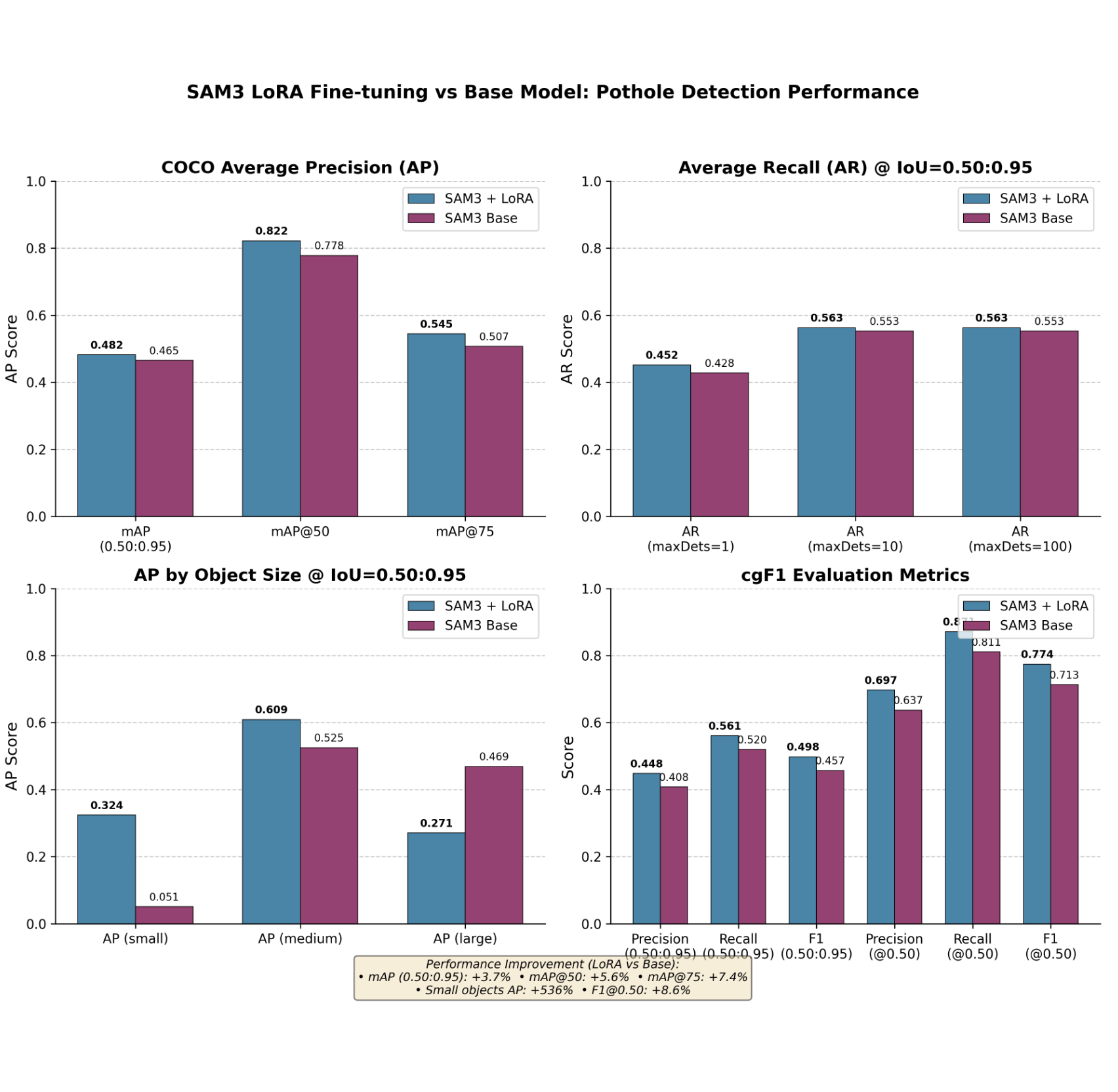 Validation performance: LoRA fine-tuned model vs Base SAM3 model
**Key Findings:**
- **LoRA Model (Fine-tuned)**: Shows improved precision and better detection of multiple potholes
- **Base Model**: Tends to produce more false positives and misses some instances
- **Dataset**: Pothole detection on road surfaces (data3)
### Visual Comparison
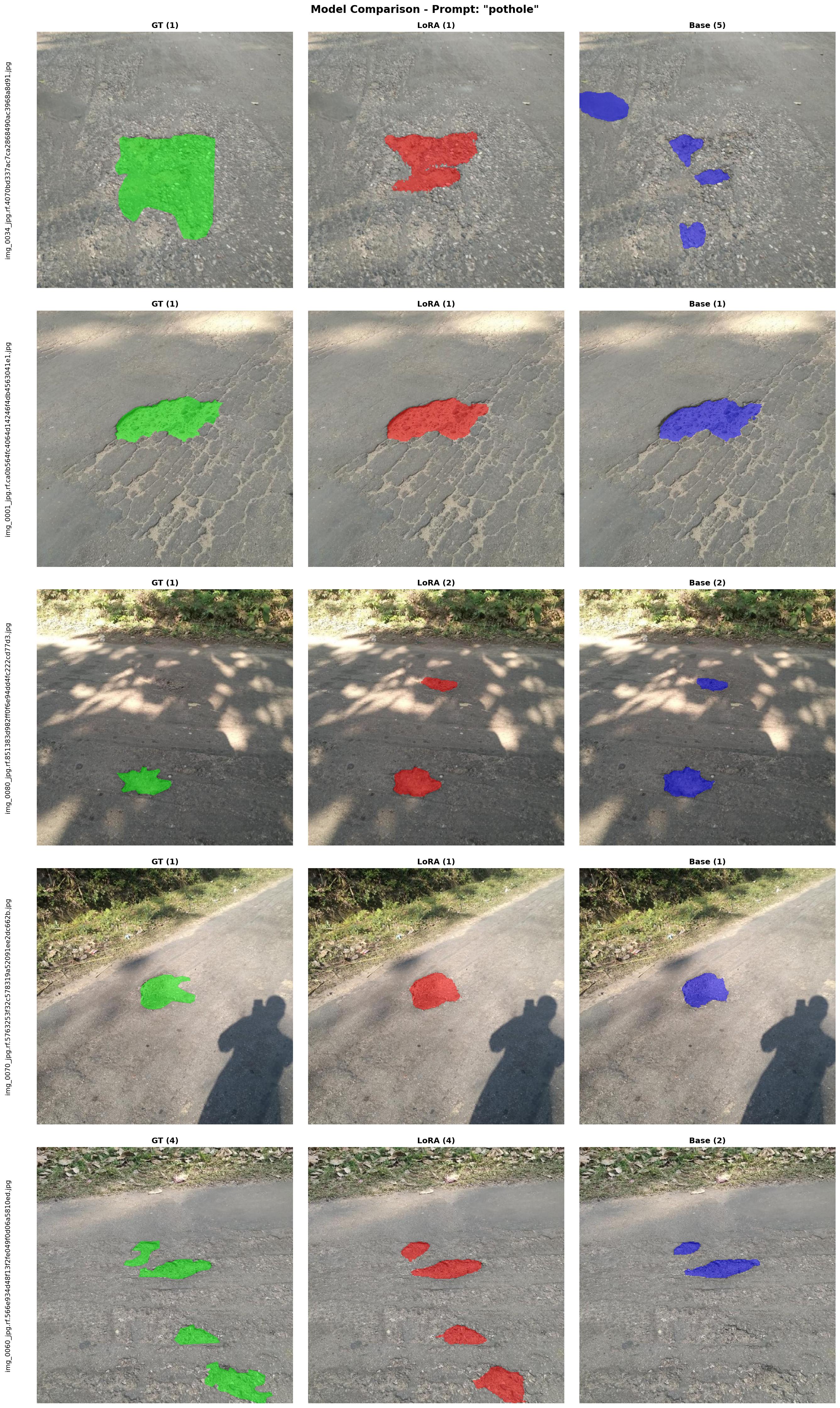 Side-by-side comparison: Ground Truth (Green) | LoRA Model (Red) | Base Model (Blue)
**Observations from Visual Results:**
| Image | Ground Truth | LoRA Model | Base Model | Analysis |
|-------|--------------|------------|------------|----------|
| **img_0034** | 1 pothole | 1 detection ✓ | 5 detections ✗ | LoRA matches GT perfectly, Base has 4 false positives |
| **img_0001** | 1 pothole | 1 detection ✓ | 1 detection ✓ | Both models perform well |
| **img_0080** | 1 pothole | 2 detections ~ | 2 detections ~ | Both have 1 false positive |
| **img_0070** | 1 pothole | 1 detection ✓ | 1 detection ✓ | Both models perform well |
| **img_0060** | 4 potholes | 4 detections ✓ | 2 detections ✗ | LoRA finds all instances, Base misses 2 |
**Summary:**
- **LoRA Model**: 3/5 perfect matches, better recall on multi-instance images
- **Base Model**: 2/5 perfect matches, struggles with multiple instances and false positives
- **Overall**: Fine-tuning with LoRA significantly improves detection accuracy for domain-specific tasks
**Training Details:**
- **Prompt**: "pothole" (auto-detected from COCO category names)
- **Architecture**: Full LoRA adaptation (vision, text, DETR encoders/decoders)
- **Dataset**: Road damage images with COCO-format annotations
- **Threshold**: 0.5 confidence for both models
---
## Examples
### Example 1: Quick Test (5 Epochs)
```bash
# Create minimal config
cat > configs/quick_test.yaml << EOF
lora:
rank: 4
alpha: 8
dropout: 0.1
target_modules: ["q_proj", "v_proj"]
apply_to_vision_encoder: true
apply_to_mask_decoder: false
training:
batch_size: 1
num_epochs: 5
learning_rate: 1e-4
weight_decay: 0.01
output:
output_dir: "outputs/quick_test"
EOF
# Train
python3 train_sam3_lora_native.py --config configs/quick_test.yaml
# Inference with text prompt
python3 infer_sam.py \
--config configs/quick_test.yaml \
--weights outputs/quick_test/best_lora_weights.pt \
--image test.jpg \
--prompt "car" \
--output result.png
# Multiple prompts
python3 infer_sam.py \
--config configs/quick_test.yaml \
--image test.jpg \
--prompt "car" "person" "bus" \
--output result.png
```
### Example 2: Production Training
```bash
# Create production config
cat > configs/production.yaml << EOF
lora:
rank: 32
alpha: 64
dropout: 0.1
target_modules: ["q_proj", "k_proj", "v_proj", "fc1", "fc2"]
apply_to_vision_encoder: true
apply_to_mask_decoder: true
apply_to_detr_encoder: true
apply_to_detr_decoder: true
training:
batch_size: 2
num_epochs: 50
learning_rate: 3e-5
weight_decay: 0.01
output:
output_dir: "outputs/production"
EOF
# Train (single GPU)
python3 train_sam3_lora_native.py --config configs/production.yaml
# Train (multi-GPU - 2 GPUs)
python3 train_sam3_lora_native.py --config configs/production.yaml --device 0 1
# Train (multi-GPU - 4 GPUs)
python3 train_sam3_lora_native.py --config configs/production.yaml --device 0 1 2 3
```
### Example 3: Multi-GPU Training
```bash
# Quick 2-GPU training
python3 train_sam3_lora_native.py \
--config configs/full_lora_config.yaml \
--device 0 1
# 4-GPU training for large datasets
python3 train_sam3_lora_native.py \
--config configs/full_lora_config.yaml \
--device 0 1 2 3
# Use specific GPUs (e.g., skip GPU 1)
python3 train_sam3_lora_native.py \
--config configs/full_lora_config.yaml \
--device 0 2 3
# With custom master port (if default 29500 is in use)
python3 train_sam3_lora_native.py \
--config configs/full_lora_config.yaml \
--device 0 1 \
--master_port 29501
```
**Tips for Multi-GPU Training:**
- Effective batch size = `batch_size × num_gpus`
- Learning rate can be scaled: `lr × num_gpus` (optional, try both)
- Memory per GPU stays the same as single-GPU
- Training time scales roughly linearly with GPU count
### Example 4: Programmatic Training
```python
from train_sam3_lora_native import SAM3TrainerNative
# Create trainer
trainer = SAM3TrainerNative("configs/full_lora_config.yaml")
# Train
trainer.train()
# Weights saved to: outputs/sam3_lora_full/lora_weights.pt
```
### Example 5: Batch Inference with Text Prompts
```python
from infer_sam import SAM3LoRAInference
from pathlib import Path
# Initialize once
inferencer = SAM3LoRAInference(
config_path="configs/full_lora_config.yaml",
weights_path="outputs/sam3_lora_full/best_lora_weights.pt"
)
# Process multiple images with same prompt
image_dir = Path("test_images")
output_dir = Path("predictions")
output_dir.mkdir(exist_ok=True)
for img_path in image_dir.glob("*.jpg"):
predictions = inferencer.predict(
str(img_path),
text_prompts=["car"]
)
output_path = output_dir / f"{img_path.stem}_pred.png"
inferencer.visualize(
predictions,
str(output_path)
)
print(f"✓ Processed {img_path.name}")
# Process with multiple prompts per image
for img_path in image_dir.glob("*.jpg"):
# Detect multiple object types at once
predictions = inferencer.predict(
str(img_path),
text_prompts=["crack", "defect", "damage"]
)
output_path = output_dir / f"{img_path.stem}_multi.png"
inferencer.visualize(predictions, str(output_path))
# Print summary
for idx in range(3):
result = predictions[idx]
print(f" {result['prompt']}: {result['num_detections']} detections")
```
---
## Advanced Usage
### Apply LoRA to Custom Models
```python
from lora_layers import LoRAConfig, apply_lora_to_model, count_parameters
import torch.nn as nn
# Your PyTorch model
model = YourModel()
# Configure LoRA
lora_config = LoRAConfig(
rank=8,
alpha=16,
dropout=0.1,
target_modules=["q_proj", "k_proj", "v_proj"],
apply_to_vision_encoder=True,
apply_to_text_encoder=False,
apply_to_geometry_encoder=False,
apply_to_detr_encoder=False,
apply_to_detr_decoder=False,
apply_to_mask_decoder=False,
)
# Apply LoRA (automatically freezes base model)
model = apply_lora_to_model(model, lora_config)
# Check trainable parameters
stats = count_parameters(model)
print(f"Trainable: {stats['trainable_parameters']:,} / {stats['total_parameters']:,}")
print(f"Percentage: {stats['trainable_percentage']:.2f}%")
# Train normally
optimizer = torch.optim.AdamW(
[p for p in model.parameters() if p.requires_grad],
lr=1e-4
)
```
### Save and Load LoRA Weights
```python
from lora_layers import save_lora_weights, load_lora_weights
# Save only LoRA parameters (small file!)
save_lora_weights(model, "my_lora_weights.pt")
# Load into new model
load_lora_weights(model, "my_lora_weights.pt")
```
---
## Project Structure
```
SAM3_LoRA/
├── configs/ # Training configs (base, full, light, minimal, crack detection)
│ └── full_lora_config.yaml # Default training config
├── data/ # COCO format dataset
│ ├── train/
│ │ ├── img001.jpg # Training images
│ │ ├── img002.jpg
│ │ └── _annotations.coco.json # COCO annotations
│ ├── valid/
│ │ ├── img001.jpg # Validation images
│ │ ├── img002.jpg
│ │ └── _annotations.coco.json # COCO annotations
│ └── test/
│ ├── img001.jpg # Test images (optional)
│ └── _annotations.coco.json # COCO annotations
├── outputs/
│ └── sam3_lora_full/
│ ├── best_lora_weights.pt # Best model (lowest val loss)
│ └── last_lora_weights.pt # Last epoch model
├── sam3/ # SAM3 model library
├── lora_layers.py # LoRA implementation
├── train_sam3_lora_native.py # Training script (computes validation loss only)
├── train_sam3_lora_with_categories.py # Alternative trainer (category-focused)
├── validate_sam3_lora.py # Full evaluation script (mAP, cgF1, NMS)
├── validate_single_image.py # Single image validation with visualization
├── infer_sam.py # Inference script (recommended)
├── inference_lora.py # Legacy inference script
├── merge_lora_weights.py # Fold a trained adapter into the base weights
├── convert_refcoco_to_coco.py # RefCOCO/RRSIS-D -> COCO layout converter
├── README_INFERENCE.md # Detailed inference guide
└── README.md # This file
```
---
## Troubleshooting
### Common Issues
**1. Hugging Face Authentication Error**
```
Error: Access denied to facebook/sam3
```
**Solution:**
- Make sure you've requested access at https://huggingface.co/facebook/sam3
- Wait for approval (check your email)
- Run `huggingface-cli login` and paste your token
- Or set: `export HF_TOKEN="your_token"`
**2. Import Errors**
```bash
# Make sure package is installed
pip install -e .
```
**3. CUDA Out of Memory**
```yaml
# Reduce batch size and rank in config
training:
batch_size: 1
lora:
rank: 4
```
**4. Very Low Loss (< 0.001)**
- Model may be overfitting
- Reduce LoRA rank
- Add more dropout
- Check if base model is properly frozen
**5. Loss Not Decreasing**
- Increase learning rate
- Increase LoRA rank
- Train for more epochs
- Check data quality
**6. Wrong Number of Trainable Parameters**
```
Expected: ~0.5-2% (for rank 4-16)
If you see 63%: Base model not frozen (bug fixed in latest version)
```
**7. No Validation Data**
```
⚠️ No validation data found - training without validation
```
**Solution:**
- Create `data/valid/` directory with same structure as `data/train/`
- Split your data: ~80% train, ~20% validation
- Training will work without validation but you won't see validation metrics
**8. Annotation Format Errors**
```
FileNotFoundError: COCO annotation file not found: /path/to/data/train/_annotations.coco.json
```
**Solution:**
- Ensure your data is in COCO format with `_annotations.coco.json` in each split folder
- Each split (train/valid/test) needs its own annotation file
- Images should be in the same directory as the annotation file
- Supported segmentation formats: polygon lists or RLE dictionaries
**9. Want to See mAP/cgF1 During Training?**
**Solution:**
- Training only computes validation loss (fast; mirrors how SAM3's code splits loss-during-training from offline COCO/cgF1 evaluators — see the note in Quick Start)
- After training, run `validate_sam3_lora.py` for full metrics with NMS
- This approach significantly speeds up training while still monitoring overfitting
- Validation loss is sufficient to detect overfitting and select best model
**10. Grid-Like Bounding Box Pattern in Inference**
```
Problem: Visualization shows many overlapping boxes forming a grid pattern
```
**Cause:** Missing NMS (Non-Maximum Suppression) filtering. SAM3 uses 100+ object queries that produce many overlapping predictions.
**Solution:**
```bash
# Use lower NMS IoU threshold to remove overlapping boxes
python3 infer_sam.py \
--config configs/full_lora_config.yaml \
--image test.jpg \
--prompt "object" \
--nms-iou 0.3 \
--output clean_output.png
```
**NMS IoU values:**
- `0.3` - Aggressive filtering (fewer boxes, cleaner output)
- `0.5` - Default, balanced
- `0.7` - Keep more overlapping detections
### Performance Benchmarks
| Configuration | Trainable Params | Checkpoint Size | GPU Memory | Speed |
|---------------|------------------|-----------------|------------|-------|
| Minimal (r=4) | ~0.2% | ~10 MB | 8 GB | Fast |
| Balanced (r=8) | ~0.5% | ~20 MB | 12 GB | Medium |
| Full (r=16) | ~1.0% | ~40 MB | 16 GB | Slower |
| Maximum (r=32) | ~2.0% | ~80 MB | 20 GB | Slowest |
*Benchmarks on NVIDIA RTX 3090*
---
## Troubleshooting & Performance Optimization
### Problem: Out of Memory (OOM) During Training
**Symptoms:**
```
Killed (exit code 137)
Training crashes after a few batches
```
**Solutions (based on SAM3 original approach):**
1. **Use Light LoRA Config** (Recommended for GPUs with <24GB VRAM):
```bash
python train_sam3_lora_native.py --config configs/light_lora_config.yaml
```
This config:
- Reduces LoRA rank from 32 to 16
- Applies LoRA to fewer modules (skips vision encoder, geometry encoder)
- Uses batch_size=2 instead of 1
- ~60% less memory usage!
2. **Reduce Batch Size** in `configs/full_lora_config.yaml`:
```yaml
training:
batch_size: 2 # Current optimized value (was 8, then 1)
gradient_accumulation_steps: 8 # Maintains effective batch size of 16
```
**Note**: `batch_size=2` is better than `batch_size=1` because it reduces gradient variance and leads to more stable training.
3. **Clear GPU Memory** before training:
```bash
nvidia-smi # Check GPU usage
pkill python3 # Kill hanging processes
python train_sam3_lora_native.py --config configs/light_lora_config.yaml
```
### Understanding SAM3 Loss Values
**Loss values of 110-159 are NORMAL for SAM3!** ✅
SAM3 uses **weighted multi-component loss** following the original implementation:
- `loss_mask`: 200.0 (dominant component)
- `loss_ce`: 20.0 (classification)
- `loss_dice`: 10.0 (dice coefficient)
- `loss_bbox`: 5.0 (bounding box)
- `loss_giou`: 2.0 (generalized IoU)
- `presence_loss`: 20.0 (object presence)
**Example calculation:**
```python
# Typical unweighted losses at start:
loss_mask: 0.5 × 200 = 100
loss_ce: 0.5 × 20 = 10
loss_dice: 0.5 × 10 = 5
# ... others contribute ~15
Total: ~130 (NORMAL!)
```
**What to monitor:**
- ✅ **Trending downward**: Loss 150 → 120 → 100 → 80 (good!)
- ❌ **Erratic jumps**: Loss 150 → 100 → 200 → 90 (batch_size too small, see fixes below)
- ❌ **Stuck**: Loss stays at 150 for many epochs (learning rate too low)
**If loss is highly fluctuating** (e.g., 169 → 141 → 242 → 182):
1. **Increase batch_size** from 1 to 2 (reduces gradient variance)
2. **Check data_dir** in config points to correct location
3. **Reduce LoRA rank** if getting OOM errors (64 → 32)
### Problem: Low mAP/cgF1 Metrics
**Comparison to SAM3 Original Validation:**
| Aspect | SAM3 Original | Our Implementation |
|--------|---------------|-------------------|
| **Primary Metric** | cgF1 (concept-level F1) | mAP + cgF1 |
| **NMS Filtering** | Built into inference | Explicit apply_sam3_nms() |
| **Evaluation** | Loss-based during training | Full segmentation metrics |
| **Resolution** | Fixed (dataset-dependent) | Flexible (288 or original) |
**Solutions:**
1. **Check Dataset Quality**:
```bash
# Your dataset is small:
# Training: 778 images, 1631 annotations
# Validation: 152 images, 298 annotations
# For good performance, SAM3 typically uses:
# - Training: 10K+ images
# - More annotations per image (2-3 average is low)
```
2. **Adjust NMS Thresholds** in validate_sam3_lora.py:
```python
# Line 865-867: Current settings
prob_threshold=0.3 # Try 0.4-0.5 (stricter)
nms_iou_threshold=0.7 # Try 0.5-0.6 (more aggressive merging)
max_detections=100 # Reduce to 50 if over-predicting
```
3. **Train Longer (but not too long)**:
```yaml
# Updated in configs/full_lora_config.yaml
num_epochs: 100 # Reduced from 500 (small dataset overfits quickly)
eval_steps: 100 # More frequent validation to catch overfitting
```
4. **Use Lighter LoRA** for small datasets:
- Full LoRA (11.8M params) may overfit on 778 images
- Light LoRA (~5M params) generalizes better
- Try: `configs/light_lora_config.yaml`
### Problem: Training is Very Slow
**Solutions:**
1. **Increase Workers**:
```yaml
training:
num_workers: 2 # Already optimized from 1
```
2. **Use Smaller Validation Subset** during training:
- Edit train_sam3_lora_native.py to validate on first 50 images only
- Do full validation post-training
3. **Reduce Validation Frequency**:
```yaml
training:
eval_steps: 200 # Increase if validation takes too long
```
### Expected Performance Targets
Based on SAM3 fine-tuning benchmarks and your dataset size:
**After 10 epochs** (with light_lora_config.yaml):
- Training loss: 10-20
- mAP@50: 0.15-0.30
- cgF1@50: 0.25-0.40
**After 50 epochs**:
- Training loss: 5-10
- mAP@50: 0.30-0.50
- cgF1@50: 0.40-0.60
**After 100 epochs** (optimal):
- Training loss: 3-7
- mAP@50: 0.40-0.65
- cgF1@50: 0.50-0.70
**Note**: Small dataset (778 images) limits max achievable performance. For mAP >0.7, you typically need 5K+ training images.
### Recommended Training Strategy
**Quick Start (Testing)**:
```bash
# 1. Use light config for fast iteration
python train_sam3_lora_native.py --config configs/light_lora_config.yaml
# 2. Monitor first 10 batches (loss should decrease)
# 3. Train for 20-30 epochs first
# 4. Run validation:
python validate_sam3_lora.py \
--config configs/light_lora_config.yaml \
--weights outputs/sam3_lora_light/checkpoint_epoch_30.pt \
--val_data_dir /workspace/data2/valid
```
**Full Training (Production)**:
```bash
# 1. If light config works well, try full config
python train_sam3_lora_native.py --config configs/full_lora_config.yaml
# 2. Train for 100 epochs max
# 3. Validate at checkpoints: 20, 50, 100 epochs
# 4. Use best performing checkpoint
```
---
## Citation
If you use this work, please cite:
```bibtex
@software{sam3_lora,
title = {SAM3-LoRA: Low-Rank Adaptation for Fine-Tuning},
author = {AI Research Group, KMUTT},
year = {2026},
version = {0.3.0},
organization = {King Mongkut's University of Technology Thonburi},
url = {https://github.com/Sompote/SAM3_LoRA}
}
```
### References
- **LoRA**: [Hu et al., 2021](https://arxiv.org/abs/2106.09685) - "LoRA: Low-Rank Adaptation of Large Language Models"
- **SAM**: [Kirillov et al., 2023](https://arxiv.org/abs/2304.02643) - "Segment Anything"
- **SAM3**: Meta AI Research
---
## Credits
**Made by AI Research Group, KMUTT**
*King Mongkut's University of Technology Thonburi*
---
## License
This project is licensed under Apache 2.0. See [LICENSE](LICENSE) for details.
---
**Version**: 0.3.0
**Python**: 3.8+
**PyTorch**: 2.0+
Built with ❤️ for the research community
[⬆ Back to Top](#sam3-lora-efficient-fine-tuning-with-low-rank-adaptation)