 |
 |
 |
 |
 |
 |
 |
 |
 |
 |
 |
 |

 |
 |
 |
 |
 |
 |
 # MiniHawk-VTOL
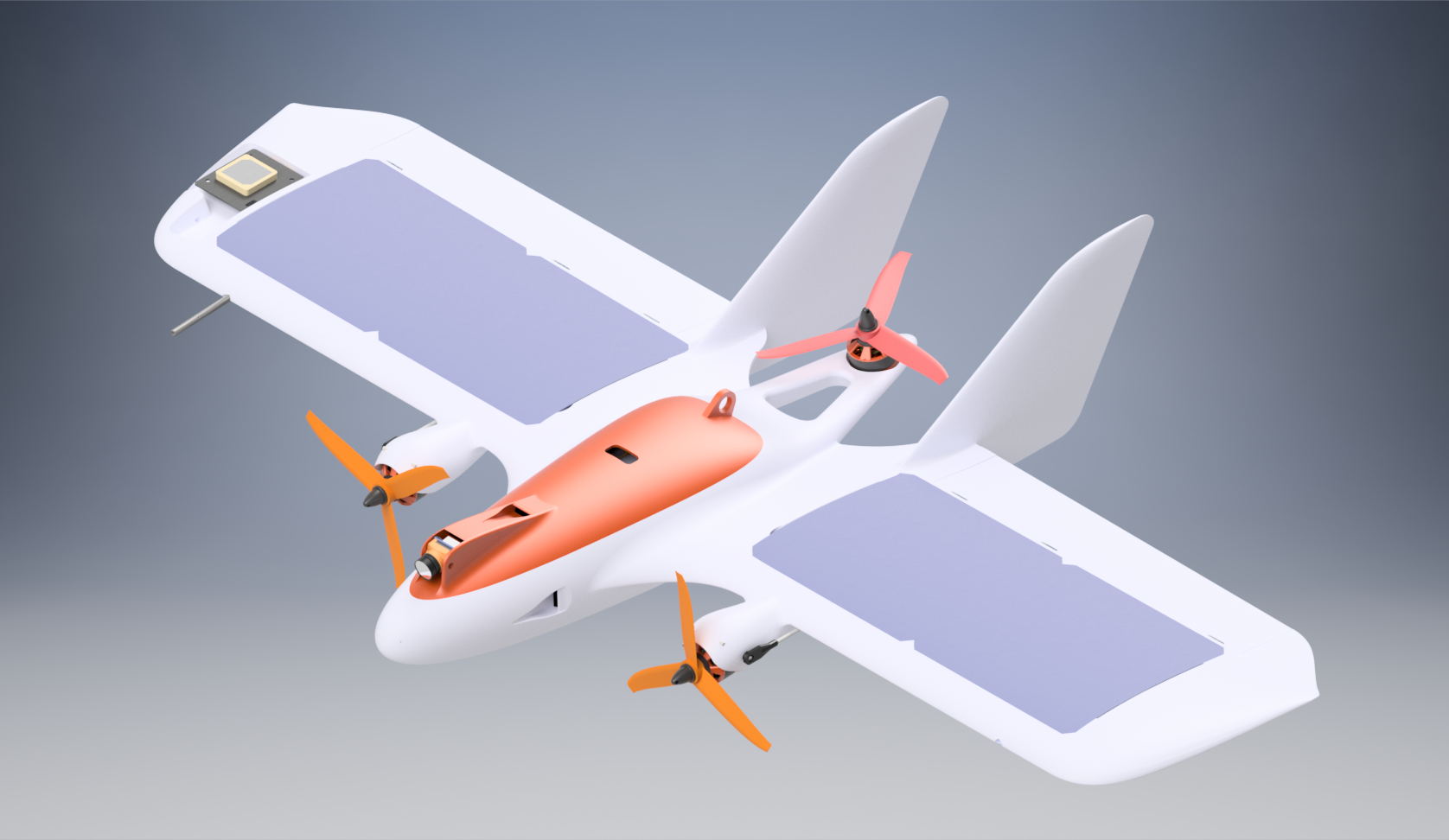
The MiniHawk VTOL is a 3D-Printed Tricopter/Fixed-wing hybrid aircraft, capable of Vertical Take-off and Landing. As with its predecessor, the [OrangeHawk VTOL](https://diydrones.com/profiles/blogs/the-orange-hawk-tricopter-flying-wing-vtol-uav), the MiniHawk is intended for R/C, FPV and UAV experimentation. Mechanical artwork, build instructions, and configuration settings are provided in this repository.
> **🔺CRITICAL WARNING🔺 IMPORTANT DIRECTIVE FOR NEW BUILDS - 22 FEBRUARY 2022: The old Version 2.0 Nacelle Arms and Motor Tilt Mounts are NOT RECCOMENDED for new builds; they are buggy and prone to cause yaw and transitions issues, if not dangerous vehicle behavior due to the crank design being too hard for servos to pull. The ZIP files on Hackaday and the V2.0 zip file here on GitHub have the old nacelle design- DO NOT USE THEM! I HIGHLY reccomend using the new nacelle design that is currently available on both the master and development branches. If you have downloaded the Version 2.0 ZIP files from either Hackaday or here, replace the Nacelle and TiltMount STLs with the new ones! The prerelease of Version 2.1 is taking a while to finish; the new ZIP files will have the corrected design.**
> **⚠️WARNING⚠️ PLEASE BE ADVISED - 12 DECEMBER 2021: With the prerelease of Version 2.1 in the works, some parts of this README are being rewritten, such as the build instructions and the _New_ Parts Tree Diagram, and an Exploded Assembly Diagram is being made. The images for the build process are over a year old and need to be updated with new images, but the essence they convey is still the same. A `development` branch has been created with the goal to hide as much of the mess as possible; check there if you want to see the cutting-edge. Regardless, just be aware that some of this content needs to be mended or fixed.**
**Milestones**
| Date | Event |
|--------------|-------------------------------|
| 15 Oct 2020 | Initial Release (v1.0) |
| 2 Oct 2021 | Version 2 (v2.0, MH7_ prefix) |
| prerelease | Version 2.1 |
Project Page at Hackaday: [HACKADAY.IO Page](https://hackaday.io/project/175286-minihawk-vtol)
MiniHawk Design Details and Features discussed here: [RCGroups VTOLs Forum Thread](https://www.rcgroups.com/forums/showthread.php?3986653-MiniHawk-VTOL-A-3D-Printed-Tricopter-Tilt-Rotor-Fixed-Wing-Plank)
Featured MiniHawk-VTOL Builds by community members: [RCGroups 3D-Printed Forum Thread](https://www.rcgroups.com/forums/showthread.php?3750791-KatanaGuy-s-MiniHawk-VTOL)
Accompanying Build Video Series: [YouTube Playlist](https://www.youtube.com/playlist?list=PLEMjH2uELUcYI_DS1zthgjE4Su79LeA_G)
Betaflight VTOL Firmware Build: [vtol-motor-mix](https://github.com/StephenCarlson/betaflight/tree/vtol-motor-mix)
# Table of Contents
1. [Introduction](#head-brief)
1.1 [Description](#head-description)
1.2 [How To Use This Repo](#head-usage)
1.3 [Remarks / FAQs](#head-faqs)
1.4 [Metrics](#head-metrics)
2. [Build Information](#build-brief)
2.1 [Recommended Tools](#build-tools)
2.2 [Components and Electronics](#build-components)
2.3 [Airframe Parts Listing](#build-airframeparts)
3. [Build Steps](#buildseq-brief)
3.1 [Part 1 - Airframe Structures](#buildseq-part1)
3.2 [Part 2 - Linkages and Servos](#buildseq-part2)
3.3 [Part 3 - Electronics and Finishing](#buildseq-part3)
4. [Flight Testing](#flight-brief)
5. [3D Printing Guidelines](#3dprinting-brief)
6. [ArduPlane](#arduplane-brief)
6.1 [R/C Controls Configuration](#arduplane-controlsconfig)
6.2 [Flight Controller Connections](#arduplane-connections)
6.3 [Parameters](#arduplane-parameters)
6.4 [Remarks](#arduplane-remarks)
8. [License](#license-brief)
## Description
The MiniHawk is a 3D-Printed VTOL aircraft. It was designed with printability in mind, and is intended to provide the community with a common and accessible VTOL testbed for experimentation and tinkering. Specifically, the vehicle is designed to demonstrate migratory (or recurrent solar energy harvesting) mission behaviors with the _minimum_ cost and complexity to build. The vehicle uses three (3) brushless DC motors for propulsion, with the forward pair tilting for forward flight and yaw control, and the rear motor fixed for hover only. Four (4) servos are used to tilt the forward motors and to control the elevon control surfaces of the wing. The airframe is a "plank"-style wing with a center body containing avionics and battery, and internal conduits routing to the nacelles and servos. Twin vertical stabilizer fins provide mild directional stability.
## How To Use This Repo
This project is hosted on GitHub, which is traditionally a software repository site, but the format works well for a hardware project such as the MiniHawk-VTOL, where a few of the features come in handy:
- The history for each part file is accessible; if you need an old version, it is available even off-line if you've "cloned" the repo. (Beware, cloning the repo means hundreds of MB download.)
- [Versions and Releases](https://github.com/StephenCarlson/MiniHawk-VTOL/releases) are published just like a software project, and this includes setting milestones and planning future releases, keeping the community informed about what is next. Releases are the condensed set of essential files, placed in a zip archive, which represent a snapshot of the project at a moment when the artwork is stable and worth broad public distribution.
- The [Issues](https://github.com/StephenCarlson/MiniHawk-VTOL/issues) tab allow for the community to participate in the evolution of the design by providing feedback or contributions toward improving the design.
- The [Discussions](https://github.com/StephenCarlson/MiniHawk-VTOL/discussions) tab is another location for communication on the project.
While I have described the hosting environment, it isn't necessary for you to make a GitHub account or participate in the project; and more than likely, you are just interested in downloading the STLs and making the plane. Here is what you need to do:
- Click on the [Latest Release](https://github.com/StephenCarlson/MiniHawk-VTOL/releases/latest) in the Top-Right section of this webpage. This will take you to the most recent version of the design that was stable.
- Read the description to understand what is new or notable for the release, and then look under the Assets section and find the .zip file named `MiniHawk-VTOL-x.x.x.zip`, where the 'x''s are the release version numbers. Skip the `Source Code` downloads as these are auto-generated by GitHub and represent the entire contents of the project, which you probably are not interested in unless you really want all of it.
- Unzip the archive and examine the files. A snapshot of this README you are reading is contained in the README.md file, and it should be able to be opened by any text editor.
- Follow the [Build Steps](#buildseq-brief) below. It should be possible to print this page or save as a PDF. If you are code-savvy, this is all written in Markdown and should render in whatever text editor or Markdown renderer you prefer.
## Remarks / FAQs
- As this is a totally 3D-printed airframe, the fully-finished vehicle is moderately heavy, which is a handicap, especially in the hovering mode of flight. As such, be gentle and cautious in adding any additional weight. For the recommended print settings with a 0.4mm nozzle on standard PLA, the airframe alone weights a bit over 460g, and the all-up-weight of the finished vehicle is between 1000g to 1200g.
- The parts used in this project are commonly available in the drone racing and R/C plane market(s). Standard motors such as 2207, 2306 or similar can be used. The nacelle design dictates a maximum motor bell diameter of 29mm, but this is relaxed compared to previous versions of the design that had more stringent requirements. The Ball-Stud Linkage is perhaps the most specific part used, with Dubro #181, Dubro #190, or even Dubro #367 as acceptable options.
- The aerodynamics and stability of the vehicle are still under analysis and subject to revision. The CFD poses/cases used for aerodynamics analysis are included for independent study.
- As of Version 2 of this design, project files are prefixed with "MH7", as this is the 7th internal revision of the design of the MiniHawk VTOL. There may be some old "MH5" parts are retained in the repo; these are from the old version(s). Also, the "MH#" prefix is incidental and not to be confused with the MH airfoil series, of which the MH45 is used for this vehicle. Generally, "MiniHawk-VTOL" is the correct name for this design and any revisions to be released.
- This vehicle was designed in Autodesk Inventor Professional 2019. While compiled STLs are provided as open-access, the Solid Model and Assembly Source files for this vehicle are withheld at the time of this writing; contact me for inquires on obtaining a copy or further development. One minor accommodation: STEP/STP versions of some parts such as the Hatch/Lid are included for community derivations.
- There are some variants to each part, such as the wings being available as smooth/plain wings, or with features to accomodate Maxeon™ C60 solar cells. The Winglet is available as "normal" or with an excavation for a GPS or other devices. The Hatch/Lid has a FPV Variant, which supports the Foxeer -Nano camera formfactor (15mm width) and has a 30.5mm grid for a video transmitter, such as the AKK Infinite DVR. All the part options and variations are detailed below in the [Parts Tree Diagram](#build-airframeparts).
## Metrics
| Description | Value |
|--------------------------|---------------------------|
| Wing Span | 800mm |
| Wing Area | 15.6dm^2 |
| Aspect Ratio | 4.1 |
| Airfoil (Root and Tip) | [MH45][1] |
| Length | 520mm |
| Rotor Spacing | 315mm Circle |
| Lipoly Battery | 4s, 1300-1500mAh (~160g) |
| Motors (front) | 2207 or 2306 2300-2600kV |
| Motor (rear) | 2207 or 2306 ~2000kV |
| Servos | HS-65HB/MG or eqv. |
| Flight Controller (size) | 30.50mm to 16.0mm Grid |
| Propellers (front) | 5050 to ~5249 |
| Propeller (rear) | 6030 to ~5249 |
| All-up Weight | 1000g to ~1200g w/ PLA |
[1]:
# MiniHawk-VTOL
The MiniHawk VTOL is a 3D-Printed Tricopter/Fixed-wing hybrid aircraft, capable of Vertical Take-off and Landing. As with its predecessor, the [OrangeHawk VTOL](https://diydrones.com/profiles/blogs/the-orange-hawk-tricopter-flying-wing-vtol-uav), the MiniHawk is intended for R/C, FPV and UAV experimentation. Mechanical artwork, build instructions, and configuration settings are provided in this repository.
> **🔺CRITICAL WARNING🔺 IMPORTANT DIRECTIVE FOR NEW BUILDS - 22 FEBRUARY 2022: The old Version 2.0 Nacelle Arms and Motor Tilt Mounts are NOT RECCOMENDED for new builds; they are buggy and prone to cause yaw and transitions issues, if not dangerous vehicle behavior due to the crank design being too hard for servos to pull. The ZIP files on Hackaday and the V2.0 zip file here on GitHub have the old nacelle design- DO NOT USE THEM! I HIGHLY reccomend using the new nacelle design that is currently available on both the master and development branches. If you have downloaded the Version 2.0 ZIP files from either Hackaday or here, replace the Nacelle and TiltMount STLs with the new ones! The prerelease of Version 2.1 is taking a while to finish; the new ZIP files will have the corrected design.**
> **⚠️WARNING⚠️ PLEASE BE ADVISED - 12 DECEMBER 2021: With the prerelease of Version 2.1 in the works, some parts of this README are being rewritten, such as the build instructions and the _New_ Parts Tree Diagram, and an Exploded Assembly Diagram is being made. The images for the build process are over a year old and need to be updated with new images, but the essence they convey is still the same. A `development` branch has been created with the goal to hide as much of the mess as possible; check there if you want to see the cutting-edge. Regardless, just be aware that some of this content needs to be mended or fixed.**
**Milestones**
| Date | Event |
|--------------|-------------------------------|
| 15 Oct 2020 | Initial Release (v1.0) |
| 2 Oct 2021 | Version 2 (v2.0, MH7_ prefix) |
| prerelease | Version 2.1 |
Project Page at Hackaday: [HACKADAY.IO Page](https://hackaday.io/project/175286-minihawk-vtol)
MiniHawk Design Details and Features discussed here: [RCGroups VTOLs Forum Thread](https://www.rcgroups.com/forums/showthread.php?3986653-MiniHawk-VTOL-A-3D-Printed-Tricopter-Tilt-Rotor-Fixed-Wing-Plank)
Featured MiniHawk-VTOL Builds by community members: [RCGroups 3D-Printed Forum Thread](https://www.rcgroups.com/forums/showthread.php?3750791-KatanaGuy-s-MiniHawk-VTOL)
Accompanying Build Video Series: [YouTube Playlist](https://www.youtube.com/playlist?list=PLEMjH2uELUcYI_DS1zthgjE4Su79LeA_G)
Betaflight VTOL Firmware Build: [vtol-motor-mix](https://github.com/StephenCarlson/betaflight/tree/vtol-motor-mix)
# Table of Contents
1. [Introduction](#head-brief)
1.1 [Description](#head-description)
1.2 [How To Use This Repo](#head-usage)
1.3 [Remarks / FAQs](#head-faqs)
1.4 [Metrics](#head-metrics)
2. [Build Information](#build-brief)
2.1 [Recommended Tools](#build-tools)
2.2 [Components and Electronics](#build-components)
2.3 [Airframe Parts Listing](#build-airframeparts)
3. [Build Steps](#buildseq-brief)
3.1 [Part 1 - Airframe Structures](#buildseq-part1)
3.2 [Part 2 - Linkages and Servos](#buildseq-part2)
3.3 [Part 3 - Electronics and Finishing](#buildseq-part3)
4. [Flight Testing](#flight-brief)
5. [3D Printing Guidelines](#3dprinting-brief)
6. [ArduPlane](#arduplane-brief)
6.1 [R/C Controls Configuration](#arduplane-controlsconfig)
6.2 [Flight Controller Connections](#arduplane-connections)
6.3 [Parameters](#arduplane-parameters)
6.4 [Remarks](#arduplane-remarks)
8. [License](#license-brief)
## Description
The MiniHawk is a 3D-Printed VTOL aircraft. It was designed with printability in mind, and is intended to provide the community with a common and accessible VTOL testbed for experimentation and tinkering. Specifically, the vehicle is designed to demonstrate migratory (or recurrent solar energy harvesting) mission behaviors with the _minimum_ cost and complexity to build. The vehicle uses three (3) brushless DC motors for propulsion, with the forward pair tilting for forward flight and yaw control, and the rear motor fixed for hover only. Four (4) servos are used to tilt the forward motors and to control the elevon control surfaces of the wing. The airframe is a "plank"-style wing with a center body containing avionics and battery, and internal conduits routing to the nacelles and servos. Twin vertical stabilizer fins provide mild directional stability.
## How To Use This Repo
This project is hosted on GitHub, which is traditionally a software repository site, but the format works well for a hardware project such as the MiniHawk-VTOL, where a few of the features come in handy:
- The history for each part file is accessible; if you need an old version, it is available even off-line if you've "cloned" the repo. (Beware, cloning the repo means hundreds of MB download.)
- [Versions and Releases](https://github.com/StephenCarlson/MiniHawk-VTOL/releases) are published just like a software project, and this includes setting milestones and planning future releases, keeping the community informed about what is next. Releases are the condensed set of essential files, placed in a zip archive, which represent a snapshot of the project at a moment when the artwork is stable and worth broad public distribution.
- The [Issues](https://github.com/StephenCarlson/MiniHawk-VTOL/issues) tab allow for the community to participate in the evolution of the design by providing feedback or contributions toward improving the design.
- The [Discussions](https://github.com/StephenCarlson/MiniHawk-VTOL/discussions) tab is another location for communication on the project.
While I have described the hosting environment, it isn't necessary for you to make a GitHub account or participate in the project; and more than likely, you are just interested in downloading the STLs and making the plane. Here is what you need to do:
- Click on the [Latest Release](https://github.com/StephenCarlson/MiniHawk-VTOL/releases/latest) in the Top-Right section of this webpage. This will take you to the most recent version of the design that was stable.
- Read the description to understand what is new or notable for the release, and then look under the Assets section and find the .zip file named `MiniHawk-VTOL-x.x.x.zip`, where the 'x''s are the release version numbers. Skip the `Source Code` downloads as these are auto-generated by GitHub and represent the entire contents of the project, which you probably are not interested in unless you really want all of it.
- Unzip the archive and examine the files. A snapshot of this README you are reading is contained in the README.md file, and it should be able to be opened by any text editor.
- Follow the [Build Steps](#buildseq-brief) below. It should be possible to print this page or save as a PDF. If you are code-savvy, this is all written in Markdown and should render in whatever text editor or Markdown renderer you prefer.
## Remarks / FAQs
- As this is a totally 3D-printed airframe, the fully-finished vehicle is moderately heavy, which is a handicap, especially in the hovering mode of flight. As such, be gentle and cautious in adding any additional weight. For the recommended print settings with a 0.4mm nozzle on standard PLA, the airframe alone weights a bit over 460g, and the all-up-weight of the finished vehicle is between 1000g to 1200g.
- The parts used in this project are commonly available in the drone racing and R/C plane market(s). Standard motors such as 2207, 2306 or similar can be used. The nacelle design dictates a maximum motor bell diameter of 29mm, but this is relaxed compared to previous versions of the design that had more stringent requirements. The Ball-Stud Linkage is perhaps the most specific part used, with Dubro #181, Dubro #190, or even Dubro #367 as acceptable options.
- The aerodynamics and stability of the vehicle are still under analysis and subject to revision. The CFD poses/cases used for aerodynamics analysis are included for independent study.
- As of Version 2 of this design, project files are prefixed with "MH7", as this is the 7th internal revision of the design of the MiniHawk VTOL. There may be some old "MH5" parts are retained in the repo; these are from the old version(s). Also, the "MH#" prefix is incidental and not to be confused with the MH airfoil series, of which the MH45 is used for this vehicle. Generally, "MiniHawk-VTOL" is the correct name for this design and any revisions to be released.
- This vehicle was designed in Autodesk Inventor Professional 2019. While compiled STLs are provided as open-access, the Solid Model and Assembly Source files for this vehicle are withheld at the time of this writing; contact me for inquires on obtaining a copy or further development. One minor accommodation: STEP/STP versions of some parts such as the Hatch/Lid are included for community derivations.
- There are some variants to each part, such as the wings being available as smooth/plain wings, or with features to accomodate Maxeon™ C60 solar cells. The Winglet is available as "normal" or with an excavation for a GPS or other devices. The Hatch/Lid has a FPV Variant, which supports the Foxeer -Nano camera formfactor (15mm width) and has a 30.5mm grid for a video transmitter, such as the AKK Infinite DVR. All the part options and variations are detailed below in the [Parts Tree Diagram](#build-airframeparts).
## Metrics
| Description | Value |
|--------------------------|---------------------------|
| Wing Span | 800mm |
| Wing Area | 15.6dm^2 |
| Aspect Ratio | 4.1 |
| Airfoil (Root and Tip) | [MH45][1] |
| Length | 520mm |
| Rotor Spacing | 315mm Circle |
| Lipoly Battery | 4s, 1300-1500mAh (~160g) |
| Motors (front) | 2207 or 2306 2300-2600kV |
| Motor (rear) | 2207 or 2306 ~2000kV |
| Servos | HS-65HB/MG or eqv. |
| Flight Controller (size) | 30.50mm to 16.0mm Grid |
| Propellers (front) | 5050 to ~5249 |
| Propeller (rear) | 6030 to ~5249 |
| All-up Weight | 1000g to ~1200g w/ PLA |
[1]: |
|
|
|
|
|
|
|
|
|
|
|
|
|
|
|
|
|