
# ai-policy-generator
A Claude Code / Cowork skill that generates a polished three-page **AI Use Policy** for any company. Aligned to **EU AI Act Articles 4, 5 and 50**, with optional **Annex III** high-risk addendum for regulated sectors.
The skill researches the company, asks 12 short questions across four batches, drafts the full policy in chat for the user to validate, and only then writes the final files.
## What you get
When the skill runs to completion, it writes two files to the user's folder:
- `ai-use-policy-{slug}-v{version}.html` — print-ready three-page A4 policy (cover, the rules, the duties)
- `ai-use-policy-{slug}-inputs.json` — sidecar with every answer, used to re-run the skill with minimal questions next time
The user opens the HTML, hits the floating **Save as PDF** button (or Cmd/Ctrl+P), prints with Margins: None, and gets a clean signed PDF.
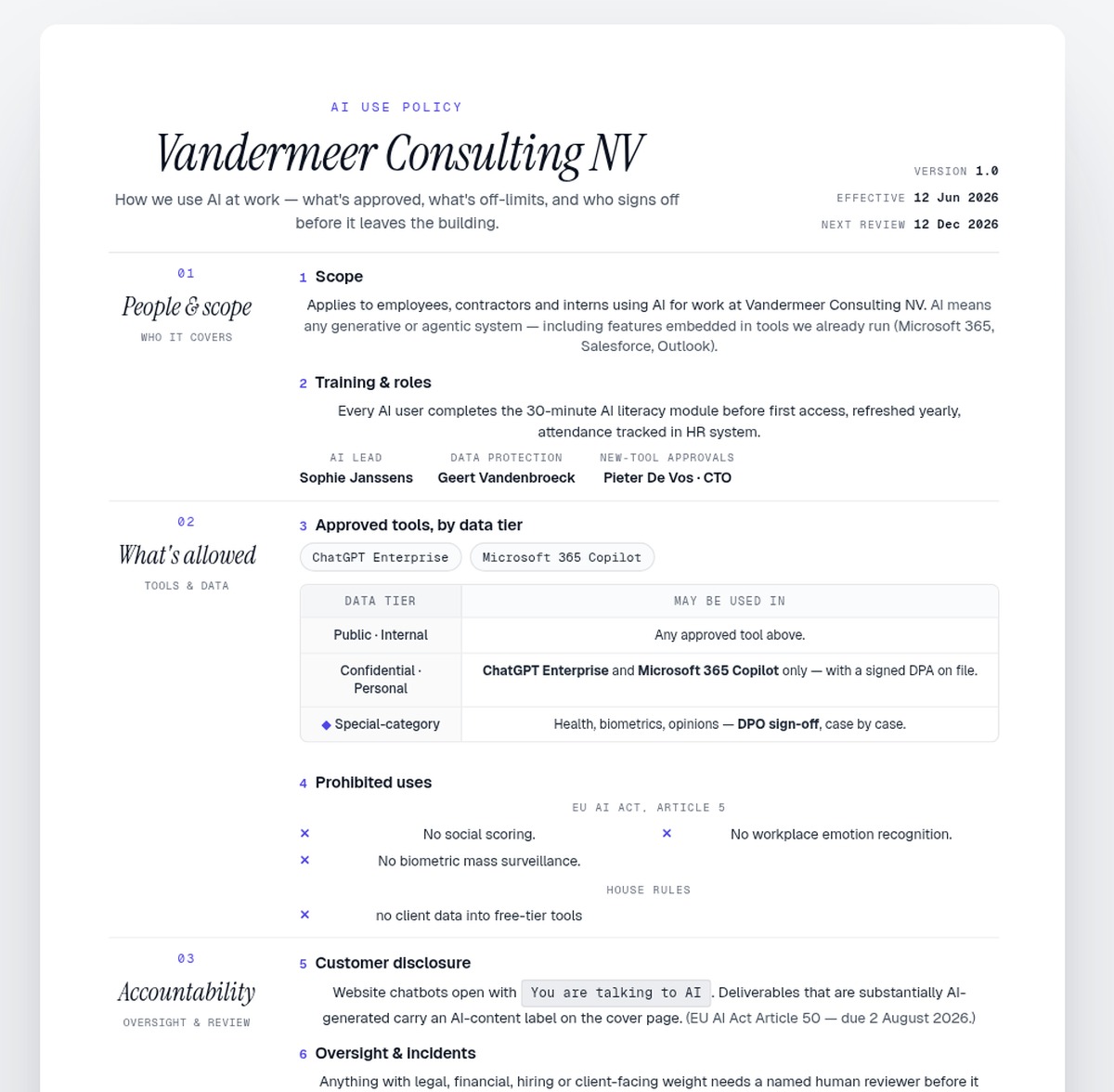
Top of the example one-pager for a fictional consulting firm. Same render shown on the shadow AI article.
## Quick start
### Option A — Install as a downloadable skill bundle
1. Run `./build.sh` to produce `ai-policy-generator.skill` (a zip of this directory)
2. Drag the `.skill` file into Cowork or Claude Code
3. Trigger with any of: *"create an AI policy"*, *"draft an AI use policy"*, *"AI policy generator"*
### Option B — Use directly from this checkout
Symlink the directory into your skills folder:
```bash
ln -s "$(pwd)" ~/.claude/skills/ai-policy-generator
# or for Cowork:
ln -s "$(pwd)" "$HOME/Library/Application Support/Claude/skills/ai-policy-generator"
```
Trigger as above. The skill reads `template.html` and `i18n/{lang}.json` at runtime.
## What's in this repo
```
ai-policy-generator-skill/
├── README.md # this file
├── LICENSE # MIT
├── CHANGELOG.md # version history
├── build.sh # zips the directory into ai-policy-generator.skill
├── SKILL.md # the skill instructions (read by Claude at runtime)
├── template.html # the policy template with {{PLACEHOLDER}} markers
├── i18n/
│ ├── en.json # English string pack
│ ├── nl.json # Dutch
│ ├── fr.json # French
│ └── de.json # German
└── examples/
├── sample-vandermeer-inputs.json # fictional filled example (inputs)
└── sample-vandermeer.html # fictional filled example (rendered)
```
## The flow
1. **Greet** and set expectation: 12 questions across 4 batches, full draft in chat, you approve, then HTML.
2. **Context question** — paste anything about the company (website, sector, customers, data, country).
3. **Research** — WebSearch confirms legal entity, CEO, regulator, Annex III sector flags. The skill never invents names.
4. **Structural questions** across 2 batches:
- Language, governance proxy (airlock or other or none), scope (company-wide or department)
- AI clients (chat tools), embedded AI (Copilot, Einstein, Notion AI, Slack AI, etc.), customer-facing AI (chatbot, in-product, voice)
5. **Sector specifics + enforcement** — Annex III enumeration for regulated sectors, breach detection method
6. **People & internals** — CEO, AI Officer (name + email + Slack), DPO + channel, tool access path, live register URL, disciplinary code name
7. **Full draft in chat with zero placeholders** — the user reads the policy as a faithful preview of what the HTML will render, word for word
8. **Iterate until approved** — no file generation before explicit user approval
9. **Generate** the HTML + JSON sidecar
10. **Print instructions** — Margins: None, Scale: Default, Background graphics: ON, Headers and footers: OFF, A4
## Output structure
Three A4 pages by default:
- **Cover** — dark indigo hero, company identity, version, effective and review dates, classification
- **The rules** — Purpose & scope, Three duties (Train / Stay on list / Report), Banned full stop (Article 5 plus house rules), Data tier matrix, Approved tools register, optional Annex III addendum
- **The duties** — Transparency, Accountability, Confidentiality and IP, Incidents same business day, Sanctions, Where to ask, Acknowledgement and review
Content can grow beyond three pages. A JS splitter in the template automatically divides long sheets into discrete A4 cards at band boundaries, with `part N of M` page numbering rewritten to match the actual count.
## Languages
English, Dutch, French, German. The static policy text lives in `i18n/{lang}.json`. Each language pack covers all clause headings, fixed clause text, the Article 5 prohibition list, and the default house rules. Variables (company name, contacts, tools register, addendum content) are substituted at render time.
## Print
The output HTML uses CSS `@page` rules to set A4 size with `14mm` content margins on every physical page (the cover stays full-bleed via a named `@page cover-page`). Empty `@page` margin boxes claim the page edges so Chrome's default browser headers and footers don't appear. A JS splitter divides long content sheets at band boundaries.
For the cleanest PDF, the in-page **Save as PDF** button alerts the user to set Margins to None, Scale to Default, Background graphics ON, and Headers and footers OFF before the print dialog opens.
## Aligned to
- **EU AI Act, Article 4** — AI literacy (clause 2, the three duties)
- **EU AI Act, Article 5** — prohibited uses (clause 3, the five fixed bullets)
- **EU AI Act, Article 50** — transparency obligations (clause 6)
- **EU AI Act, Annex III** — high-risk uses (optional sector addendum clause)
- **GDPR Article 37** — DPO informer note for regulated sectors when DPO is `[ to appoint ]`
The skill never quotes a regulator it didn't verify in the research step. Unknown contacts default to `[ to confirm ]` placeholders that the user resolves before the draft is even shown.
## Status
Version 1.3.1. Stable for production use.
## License
MIT. See [LICENSE](LICENSE).
## Related
Built with [airlock](https://air-lock.ai), the AI governance proxy. The skill's tools register positions airlock as the default proxy connector when the user selects "Yes — airlock" in Q2, but the policy works equally well without any proxy.