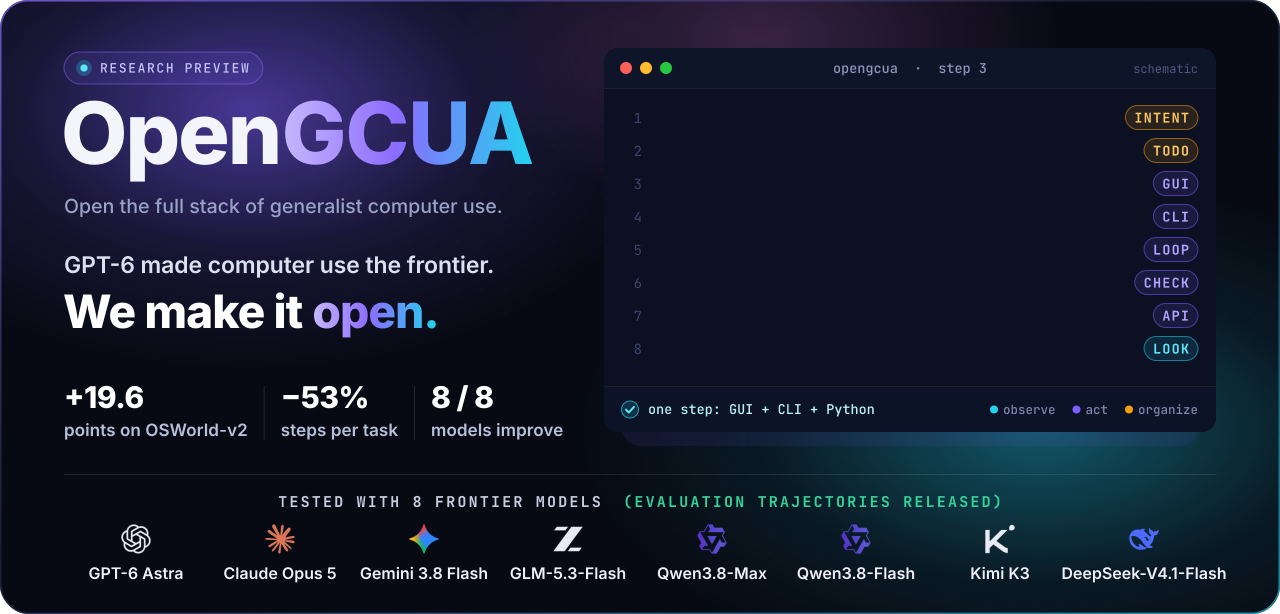
### GPT-6 made computer use the frontier. We make it open.
[](https://tongyi-mai.github.io/OpenGCUA/)
[](https://arxiv.org/abs/2610.22200)
[](https://tongyi-mai.github.io/OpenGCUA/trajectories.html)
[](#quick-start)
[](LICENSE)
[](#community)
[](#community)
[News](#news) · [Results](#results) · [Demos](#demos) · **[Quick start](#quick-start)** · [SDK](#sdk) · [Open stack](#open-stack) · [How it works](#how-it-works) · [Contributing](#contributing) · [Contact](#contact)
**Computer use has reached a turning point.** GPT-6 Astra's demos offered an exciting vision of what
computer-use agents could make possible, and the focus is expanding from GUI-only interaction to both visual
and programmatic interfaces. The question has changed, from how well a model operates a GUI to how well a
system completes work on a real computer by whatever means works.
**We call such a system a generalist computer-use agent (GCUA).** It uses a computer in more ways than you do.
It reads the accessibility tree and calls app APIs, runs shell commands, and operates the GUI when it needs to.
With **code execution**, it writes GUI operations as code and combines them with all of these in one program,
with loops and conditions. It can also share the computer with you, working in background windows without
interrupting what you are doing.
**Yet frontier systems remain largely closed.** We therefore introduce **Open Generalist CUA (OpenGCUA)**, an
ongoing project to develop and open the full stack for GCUAs with the community, including model, system,
trajectories, efficiency optimization, and evaluation.
**What we open in this version:**
- 🧠 **[OSWorld integration example](packages/harness/examples/osworld/)** with reference screenshot-action
and code-action agents for integrating the OpenGCUA design.
- 📜 **Evaluation trajectories** of the 8 frontier models, including GPT-6 Astra, Claude Opus 5,
and Gemini 3.8 Flash.
- 💻 **[macOS real-device harness](packages/harness/)** (preliminary), a menu-bar app that runs the agent on your own Mac.
- 🔌 **[Cross-Device SDK](packages/sdk/)** (preliminary), one programming interface for computers, browsers, and phones.
🗺️ See the [detailed plan for our open stack](#open-stack).
## 🔥 News
- **[2026-10]** 🚀 The OpenGCUA research preview is out, with the [tech report](https://arxiv.org/abs/2610.22200), the
[OSWorld integration example](packages/harness/examples/osworld/), the [macOS real-device harness](packages/harness/), the
[Cross-Device SDK](packages/sdk/), and evaluation trajectories of 8 frontier models.
## 📊 Results
We test the design on two fronts: OSWorld-v2 with eight frontier models, and real Macs with our real-device
harness.
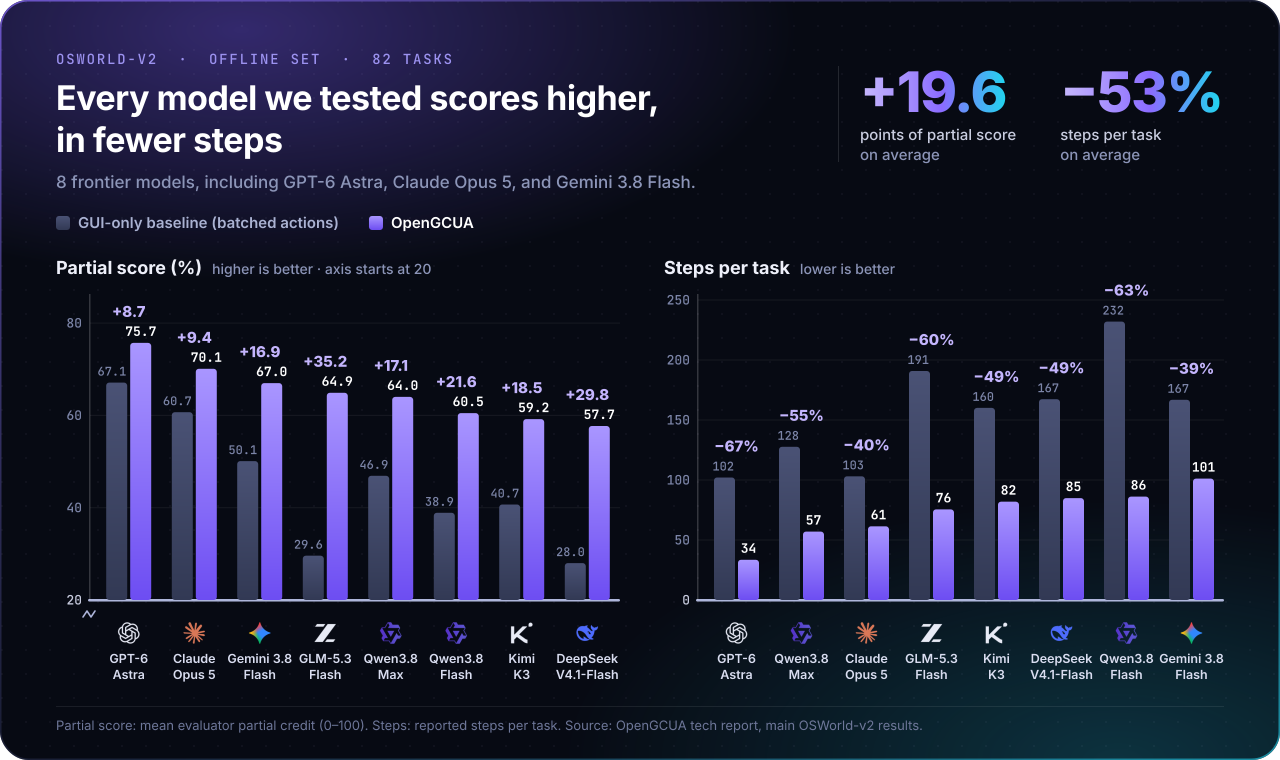
- **Every model improves, including GPT-6 Astra, Claude Opus 5, and Gemini 3.8 Flash.** Over a GUI-only
baseline with batched actions, the mean partial score rises from 45.3 to 64.9 (+19.6 points), and steps per
task fall by 53% on average. GPT-6 Astra goes from 102 to 34 steps per task.
- **Weaker models gain the most.** GLM-5.3-Flash gains 35.2 points and DeepSeek-V4.1-Flash 29.8. The gap
between the strongest and the weakest model shrinks from 39.1 to 18.0 points.
- **Code execution adds value beyond shell access.** With the same GUI and shell access, writing operations as
code adds 6.1 points and cuts steps by 14.8% over a GUI+CLI agent (mean of three models).
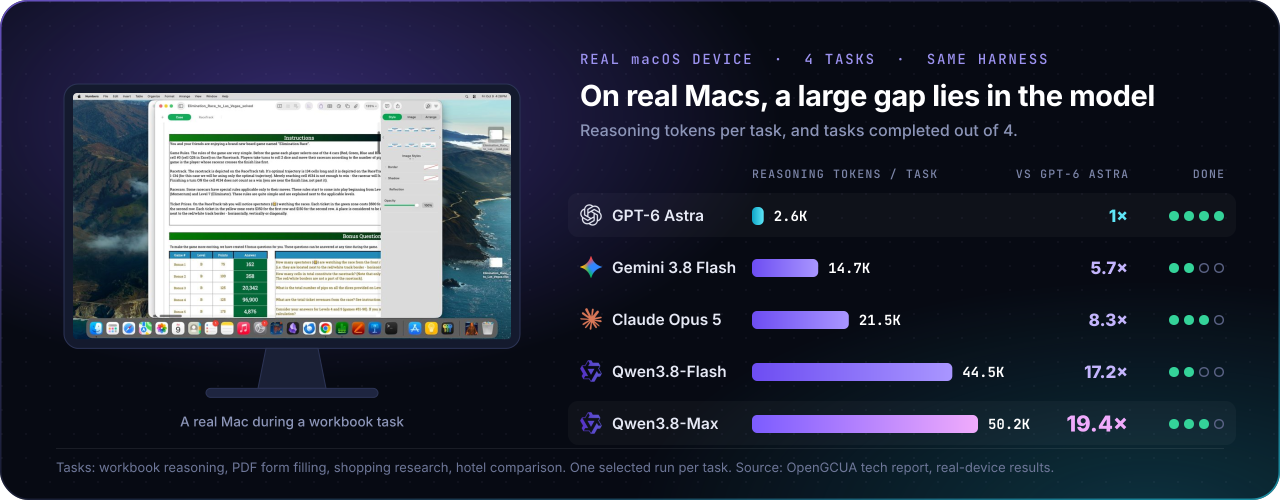
With our real-device harness held fixed, on four macOS tasks Qwen3.8-Max used 19.4 times the reasoning tokens
of GPT-6 Astra and still completed fewer tasks. The case studies trace this gap to model behavior, which is what
our next release, the GCUA model, works on. The [paper](https://arxiv.org/abs/2610.22200) has the full setup, ablations, and case
studies.
## 🎬 Demos
Click a screenshot to watch the video.
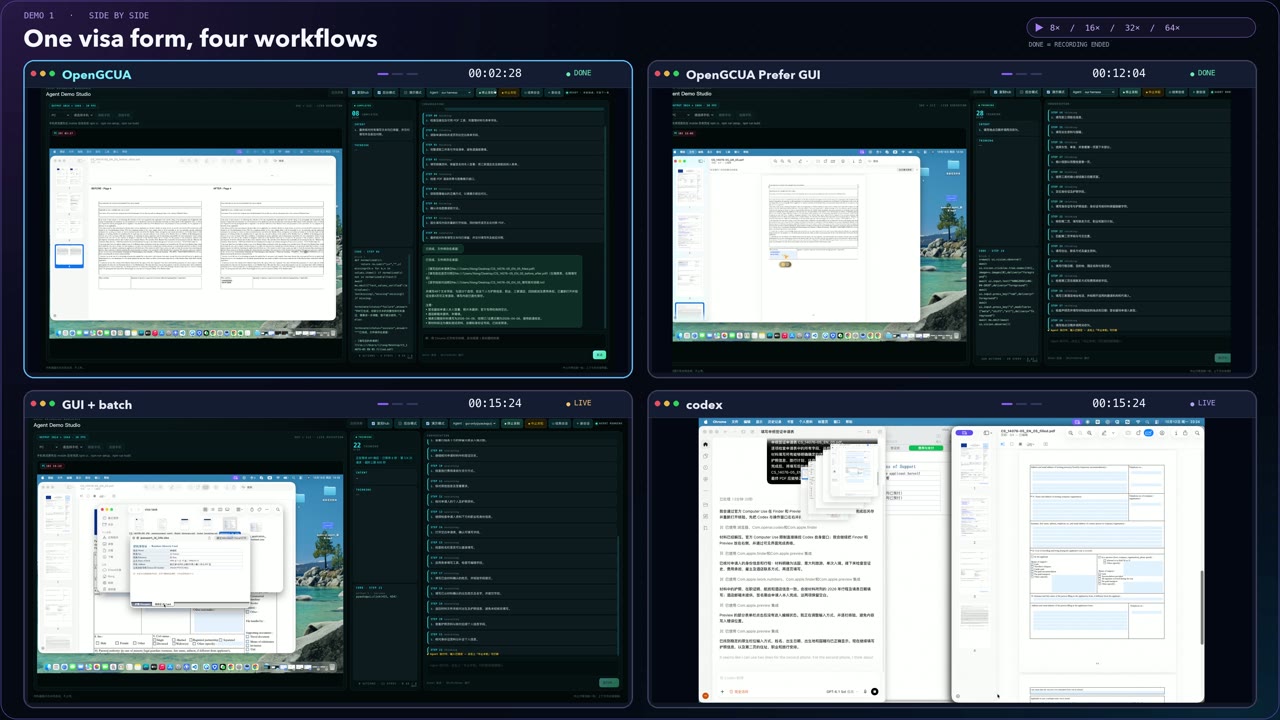
**One visa form, four workflows.** OpenGCUA, OpenGCUA (prefer GUI), GUI + batch, and Codex work on the
same visa application on a real Mac. Playback speeds vary; use the in-video clocks for elapsed task time.
[](https://tongyi-mai.github.io/OpenGCUA-blog/demos/four-workflows.mp4)
[▶ Watch the comparison · 1:50](https://tongyi-mai.github.io/OpenGCUA-blog/demos/four-workflows.mp4)
**Hotel research.** OpenGCUA researches and compares hotel options across desktop apps and the browser.
[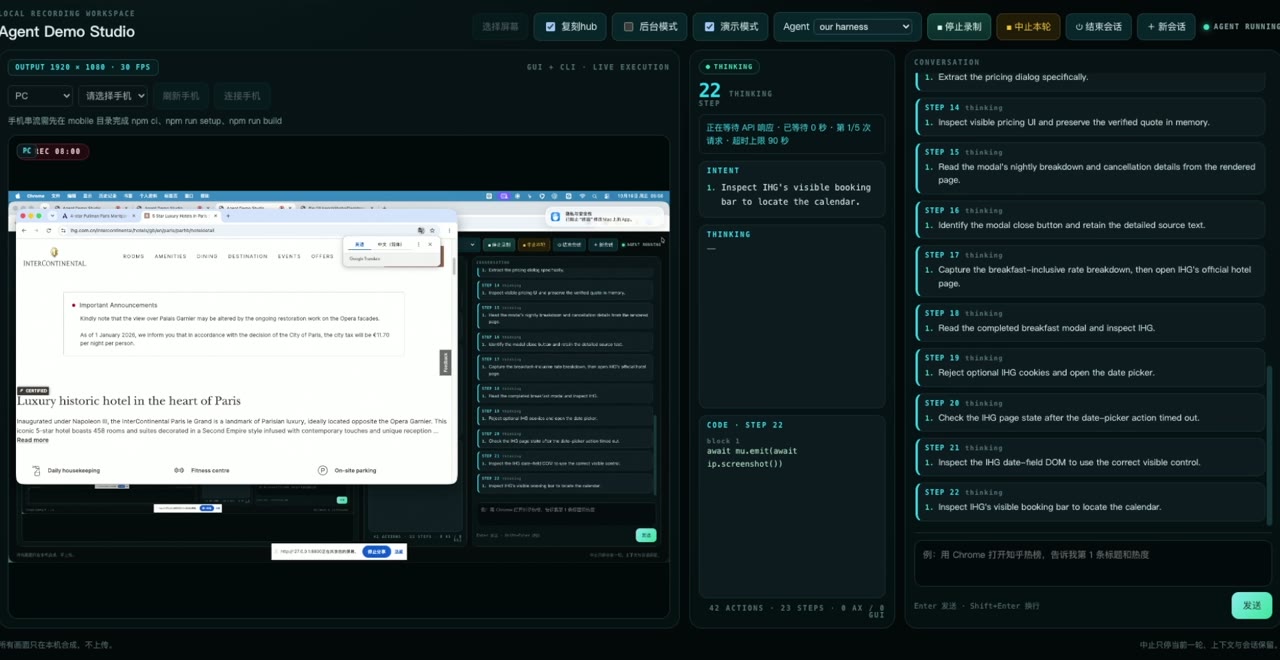](https://tongyi-mai.github.io/OpenGCUA-blog/demos/hotel-research.mp4)
[▶ Watch hotel research · 3:33](https://tongyi-mai.github.io/OpenGCUA-blog/demos/hotel-research.mp4)
**GUI click sequence.** A short excerpt of GUI actions during the visa-form workflow.
[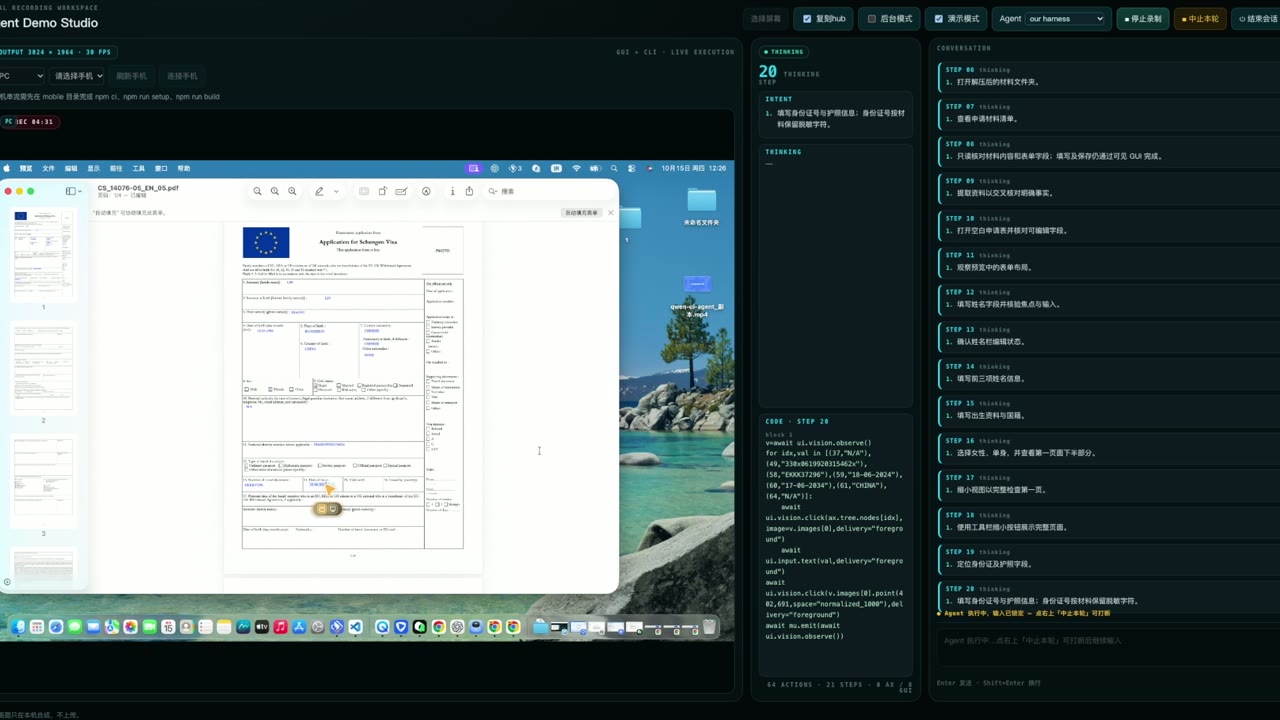](https://tongyi-mai.github.io/OpenGCUA-blog/demos/click-sequence.mp4)
[▶ Watch the click sequence · 0:25](https://tongyi-mai.github.io/OpenGCUA-blog/demos/click-sequence.mp4)
## 🚀 Quick Start (macOS source harness)
This is the shortest path from a clean clone to an interactive agent. It requires macOS 14+,
[uv](https://docs.astral.sh/uv/), Python 3.11–3.14, Rust/Cargo 1.89+, and Xcode Command Line Tools.
Python 3.12 is recommended. Prebuilt SDK wheels do not require Rust.
```bash
git clone https://github.com/Tongyi-MAI/OpenGCUA.git
cd OpenGCUA
uv venv --python 3.12
source .venv/bin/activate
uv pip install -e ./packages/sdk -e ./packages/harness/runtime
# Install the native driver app. Its daemon is included in the app bundle.
.venv/bin/mu setup macos
.venv/bin/mu doctor macos
.venv/bin/mu setup browser --engine chromium
.venv/bin/mu doctor browser --engine chromium
# Create a private local configuration from the shipped defaults.
cp packages/harness/configs/macos_demo.json packages/harness/configs/local.json
```
Edit the following fields in `packages/harness/configs/local.json`:
```json
{
"api_key": "YOUR_API_KEY",
"model_name": "qwen3.8-flash",
"llm_base_url": "https://dashscope.aliyuncs.com/compatible-mode/v1",
"llm_protocol": "openai"
}
```
Keep the other fields copied from `macos_demo.json`; the object above shows only the values
normally changed. Chat Completions-compatible gateways use `"llm_protocol": "openai"`;
GPT reasoning endpoints with Responses support can use `"openai-thinking"` to replay
encrypted reasoning across turns. Native Anthropic Messages endpoints use `"anthropic"`;
set `"anthropic_thinking": {"type": "adaptive"}` in `local.json` for Claude models
that support adaptive thinking. The Anthropic path preserves signed thinking blocks
in subsequent requests; `reasoning_effort` is not an Anthropic thinking switch.
Provider examples and every advanced setting are documented
in [Setup, configuration, and troubleshooting](QUICKSTART.md).
Grant **CuaDriver.app** access in **System Settings → Privacy & Security → Accessibility** and
**Screen Recording**, quit and reopen CuaDriver, then verify the installation:
```bash
.venv/bin/mu doctor macos
```
Start either the terminal agent or the browser demo studio. The terminal command automatically
uses the visual interface when stdin/stdout are an interactive terminal; pipes and `TERM=dumb`
keep the compatible plain-text interface.
```bash
# Persistent visual terminal conversation. Type /exit or press Ctrl-D to stop.
.venv/bin/python packages/harness/runtime/mac_agent.py
# Force the original line-oriented output (also useful for scripts and logs).
.venv/bin/python packages/harness/runtime/mac_agent.py --ui plain
# Or start the demo studio at http://127.0.0.1:8800.
bash packages/harness/runtime/start_demo.sh
```
In the visual terminal, reasoning and generated code are hidden by default. Use `/reasoning on`
or `/code on` to show future output, `/help` for shortcuts, and Alt/Option+Enter to insert a
newline. Ctrl-C during an active step aborts that turn; operations already sent to applications
or the shell are not rolled back.
If you see `PERMISSION_DENIED`, `DEVICE_OFFLINE`, a native-extension import error, or a recording
problem, use the [error-indexed troubleshooting guide](QUICKSTART.md#troubleshooting). For SDK-only
installation and wheel builds, see the [SDK guide](packages/sdk/README.md#install). The standalone
[native macOS app](packages/macos/README.md) is a separate distribution path with its runtime bundled.
## Native macOS app
[OpenGCUA for macOS](packages/macos/README.md) implements the menu bar assistant:
enter a task, collapse into a floating control panel, reply to questions, and
review saved results. SwiftUI + AppKit, with Python, the SDK and signed CuaDriver
bundled inside the app; no browser or separately installed runtime is required.
Apple Silicon / macOS 14+, currently a local development build. See the app guide
for building, packaging and the remaining public-release validation.
Version tags can automatically build the DMG and Python SDK downloads through
GitHub Actions.
## 🔌 Cross-Device SDK
The Cross-Device SDK is the interface the model programs against. It binds every operation to an explicit
device, app, window, or tab, keeps accessibility and vision as separate ways to observe and act, and lets one
program coordinate several devices in a task.
```python
import asyncio
from qwen_intelligence import Runtime
async def main():
async with Runtime() as runtime:
await runtime.add_macos(name="local-mac")
async with runtime.session() as mu:
mac = await mu.register("local-mac", name="mac")
app = await mac.apps.get("com.apple.TextEdit")
await mu.emit(await app.ui.ax.observe()) # TextEdit's accessibility tree
await mu.emit(await app.windows.list())
asyncio.run(main()) # open TextEdit first
```
It has adapters for macOS, Android, browsers, and Linux, built on a Rust core with Python bindings.
The [source setup above](#quick-start) installs it. The package is `qwen-intelligence-sdk`, imported as `qwen_intelligence`
(`mai_ui` is the same API under its internal name). See [`packages/sdk/`](packages/sdk/) and the [examples](packages/sdk/examples/src/).
## 🗺️ The open stack and what comes next
OpenGCUA aims to open the full stack of generalist computer use. This preview releases the first layers, and
the rest come next.
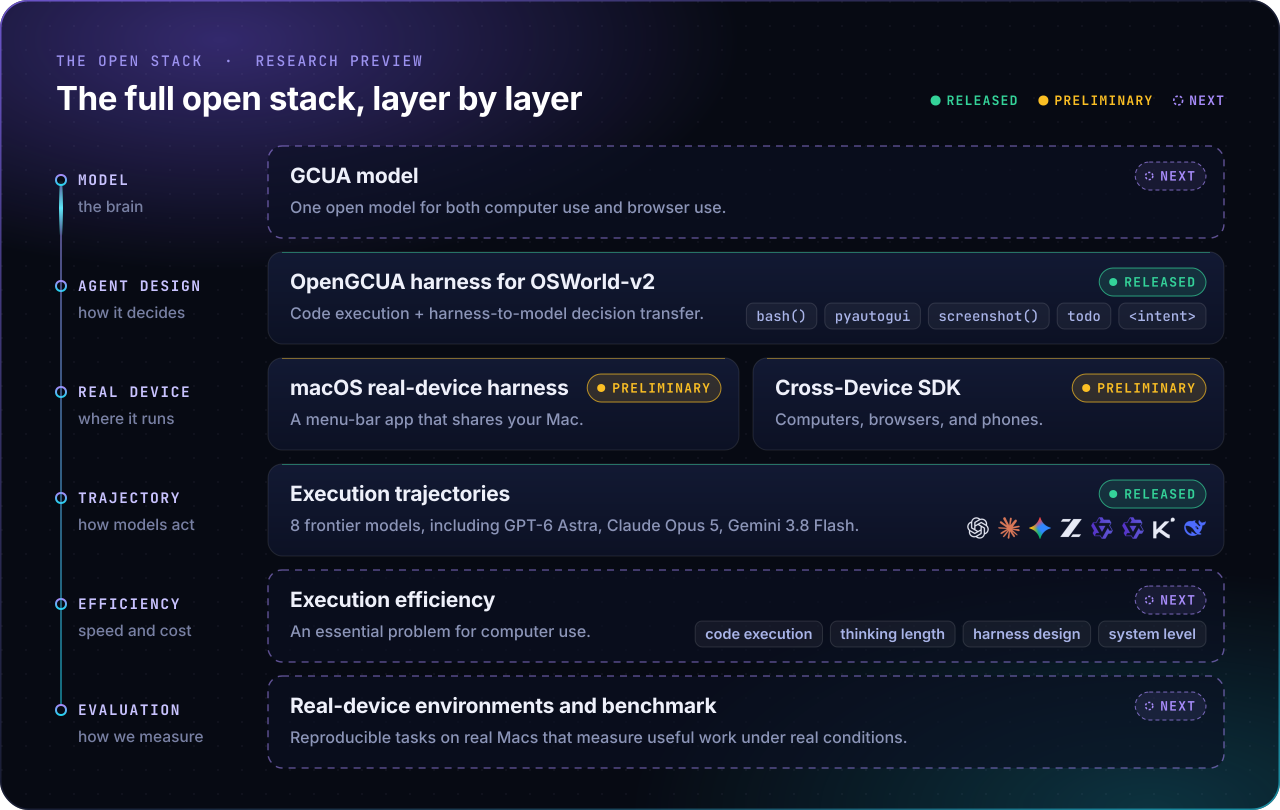
- [x] [OSWorld integration example](packages/harness/examples/osworld/) with standalone screenshot-action and code-action agents
- [x] macOS real-device harness and Cross-Device SDK, as preliminary open-source versions
- [x] [Native OpenGCUA macOS app](packages/macos/README.md), a preview menu-bar assistant with a floating task panel, voice, and bundled harness, SDK, and driver
- [ ] **GCUA model** for both computer use and browser use, turning code execution, on-demand observation, and
task tracking into learned skills
- [ ] **Execution efficiency**, an essential problem for computer use: optimizing code execution, thinking
length, and harness design, and exploring broader system-level improvements
- [ ] **Real-device environments and benchmark**, macOS first, measuring useful work under real conditions
- [ ] **Reliable work on your devices**: tasks across computers, browsers, and phones, with dependable
targeting, recovery from failures, and continuity when you step in
We do not commit to dates. The plan follows the evidence and what the community proposes, including
directions beyond this list. Details are in [ROADMAP.md](ROADMAP.md).
## 🧩 How it works
Formally, a GCUA is an agent system that completes diverse computer tasks through visual interaction and
programmatic access, choosing **how to observe, act, and organize its work** as each task requires. These are
three decisions made at every step. A GUI agent leaves all three to fixed rules in its harness. OpenGCUA lets
the model make them.
| Decision | GUI agent | OpenGCUA |
|:--|:--|:--|
| 👁️ **What to observe** | a screenshot after every action | `screenshot()`, only when the model needs one |
| ✋ **How to act** | one click or keystroke at a time | a Python program that combines the accessibility tree and app APIs, shell commands, and GUI actions, with loops, branches, and checks |
| 🗂️ **How to organize work** | fixed by the harness | the model keeps a `todo` list and states its `` before each program |
Two designs make this work. **Code execution** lets a model bring the programming skill it already has, and
lets intermediate results decide the next operation without another model call. **Harness-to-model decision
transfer** moves choices such as when to look and what to track out of harness rules and into the model.
GUI agents, CLI agents, and GUI+CLI hybrids such as our earlier Qwen-UI-Agent are special cases that fix some
of these decisions in advance.
Here is one real step by GPT-6 Astra on a CRM task in OSWorld-v2. Lines marked `...` are cut, and long lines
are wrapped:
```python
Apply the 29 evidence-based status changes while preserving all original
customer details.
todo.update(id="updates", kind="task", content="Applying 29 reviewed status changes ...",
            status="attempted")
r = bash(r"""...
cat > /tmp/apply_lead_statuses.py <<'PY'
...
current=api(p,'/api/crm/workspace')['workspace']
assert current==original,'Workspace changed since original review; stopped before edits.'
for change in changes:
    d=api(p,'/api/crm/leads/'+change['leadId'],'PATCH',{'status':change['to']})
    ...
    assert lead['status']==change['to']
...
print('VERIFIED:',len(log),'status changes; all 40 statuses correct; ...')
PY
python /tmp/apply_lead_statuses.py""")
if r.ok:
    todo.update(id="status_updates", kind="task",
                content="Applied and API-verified all 29 planned status changes. ...",
                status="claimed_verified")
```
In one step, the model states its intent and records its plan. It then writes and runs a script that stops if
the app changed since it last looked, applies 29 edits through the app's own API, and checks each one. Only
after the script succeeds does it record the result as verified.
## 🤝 Contributing
We hope the community will shape not only how GCUAs are built, but also what they should be able to do and
how progress is measured. There are three ways to join:
- **Improve the harness and SDK.** Platform adapters, more reliable observation and control, faster
execution, real-device testing, and documentation.
- **Build real-device evaluation.** Environments, realistic tasks, evaluation criteria, and benchmark
tooling, including traces that show where today's agents fail.
- **Propose research goals.** Workflows agents should handle, capabilities worth building, or questions to
study with the released code and trajectories. [Open a research question](../../issues/new?template=research-question.yml).
Start with [CONTRIBUTING.md](CONTRIBUTING.md).
## 👥 Community
WeChat group
 |
Discord
 |
## ✉️ Contact
Hanzhang Zhou
Project co-lead
hanzhang.zhou@alibaba-inc.com |
Long Li
Project co-lead
longyu.ll@alibaba-inc.com |
Yue Wang
Project lead
yue.w@alibaba-inc.com |
## 📄 Citation
```bibtex
@misc{opengcua2026,
title = {{OpenGCUA}: Toward a Fully Open Stack for Generalist Computer Use},
author = {Hanzhang Zhou and Long Li and Quyu Kong and Lei Wang and
Panrong Tong and Long Chen and Tianyu Xia and Gongjie Zhang and
Xu Zhang and Chen Liu and Jianan Zhang and Chenglin Cai and
Zhengwen Zeng and Steven Hoi and Yue Wang},
year = {2026},
eprint = {2610.22200},
archivePrefix = {arXiv},
primaryClass = {cs.CV},
url = {https://arxiv.org/abs/2610.22200}
}
```
## 🙏 Acknowledgments
OpenGCUA builds on our earlier work, [Qwen-UI-Agent](https://github.com/Tongyi-MAI/MAI-UI). The macOS driver
is [CuaDriver](https://github.com/trycua/cua) by trycua. We evaluate on
[OSWorld-v2](https://github.com/xlang-ai/OSWorld-V2), and our definition of a GCUA follows the system-level view
of [Agents' Last Exam](https://github.com/rdi-berkeley/agents-last-exam).
## ⚖️ License
Apache-2.0. See [LICENSE](LICENSE).