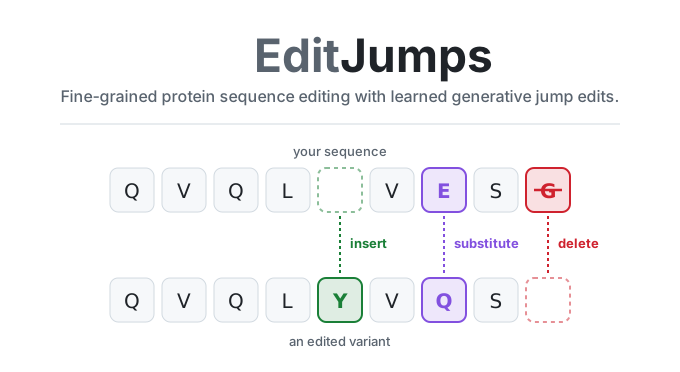





EditJumps - fine-grained protein sequence editing with learned generative jump edits

CI License: MIT Version Python 3.10+ NeurIPS 2026 Workshop AIDaR arXiv:2609.18745 Replicates EvoFlows Replicates Edit Flows Weights on Hugging Face

### [When Edit Flows are Edit Jumps: replicating Edit Flows and EvoFlows](https://arxiv.org/abs/2609.18745) **NeurIPS 2026 Workshop AIDaR** Gabriel Bénédict · Melanie Buechler · Gerard Riera-Solà · Chloé de Ancos · Yves Gaetan Nana Teukam · Moritz Freidank — Visium Edit Flows and EvoFlows are one process: the pure-jump case of generator matching. EditJumps is the first open implementation — one generalist antibody editor, trained on 1.66M OAS homolog pairs, that edits unseen leads zero-shot without the per-family retraining the original approaches require.
**Give one antibody or protein sequence in. Get near neighbours of it back** — a handful of insertions, deletions and substitutions, placed where related natural sequences actually differ. You set roughly how many edits you want. ## Quick Edit Trained weights live on Hugging Face at [**VisiumSA/EditJumps**](https://huggingface.co/VisiumSA/EditJumps). ```bash uvx --from "huggingface_hub[cli]" hf download VisiumSA/EditJumps --local-dir ./weights uv run --group inference editjumps edit --sequence QVQLVESGGGLVQPGGSLRLSCAAS --edits 5 ``` [Quick Start](#quick-start) covers training your own instead, and [`docs/weights.md`](docs/weights.md) the checkpoint layout.
Pixelated portrait of William Feller > *"In a small time interval there is an overwhelming probability that the state will remain > unchanged; however, if it changes, the change may be radical."* Feller, W. (1949). "On the Theory of Stochastic Processes, with Particular Reference to Applications". *Proceedings of the (First) Berkeley Symposium on Mathematical Statistics and Probability*. Vol. 1. University of California Press. pp. 403–432.
## Overview - **Local sequence variation:** Proposes candidate neighbours of an existing lead sequence with a small number of insertions, deletions, and substitutions for experimental evaluation. - **Unconditional generation:** Generates plausible variants without scoring against a specific target property; downstream assays determine variant fitness. ### Comparison with Alternatives - **Masked language models:** Infilling models operate on fixed-length masks and only propose substitutions. This editor supports insertions and deletions: across 400 evaluated variants per family, roughly half exhibited length changes (195/400 on Ty1 at 4.58 mean edits, 198/400 on HER2-VH at 4.08 mean edits; see [`metrics/disjoint/`](metrics/disjoint)). - **Random mutagenesis:** Mutagenesis libraries vary positions arbitrarily. Here, edits follow distributions learned from homologous natural sequences. - **MSA generators:** Multiple sequence alignment generators require full alignments and generate entire sequences. This model edits an individual sequence directly to stay within a specified edit budget. ### Replication Scope This repository provides an independent replication of the EvoFlows edit-flow generator evaluated under the §4.2 protocol on two seed families (Ty1 and HER2-VH). Each comparison cell measures 400 generated sequences against a 200-sequence natural holdout across six methods. Results are traceable to files in [`metrics/`](metrics/). All 14 pipeline stages are classified under `reproduction` in `editjumps/core/provenance.py` (documented in [`docs/claims.md`](docs/claims.md) and [`docs/findings.md`](docs/findings.md)). EvoFlows generation is unconditional; no target property guidance is implemented. ## Quick Start ### 1. Installation ```bash uv sync --all-groups ``` > [!TIP] > Run `uv run editjumps` on its own to list every available command, or add `--help` to any > command (e.g. `uv run editjumps edit --help`) to see its full flag list with descriptions > and defaults, straight from the source. ### 2. Minimal Local Loop: Train, Track & Evaluate (DVC & MLflow) A self-contained training and evaluation cycle on CPU or Apple Silicon (MPS), logged to **MLflow** and versioned with **DVC**. #### Step 1: Launch Local MLflow Tracking ```bash make mlflow-ui # Live dashboard: http://127.0.0.1:5555 ``` #### Step 2: Fetch Base Trunk & Prepare Data ```bash uv run editjumps fetch-base-checkpoint uv run editjumps download-oas --max-units 1 --pair-chains --emit-cdr-keys bash editjumps/core/install_mmseqs.sh uv run editjumps build-homolog-pairs ``` #### Step 3: Run Minimal Training ```bash uv run --group train editjumps train-edit-flows \ --pairs data/pretrain/oas_homolog_pairs.tsv.gz \ --model-name data/pretrain/base_checkpoints/esm2_t12_35M_UR50D \ --output-folder data/pretrain/edit_flows \ --rate-head linear --q-head fresh \ --max-steps 50 --batch-size 2 ``` `--rate-head` and `--q-head` are baked into the checkpoint: every later command that loads it (`edit`, `generation-eval`) must pass the same pair back. > [!TIP] > The same stage, version-controlled, is in [`dvc.yaml`](dvc.yaml) with its hyperparameters in > [`params.yaml`](params.yaml): > ```bash > uv run dvc repro -s train_edit_flows > ``` #### Step 4: Evaluate Generations Appendix B generation metrics: Levenshtein distance, covariance agreement, spectrum MMD, naturalness, diversity. ```bash # Extract seed family reference holdouts uv run editjumps seed-homologs # Evaluate generation metrics uv run --group train editjumps generation-eval \ --model-folder data/pretrain/edit_flows \ --pairs data/pretrain/oas_homolog_pairs.tsv.gz \ --family-fasta data/interim/seed_families/Anti-SARS-CoV-2_VHH_Ty1.fasta \ --rate-head linear --q-head fresh \ --n-templates 5 --n-variants 5 --n-steps 10 --holdout-size 20 \ --allow-train-overlap \ --metrics-path metrics/generation_eval.json ``` `--allow-train-overlap` lets training pairs overlap the holdout; smoke runs only, real results need a disjoint holdout. Or run the standardized suite: ```bash uv run editjumps evaluate --steps editor --allow-train-overlap ``` #### Step 5: Generate Candidate Edits ```bash uv run --group inference editjumps edit \ --sequence QVQLVESGGGLVKPGGSLRLSCAASGFTFSDYYMSWIRQAPGKGLEWVSYISSSSSYTNYADSVKGRFTISRDNAKNSLYLQMNSLRAEDTAVYYCAREGILGSGYYSVDYWGQGTLVTVSS \ --model data/pretrain/edit_flows \ --rate-head linear --q-head fresh \ --n 5 --edits 5 ``` ``` input 122 aa model data/pretrain/edit_flows (rate_head=linear, q_head=fresh, sampler=euler) budget clock 50.5 (from --edits 5 via lambda_bar 0.099, uncalibrated) edits realised mean 7.0, range 6-8 0 6 edits QVQLVESGGGLVKPGGSLRLSCAASGFTFSDYYMSWIRQAPKGLEWVSYISSSSSLTNYADSVKRFTISRDNAKNSLYQMNSLRAEDTAVYYCAREGILGSGVASVDYWGQGTLVTVSS 1 7 edits QVQLVESGGGLVKPGGSLRLSCAASGFTFSDYYMSVRRQAPGKGLEWVSYISSSSSYTNYADSVKGRFTFSRDNAKNSLYLQMNSLRASDAAVYYCAREGIVGSGYYSVDYWGQGMLVTVSS 2 8 edits QVQLVSSGGGLVKPGSLRLSCAASGFRFSDKMSWIRQAPGKLLEWVSYISSSSSYTNYADSVKGRFTISRDNAKNSLYLQMNSLRAEDNAVYYCAREGILGSGYYSVFYWGQGTLVTVSS ``` `--edits` is a target, not a guarantee: read each variant's `edit_distance` for the realized count, or set the sampler's clock directly with `--clock`. Edits come with no fitness or quality score — scoring needs a family holdout (`--family-fasta` in Step 4, or `rank` below). The same call from Python: ```python from editjumps import edit for v in edit("QVQLVESGGGLVKPGGSLRLSC...", model="data/pretrain/edit_flows", rate_head="linear", q_head="fresh", n=5, edits=5): print(v.edit_distance, v.sequence) ``` ## Ranking Candidates Score and rank candidates by pseudo-likelihood under a reference protein language model: ```bash uv run --group inference editjumps rank \ --sequence QVQLVESGGGLVKPGGSLRLSCAASGFTFSDYYMSWIRQAPGKGLEWVSYISSSSSYTNYADSVKGRFTISRDNAKNSLYLQMNSLRAEDTAVYYCAREGILGSGYYSVDYWGQGTLVTVSS \ --sequence QVQLVESGGGLVKPGGSLRLSCAWSGFTFSDYYMSWIRQAPGKGLEWVSYISSSSSYTNYADSVKGRFTISRDNAKNSLYLQMNSLRAEDTAVYYCAREGILGSGYYSVDYWGQGTLVTVSS \ --sequence QVQLVESGGGLVKPGGSLRLSCAASGFTFSDYYMSWIRQAPGKGLEWVSCISSKSSYTNYADSVKGRFTISRDNAKNSLYLQMNSLRAEDTAVYYCATEGILGSGYYSSDYWGPGTLVTVSS \ --sequence SLATALDCQLGRVLGGSRINYDGLGVEISYSSQWANLGYNSVSFSRKTPSCDVYGWLSVGMSENTSDFSGGYYVQSVVSGMRYSSFQLPSLERAKAGYSARSTTYGYKAWILKTGAEDQYIV uv run --group inference editjumps rank --fasta candidates.fasta # or from a file uv run --group inference editjumps rank --fasta candidates.fasta --json # machine-readable ``` ``` scorer facebook/esm2_t33_650M_UR50D metric ESM-2 pseudo-log-likelihood, mean per position over 40 positions (higher = more natural) ranked 4 candidates 1 -0.6779 (input #0) QVQLVESGGGLVKPGGSLRLSCAASGFTFSDYYMS… natural VH 2 -0.6976 (input #1) QVQLVESGGGLVKPGGSLRLSCAWSGFTFSDYYMS… + 1 substitution 3 -0.7752 (input #2) QVQLVESGGGLVKPGGSLRLSCAASGFTFSDYYMS… + 5 substitutions 4 -2.8617 (input #3) SLATALDCQLGRVLGGSRINYDGLGVEISYSSQWA… scrambled ``` This is naturalness under a general PLM (EvoFlows Appendix B.2 estimator), not a functional assay property. `rank` uses public ESM-2 weights, no custom checkpoint — the default 650M scorer is a ~2.5 GB download, and `--scorer facebook/esm2_t12_35M_UR50D` is smaller. ## Documentation | Document | Description | | --- | --- | | [Installation](docs/installation.md) | Prerequisites, dependency groups, Python requirements | | [Weights](docs/weights.md) | Checkpoint availability and restoration | | [Model cards](docs/model_cards/README.md) | Model architectures, training data, and hyperparameters | | [Training](docs/training.md) | Local and distributed training procedures | | [Replicating the paper](docs/reproducing.md) | Step-by-step replication of §4.2 and §4.3 evaluations | | [Which claim is which](docs/claims.md) | Claim classification across pipeline stages | | [Configuration](docs/configuration.md) | Target, comparability, and arm configurations | | [Pipeline](docs/pipeline.md) | DVC DAG and stage definitions | | [Common tasks](docs/common_tasks.md) | Common `make` targets | | [Repository layout](docs/repository_layout.md) | Codebase directory structure | | [Performance](docs/performance.md) | Throughput, compute, and hardware benchmarks | | [Known issues](docs/known_issues.md) | Known issues, pitfalls, and workarounds | | [What it does not do](docs/limitations.md) | Scope, non-goals, and limitations | | [Findings](docs/findings.md) | Measured experimental results and logs | ## Citation If you use EditJumps, please cite the paper: > Bénédict, G., Buechler, M., Riera-Solà, G., de Ancos, C., Nana Teukam, Y. G., & Freidank, M. (2026). > *When Edit Flows are Edit Jumps: replicating Edit Flows and EvoFlows*. > NeurIPS 2026 Workshop AIDaR. arXiv:2609.18745. ```bibtex @inproceedings{benedict2026editjumps, title = {{When Edit Flows are Edit Jumps: replicating Edit Flows and EvoFlows}}, author = {Gabriel B{\'e}n{\'e}dict and Melanie Buechler and Gerard Riera-Sol{\`a} and Chlo{\'e} de Ancos and Yves Gaetan Nana Teukam and Moritz Freidank}, booktitle = {NeurIPS 2026 Workshop AIDaR}, year = {2026}, eprint = {2609.18745}, archivePrefix = {arXiv}, primaryClass = {cs.LG}, url = {https://arxiv.org/abs/2609.18745} } ``` This repository replicates [EvoFlows](https://arxiv.org/abs/2603.11703) (Deutschmann et al., 2026) and builds on [Edit Flows](https://arxiv.org/abs/2506.09018) (Havasi et al., 2025); please cite those as well when the comparison matters.