# AI Research Skills
> **The catalog, installation, and visual layer for a Vertical AI Research Reference Harness.**
> Move from research orientation to release through 17 portable skills,
> an eight-stage lifecycle, evidence-aware handoffs, and explicit human gates.
Built for graduate students, PhDs, postdocs, research support staff, and
agent/harness builders who need inspectable research workflows rather than a black box.
The portable skills live in this repository; `research-hub` supplies the executable
runtime, while the optional `agent-collab-harness` adds policy/checkpoint governance.
Languages: [English](README.md) | [繁中](README.zh-TW.md) ·
[Pipeline](docs/pipeline.md) ·
[Examples](docs/examples.md) ·
[Runtime contract](docs/runtime-contract.md) ·
[Glossary](docs/glossary.md) ·
[For Agent/Harness Builders](docs/for-agent-harness-builders.md)
 > 📚 Part of the [agentic AI learning roadmap](https://github.com/WenyuChiou/awesome-agentic-ai-zh)
> — featured in §13–14 (research workflows).
---
## Start here — Why, what, and how
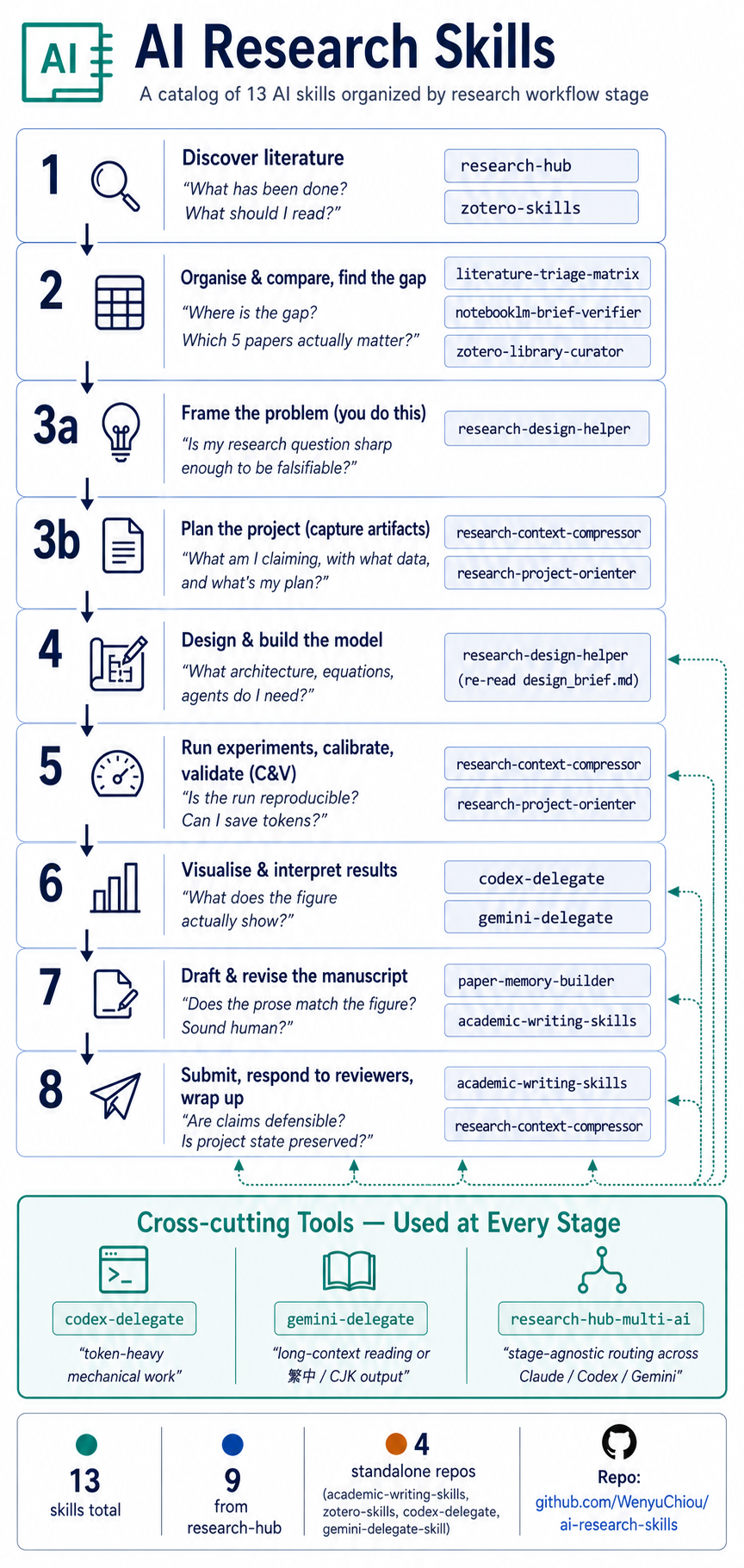
### See the whole research lifecycle first
[](docs/pipeline.md)
The 17-skill core is organized around durable handoffs: each stage produces the next stage's input, while cross-cutting tools preserve context, verification, and delegation boundaries.
| Your first question | Short answer | Go deeper |
|---|---|---|
| **Why use these skills?** | Keep research context durable, verify evidence before claims move downstream, and pause automation at meaningful human decisions. | [Problems this catalog solves](#2-why-this-catalog-exists) |
| **What is included?** | 17 portable skills, 8 lifecycle stages, 5 installable plugins, an executable research runtime, and an optional policy/checkpoint harness. | [Skill outputs](#5-see-what-each-skill-produces) |
| **How do I use it?** | Install the 12-skill research workspace, then ask for a concrete research outcome in natural language. Add writing, Zotero, or delegation plugins only when needed. | [30-second install](#1-install--get-the-skills) · [Usage patterns](#4-use-it) |
| 17 core skills | 8 research stages | 5 optional-by-need plugins | 3 truth-store integrations |
|---:|---:|---:|---:|
| Portable `SKILL.md` contracts | Orientation → release | Start with 1; grow to 5 | Zotero · Obsidian · NotebookLM |
### Try the smallest useful path
```bash
claude plugin marketplace add WenyuChiou/ai-research-skills
claude plugin install research-workspace@ai-research-skills
```
Then ask, for example:
> Build a literature triage matrix for human-in-the-loop research agents. Verify identifiers, preserve contradictions, and show me the evidence gaps before recommending next steps.
Need an executable, resumable workflow instead of prompt-only skills? Continue
with `pip install research-hub-pipeline`, then run `research-hub setup` and
`research-hub doctor`. The full path is in [Install](#1-install--get-the-skills).
### Understand the two control layers
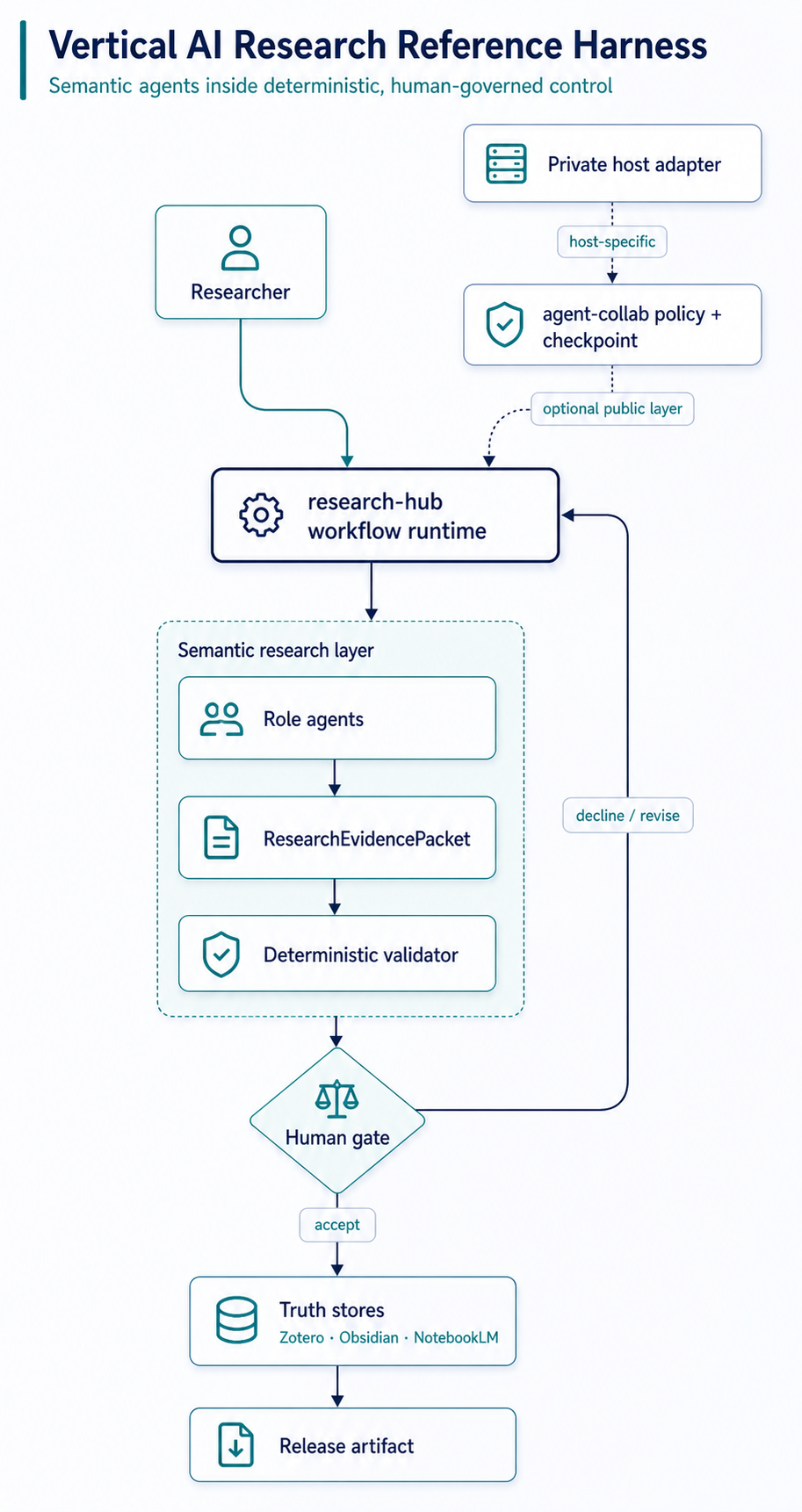
#### Harness architecture — deterministic control around semantic work
[](docs/for-agent-harness-builders.md)
`research-hub` owns the research-domain runtime and recoverable state. Role agents do semantic work; deterministic validators, evidence contracts, and the optional `agent-collab-harness` policy/checkpoint layer control what may proceed.
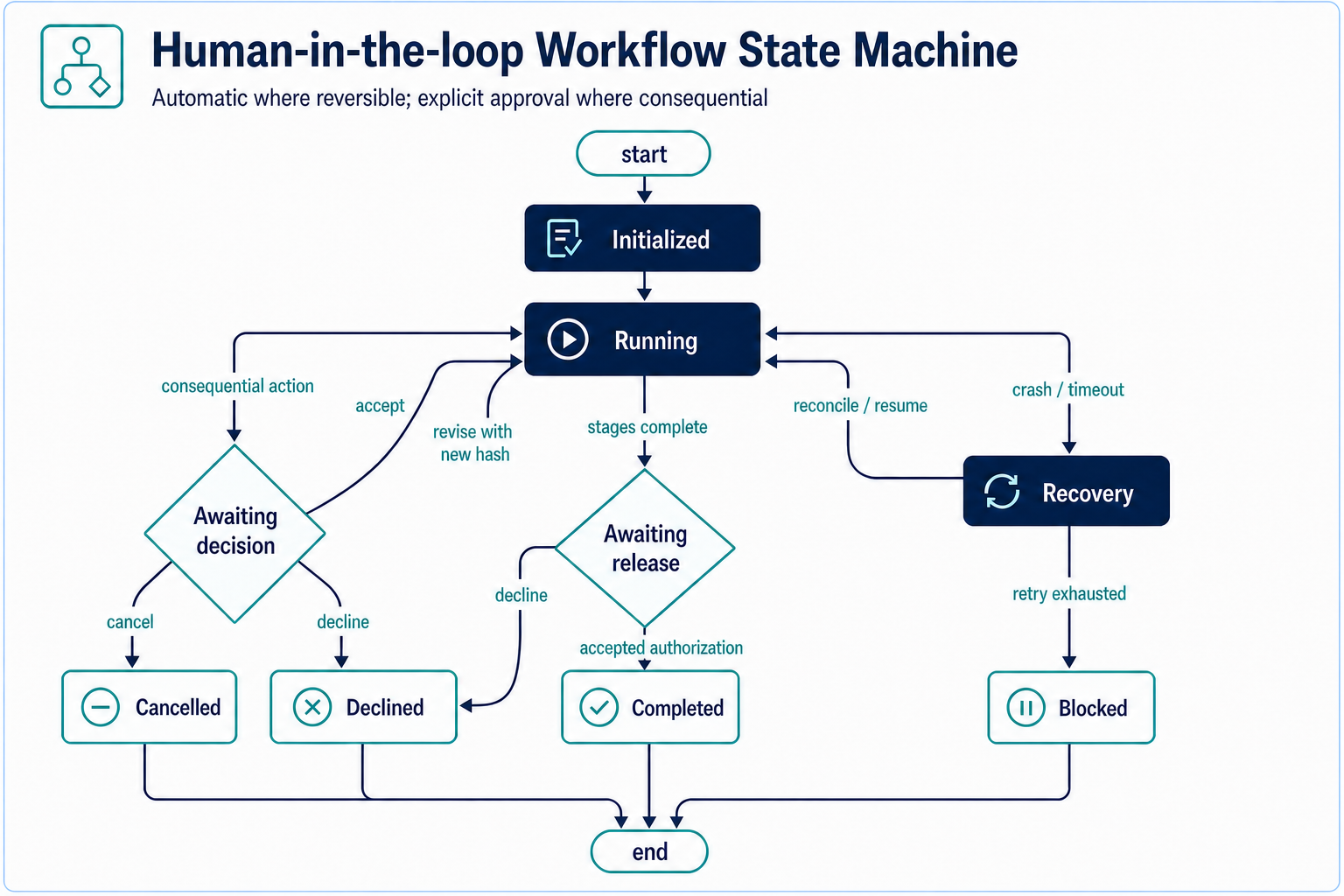
#### Human-in-the-loop — where automation must pause
[](docs/for-agent-harness-builders.md)
Read-only and reversible steps can continue automatically. Breaking contracts, skill removal, external writes, semantic acceptance, and release authorization remain explicit human decisions.
| If you are… | Best next page |
|---|---|
| A researcher or research team | Follow the [eight-stage pipeline](#3-the-pipeline--what-each-stage-delivers-to-the-next) after the quick install above. |
| An agent or harness builder | Read the [architecture, state, HITL, recovery, and evaluation guide](docs/for-agent-harness-builders.md). |
| Evaluating portability or trust boundaries | Review [compatibility](#7-compatibility), the [runtime contract](docs/runtime-contract.md), and [limitations](#8-limitations). |
---
## Contents
1. [Install — get the skills](#1-install--get-the-skills)
2. [Why this catalog exists](#2-why-this-catalog-exists)
3. [The pipeline — what each stage delivers to the next](#3-the-pipeline--what-each-stage-delivers-to-the-next)
4. [Use it](#4-use-it)
5. [See what each skill produces](#5-see-what-each-skill-produces)
6. [FAQ](#6-faq)
7. [Compatibility](#7-compatibility)
8. [Limitations](#8-limitations)
---
## 1. Install — get the skills
The core asset is portable `SKILL.md`; Claude Code marketplace support is
the convenience layer. Use the path that matches your host:
| Host | Path |
|---|---|
| Claude Code | Marketplace install below; gets auto-triggering and `claude plugin list` verification. |
| Codex CLI / Cursor / Windsurf | Load the canonical repo's `SKILL.md` into the host's skills/rules directory, or inline it into the prompt. |
| Gemini CLI / generic API client | Inline `SKILL.md` as prompt or system context. |
| Hermes | Install a raw `SKILL.md`; this repo has Hermes 0.13.0 skill-load verification for `literature-triage-matrix`. |
| OpenClaw | Use a `SKILL.md` directory shape such as `~/.openclaw/skills//SKILL.md` when supported; not release-verified here yet. |
Full per-host recipes are in
[docs/install.md → Using these skills outside Claude Code](docs/install.md#using-these-skills-outside-claude-code).
**Claude Code fastest path — 30 seconds:**
```bash
claude plugin marketplace add WenyuChiou/ai-research-skills
claude plugin install research-workspace@ai-research-skills
```
**Windows `cmd.exe`:** run the commands one at a time. If the plugin list
does not show `research-workspace@ai-research-skills`, your paste probably
only executed the first line; see [docs/install.md](docs/install.md) for the
single-line CMD form.
For Claude Code, the first two commands install the 12-skill
`research-workspace` plugin. Add the optional plugins only when you need
manuscript writing, full Zotero operations, or Claude-to-Codex/Antigravity
delegation.
**Additive install — stop after any step and use what you have:**
```bash
# 1. Marketplace + 12 research-hub skills
claude plugin marketplace add WenyuChiou/ai-research-skills
claude plugin install research-workspace@ai-research-skills
# 2. Manuscript work — outline, drafting, prose and evidence audit, scientific review (14/17)
claude plugin install academic-writing-skills@ai-research-skills
# 3. Zotero CRUD (15/17; enable local API in Zotero desktop first — docs/setup-guide.md §C)
claude plugin install zotero-skills@ai-research-skills
# 4. Multi-CLI delegation (17/17; install codex / agy CLI binaries first)
claude plugin install codex-delegate@ai-research-skills
claude plugin install antigravity-delegate@ai-research-skills
# 5. Literature pipeline automation (Python CLI behind research-hub skills)
pip install research-hub-pipeline
research-hub setup --persona researcher
research-hub doctor
```
**Separate live smoke (not installation):**
This is a **live** literature workflow, not an offline install check.
`--no-nlm` disables NotebookLM only; it does not disable other network calls,
models, or writes. Complete the [live-run preflight](docs/live-run-preflight.md)
and obtain the applicable data/cost/write authorization before running:
```bash
research-hub auto "agent-based modeling" --max-papers 3 --no-nlm
```
Batch all 5 plugins in one go:
```bash
bash scripts/install-all.sh # macOS / Linux / git-bash
pwsh scripts/install-all.ps1 # Windows PowerShell
```
**Verify:**
```bash
claude plugin list
# fastest path: research-workspace@ai-research-skills is ✔ enabled.
# full install: 5 plugins ending in @ai-research-skills are ✔ enabled.
```
`claude plugin list` verifies only the Claude Code marketplace install.
It does not tell you whether Codex, Cursor, OpenClaw, Hermes, or a
generic API client has loaded the `SKILL.md` files. Marketplace-installed
plugins live under `~/.claude/plugins/cache/...`, not `~/.claude/skills/`.
Per-plugin details: [docs/install.md](docs/install.md). Python / Zotero /
Git not set up yet? Start with [docs/setup-guide.md](docs/setup-guide.md).
Need to know whether a skill is prompt-only or needs the Python runtime?
See [docs/runtime-contract.md](docs/runtime-contract.md).
I'd rather clone the repo (contributors / debugging)
```bash
git clone https://github.com/WenyuChiou/ai-research-skills.git
cd ai-research-skills
```
This catalog is the **registry**, not a monorepo. Each plugin's source
code lives in its own repo:
- `github.com/WenyuChiou/research-hub` — 12 `research-workspace` skills
- `github.com/WenyuChiou/academic-writing-skills` — 2 skills
- `github.com/WenyuChiou/zotero-skills` — 1 skill
- `github.com/WenyuChiou/codex-delegate` — 1 skill
- `github.com/WenyuChiou/antigravity-delegate` — 1 skill
If you're hacking on a plugin, clone **its** source repo, not this
catalog. This catalog only maintains `marketplace.json`, docs, image
assets, and the catalog-side `CHANGELOG.md`.
---
## 2. Why this catalog exists
You probably know the AI-for-research pain points already. The five
below are the ones this catalog actually fixes — not the ones it
gestures at.
### P1 — "I keep re-explaining context to every new AI session"
You open a new Claude / ChatGPT session to continue yesterday's work,
and the model knows nothing about your research question, the
experiments you've already finished, your baselines, or the gap you
closed last week. You spend the first ten minutes re-typing all of it.
Tomorrow, again.
### P2 — "AI confidently cites papers that don't exist"
The model writes *"as Chen et al. (2024) demonstrated…"* — the paper
is not real. You catch it (this time). In a reviewer response, a
hallucinated citation is a desk-reject.
### P3 — "I've read 50 papers and still can't tell which gap is worth a thesis"
Three questions need structured answers: *(1) is the gap actually
still open? (2) is closing it a real contribution or a permutation of
existing work? (3) can I close it in the time I have?* Tools that
produce a one-paragraph "research gap summary" don't answer any of
them.
### P4 — "AI-written prose smells like AI"
*"Furthermore", "It is noteworthy that"*, hedged sentences with no
committed claim. Reviewers (and senior co-authors) catch the smell in
two paragraphs, and the manuscript drops in their priority list.
### P5 — "Switching Claude / Codex / Antigravity wipes my state"
You design the prompt with Claude, hand it to Codex to scaffold the
code, then use Antigravity only for bounded mechanical follow-up work.
Long-context synthesis, CJK drafting, judgment, governance, and final
review stay with the primary model. Each switch still costs five
minutes of re-onboarding unless the handoff is explicit and durable.
---
### Three design principles, applied across 17 skills
The catalog is arranged around three load-bearing ideas, not a feature
list:
| Principle | What it does | Solves |
|---|---|---|
| **1. Manifests** (`.research/`, `.paper/`) | Research state lives in checked-in YAML / Markdown files. A new AI session reads the manifest and re-onboards itself — you don't re-explain context. | P1, P5 |
| **2. Schemas with anti-leakage rules** | Every cross-skill artifact has a YAML schema. A claim with empty `evidence_artifacts` is **forced** to carry `status: gap` + a `gap_reason` — never `supported`. A topic candidate with `verdict: do-not-pursue` is structurally separated from `worth-pursuing` ones. Downstream tools refuse to ship overconfident output. | P2, P3, P4 |
| **3. Character-driven routing** | Token-heavy mechanical bulk → Codex. Bounded non-honesty-critical mechanical work → Antigravity. Long-context, CJK, judgment, governance, and final review stay with the primary model. The router (`research-hub-multi-ai`) writes a coordination file so each delegate reads its own brief, not the parent context. | P5 |
The eight-stage visual map above shows these three principles applied
to a real research workflow.
---
## 3. The pipeline — what each stage delivers to the next
Eight stages from *"I should read about X"* to *"the manuscript
shipped"*. Each stage's output is the next stage's input — the
handoff is mechanical, not vibes.
Use `research-workflow-orchestrator` when the whole lifecycle needs one
stateful controller: it coordinates orient, scope, discover, synthesize,
design, execute, write, and release; proceeds automatically for
read-only or reversible work; and pauses at the five human gates.
| # | Stage | Skill(s) | Output → next stage |
|---|---|---|---|
| 1 | **Discover literature** | `research-hub`, `paper-summarize` | `.bib` + per-paper Key Findings notes → Stage 2 |
| 2 | **Find the gap** | `gap-to-topic`, `literature-triage-matrix`, `notebooklm-brief-verifier`, `zotero-library-curator` | `topic_dossier.gaps.yml` (with `verdict`, `verdict_reason`) → Stage 3a |
| 3a | **Frame the RQ** | `research-design-helper` | `design_brief.md` (frontmatter `source: gaps.yml#G2`, `gap_verdict`) → Stage 3b + Stage 4 |
| 3b | **Plan the project** | `research-context-compressor`, `research-project-orienter` | `project_manifest.yml` (`provenance.from_gap`) → Stages 4–8 |
| 4 | **Build the model** | *cookbook* — `codex-delegate` for ≥5-file scaffold, Claude direct for ≤4-file or judgment work | code in your project repo (see [cookbook](docs/example-design-to-build.md)) → Stage 5 |
| 5 | **Run & validate** | `research-context-compressor`, `research-project-orienter` | `.research/` run manifests so future AI sessions skip the rescan → Stage 6 |
| 6 | **Visualise & interpret** | `codex-delegate`, `antigravity-delegate`, primary model | figures + analysis scripts → Stage 7 |
| 7 | **Draft the manuscript** | `paper-memory-builder`, `academic-writing-skills` | `.paper/claims.yml` (with `status` enum + anti-leakage) → Stage 8 |
| 8 | **Submit + respond** | `academic-writing-skills`, `research-context-compressor` | reviewer-response.md, version-tagged manifests → done |
The cross-skill handoffs (Stage 2 → 3a → 3b → 8; Stage 7 → 8) are
documented as **YAML schemas**, not free text. A downstream skill can
refuse to process a malformed handoff — and does, when the schema
violation would otherwise propagate (e.g. `status: gap` claims with no
`gap_reason` are rejected at Stage 7).
**Cross-cutting (every stage):** `research-workflow-orchestrator`,
`codex-delegate`, `antigravity-delegate`, `research-hub-multi-ai`.
These sit beside the pipeline, not on it — the orchestrator preserves
lifecycle state and gates, while multi-agent routing uses Codex and
Antigravity leaves for bounded mechanical execution.
Full narrative + per-stage tool tables: [docs/pipeline.md](docs/pipeline.md).
---
## 4. Use it
### Pick by goal
If you'd rather not read the full pipeline above, jump in by your
immediate goal:
| Your immediate goal | Skills you'll use |
|---|---|
| **Find & compare literature** | `research-hub` + `literature-triage-matrix` |
| **Write or revise a paper** | `paper-memory-builder` + `academic-writing-skills` |
| **Manage a research project** | `research-design-helper` + `research-context-compressor` + `zotero-library-curator` |
For literature discovery, start with the search and source-reading capabilities
actually available in Codex or Claude Code. Zotero, Obsidian and NotebookLM are
optional, not a required setup detour; follow the existing
[Stage 1 evidence handoff](docs/pipeline.md#1-discover-literature).
> **Helping others adopt AI for research** (librarian / RA / advisor)?
> No install needed — share this README plus [docs/install.md](docs/install.md).
### Or, just describe what you want
Describe what you want in plain language — Claude Code matches your
phrasing to a skill. You don't need to remember skill names.
| When you say… | Skill that activates |
|---|---|
| "Compare these 5 papers by method, data, limitations" | `literature-triage-matrix` |
| "Is this gap worth a thesis? Walk me through the three gates" | `gap-to-topic` |
| "Walk me through my research design before I start coding" | `research-design-helper` |
| "Check this paragraph's terminology, repeated wording, flow, and overclaim" | `academic-writing-skills` |
| "Review this paper and load the relevant notation, display, SEM, LLM, water, or flood checks" | `paper-review` |
Full trigger map (17 rows): [docs/skill-directory.md](docs/skill-directory.md).
If auto-trigger picks the wrong skill, name it explicitly:
*"Use `literature-triage-matrix` to compare these 5 papers."*
### Already use Zotero / Obsidian / NotebookLM?
> **Have any of Zotero / Obsidian / NotebookLM in your workflow?**
> [`research-hub`](https://github.com/WenyuChiou/research-hub) integrates
> whichever of these you have as one library-management loop: search
> new literature (arXiv, Semantic Scholar) → Zotero metadata + ingest
> → per-paper notes synced to Obsidian → NotebookLM briefs verified
> against source bundles. **All three tools are optional** —
> `research-hub` adapts to whichever subset you have (or even none, in
> sample-dashboard mode). Python-CLI-backed;
> `pip install research-hub-pipeline`.
>
> Already run independent MCP servers for these tools (e.g.
> `paper-search-mcp`, a Zotero MCP, a NotebookLM MCP)? They coexist —
> the skill orchestrates workflows, the MCPs give raw tool access. The
> CLI itself also exposes an MCP interface (`research-hub serve`).
> Full setup + tool-by-tool modes:
> [research-hub project README](https://github.com/WenyuChiou/research-hub).
### All 17 skills
From research-hub (12 skills) — one install gets all
- [`research-hub`](https://github.com/WenyuChiou/research-hub/blob/master/skills/research-hub/SKILL.md) — search, ingest, organise papers across Zotero / Obsidian / NotebookLM. *(Stages 1, 2)*
- [`literature-triage-matrix`](https://github.com/WenyuChiou/research-hub/blob/master/skills/literature-triage-matrix/SKILL.md) — comparison matrix across method, data, claim, limitation. *(Stage 2)*
- [`notebooklm-brief-verifier`](https://github.com/WenyuChiou/research-hub/blob/master/skills/notebooklm-brief-verifier/SKILL.md) — verify NotebookLM briefs against source bundles. *(Stage 2)*
- [`zotero-library-curator`](https://github.com/WenyuChiou/research-hub/blob/master/skills/zotero-library-curator/SKILL.md) — audit Zotero, propose cleanup (preview-only without `zotero-skills`). *(Stage 2)*
- [`gap-to-topic`](https://github.com/WenyuChiou/research-hub/blob/master/skills/gap-to-topic/SKILL.md) — 3-gate go/no-go decision dossier for a candidate thesis/proposal topic (open? a contribution? feasible?). Emits `.gaps.yml` for `research-design-helper` Stage 3a handoff. *(Stage 2)*
- [`research-design-helper`](https://github.com/WenyuChiou/research-hub/blob/master/skills/research-design-helper/SKILL.md) — Socratic dialog through RQ → mechanism → identifiability → validation → risk. Reads `.gaps.yml` to pre-fill segments 1 + 5; Stage 4 [cookbook](docs/example-design-to-build.md) reuses the produced `design_brief.md`. *(Stages 3a, 4)*
- [`research-context-compressor`](https://github.com/WenyuChiou/research-hub/blob/master/skills/research-context-compressor/SKILL.md) — `.research/` manifests so future AI sessions skip the rescan. *(Stages 3b, 5, 8)*
- [`research-project-orienter`](https://github.com/WenyuChiou/research-hub/blob/master/skills/research-project-orienter/SKILL.md) — fast orientation memo from those manifests. *(Stages 3b, 5)*
- [`research-hub-multi-ai`](https://github.com/WenyuChiou/research-hub/blob/master/skills/research-hub-multi-ai/SKILL.md) — character-driven routing across the primary model, Codex, and Antigravity. *(Cross-cutting)*
- [`research-workflow-orchestrator`](https://github.com/WenyuChiou/research-hub/blob/master/skills/research-workflow-orchestrator/SKILL.md) — resumable controller for orient → scope → discover → synthesize → design → execute → write → release, automatic for read-only/reversible work and paused at catalog human gates. *(All stages)*
- [`paper-memory-builder`](https://github.com/WenyuChiou/research-hub/blob/master/skills/paper-memory-builder/SKILL.md) — `.paper/claims.yml` + `.paper/figures.yml` (status enum, anti-leakage rule, file sentinels). *(Stage 7)*
- [`paper-summarize`](https://github.com/WenyuChiou/research-hub/blob/master/skills/paper-summarize/SKILL.md) — fill per-paper Key Findings / Methodology / Relevance in both Obsidian and Zotero child notes after `research-hub auto`. *(Stage 1)*
Standalone repos (4 plugins) — one plugin install each
- [`academic-writing-skills`](https://github.com/WenyuChiou/academic-writing-skills/blob/main/skills/academic-writing-skills/SKILL.md) — extended outlines, scoped pre-draft plans and post-edit checks, chapter closure, shared terminology records, four-pass manuscript review, cross-artifact revision, and release readiness. *(Stages 7, 8)*
- [`paper-review`](https://github.com/WenyuChiou/academic-writing-skills/blob/main/skills/paper-review/SKILL.md) — general scientific review with progressively selected equation/display provenance, psychometrics/SEM, AI/LLM, water/CNHS, flood/hydrodynamics, round, and explicit reviewer modules. *(Stages 7, 8)*
- [`zotero-skills`](https://github.com/WenyuChiou/zotero-skills/blob/master/skills/zotero-skills/SKILL.md) — full Zotero CRUD, batch metadata, library maintenance. *(Stages 1, 2, 7)*
- [`codex-delegate`](https://github.com/WenyuChiou/codex-delegate/blob/master/skills/codex-delegate/SKILL.md) — Claude → Codex CLI handoff for code-heavy / mechanical work. *(Cross-cutting, also Stages 4, 6)*
- [`antigravity-delegate`](https://github.com/WenyuChiou/antigravity-delegate/blob/master/skills/antigravity-delegate/SKILL.md) — Claude → Antigravity CLI handoff for bounded non-honesty-critical mechanical work. *(Cross-cutting, also Stages 4, 6)*
### Time + cost expectations
Rough envelope from in-session use — adjust to your input size:
| Task | Typical wall time | Conversation turns | Notes |
|---|---|---|---|
| Compare 5 papers (`literature-triage-matrix`) | 1–3 min | 1–2 | Linear in paper count; 20 papers ≈ 5 min |
| 3-gate gap decision (`gap-to-topic`) | 5–15 min | 3–6 | Scales with candidate count + literature-recall depth |
| Terminology, repetition, and flow audit on 1 paragraph (`academic-writing-skills`) | <1 min | 1 | Independent of manuscript size |
| Reviewer response (6 comments) (`academic-writing-skills`) | 3–8 min | 3–5 | Scales with comment depth + revision required |
| Audit 800-item Zotero library (`zotero-library-curator`) | 2–4 min | 1 | Read-only; library size matters less than tag diversity |
| Summarize 5 papers per cluster (`paper-summarize`) | 4–10 min | 1 | One LLM call per paper; rolls back per-paper on failure |
These are **maintainer-observed ranges**, not benchmark numbers. Your
LLM provider, network, library state, and prompt phrasing all affect
the actual time.
### ⚠ Back up Zotero before any CRUD
`zotero-library-curator` is read-only — it emits a preview report.
`zotero-skills` *can* write (merge duplicates, delete items, rebind
collections). **Always export a Zotero backup before letting any AI
modify your library**: Zotero → File → "Export Library…" → Zotero RDF.
The skills will not do this for you.
---
## 5. See what each skill produces
Each pipeline stage's deliverable has a worked-example file. Click
through to see the actual artifact a skill emits — not a description.
| Stage | What the skill produces | Example file |
|---|---|---|
| 1–2 | Literature-review deliverable (TL;DR + per-paper synthesis + tagged gap analysis) | [`example-literature-review-deliverable.md`](docs/example-literature-review-deliverable.md) · [`.docx`](docs/example-literature-review-deliverable.docx) |
| 2 | Topic dossier with the 3-gate decision (open / contribution / feasibility) + machine-readable gap roster | [`example-topic-dossier.md`](docs/example-topic-dossier.md) + [`.gaps.yml`](docs/example-topic-dossier.gaps.yml) · [`.docx`](docs/example-topic-dossier.docx) |
| 3a | Design brief with provenance to the dossier, Socratic-walked RQ → mechanism → identifiability → validation → risk | [`example-design-brief.md`](docs/example-design-brief.md) |
| 3b | Project manifest carrying `provenance.from_gap` so future AI sessions skip the rescan | [`example-project-manifest.yml`](docs/example-project-manifest.yml) |
| 4 | Cookbook — two paths from brief to scaffolded code (Claude-direct for ≤4 files; `codex-delegate` for ≥5) | [`example-design-to-build.md`](docs/example-design-to-build.md) |
| 7 | Paper claims with `status: gap` anti-leakage rule + figure roster with embedded-in-manuscript sentinels | [`example-paper-memory-claims.yml`](docs/example-paper-memory-claims.yml) + [`example-paper-memory-figures.yml`](docs/example-paper-memory-figures.yml) |
The cross-cutting and orchestration skills (`research-hub` ingestion,
`research-project-orienter`, `research-hub-multi-ai`,
`notebooklm-brief-verifier`) don't map to a single stage deliverable —
they're exercised end-to-end in [`test-corpus/`](test-corpus/) from a
real dogfood run: an
[orientation memo](test-corpus/ai-agents-social-interaction/.research/orientation_memo.md),
a [multi-AI routing decision](test-corpus/ai-agents-social-interaction/.research/multi-ai-routing-decision.md),
and a [NotebookLM brief verification](test-corpus/ai-agents-social-interaction/.research_hub/brief-verify-20260426T001559Z.md).
Or read [`docs/examples.md`](docs/examples.md) end to end for the
narrative tour with per-skill input/output tables.
---
## 6. FAQ
### Does this work with Chinese-language literature?
Yes — skills are language-agnostic. Run them in Chinese, the output is
Chinese. NotebookLM, Claude, and Gemini all handle Traditional /
Simplified Chinese well.
### How do I export to `.docx` for an advisor?
Stage 2 dossier and Stage 1–2 literature-review deliverable ship with
`.docx` generators — direct links in §5 above. Other stages
(`design_brief.md`, `project_manifest.yml`, `claims.yml`) emit
Markdown / YAML; pipe through `pandoc` or Word's "Open Markdown" if
needed.
---
## 7. Compatibility
The portable layer is the `SKILL.md` instruction file plus any bundled
`references/`, `scripts/`, and workflow contracts. Claude Code
marketplace support is one host-specific packaging layer, not the only
way to use the skills.
| Layer | What is portable | Status |
|---|---|---|
| Universal `SKILL.md` layer | Skill instructions, trigger descriptions, references, scripts, and project handoff contracts | 17 catalogued skills; recorded source-layout/manifest checks do not establish live host behavior |
| Host-specific behavior | Auto-triggering, plugin marketplace install, `claude plugin list`, skill discovery, and rules-directory conventions | Depends on the agent host; use that host's own list/discovery check |
| Current portability audit | Generic `SKILL.md`-loading hosts | 11/14 zero-edit portable in the 2026-05-10 audit; 3/14 needed cosmetic `` path edits that have since landed |
| Verified host install | NousResearch/hermes-agent 0.13.0 | `literature-triage-matrix` installed end to end, security scan SAFE, registered `enabled`; Hermes inference loop not tested |
| OpenClaw | `SKILL.md`-style directories such as `~/.openclaw/skills//SKILL.md` when supported by the user's OpenClaw install | Structurally compatible target, but not release-grade verified by this repo yet |
| Other agents | Codex CLI, Gemini CLI, Cursor, Windsurf, generic API clients, and other `SKILL.md`-loading hosts | Load the same `SKILL.md` as context or into the host's skill/rules directory; not all hosts are individually tested |
The `11/14` portability figure reflects the audit run on 2026-05-10,
when the catalog had 14 skills. Later additions (`gap-to-topic`,
`paper-review`, `research-workflow-orchestrator`, and `antigravity-delegate`)
have separate catalog records and were not part of that portability audit.
Calibrated audit + experiment transcripts:
[`.research/hermes-compatibility-audit.md`](.research/hermes-compatibility-audit.md).
For documented Codex CLI / Gemini CLI / Cursor / Windsurf / Hermes and
generic-API examples, see
[docs/install.md → Using these skills outside Claude Code](docs/install.md#using-these-skills-outside-claude-code).
For OpenClaw, use the `SKILL.md` directory shape above until this repo adds
release-grade OpenClaw verification.
---
## 8. Limitations
- Assembled and tested by one graduate-student researcher; not
corpus-scale-validated.
- Domain bias toward water resources and agent-based modeling; not
validated for social sciences, ML, or clinical writing.
- Behavioral correctness on real-world inputs is the source repo's
responsibility, not this catalog's.
- Report-only monthly health/drift checks inspect upstream repositories,
manifests, skill URLs, and verification-age records. A successful HTTP
response or source-layout check does not establish live host behavior or
renew a human verification date; unresolved findings need human review.
- No `claude plugin install` round-trip is asserted by CI; the
marketplace registry is checked structurally, the actual install +
trigger path is verified by the maintainer between releases (see
[docs/verification.md](docs/verification.md) for what is and isn't
covered).
- Current research-workspace source no longer embeds `zotero-skills`; the
standalone plugin is canonical. The bare-name collision in
[the 2026-05-20 verification](docs/verification.md#2026-05-20--phase-53b-end-to-end-verification)
is historical. Old host caches can differ from current source, so inspect
your installed plugin state before treating the source fix as a local update.
The full design contract — including what is and is not machine-checked
— is in [docs/design-philosophy.md](docs/design-philosophy.md).
---
## License
MIT. Each skill is maintained in its canonical repo — this catalog is
the index, not a monorepo. Contributions welcome via issue or PR.
New-skill proposals → either `research-hub` (workflow integration) or
a standalone repo (deep, single-purpose CRUD).