---
title: Architecture
description: >-
How Maestro routes one prompt through an orchestrator, a domain main agent,
parallel subagents and an optional reviewer - plus the durable execution,
BYOK encryption and data model underneath.
---
# Architecture
Maestro turns a single prompt into a bounded, resumable, reviewable run. This page covers
the agent hierarchy, what guarantees each layer carries, and the storage and security model
underneath.
## Agent hierarchy
```
User prompt
│
▼
ORCHESTRATOR Routing only. Classifies the task domain; produces no work itself.
│
▼
MAIN AGENT Domain expert (finance, software, marketing, ...).
│ Builds the subtask plan and coordinates subagents.
├──────────────┐
▼ ▼
SUBAGENT SUBAGENT One atomic task each (fetch data, analyze, summarize).
│ │
└──────┬───────┘
▼
REVIEWER Optional. Validates subagent output and sends it back with
issues. Bounded by max_review_iterations.
```
Every agent carries a system prompt, an explicit tool list, and an iteration bound.
### The layers
**Orchestrator.** Classifies the prompt into a domain and a complexity tier, and produces
nothing else. Complexity is judged by *how many kinds of work* a request contains, not by how
long it is: `simple` gets one member and skips review entirely, `standard` gets four,
`complex` gets up to eight. Custom agents published by users are merged into the routing
catalog, so the orchestrator can route to a team it did not ship with.
**Main agent.** A domain expert — fifteen built-in squads covering finance, software,
marketing, SEO, legal, data, community, open source and more. It decomposes the request into
a subtask plan, assigns each member a task-specific brief, and declares dependencies between
members. It may pause once to ask the user a clarifying question when the prompt is genuinely
ambiguous.
**Subagents.** Each executes one atomic task with a bounded tool set and its own token
budget. Members that do not depend on each other run in parallel. A member whose answer comes
back blank is recorded as an **error**, not a success — this matters more than it sounds,
because an empty string merged into a synthesis is invisible, and a run where every member
came back blank would otherwise report as completed.
**Reviewer.** Optional and off for simple tasks. It grades output against a structured
rubric with weighted criteria and `hard_fail` conditions, and returns specific issues plus
retry hints rather than a verdict.
### Contracts between layers
Structured JSON, never free text. A subagent returns:
```json
{
"status": "success | error | needs_review",
"data": {},
"metadata": { "tokens_used": 0, "execution_time_ms": 0, "model_used": "string" }
}
```
The reviewer returns:
```json
{ "approved": false, "issues": ["..."], "retry_hints": ["..."] }
```
Free text between layers is how agent systems fail quietly. A schema is how a failed step
stays a failed step.
## Watching a run
The full execution streams to the browser over an authenticated WebSocket. The **Architect**
view draws the live agent graph — which member is running, which tool it just called, which
external provider it reached, and where the edges between them are.
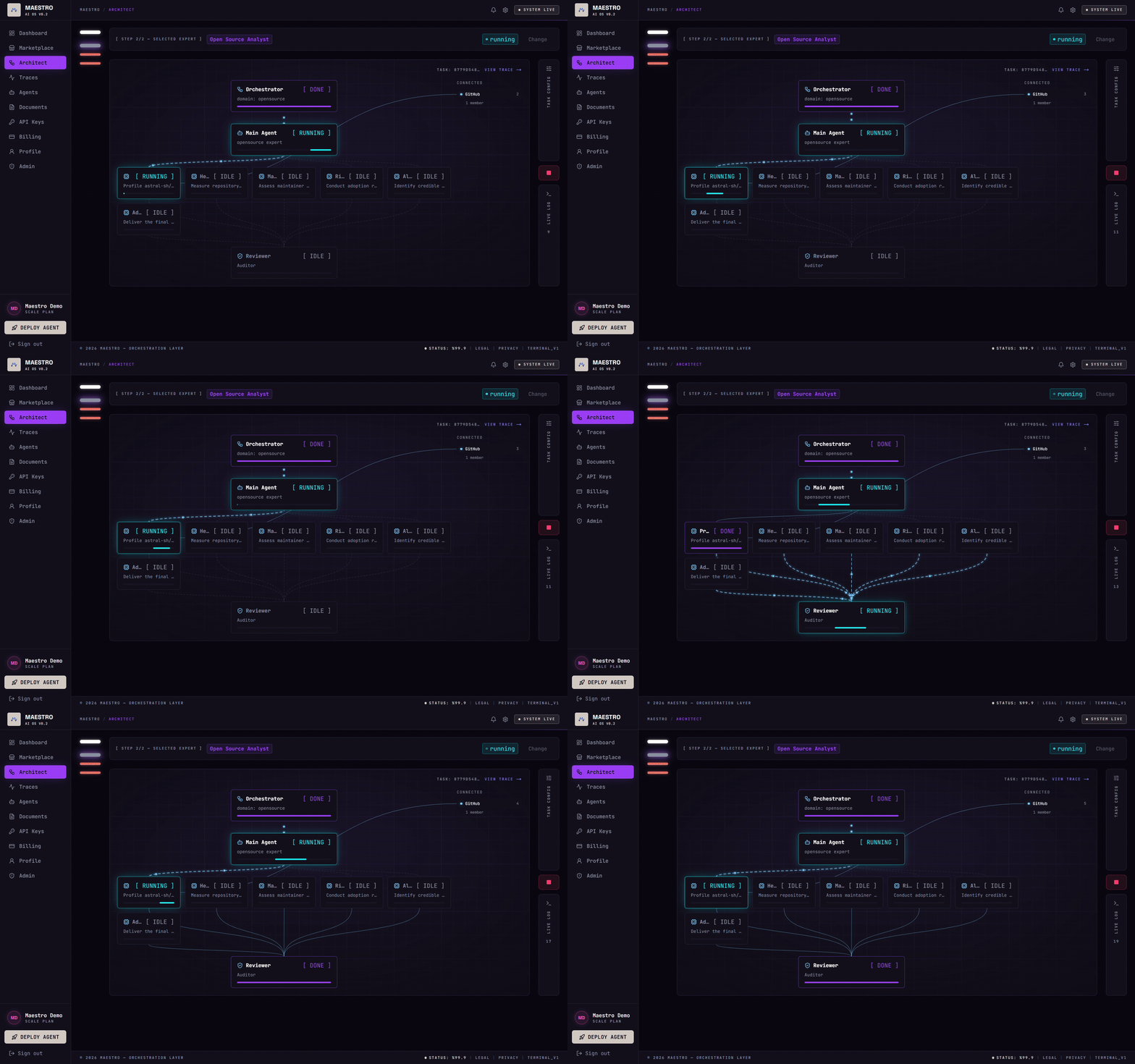 Connected-API calls get their own rail, one edge per member-provider pair, so "two of four
members went to GitHub" stays readable instead of drawing a line per call.
## Durable execution
An agent run is long, expensive and easy to lose. Maestro treats it as a durable step loop
rather than an in-memory coroutine.
- **Checkpoints.** `task_runs`, `task_checkpoints` and `task_questions` in PostgreSQL record
the state machine (ROUTE → EXECUTE → FINALIZE). A resumed run replays from its last
checkpoint instead of restarting.
- **Leases and heartbeats.** A worker holds a lease on a run and refreshes it. A
reconciliation sweep finds runs whose lease expired and either resumes or finalizes them,
so nothing hangs in "running" forever after a crash.
- **Cross-worker coordination.** With Redis configured, a pub/sub event bus carries the live
stream, human-in-the-loop answers and cancellations between workers. Booting with more than
one worker and no Redis is refused at startup rather than silently falling back to a
process-local bus.
- **Bounded everywhere.** `max_iterations`, `max_review_iterations` and
`task_timeout_seconds` bound every run. A hierarchical token budget is enforced per wave and
per call, with a quota re-check at each step boundary.
Terminal states are honest: a run where every member failed is `failed`, a run where some
failed is `completed_with_warnings` and carries a "Known gaps" section naming what is missing.
## Tools
Subagents get a bounded tool set resolved per run:
| Tool | What it does |
|---|---|
| `web_search` | Search with an automatic query-simplification ladder, invisible to the tool budget |
| `data_fetch` | Fetch a page with TLS impersonation, optionally extracting by CSS selector |
| `repo_intel` | GitHub repository activity, contributors, releases, issue close times |
| `social_search` | X/Twitter search |
| `community_read` | Discord, Slack or Telegram channel reading |
| `places_intel` | Google Places lookups |
| `code_execution` | Sandboxed execution, off by default in production |
A **missing service key degrades rather than stops.** The tool is withheld from the enabled
set, the squad falls back to `web_search`, and a mandatory coverage section — enforced by a
`hard_fail` review criterion — states plainly what could not be reached. Stopping instead
would make every connected squad unusable for the majority of accounts, which hold no service
keys at all. A missing **brain** key is different: that stops the task, because there is
nothing to run.
## Storage
Three stores, each doing what it is good at.
**PostgreSQL** — users, encrypted API keys, refresh-token families, subscriptions, the
append-only `usage_records` quota ledger, and durable task state. Schema changes go through
Alembic; SQL is never run by hand.
**MongoDB** — step-by-step `agent_logs` (sequence-ordered, the source for stream replay),
marketplace items, task sessions, custom agent configurations, and trace spans with a TTL.
**Qdrant** — `conversation_memories` and `document_chunks`. Vectors are scoped per user and
deleted on account purge.
Data isolation is per user across all three. Memory never crosses accounts.
## Security model
**BYOK.** Provider keys are encrypted with AES-256-GCM under a master key held only in the
environment. Only `provider` and `label` are ever returned to the frontend — never the key.
Credentials are decrypted once per run at the engine edge and handed to the agent layer as a
value whose string representation renders provider names only, so a traceback or a log record
cannot print a secret.
**Outbound requests.** Every user- or model-supplied URL passes a guard: http(s) only, no
embedded credentials, and every resolved address must be globally routable. Redirects use
libcurl's SAFE mode, which refuses a hop to an internal address before the request is made,
and the landed URL is re-validated afterwards. The connected-API tools have no SSRF surface
at all — every host is a compile-time constant — but any value reaching a URL *path*, such as
a repository slug or a channel id, is pattern-matched before a request can be built.
**Prompt injection.** Fetched content is delimited, labelled untrusted, and scanned before a
model sees it. Because a commit message or a social post is attacker-authored, connected-API
results are scanned and dropped **individually** rather than blanking a whole block.
Marketplace submissions are security-scanned on publish, custom system prompts are scanned on
write and sandboxed inside an `` boundary at execution time, and installed
marketplace agents never touch the installing user's keys directly.
**Everything else.** JWT on every non-public endpoint including WebSockets, which
authenticate *before* accepting the connection. An explicit rate limit on every route,
enforced by a test that walks the route table and fails on any endpoint without one. Pydantic
v2 validation on every input. Refresh-token rotation with reuse detection that revokes an
entire session family. Optional TOTP 2FA with Argon2-hashed single-use recovery codes.
Full policy and the reasoning behind each decision: [Security](SECURITY.md).
## Stack
| Layer | Technology |
|---|---|
| Frontend | Next.js (App Router), React, TypeScript, Tailwind |
| Backend | FastAPI, Python 3.11+ |
| Relational | PostgreSQL via SQLAlchemy async, Alembic migrations |
| Documents | MongoDB via Motor |
| Vectors | Qdrant |
| Cache and bus | Redis |
| Realtime | WebSocket |
| Local models | Qwen3 and `nomic-embed-text` via Ollama |
| Reverse proxy | Caddy, single origin, automatic TLS |
Next: [Configuration](CONFIGURATION.md) for what each setting changes, or
[Deployment](DEPLOYMENT.md) for running it in production.