# πŸ“Š CoDeTT Benchmark
**CoDeTT: A Context-Aware Decision Benchmark for Turn-Taking Evaluation** A context-aware turn-taking decision benchmark for full-duplex spoken dialogue systems. [δΈ­ζ–‡](README.md) | **English**

Project Page arXiv Hugging Face Dataset ModelScope Dataset

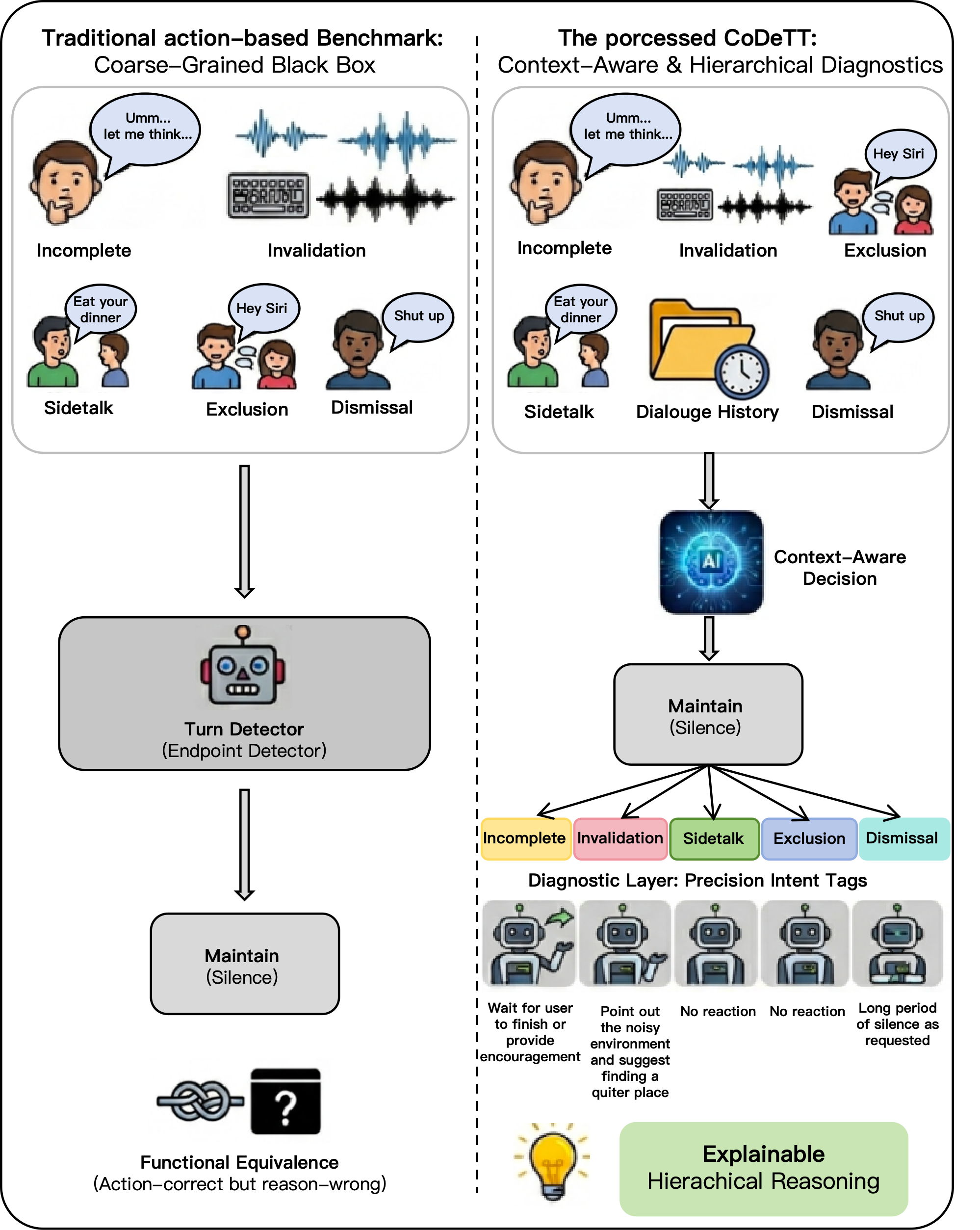
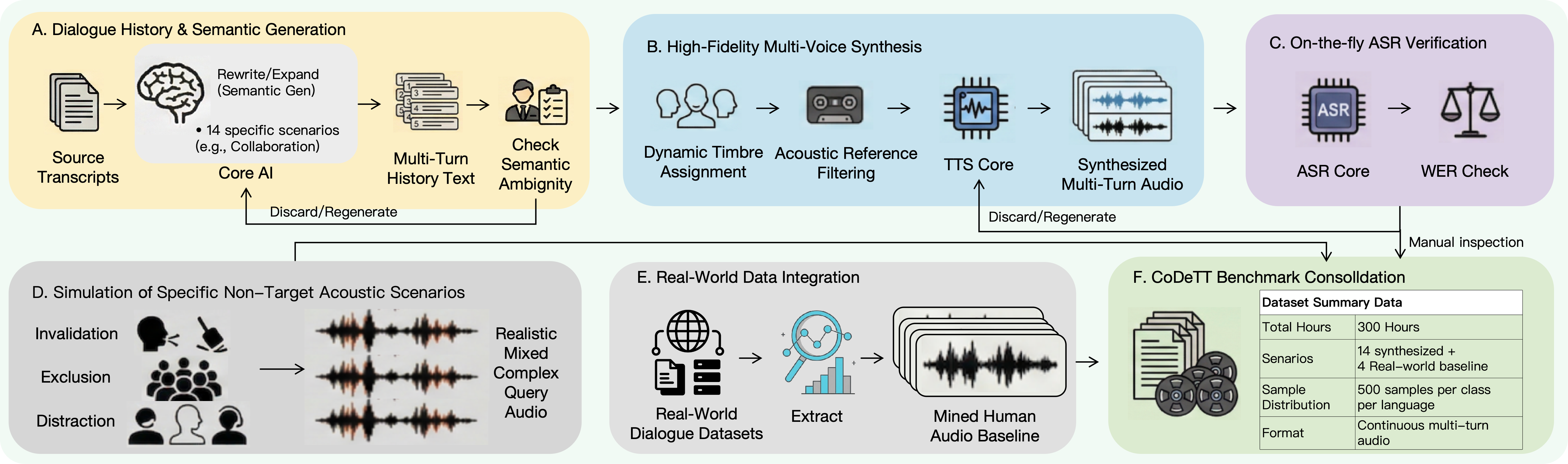
--- ## πŸ”₯ Overview CoDeTT is a benchmark and evaluation toolkit for measuring **turn-taking decision making** in spoken dialogue systems. Instead of only asking whether a user has finished speaking, CoDeTT evaluates whether a system can choose the right action under different conversational contexts: - Should the system **take over** and respond? - Should it **keep waiting** because the user has not finished? - Should it **maintain** its current speech because the user only gave a backchannel? - Should it **stop and listen** because the user is interrupting or dismissing the current response? CoDeTT extends turn-taking from endpoint detection to structured decision evaluation grounded in user intent, system state, dialogue history, and interaction timing. --- ## πŸ“Œ News - **2026-04-01**: arXiv v2 released. - **2026-03-26**: Paper submitted to arXiv. - The dataset and evaluation toolkit are available on GitHub, Hugging Face, and ModelScope. --- ## πŸ“„ Paper, Dataset And Project Page | Resource | Link | | --- | --- | | πŸ“„ Paper | [CoDeTT: A Context-Aware Decision Benchmark for Turn-Taking Evaluation](https://arxiv.org/abs/2603.25434) | | πŸ“• Local PDF | [`CoDeTT_benchmark/codett.pdf`](CoDeTT_benchmark/codett.pdf) | | 🌐 Project Page | [yingaowang-casia.github.io/CoDeTT.github.io](https://yingaowang-casia.github.io/CoDeTT.github.io/) | | πŸ€— Hugging Face Dataset | [YingaoWang-casia/CoDeTT](https://huggingface.co/datasets/YingaoWang-casia/CoDeTT) | | πŸ”· ModelScope Dataset | [wyawya/CoDeTT](https://www.modelscope.cn/datasets/wyawya/CoDeTT) | --- ## 🧠 What CoDeTT Evaluates CoDeTT models turn-taking as four core decisions and further analyzes 14 fine-grained semantic intent scenarios. ### Four decision actions | Action | Meaning | Unified label in the toolkit | | --- | --- | --- | | `Takeover` | The system should take the conversational floor and respond. | `complete` | | `Dismiss` | The system should keep waiting or ignore the current input. | `incomplete` | | `Maintain` | The system should continue its current response. | `backchannel` | | `Stop & Listen` | The system should stop speaking and listen to the user. | `dismissal` | ### 14 fine-grained intent scenarios | System state | Action group | Fine-grained intent | | --- | --- | --- | | `SystemSpeaking` | `Maintain` | `Backchannel`, `Invalidation`, `SideTalk`, `Distraction` | | `SystemSpeaking` | `StopAndListen` | `Interruption`, `Dismissal`, `Collaboration` | | `SystemIdle` | `Takeover` | `Completion`, `Cooperation` | | `SystemIdle` | `Dismiss` | `Incomplete`, `Invalidation`, `Dismissal`, `Exclusion`, `SideTalk` | This design helps diagnose whether a model makes the wrong coarse action or selects the right action while misunderstanding the underlying intent. --- ## πŸ“Š Evaluation Protocol CoDeTT supports two levels of evaluation. ### Stage 1: Action-level evaluation All models are normalized into a unified four-label space: ```text complete | incomplete | backchannel | dismissal ``` The scripts report overall accuracy, per-class accuracy, and binary-style precision, recall, F1, FPR, and FNR using `complete` as the positive class. ### Stage 2: Intent-level analysis For models with stronger semantic reasoning capability, the benchmark can be extended to inspect the 14 fine-grained intent categories and analyze semantic alignment under different interaction contexts. --- ## πŸ–ΌοΈ Figures

CoDeTT introduction

CoDeTT pipeline

--- ## πŸ“¦ Repository Structure ```text . β”œβ”€β”€ index.html β”œβ”€β”€ README.md β”œβ”€β”€ README_EN.md └── CoDeTT_benchmark/ β”œβ”€β”€ benchmark.py β”œβ”€β”€ benchmark_qwen3.py β”œβ”€β”€ benchmark_minicpm.py β”œβ”€β”€ benchmark_ke_semantic.py β”œβ”€β”€ codett.pdf β”œβ”€β”€ requirements.txt β”œβ”€β”€ image/ β”‚ β”œβ”€β”€ introduction.png β”‚ β”œβ”€β”€ pipline_new.png β”‚ β”œβ”€β”€ Table2.png β”‚ └── Table3.png └── _Adapters/ β”œβ”€β”€ easy_turn_wp.py β”œβ”€β”€ smart_turn_wp.py β”œβ”€β”€ ten_turn_wp.py β”œβ”€β”€ firered_wp.py β”œβ”€β”€ namo_wp.py └── base.py ``` --- ## πŸ› οΈ Environment Setup ```bash git clone https://github.com/YingaoWang-casia/CoDeTT.github.io.git cd CoDeTT.github.io/CoDeTT_benchmark python -m venv .venv source .venv/bin/activate pip install -r requirements.txt ``` Windows PowerShell: ```powershell python -m venv .venv .\.venv\Scripts\Activate.ps1 pip install -r requirements.txt ``` Python 3.10 or later is recommended. Some model-specific scripts also require local checkpoints, ONNX files, or a running local API service. --- ## πŸ“₯ Dataset Preparation Download the dataset from one of the official mirrors: - Hugging Face: [YingaoWang-casia/CoDeTT](https://huggingface.co/datasets/YingaoWang-casia/CoDeTT) - ModelScope: [wyawya/CoDeTT](https://www.modelscope.cn/datasets/wyawya/CoDeTT) The benchmark scripts expect JSONL files grouped by language and scenario. The historical default paths look like: ```text Benchmark_Datasets/jsonls/ZH/syn/... Benchmark_Datasets/jsonls/EN/syn/... Benchmark_Datasets/jsonls/EN/real/... ``` Before running on a new machine, update the default paths in the scripts or pass dataset paths explicitly when the script supports CLI overrides. --- ## πŸš€ Quick Start ### 1. Unified benchmark ```bash cd CoDeTT_benchmark python benchmark.py --out_dir ./outputs --run_name exp1 ``` `benchmark.py` evaluates different turn-taking models through a shared protocol. Please check `DEFAULT_DATASETS_ZH`, `DEFAULT_DATASETS_EN`, and `build_default_paths()` before running. ### 2. Qwen3-Omni ```bash cd CoDeTT_benchmark python benchmark_qwen3.py ``` This script calls an OpenAI-compatible local API endpoint. Useful environment variables: ```bash export QWEN_API_URL="http://localhost:8000/v1/chat/completions" export QWEN_TIMEOUT=120 export SEND_MODEL_FIELD=0 ``` Windows PowerShell: ```powershell $env:QWEN_API_URL="http://localhost:8000/v1/chat/completions" $env:QWEN_TIMEOUT="120" $env:SEND_MODEL_FIELD="0" python benchmark_qwen3.py ``` ### 3. MiniCPM ```bash cd CoDeTT_benchmark python benchmark_minicpm.py ``` Before running, set `LOCAL_MODEL_DIR` in `benchmark_minicpm.py` to your local MiniCPM checkpoint path. ### 4. KE-SemanticVAD ```bash cd CoDeTT_benchmark python benchmark_ke_semantic.py \ --out_dir ./outputs_ke \ --history_rounds 0 \ --datasets_user /path/to/user_1.jsonl /path/to/user_2.jsonl \ --datasets_agent /path/to/agent_1.jsonl /path/to/agent_2.jsonl ``` `history_rounds` controls how much dialogue context is preserved: | Value | Meaning | | --- | --- | | `0` | current utterance only | | `1` | current utterance + previous 2 messages | | `2` | current utterance + previous 4 messages | | `<0` | full history | --- ## πŸ§ͺ Supported Baselines And Adapters | Adapter | Input / paradigm | Output space | | --- | --- | --- | | `EasyTurnWP` | audio | `complete`, `incomplete`, `backchannel`, `dismissal` | | `SmartTurnWP` | audio / ONNX | binary `complete`, `incomplete` | | `TENTurnWP` | text / turn detection | `complete`, `incomplete`, `backchannel`, `dismissal` | | `FireRedChatWP` | text / ONNX | binary `complete`, `incomplete` | | `NAMOTurnWP` | text / ONNX | binary `complete`, `incomplete` | | `KESemanticVAD` | semantic VAD | 4-label evaluation | | `Qwen3-Omni` | multimodal API | 4-label evaluation | | `MiniCPM` | local multimodal model | 4-label evaluation | Binary models are evaluated on the supported subset or mapped into the unified label space through adapter logic. --- ## πŸ“ Outputs Output directories vary by script, but usually include: ```text config.json results.json report.md per_sample*.jsonl error_samples.jsonl ``` | File | Meaning | | --- | --- | | `config.json` | run configuration, dataset paths, and model paths | | `results.json` | aggregate metrics | | `report.md` | human-readable Markdown report | | `per_sample*.jsonl` | per-sample prediction logs | | `error_samples.jsonl` | failed or malformed samples | --- ## ⚠️ Notes 1. Some default paths come from historical experiment environments and need to be updated on a new machine. 2. If you see `No dataset files found`, check `DEFAULT_DATASETS_*` or pass dataset paths explicitly. 3. API-based scripts require the local model service to be running before evaluation. 4. Local multimodal models may require large GPU memory. Reduce concurrency or use a smaller model if OOM occurs. 5. In this toolkit, `dismissal` also covers normalized wait / stop-and-listen style cases. --- ## πŸ“š Citation If you use CoDeTT, its evaluation scripts, or its benchmark design, please cite: ```bibtex @misc{shen2026codettcontextawaredecisionbenchmark, title={CoDeTT: A Context-Aware Decision Benchmark for Turn-Taking Evaluation}, author={Huan Shen and Yingao Wang and Shangkun Huang and Wei Zou and Yunzhang Chen}, year={2026}, eprint={2603.25434}, archivePrefix={arXiv}, primaryClass={cs.SD}, url={https://arxiv.org/abs/2603.25434} } ``` --- ## πŸ“¬ Contact For questions about the dataset, benchmark scripts, or paper, please open an issue in this repository or contact the authors through the project page.