


One chat for everything you're working on.
It knows which project each message belongs to, and keeps every project's context separate.
English | 简体中文

A GPU question, a hotel question, then the GPU again, with no cues in between. The two topics on the left made themselves; nothing was clicked. (Example conversation.)
--- How many sessions are sitting in your DSH sidebar? Getting back to last week's work means digging through them. Skip creating a new one and everything piles into a single session, where topics bleed into each other and the details vanish at the next compaction. If you've ever said any of these, TheOne was probably written for you: - "Where was that chat again?" Too many conversations, and the old one is nowhere to be found. - "Not starting a new chat for this, I'll just ask here." And one chat turns into a mess. - "I already told you that!" The AI forgot what you talked about. **What TheOne does:** you only ever talk in one main chat. In the background it opens a separate session for each thing you're working on and sends every message to the one it belongs to.
`) to pair | The token stays on your computer |
| iMessage | Mac only: enter the phone number or Apple ID you text from | Give the app running DSH Full Disk Access, and allow it to control Messages on the first reply |
Messages arrive only while DSH is running, not while the computer sleeps or DSH is closed. After a network drop or a restart it picks up where it left off, without losing or repeating messages.
## How well does it route?
Claims are cheap, so we built a public benchmark, **InterleaveBench**: one person pushing 3–5 things forward in the same chat at once (a trip, a budget, a paper, a training plan…), half in Chinese and half in English, 50 conversations and 2,466 messages, each labelled in advance with the thing it belongs to. Below, the 40-conversation dev split replayed message by message through TheOne's own routing code with DeepSeek V4.1 Flash (messages even a careful human could not attribute are not scored):
| Approach | Messages routed correctly |
| --- | --- |
| TheOne, topic list given up front | **91.6%** |
| TheOne, starting from nothing and creating topics as it goes (your first day) | **86.6%** |
| Keyword search (BM25), topic list given up front | 73.3% |
| No routing, everything in one chat | 44.5% |
| Keyword search, starting from nothing | 39.9% |
| A new topic for every message | 9.8% |
A few numbers worth knowing:
- **A message landing in another thing's topic**, the mistake that hurts context most: about 3.7% when starting from nothing.
- The main weakness today is **opening new topics too eagerly**: one thing ends up split over 2.1 topics on average. 0.3.21's routing cards go after exactly that.
- The whole run cost about one US dollar. Data, code and scoring live in [`eval/`](./eval/README.md); reproduce it, or try another model.
The conversations are model-written from a script and this version has no assistant replies, so it measures whether messages are routed right, not everything about how chatting feels.
## What's next
For now, TheOne is being refined on DeepSeek Harness, whose background sessions, tools and compaction can be reused as they are: the right place to get "one chat for everything" solid first.
In progress:
- **Better routing**: looking at a burst of messages together while deciding each one separately, and measuring what routing cards add.
- **Confirmed facts shared between topics**: a budget, a date, where a file lives, kept current wherever you need it. It is experimental and will only be turned on by default once it passes its benchmark.
Once it is stable, the next step goes beyond DSH:
- **A standalone client**: one interface over different models and providers, opening straight into a single chat;
- **or adapters for other platforms**: the same automatic topics, inside the chat tools you already use.
Which comes first depends on what people need more. If you have a view, say so in [Issues](https://github.com/YunongDai2005/dsh-theone/issues) or by email at [theone@yulid.org](mailto:theone@yulid.org).
## How it works
**Choosing a topic.** Each message is matched to the current topic, an earlier one, or a new one. By default the model you selected makes one short classification (thinking off, at most 2,048 tokens), with candidates recalled through DSH full-text search.
- With no credible match it starts a new topic instead of asking whether it is new. It only asks when you refer to an earlier chat it cannot find, or it truly cannot tell which one you mean.
- When one message draws on several topics, the one doing the work gets it and the others come along as reference.
- "ok" or "go on" continues the current topic without waiting for a decision, and so does a picture or file sent without words.
- If the classification call fails, rules decide, staying in the current topic when unsure. Rule-based routing (`THEONE_ROUTER_MODE=rules`) makes no model calls at all.
**Linking topics.** A background session starting work receives a reference briefing, and none when there is nothing new:
- right after a topic switch, the last few turns of main chat, so "use what we just said" carries over;
- what changed in related topics since it last heard: their latest compaction summary (dated) and the progress after it;
- each topic's constraints, verbatim, every time.
The briefing is marked as reference, not instructions. For details, the background session can use `theone_read_topic` and `theone_search_history`. Linking scope is **Learn automatically** (default), **Same workspace only** or **Off**. In the directory you can link or unlink topics and mark a topic **Do not share**; your choices always win.
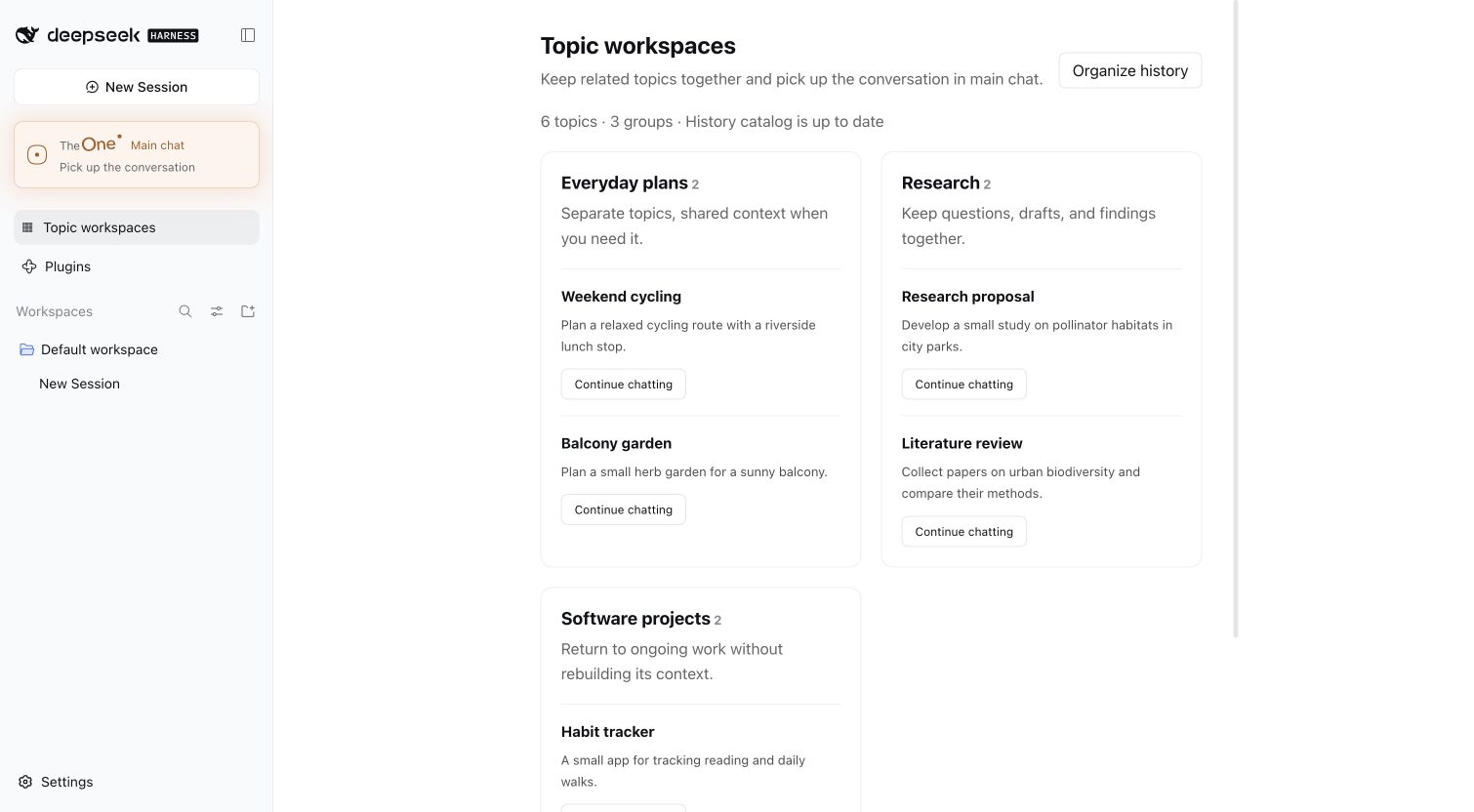
**Topic directory.** Each topic shows its latest progress and constraints, the project (DSH workspace) it works in, and its status when that is not plain in progress: **Waiting on you** (it asks you something, or a restart cut its work off), **Set aside** (untouched for longer than you usually come back), or **Done** (you marked it; a new message to it reopens it). Status is kept apart from the topic's record of what it worked on (its latest 20 messages and how each ended), and is worked out from it. **Mark done** / **Reopen** sits next to **Manage**. Under **Manage** you can rename, edit the summary and constraints, move to another workspace, merge, delete, or attach an existing DSH session as searchable history; **+ New topic** starts one by hand. **Recent topic routing** lists where each message went, why, with which model and how long it took. With a long history, the first pass takes some time and API quota; set `THEONE_HISTORY_CATALOG=false` to turn it off.
Settings
Right-click the TheOne button in the sidebar and choose **Settings**. Changes apply when saved; only the history catalog settings wait for a DSH restart.
| Setting | What it does |
| --- | --- |
| Topic notices | How main chat shows topic changes: hidden, one line only when the topic changes (default), or on every message with the reason |
| Linking scope | Learn automatically (default), same workspace only, or off |
| Share confirmed facts (experimental) | Off by default. Topics share only facts the user confirmed (a figure, a decision, where a file is), with version and source; a topic that used one is told when it changes or is withdrawn. Applies after a DSH restart |
| Record facts automatically (experimental) | Off by default. With shared facts on, one small model call after each turn records facts the topic session left out; only user-confirmed ones are shared |
| Model | Follow DSH (default) or pin the background model from any model configured in DSH; a pinned model takes precedence over main chat's selector |
| Routing | LLM decision (default) or rule-based |
| History catalog | On/off and rescan interval |
| Limits | Topic descriptor length; reply length per background step, thinking included |
| Manual catalog file | Optional JSON file of hand-written topics, imported when saved |
The database location and entry identifier switch TheOne to different data, so they are set only through environment variables: `THEONE_DATABASE_PATH` and `THEONE_GATEWAY_KEY`. Also optional: `THEONE_CONTEXTS_PATH` and `THEONE_WORKER_PROVIDER` / `THEONE_WORKER_MODEL` (set both).
Data and privacy
- DSH keeps the original conversations and tool results; TheOne keeps only its catalog, summaries, links and routing records in its own SQLite database (`$DSH_HOME/theone/contexts.db`, `~/.dsh/theone/` by default).
- Text sent to the router or written into briefings has API keys, passwords and similar secrets removed.
- A topic marked **Do not share** never appears in other topics' briefings, recent-chat excerpts or lookups.
- Notices from the author are read from `https://yulid.org/theone/notice.json` with a plain request that sends none of your data; turn them off in Settings.
- **Report a problem** (top right of Topic workspaces, or **Report a problem** on a message under Recent topic routing) sends only when you press Send, and shows everything it would send first. By default it holds versions, settings and routing error codes and timings, no chat content; for one message, its text and reply are added only if you tick the box. Reports go to `feedback.yulid.org`, are used only to look into problems and are deleted after 90 days; to have one deleted sooner, email theone@yulid.org with its id.
- When main chat grows long, DSH compacts it through TheOne: frequently used topics keep longer summaries and their latest turns, rarely used ones keep a short status. This makes no model call.
- Updates are installed by DSH's plugin manager and reload TheOne in place; a DSH without plugin hot reload applies them at the next restart.
Known limitations
- Telling whether a message sent during a reply is about that reply needs the routing model; with rules-only routing, every such message joins the reply, as before.
- A new topic not about any of your projects works in DSH's own folder for chats outside any project (`Documents/deepseek-harness/default-workspace`), or in `~/.dsh/theone/gateway` if you do not have that folder. Topics organised from your existing chats work in those chats' folders.
- Main chat stores copies of tool calls, so its log grows with use; entry-log rotation is not implemented yet.
- Only one DSH process should use a database at a time.
- Image output is not forwarded yet; there is no vector search; topics cannot be split yet.
- Main chat shows tool cards without running them because TheOne sits first in DSH's tool pipeline. If another plugin also places itself first, it may see these mirrored calls, but no tool runs twice.
Development
```sh
git clone https://github.com/YunongDai2005/dsh-theone.git
cd dsh-theone
npm ci --ignore-scripts
npm run typecheck
npm test
```
Tests use the real DSH runtime (AgentLoop, Session, SQLite, JSONL persistence, compaction) with a simulated model, and call no external API. `npm run pack:plugin` builds the install package; `npm run install:local` and `npm run start:local` run a separate DSH profile in `~/.dsh-theone`.
Service API: `ctx.theone.searchHistoryDetailed(contextId, query, limit)` searches a topic's reviewed history; `store.addSource(contextId, sessionId, { startSeq, endSeq })` attaches part of a session. Earlier acceptance records: [v0.1](./docs/plugin-v0.1.md) and [v0.2](./docs/plugin-v0.2.md).
🥚
Congratulations, you found the easter egg.
In the benchmark, TheOne once made a very human mistake. The user said "the café's autumn menu was due on September 25, let's push it to October 8", and TheOne filed it under the October holiday trip to Yunnan. Both were in October, after all.
We're still training it. If it ever files something of yours in the wrong place, just say "wrong topic" in the main chat. It will remember, and it won't take it personally.
---
If TheOne helps, a ⭐ helps others find it. Questions or ideas? Open an issue or email theone@yulid.org.