
Reinforcement Learning for Generalizable Medical Reasoning in Vision-Language Models
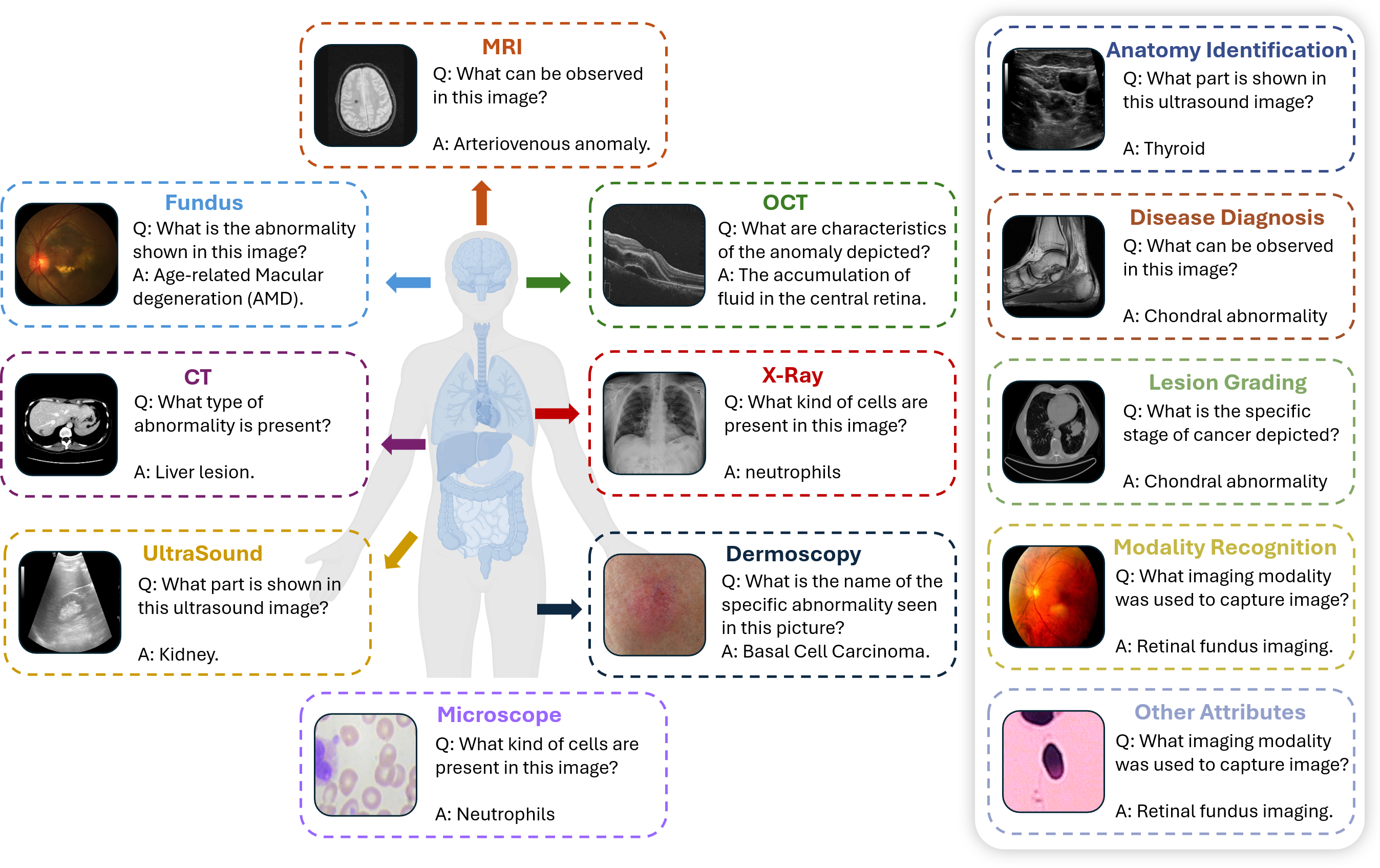
**Med-R1** is a reinforcement learning-enhanced vision-language model (VLM) designed for generalizable medical reasoning. Built on Qwen2-VL, Med-R1 uses Group Relative Policy Optimization (GRPO) to support **8 diverse imaging modalities** and **5 core diagnostic tasks**, achieving high performance with parameter efficiency.
[](https://huggingface.co/yuxianglai117/Med-R1)
[](https://arxiv.org/abs/2503.13939)

[](https://github.com/Yuxiang-Lai117/Med-R1/stargazers)
> Qwen2.5 checkpoint and training code are now publicly available on Hugging Face!
> 🚀 **[Code & Checkpoints Released → v1.0.0](https://github.com/Yuxiang-Lai117/Med-R1/releases/tag/v1.0.0)**
---
## 🔍 Overview
Med-R1 explores how reinforcement learning can improve medical reasoning in VLMs. Unlike traditional supervised fine-tuning (SFT), which may overfit to specific tasks, Med-R1 leverages reward-guided optimization to promote robust, diverse, and interpretable reasoning paths.
---
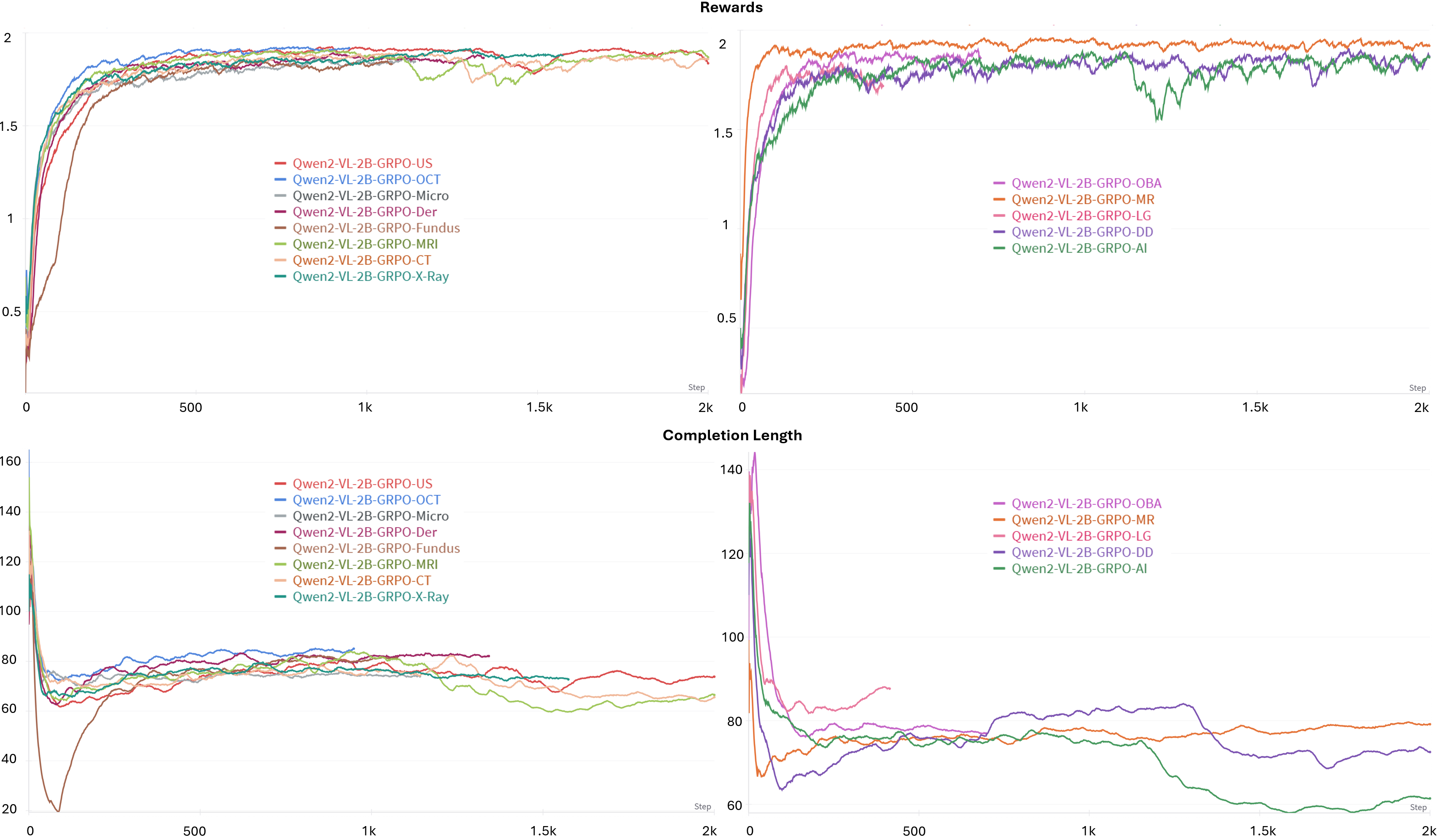
## 📈 GRPO Training Curves
Med-R1 is optimized with GRPO, producing stable training behavior across imaging types and diagnostic tasks.
---
## 🛠️ Setup
```bash
conda create -n med-r1 python=3.11
conda activate med-r1
bash setup.sh
```
> [!NOTE]
> If you encounter issues during setup, please ensure your environment aligns with `./src/requirements.txt`.
---
## ✅ Supported Models
- `Qwen2-VL`
- `Qwen2.5-VL`
---
## 🧠 Supported Modalities
We provide **cross-modality checkpoints**, each trained on a specific imaging type:
- **CT**
- **MRI**
- **X-Ray**
- **Fundus (FP)**
- **Dermoscopy (Der)**
- **Microscopy (Micro)**
- **Optical Coherence Tomography (OCT)**
- **Ultrasound (US)**
---
## 🧠 Supported Tasks
We also release **cross-task checkpoints**, each focusing on a key diagnostic function:
- **Anatomy Identification (AI)**
- **Disease Diagnosis (DD)**
- **Lesion Grading (LG)**
- **Modality Recognition (MR)**
- **Biological Attribute Analysis (OBA)**
---
## 📂 Data Format
**Data Link:** [](https://huggingface.co/datasets/foreverbeliever/OmniMedVQA)
All input images should be resized to **384×384** resolution. Below is an example of the expected input JSON format:
```json
[
{
"image": "Images/Chest CT Scan/test/adenocarcinoma_left.lower.lobe_T2_N0_M0_Ib/000139 (9).png",
"problem": "What imaging technique is employed for obtaining this image? A)Mammogram, B)PET, C)CT, D)Fluoroscopy",
"solution": " C "
},
...
]
```
# 🚀 GRPO Training Script for Med-R1
```bash
torchrun --nproc_per_node=2 \
--nnodes=1 \
--node_rank=0 \
--master_addr="127.0.0.1" \
--master_port=12345 \
src/open_r1/grpo_vqa_nothink.py \
--output_dir ./output/Modality_CT \
--model_name_or_path ./checkpoints/Qwen2.5-VL-3B-Instruct \
--dataset_name ./data/VQA/CT_384 \
--max_prompt_length 1024 \
--per_device_train_batch_size 1 \
--gradient_accumulation_steps 2 \
--logging_steps 1 \
--bf16 \
--report_to wandb \
--gradient_checkpointing false \
--attn_implementation flash_attention_2 \
--max_pixels 401408 \
--num_train_epochs 2 \
--run_name Qwen2.5-VL-3B-GRPO-CT \
--save_steps 200 \
--save_only_model true \
--num_generations 4
```
## 🤖 Model Inference & Usage
**Checkpoints**: [](https://huggingface.co/yuxianglai117/Med-R1)
```python
from transformers import Qwen2VLForConditionalGeneration, AutoProcessor
MODEL_PATH = "..."
model = Qwen2VLForConditionalGeneration.from_pretrained(
MODEL_PATH,
torch_dtype=torch.bfloat16,
attn_implementation="flash_attention_2",
device_map="auto",
)
processor = AutoProcessor.from_pretrained(MODEL_PATH)
```
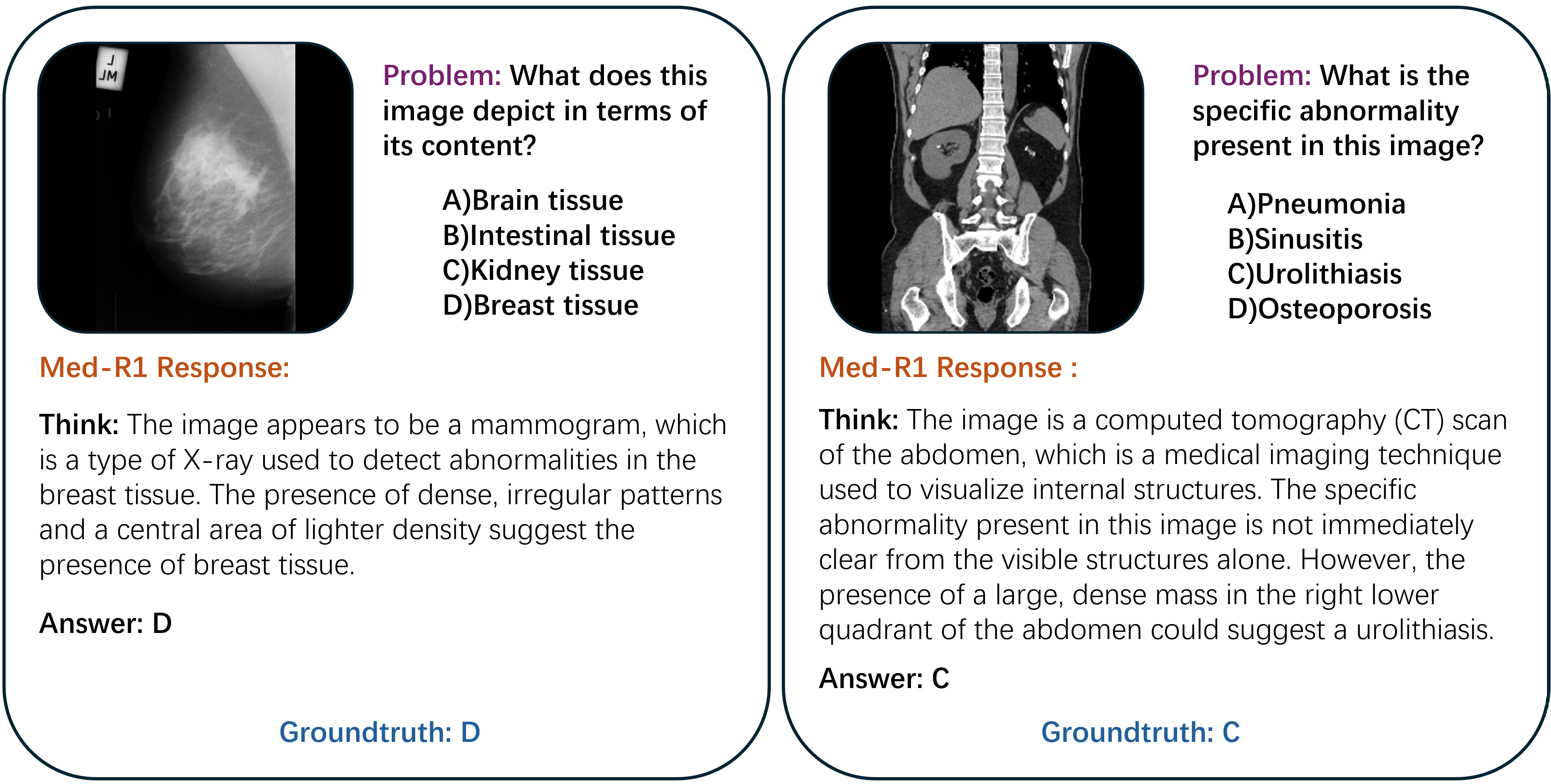
Med-R1 generates chain-of-thought (CoT) responses for medical visual queries:
### Inference Script
```python
from qwen_vl_utils import process_vision_info
with open(PROMPT_PATH, "r", encoding="utf-8") as f:
data = json.load(f)
QUESTION_TEMPLATE = "{Question} First output the thinking process in and final choice (A, B, C, D ...) in tags."
messages = []
for i in data:
message = [{
"role": "user",
"content": [
{"type": "image", "image": f"file://{i['image']}"},
{"type": "text", "text": QUESTION_TEMPLATE.format(Question=i['problem'])}
]
}]
messages.append(message)
for i in tqdm(range(0, len(messages), BSZ)):
batch = messages[i:i + BSZ]
text = [processor.apply_chat_template(msg, tokenize=False, add_generation_prompt=True) for msg in batch]
image_inputs, video_inputs = process_vision_info(batch)
inputs = processor(text=text, images=image_inputs, videos=video_inputs, padding=True, return_tensors="pt")
inputs = inputs.to("cuda")
outputs = model.generate(**inputs, use_cache=True, max_new_tokens=256, do_sample=False)
trimmed = [out[len(inp):] for inp, out in zip(inputs.input_ids, outputs)]
decoded = processor.batch_decode(trimmed, skip_special_tokens=True)
all_outputs.extend(decoded)
```
---
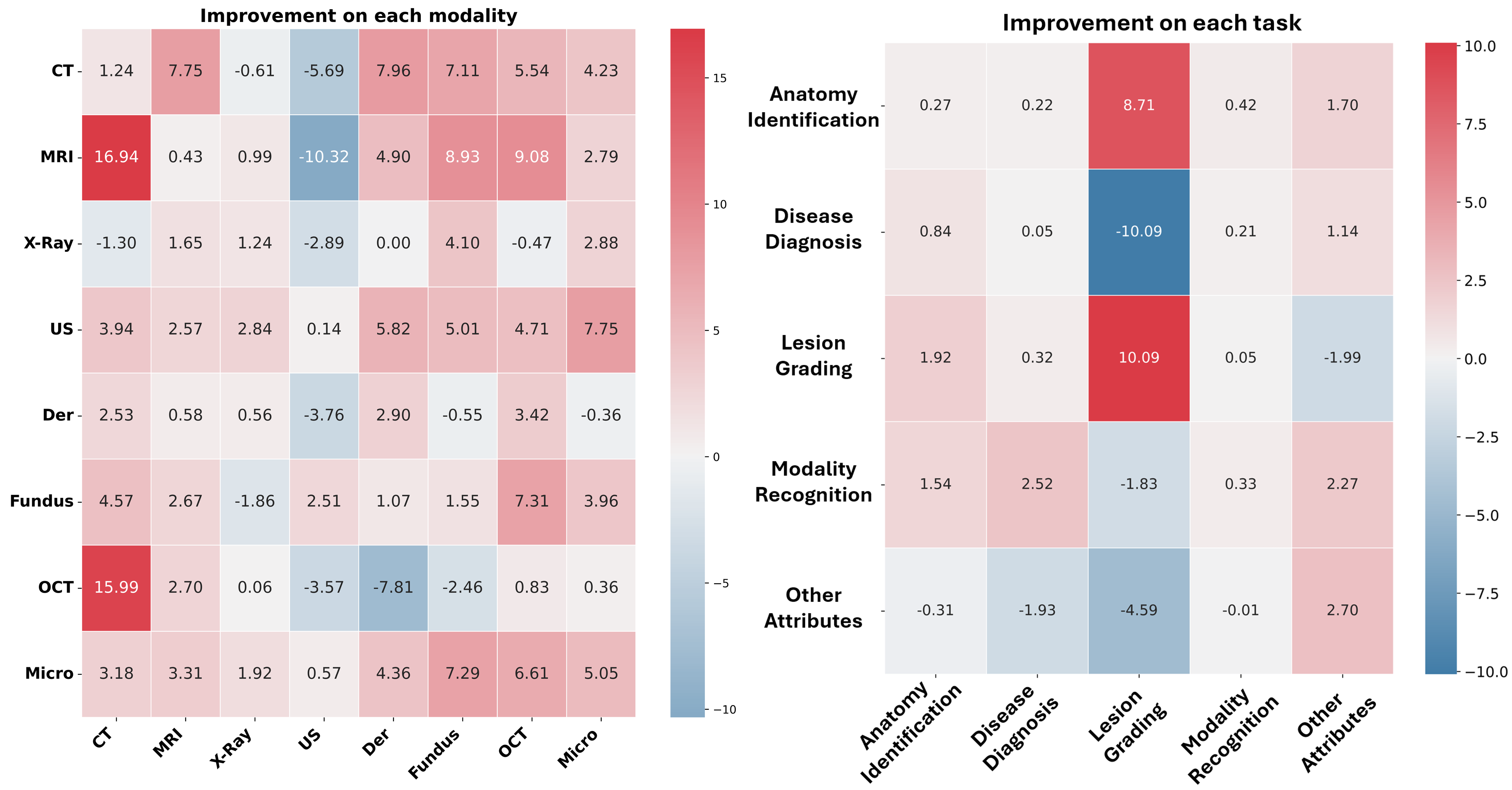
## Think or Nothink
Evaluation across modalities and tasks:
---
## 🙏 Acknowledgements
We thank the authors of **OmniMedVQA** and **R1-V** for their open-source contributions.
🔗 [R1-V GitHub](https://github.com/Deep-Agent/R1-V)
🔗 [OmniMedVQA GitHub](https://github.com/OpenGVLab/Multi-Modality-Arena)
---
## 📚 Citation
```bibtex
@article{lai2025med,
title={Med-R1: Reinforcement Learning for Generalizable Medical Reasoning in Vision-Language Models},
author={Lai, Yuxiang and Zhong, Jike and Li, Ming and Zhao, Shitian and Yang, Xiaofeng},
journal={arXiv preprint arXiv:2503.13939},
year={2025}
}
```