
DSH Android
A live Android device inside a DeepSeek Harness conversation — emulator or USB phone, driven entirely through adb.
20 agent tools • in-process live stream, no external helper • three-button navigation panel • Gradle build & run • Vision OCR
npm: @zseven-w/dsh-android · Current plugin release: 0.1.0-rc.4 · Tested with DSH 0.1.1-rc.1
English · 简体中文 · 繁體中文 · 日本語 · 한국어 · Français · Español · Deutsch · Português · Русский · हिन्दी · Türkçe · ไทย · Tiếng Việt · Bahasa Indonesia
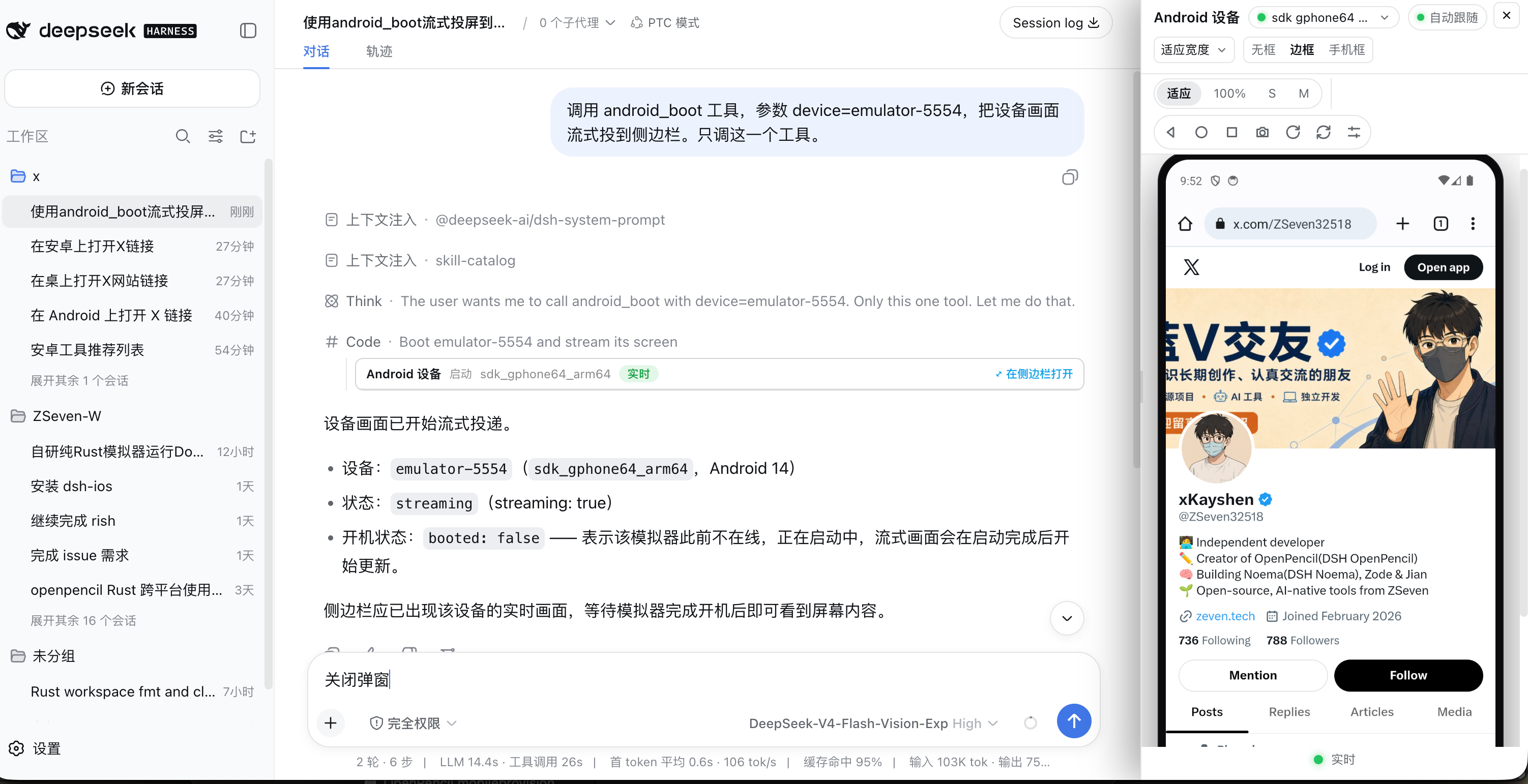
An Android device streamed and controlled from inside a DSH conversation — the agent's tool call in the center, the live device panel on the right
## Why DSH Android
DSH Android gives the agent a real Android device inside the conversation — and gives you the pixels. The agent can start a stream on an emulator or a USB-connected phone, build and install a Gradle project, drive the UI by `resource-id`/text or by OCR, read logcat, and inspect processes and memory, while a live stream of the device renders in a persistent sidebar panel where you can tap, drag, rotate, and press Back / Home / Recents directly on the video. No image blocks and no screen-recording files: visual bytes reach the UI only through signed, expiring URLs served by the DSH webserver.
There is exactly one code path. `adb devices -l` reports a **serial**, and that serial is a device's only identity — `emulator-5554`, a USB serial, or an `ip:port` target all behave identically. The plugin is bound to no emulator product (AVD, Genymotion, WSA, a cloud device farm), and there is no simulator/real-device split to reason about.
| | |
| --- | --- |
| 📱 **Live device in the conversation** | A `multipart/x-mixed-replace` PNG stream produced **in-process** and served straight from the latest-frame buffer through signed `/_dsh/dsh-android/*` routes. |
| 🔌 **No external stream helper, no inner port** | One persistent `adb exec-out` child runs `while :; do screencap -p; done`; the host splits the concatenated PNGs into frames itself. There is no loopback stream server to proxy, no port range to manage, and nothing to adopt after an ungraceful exit. |
| 🧩 **One adb code path** | Emulators and phones are the same thing to adb and to this plugin. No `simctl`/WebDriverAgent dual stack, no build-and-trust dance before a physical device works. |
| 🛠️ **20 agent tools** | Devices, boot/shutdown, screenshot, interact, Gradle build & run, app listing/launching, `uiautomator` UI tree + tap-by-element, list/feed row actions, Vision OCR find/tap/wait, logcat, processes, ANR/crash backtrace, meminfo, app info. |
| 👆 **Three-button navigation panel** | Tap and drag on the live video; a toolbar with **◁ Back · ○ Home · □ Recents** plus rotate, screenshot, and refresh; a device menu for the notification shade, quick settings, lock, wake, and the assistant. |
| 🖼️ **Native multimodal** | On an image-capable model every capture tool (screenshot, interact, tap_element, tap_text, tap_row) returns the screenshot ITSELF as an image block — the model sees the screen directly. OCR stays for pixel-precise text taps and text-only routes; text-only models keep the plain JSON summary. |
| 🔐 **Signed loopback-only routes** | Every route requires a loopback peer, a loopback `Host` (DNS rebinding rejected), and Fetch-Metadata/Origin checks — before any capability is consulted. HMAC-SHA256 capabilities expire within 10 minutes. |
| 🔍 **Semantic + visual automation** | `android_ui_tree` dumps the `uiautomator` hierarchy and `android_tap_element` taps by `resource-id`, text, or content-description; when the tree is empty or the text is baked into an image, `android_find_text` / `android_tap_text` OCR the screen instead of guessing coordinates. |
## Tools
All 20 tools are registered on every host and return plain JSON — visual bytes reach the UI only through `presentationMeta` + signed routes, never as image blocks. When adb cannot be resolved the tools stay registered and every call fails with an explanatory error naming the fix.
Coordinates are **normalized 0..1 of the streamed frame** everywhere. The frame follows the display rotation (a landscape app streams 2400×1080 on a 1080×2400 device) and `input tap` shares that same space, so no client-side rotation math exists anywhere in this plugin.
### Core tools
| Tool | What it does | Key parameters |
| --- | --- | --- |
| `android_devices` | List every device `adb devices -l` reports (serial, state, emulator/physical, model, Android version, API level, AVD name) plus the machine's AVD names under `avds`. Use it to discover the serial the other tools take. A failed enumeration throws instead of returning an empty list. | — |
| `android_boot` | Start the live stream. Pass an ONLINE serial to stream it immediately, or an AVD name to launch that emulator first and stream it once it finishes booting (minutes on a cold start). The stream stays alive for the conversation so the panel can show the device live. | `device` (required — a serial or an AVD name) |
| `android_shutdown` | Shut an emulator down (`adb emu kill`) and stop the stream when it targets that device. A physical device is refused with the reason: adb cannot power off a phone. | `device` |
| `android_screenshot` | Capture a PNG and return a small JSON summary (path, bytes, dimensions, device); the image renders in the card and the panel, never as an image block. | `device` (optional — streamed device, else the only online one) |
| `android_interact` | Interact with the streamed device: tap at normalized 0..1 coordinates, type text, press a navigation or hardware button (`back`, `home`, `recents`, `power`, `volume_up`, `volume_down`, `menu`, `enter`, `delete`), send a swipe gesture, or scroll. After the action settles (~300 ms) a fresh screenshot shows the effect. | `action` (required — `tap`/`type`/`button`/`gesture`/`scroll`), `x`/`y`, `text`, `name`, `json`, `device` |
| `android_list_apps` | List the packages installed on the device (`pm list packages`), with the version name from `dumpsys package` and a human label when one is resolvable — a third-party package name cannot be guessed, so list it or pass `name` to `android_launch_app`. | `device`, `query` (case-insensitive substring, CJK included), `include_system` (default false) |
| `android_launch_app` | Launch an installed app by `packageName`, or by `name` (a case-insensitive label substring resolved through the same listing). Exactly one of the two. `relaunch` force-stops the app first. | `packageName` or `name` (exactly one), `device`, `relaunch` |
| `android_build_run` | Build a Gradle project (`./gradlew assembleDebug`), install the resulting debug APK (`adb install -r`), and launch it. Takes minutes for a full build; on failure the result carries the tail of the Gradle error output. | `projectPath` (required), `device` |
### UI-tree and row tools (`uiautomator`)
| Tool | What it does | Key parameters |
| --- | --- | --- |
| `android_ui_tree` | Dump the foreground app's `uiautomator` hierarchy as nodes — `type` (the class tail), `text`, `contentDesc`, `resourceId`, `bounds` in pixels, `enabled`, `focused` — capped at ~40 KB (the deepest levels are pruned and `truncated` is set). | `device`, `max_depth`, `filter` (case-insensitive substring over text/content-description/resource-id) |
| `android_tap_element` | Tap an element by identity — `resource_id` matches the node's `resource-id`; `text` matches its text or content-description. Exact match first, then case-insensitive substring; nested duplicates collapse to one target and an ambiguous match lists up to 8 candidates instead of picking one. Disabled elements are refused. The tap lands on the element center, then a ~300 ms screenshot shows the effect; pass `expect_text` / `expect_gone` and the tap plus its verification become one round trip. | `device`, `resource_id`, `text`, `expect_text`, `expect_gone` |
| `android_ui_rows` | Read a list/feed screen (`RecyclerView` and friends) as ROWS instead of a raw tree: repeated same-shaped children become rows carrying an index, a pixel frame, the aggregated label, and the counters parsed out of that label (number + classifier token, Chinese or English — no app vocabulary is hardcoded). Counter keys round-trip: pass one exactly as listed to `android_tap_row.expect_count`. | `device`, `max_depth` |
| `android_tap_row` | Tap at a relative position inside one visible row (`index` from `android_ui_rows`; `x`/`y` as fractions of that row's frame, default 0.5 = center). The frame comes from a FRESH tree read, so no absolute coordinates are guessed, and an out-of-range index FAILS rather than clamping. With `expect_count={key, delta}` the tool re-reads the row after ~800 ms and verifies the counter moved by exactly ±1; an unknown key REFUSES the tap before it happens. | `device`, `index` (required), `x`, `y`, `expect_count` (`{key, delta}`) |
### OCR, logs, and debug tools
| Tool | What it does | Key parameters |
| --- | --- | --- |
| `android_find_text` | OCR the CURRENT screen with the plugin-compiled Vision helper (accurate recognition, zh-Hans + en-US). Use it when the UI tree is empty or degenerate, for text rendered as graphics (badge counts, prices baked into images), or to independently verify what is on screen. Returns `{device, size, items:[{text, confidence, rect}]}` where rects are **pixel** boxes with a top-left origin, confidence-sorted and capped at ~40 KB. macOS host only. | `device`, `query` (case-insensitive substring), `min_confidence` (default 0.3) |
| `android_tap_text` | OCR the CURRENT screen and tap the center of the best text match — the same exact → contains → candidate-list rules as `android_tap_element`, for text the UI tree cannot see. The matched pixel center is normalized against the frame size and sent as a tap; after ~300 ms a fresh screenshot shows the effect. macOS host only. | `device`, `query` (required), `min_confidence`, `expect_text`, `expect_gone` |
| `android_wait_for` | Wait until text appears or disappears, polling the same capture + OCR pipeline every 600 ms until the condition holds or the timeout expires (default 8 s, max 60 s). A timeout is a normal `matched:false` answer, never an error. macOS host only. | `device`, `text` (required), `mode` (`appear`/`disappear`), `timeout_ms`, `min_confidence` |
| `android_logs` | Read what the device logs: `snapshot` (`logcat -d -v time` over a recent window, default 2m) or `follow` (a bounded live capture for `duration_seconds`, default 10, max 60 — never a hanging stream). Filter to one app with `bundle_id` (the Android package name, resolved to its pid). Output is capped at ~300 lines / 30 KB with a narrowing hint. | `device`, `mode` (`snapshot`/`follow`), `duration`, `duration_seconds`, `bundle_id`, `grep` |
| `android_processes` | List the device's running processes (`ps -A`) as `{pid, name}` — the pid source for `android_backtrace`. | `device`, `filter` (case-insensitive substring over the process name) |
| `android_backtrace` | Ask the process to dump its stacks (`kill -3`) and read the resulting ANR trace from `/data/anr/`. Most non-rooted devices refuse that directory, so the tool degrades to the crash buffer (`logcat -b crash -d`) and reports honestly which engine answered and what it cannot see. | `device`, `pid` or `bundle_id` |
| `android_meminfo` | Parse `dumpsys meminfo `: total PSS, the Java/native/graphics split, and the top categories — the Android answer to a leak summary. | `device`, `bundle_id` (required) |
| `android_app_info` | Installed-app facts from `dumpsys package `: version name and code, data directory, code path, first-install time, and the system flag. A missing app returns `installed: false` plus a note naming `android_list_apps` — it does not throw. | `device`, `bundle_id` (required) |
## Display surfaces
- **Sidebar panel.** The live view lives in a persistent right-hand panel (a fixed dock that pushes the conversation aside, or a centered overlay on narrow viewports). It renders the live PNG stream and accepts click-to-tap and drag-to-gesture directly on the video, with a toolbar carrying **◁ Back**, **○ Home**, **□ Recents**, rotate, screenshot, and refresh. A device menu runs the five device-level actions (notification shade, quick settings, lock, wake, assistant). The device picker lists every adb device in ONE list, grouped by kind, with offline AVDs shown as a hint pointing at `android_boot` rather than a boot-on-click. Size modes and frame styles (frameless / bezel / phone shell) work as in the iOS twin; the panel adapts its aspect ratio from the frame's own natural size, so a rotation needs no configuration.
- **Compact conversation cards.** Tool results render as one-line cards with no inline imagery: the device name, an action sub-label, a status badge, and an "open in sidebar" cue. Clicking the row opens the panel.
- **Status capsule above the input.** While the panel is closed and a stream is online, a small pill appears above the composer and opens the panel when clicked.
- **Standard mode and Code Mode.** Standard sessions use the host-projected `presentationMeta`; nested Code Mode dispatches carry no meta, so the client reconstructs the identical meta from the durable result JSON — the panel, the cards, and the capsule work in both.
## Security
- **The browser never talks to adb, and there is no inner port to talk to.** The stream is produced in this process and served from memory; every byte crosses the DSH webserver origin through plugin-owned `/_dsh/dsh-android/*` routes: `/stream/` (live multipart PNG), `/screenshot/` (cached PNG), plus `/grant`, `/switch-device`, `/devices`, `/capture`, `/status`, `/control`, and `/device-action`. This is a strictly smaller attack surface than a proxied loopback stream server.
- **A triple loopback fence, applied before any capability is read.** The transport peer must be a loopback address, the `Host` header must name a loopback authority (so a DNS-rebinding `Host` is rejected), and Fetch-Metadata/`Origin` must be same-origin. Host and Origin are caller-controlled data and are never trusted on their own.
- **HMAC-SHA256 capabilities expiring within 10 minutes**, formatted `base64url(payload).base64url(mac)` and signed with a 32-byte per-DSH-home key (`/cache/dsh-android/stream-access.key`, mode 0600, created atomically). A capability minted for one device stops working the moment another device takes the stream slot, and a screenshot capability cannot be replayed against the stream route.
- **The screenshot route serves exactly one directory.** Paths are walked with `lstat` (any symbolic link is refused), finished with a `realpath` containment check, opened with `O_NOFOLLOW`, size-bounded, and re-validated after the read — so a file swapped for a symlink between minting and fetching is never served.
- **`/grant` never boots anything.** It only starts the frame loop for a device that is already online, and it refuses (409 `device_busy`) to yank the stream away from another device. Switching devices requires the explicit `/switch-device` gesture; booting an AVD stays with the `android_boot` tool.
- **Keep-alive and idle stop.** A crashed frame loop restarts in the background (~5 s delay); with zero consumers the stream stops itself after 5 minutes. Intentional stops are never fought.
## Requirements
- **Node ≥ 24.11.0.**
- **adb**, from the Android SDK platform-tools, resolved in this order: the `ADB` environment variable → `adb` on `PATH` → ``/``/the per-OS default SDK root + `/platform-tools/adb`. Install it with `sdkmanager "platform-tools"`, with Android Studio, or with `brew install --cask android-platform-tools`. Without adb the plugin still loads and all 20 tools register; every call then explains what is missing.
- **A device**: an emulator of any product, or a phone with USB debugging enabled. The `emulator` launcher is optional and only `android_boot`-by-AVD-name needs it — everything else works with whatever adb can see.
- **DSH ≥ 0.1.0-rc.6 with the web bundle** for the panel. Headless profiles work too: all 20 tools function normally, just without the live view.
- **macOS host for OCR** (only `android_find_text` / `android_tap_text` / `android_wait_for` need it): the plugin compiles its bundled `assets/ocr.swift` with `swiftc` on first use into `~/Library/Caches/dsh-android/bin/ocr`. On Linux and Windows hosts those three tools report that OCR needs the macOS Vision framework; the other 17 are unaffected. Overrides: `DSH_ANDROID_OCR_DIR`, `DSH_ANDROID_OCR_SWIFT`, `DSH_ANDROID_SWIFTC`.
- **ADBKeyboard** (optional, for CJK and emoji input): `adb shell input text` is ASCII-only. Install [ADBKeyboard](https://github.com/senzhk/ADBKeyBoard) on the device and select it as the active IME, and non-ASCII text is delivered through its broadcast interface. Without it, non-ASCII typing is REFUSED with the install hint — never silently mistyped.
## Physical devices
There is no WebDriverAgent equivalent to build, sign, trust, or re-sign every seven days. Enable USB debugging, plug the phone in, accept the authorization prompt on the device, and it appears in `android_devices` with every tool working against it. An unauthorized device is reported as such with the prompt hint, not as a mysterious failure.
Three honest caveats:
- **Frame rate is lower over USB** — roughly 2–5 fps against a phone versus 5–10 fps on an emulator, because every frame crosses the USB link as a full PNG.
- **CJK typing needs ADBKeyboard** (see above); this affects emulators and phones alike.
- **`android_shutdown` cannot power off a phone.** adb has no such verb; the tool says so instead of pretending.
## Performance
Measured on an emulator (Android 14, 1080×2400):
| | |
| --- | --- |
| Persistent screencap loop | ≈ 8 fps |
| `ensureStreaming` first frame | ~200 ms |
| `input tap` round trip | ~130 ms |
The single persistent child is what buys this: spawning one `adb` per frame costs ~50–100 ms before any pixels move. Expect ~5–10 fps on an emulator and ~2–5 fps on a USB phone, depending on the machine and the screen density.
## Install into DSH
```sh
dsh plugin --profile web add @zseven-w/dsh-android@latest
dsh web
```
Or add it as a dependency of an existing profile package:
```sh
pnpm add @zseven-w/dsh-android
```
## Quick start
1. **Discover devices** — "List the Android devices." → `android_devices`.
2. **Start the stream** — "Stream emulator-5554." → `android_boot`. The panel opens with the device live. (An AVD name boots that emulator first.)
3. **Tap on the video** — tap or drag directly on the panel, or let the agent drive: "Open Settings, then tap Display." → `android_interact`, or `android_ui_tree` + `android_tap_element` for identity-based taps, or `android_find_text` + `android_tap_text` when the tree is blind.
4. **Build and run your app** — "Build and run /path/to/MyApp." → `android_build_run`. A full Gradle build takes minutes; when it lands, the app launches and you watch it live in the panel.
5. **Read the logs** — "Show the last two minutes of logcat for com.example.app." → `android_logs`.
## Troubleshooting
- **Every tool says adb is unavailable** — the error names the three resolution tiers. Set `ADB=/path/to/adb`, put `adb` on `PATH`, or install the SDK platform-tools (`sdkmanager "platform-tools"`).
- **The device is `unauthorized`** — accept the USB debugging prompt on the device screen. `android_devices` reports the state honestly rather than hiding the device.
- **`android_boot` cannot find an AVD** — the `emulator` launcher was not discoverable. Start the emulator by any means; it appears in `android_devices` as soon as adb sees it, and `android_boot` then takes its serial.
- **Non-ASCII text is refused** — install ADBKeyboard and select it as the input method (see Requirements). The refusal is deliberate: `input text` would silently drop or mangle the characters.
- **`android_find_text` says OCR is unavailable** — OCR needs a macOS host (Apple's Vision framework). The 17 non-OCR tools work everywhere.
- **The stream stops by itself** — that is the idle policy, not a crash: with zero consumers (panel closed, no cards mounted, no route active) the stream stops after 5 minutes and restarts on the next tool call or panel open. A crashed loop restarts on its own within ~5 seconds.
- **Rotation looks wrong on the launcher** — launchers and Settings pin themselves to portrait and ignore `user_rotation`. That is normal Android behaviour, not a plugin bug; rotate inside an app that allows it.
## Development
```sh
pnpm install
pnpm run build # host tsc + client bundle → lib/
pnpm run typecheck
pnpm test # every static suite; no device required
```
The `scripts/` smoke suites exercise the built `lib/`. All of them are static except `dev-emulator-smoke.mjs`, which needs a device and reports SKIP (exit 0) when there is none.
| Script | What it covers |
| --- | --- |
| `node scripts/dev-adb-smoke.mjs` | adb resolution (env / PATH / SDK) against a shim binary, `devices -l` parsing, binary-safe `exec-out`, the PNG frame splitter and its resync, input-text escaping, and the host lifecycle (stream, control, idle stop, dispose) against a fake toolchain. |
| `node scripts/dev-routes-static-smoke.mjs` | The signed routes against a fake host: relative grants, expired/forged/cross-kind tokens, the loopback fence, 405/415/400 envelopes, coded device refusals, `/control` validation, the rotate shape, screenshot containment, and the live multipart stream. |
| `node scripts/dev-tools-smoke.mjs` | The core tools against a fake host through the `createAndroidTools` seam. |
| `node scripts/dev-uitree-smoke.mjs` | UI-tree and row tools: `uiautomator` XML parsing, selectors, depth capping, row and counter heuristics. |
| `node scripts/dev-logs-smoke.mjs` | `android_logs` snapshot/follow, filters, caps, and process reaping. |
| `node scripts/dev-panel-smoke.mjs` | Panel components, size modes, frame styles, dock/trigger/capsule logic (SSR only). |
| `node scripts/dev-emulator-smoke.mjs [serial]` | Live device: first frame, sustained frame rate, tap round trip, dispose. |
## Troubleshooting
### Blank / white stream on an emulator
If the panel streams a solid white (or black) image while `android_ui_tree`
still sees real UI elements, the emulator's host-GPU framebuffer readback is
broken on your machine (a known gfxstream issue on some macOS hosts —
`screencap` itself returns blank frames, so every screen tool is affected).
Relaunch the emulator with software rendering:
```bash
emulator -avd -gpu swiftshader_indirect
```
or set `hw.gpu.mode=swiftshader_indirect` in the AVD's `config.ini`. Physical
devices are never affected.
## Roadmap
- **A higher-frame-rate source.** The `StreamSource` seam is deliberately pluggable: an `scrcpy-server` + WebCodecs H.264 path would replace the per-frame PNG stream without touching the routes, the tools, or the panel.
- **Compose preview hot reload.** The iOS twin hot-swaps SwiftUI previews as a dylib; Compose has no equivalent hot-swap primitive today, so this stays a future item rather than a shipped-and-flaky one.
## Ecosystem
- [DSH iOS Simulator](https://github.com/ZSeven-W/dsh-ios) — the same architecture for the iOS Simulator and USB-connected iPhones
- [DSH Crew](https://github.com/ZSeven-W/dsh-crew) — dispatch work to DSH agents from Claude Code / Codex
- [DSH Noema](https://github.com/ZSeven-W/dsh-noema) — long-term memory for DSH
- [DSH OpenPencil](https://github.com/ZSeven-W/dsh-openpencil) — inspect and edit `.op` design documents inside a conversation
## Credits & License
- [Android SDK platform-tools](https://developer.android.com/tools/releases/platform-tools) (`adb`) — resolved at runtime, never redistributed: Google's SDK licence does not permit bundling it.
- [ADBKeyboard](https://github.com/senzhk/ADBKeyBoard) — Senzhk — the optional on-device IME behind non-ASCII typing (Apache-2.0; not bundled).
- Architecture and route posture shared with [dsh-ios](https://github.com/ZSeven-W/dsh-ios), from which this plugin is ported.
- See [THIRD_PARTY_NOTICES.md](./THIRD_PARTY_NOTICES.md) for the full notices.
**License**: MIT