ZSvirt Logo

Open Source Virtualization
Enterprise Ready, Community Driven

ZSvirt Website Documentation Live Demo Download

English  ·  简体中文

## What is ZSvirt ZSvirt brings [ZStack](https://www.zstack-cloud.com/)'s enterprise-proven ZSphere virtualization engine into the open-source world. Backed by [ZStack](https://www.zstack-cloud.com/), a mature infrastructure leader, ZSvirt delivers a lightweight, scalable platform designed for absolute freedom—from high-performance homelabs to hyperscale infrastructure without vendor lock-in. ## Product Tour
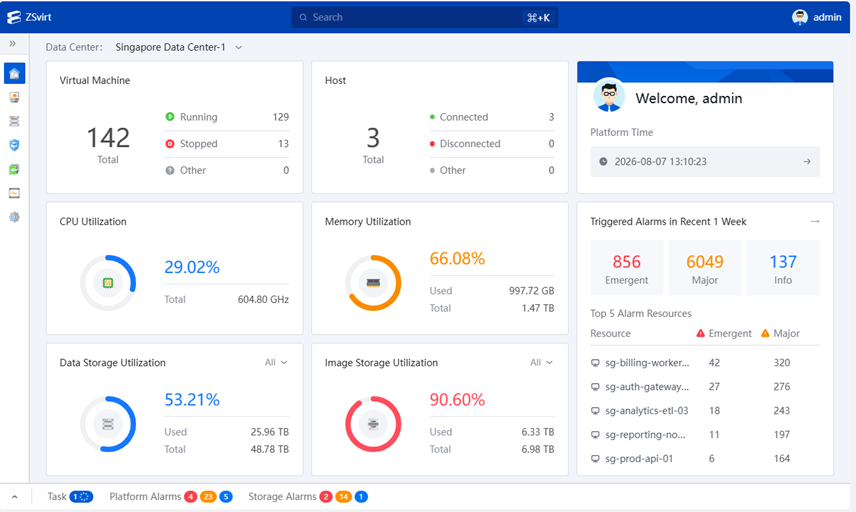
📊 DASHBOARD — Unified Operations Overview

ZSvirt Unified Operations Dashboard


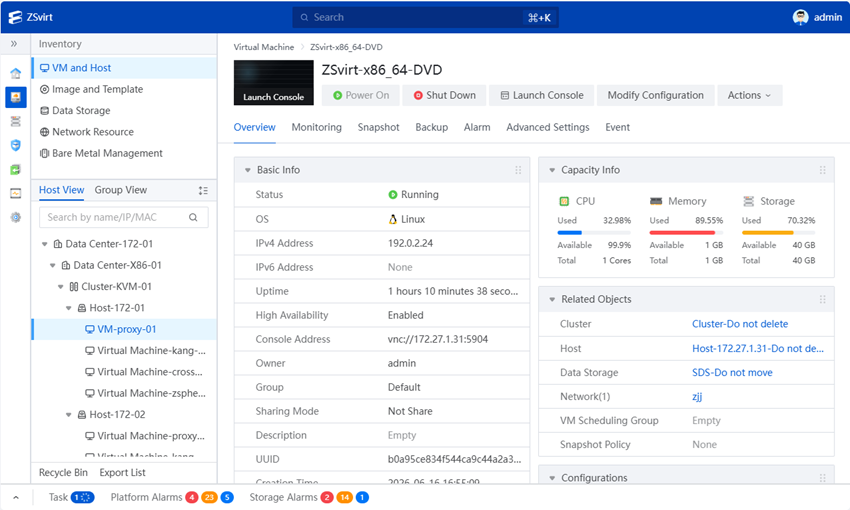
🗂️ INVENTORY — Centralized Infrastructure Management

ZSvirt Centralized Infrastructure Inventory


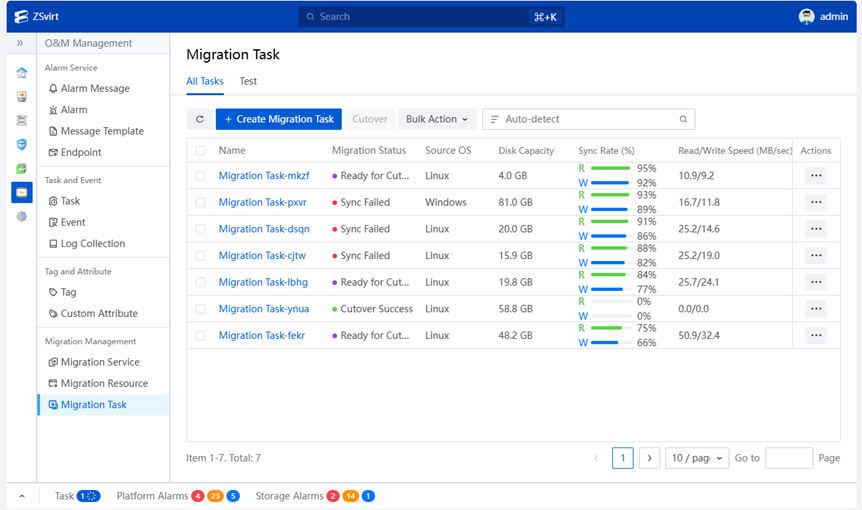
🔄 MIGRATION MANAGEMENT — Workload Migration

ZSvirt Migration Management

## Live Demo [ZSvirt Live Demo](https://demo.zsvirt.io/) is a free hosted environment for trying ZSvirt online. No local installation is required—after registration and login, you can start exploring the platform right away. ## Architecture ZSvirt uses a modular architecture built around virtualization resource management, the management plane, extension services, and operational tooling. Core capabilities include: - **Compute virtualization**: host, cluster, virtual machine, image, and lifecycle management. - **Network virtualization**: virtual networks, network services, security groups, and related capabilities. - **Storage virtualization**: primary storage, backup storage, volumes, snapshots, and storage resource management. - **Management plane**: API framework, permission model, events, alarms, auditing, and system operations. - **Extension services**: capabilities for migration, disaster recovery, monitoring, quota management, access control, and enterprise operations. - **Tools and integrations**: installation tools, diagnostics tools, migration tools, automation scripts, agents, CLI, and external system integrations. At the software architecture level, ZSvirt emphasizes asynchrony, statelessness, extensibility, and automation: - **Asynchronous architecture**: supports asynchronous messages, asynchronous methods, and asynchronous HTTP calls to reduce blocking and improve system throughput. - **Stateless services**: individual requests do not depend on state from other requests, making services easier to scale, recover, and operate. - **Plugin-based extensibility**: supports horizontal extension of resource types, business capabilities, and integration capabilities through plugins. - **Workflow engine**: manages the execution order of complex operations and supports rollback and recovery in failure scenarios. - **Tagging and query capabilities**: supports resource attribute extension, resource classification, unified queries, and automation orchestration. - **Automated deployment**: uses automation tools to handle deployment, configuration, and operations tasks, reducing deployment and maintenance complexity.

ZSvirt Architecture

## VMware Migration Guide As enterprises reassess their virtualization strategies, migration from VMware to alternative platforms has become an important topic for organizations seeking cost control, infrastructure flexibility, and long-term operational stability. ZSvirt provides migration-oriented capabilities and operational tools to help users evaluate, plan, and move workloads from existing VMware environments to ZSvirt-based virtualization infrastructure. - [VMware Migration Guide](https://zsvirt.io/vmware-alternative/)

Migrate from VMware to ZSvirt

## Quick Start The fastest way to evaluate ZSvirt is to follow the quick start guide in the product documentation. It walks you through preparing compute, network, and storage resources, initializing the management service, and creating your first virtual machine. 🚀 [Quick Start](https://zsvirt.io/en/docs/quick-start)
▶️ [Video](https://youtu.be/LsSJlBRUvYw) ## Best Practices Powered by the same enterprise engine as ZSphere, ZSvirt inherits proven success across global customers below.

ZSvirt global customers and partners

## Governance ZSvirt is governed by a lightweight open-source governance model that defines how the project is maintained, how decisions are made, and how contributors collaborate. The [GOVERNANCE.md](GOVERNANCE.md) document is the starting point for learning about project roles, maintainer responsibilities, decision-making processes, release management, and community collaboration. As the community grows, the governance model may evolve to include dedicated maintainers, working groups, and more formal project processes. ## Contributing We welcome and appreciate contributions from the community. Whether you are fixing bugs, improving documentation, proposing features, adding tests, or sharing deployment, migration, and operational practices, your contribution helps make ZSvirt better. If you are new to the project, you can start with documentation improvements, issue reports, test verification, migration experience, or community discussions. Developers are also welcome to contribute code improvements, tooling enhancements, and integrations. We may recognize active contributors through community acknowledgements, release notes, contributor lists, or future community programs. Before contributing, please read: - [CONTRIBUTING.md](CONTRIBUTING.md) ## Security The security process for reporting vulnerabilities is described in [SECURITY.md](SECURITY.md). Please do not report security vulnerabilities through public GitHub Issues or Discussions. ## License ZSvirt is licensed under the [GNU General Public License v3.0](LICENSE). Some repositories or components may include third-party open-source software under different licenses. Please check the `LICENSE`, `NOTICE`, and related files in each repository for details. ## Resources

🌐 Community Website

Explore ZSvirt features, use cases, news, and community resources.

Visit Website →

▶️ Videos

Watch the ZSvirt product introduction and discover its core capabilities.

Watch Product Video →

📝 Blog

Discover release updates, engineering stories, and virtualization insights.

Read the Blog →

💬 GitHub Discussions

Ask questions, share ideas, and connect with the ZSvirt community.

Join the Discussion →

▶️ YouTube

Follow the ZSvirt channel for demonstrations, tutorials, and product updates.

Follow on YouTube →

💼 LinkedIn

Follow ZSvirt for project news, community highlights, and industry insights.

Follow on LinkedIn →

𝕏 X

Get the latest ZSvirt announcements and community updates.

Follow on X →

🟠 Reddit

Join community conversations and share your ZSvirt experience.

Join on Reddit →