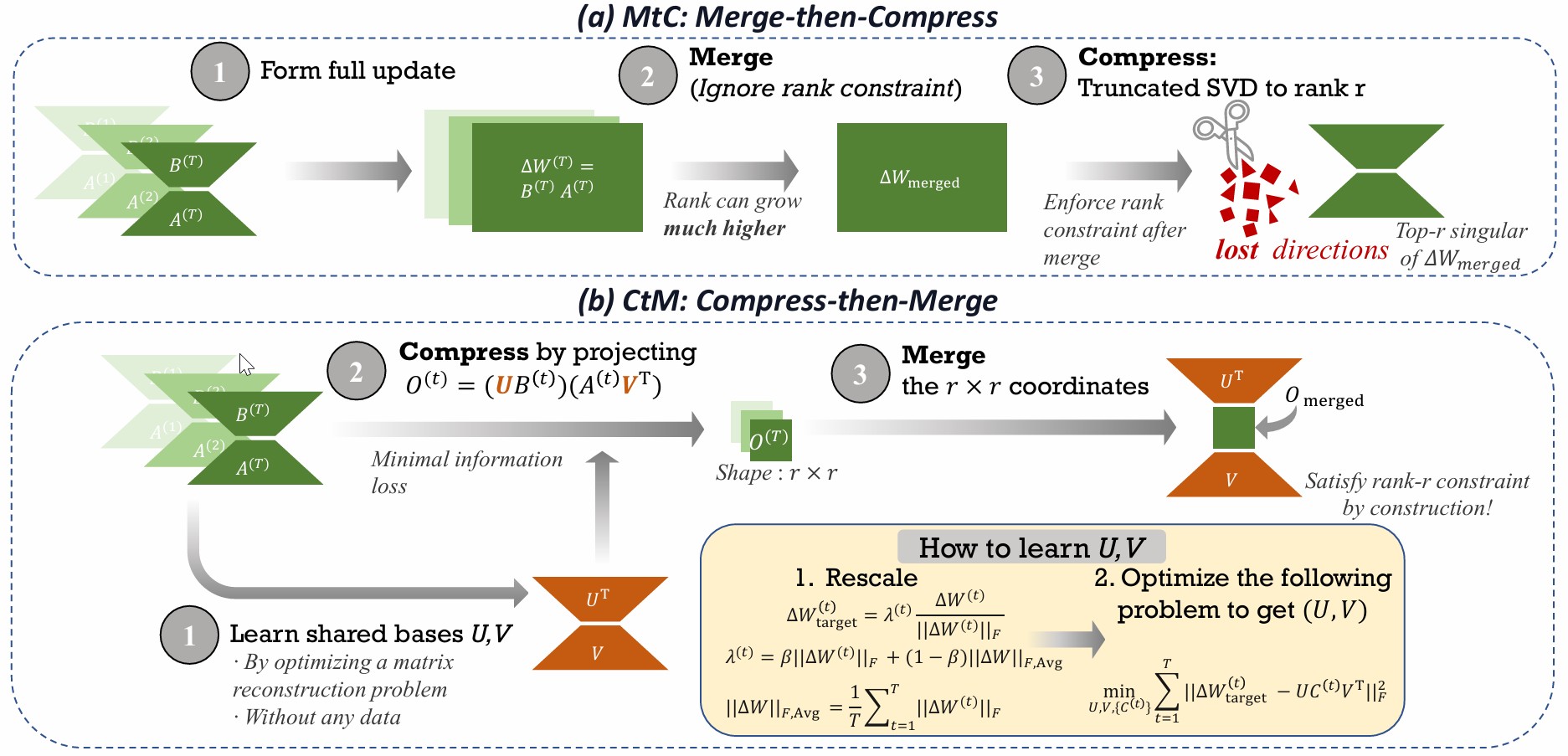
Overview of Compress-then-Merge: low-rank compression is performed before adapter merging.
## 🗂️ Code Structure - `task_merger.py`: core implementation of the merging pipelines. - `eval_scripts_clean/`: evaluation entrypoints for the vision and NLI experiments. - `training_scripts/`: scripts for training task-specific LoRA adapters. - `configs/`: experiment configurations, including model, dataset, and merging settings. - `dataset/` and `models/`: dataset processing utilities and model wrappers. In this codebase, the main CtM pipeline corresponds to `merge_space=low_rank_core`. MtC-style baselines are evaluated by merging in `full`, `knots`, or `core` space, and then applying post-hoc low-rank truncation with `--low_rank=1 --lora_rank=16`. ## 🚀 Getting Started #### ⚙️ 1. Installation This codebase is designed to run in a standard Transformers + PEFT environment and does not rely on a specialized software stack beyond the usual dependencies for LoRA training and merging. For users who would like to set up the environment from scratch, the following commands provide a simple reference setup. ```bash conda create -n ctm python=3.10 conda activate ctm pip install -r requirements.txt ``` #### 📦 2. Prepare Data and Checkpoints **Datasets**: We follow the setup of [core-space-merging](https://github.com/apanariello4/core-space-merging/tree/main) for preparing the models and datasets used in this repository, where most resources can be downloaded automatically. For datasets that still require manual download or additional preprocessing, please refer to the discussions in [Github Issue 1](https://github.com/pytorch/vision/issues/7545#issuecomment-1631441616) and [Github Issue 2](https://github.com/mlfoundations/task_vectors/issues/1). **Checkpoints**: We use the checkpoints released by [KnOTS](https://github.com/gstoica27/KnOTS). The required models can also be downloaded automatically when running the scripts. #### ▶️ 3. Run To reproduce the results in the paper, run the following command. ```bash python eval_scripts_clean/8vision_pertask_linearsearch_layers.py \ ## for CLIP --config=vitB_r16_linearsearch_universal.py \ --merge_method=ties \ --merge_space=low_rank_core \ # For our compress-then-merge --representation=matrix_per_layer \ --isotropize=0 \ --low_rank \ --lora_rank=16 \ --beta=0.25 --scaling_coeffs=0.75 --topK=25 \ --only_eval ``` To search hyperparameters on the validation split, run: ```bash python eval_scripts_clean/8vision_pertask_linearsearch_layers.py \ --config=vitB_r16_linearsearch_universal.py \ --merge_method=ties \ --merge_space=low_rank_core \ # For our compress-then-merge --representation=matrix_per_layer \ --isotropize=0 \ --low_rank \ --lora_rank=16 ``` For other single-LoRA-output baselines, use the following configuration template: ```bash ## merge_method=ties/dare-ties, isotropize=0, merge_space=full/knots/core for TIES/DARE-TIES in Full/KnOTS/CoreSpace ## merge_method=sum, isotropize=1, merge_space=full/knots/core for Iso-C in Full/KnOTS/CoreSpace ## merge_method=iso-cts, isotropize=0, merge_space=full for Iso-CTS ## merge_method=robustmerge, isotropize=0, merge_space=robustmerge for RobustMerge ## merge_method=lego, isotropize=0, merge_space=lego for LoRA-LEGO python eval_scripts_clean/8vision_pertask_linearsearch_layers.py \ --config=vitB_r16_linearsearch_universal.py \ --merge_method=$merge_method \ --merge_space=$merge_space \ --representation=matrix_per_layer \ --isotropize=$isotropize \ --low_rank \ --lora_rank=16 ``` Remove `--low_rank` and `--lora_rank=16` to produce full-weight results. ## 📚 Citation ```latex @inproceedings{he2026compress, title={Compress then Merge: From Multiple Lo{RA}s into One Low-Rank Adapter}, author={Zhengbao, He and Ruiqi, Ding and Zhehao, Huang and Ruikai, Yang and Tao, Li and Xiaolin, Huang}, booktitle={Forty-third International Conference on Machine Learning}, year={2026}, url={https://openreview.net/forum?id=p32nWlgwYC} } ``` ## 🙏 Acknowledgements This repository builds on the codebase of [KnOTS](https://github.com/gstoica27/knots) and [core-space-merging](https://github.com/apanariello4/core-space-merging). We thank the authors for releasing their code and checkpoints.