
SAG
English · 简体中文



From now on, this is the only knowledge base app you need.
Built on the state-of-the-art SAG architecture, it turns scattered documents and data into knowledge that is searchable, connected, and traceable.
https://github.com/user-attachments/assets/ac805e3c-ab52-4857-bef6-2865f3831b2f
## Contents
Community ·
Project ·
Technology ·
User Guide ·
Developer Guide
---
## Project
### Changelog
**August 30, 2026**
SAG now supports [`@zleap-ai/dsh-sag`](https://github.com/Zleap-AI/dsh-sag). The built-in local DeepSeek Harness connector makes SAG knowledge available to DSH Agents for search, source reading, and source and document management.
**August 13, 2026**
Added OCTX source import and export with integrity validation, conflict handling, failure recovery, and compatible vector reuse for cross-instance knowledge base migration and backup. This release also improves continuous Chinese-term retrieval and document lifecycle controls for more reliable fast search and background processing.
**July 31, 2026**
Published the official command-line client [`@zleap-ai/sag-cli`](docs/sag-cli.en.md). One command (`sag agent connect codex | claude-code`) mounts the SAG Knowledge MCP into Codex or Claude Code — no JWT copy-paste, no hand-edited config files. The MCP guide below now leads with the CLI.
**July 14, 2026**
Released a completely new version built on the `zleap-sag` package, featuring an entirely redesigned UI. The previous version has been archived in the `v1` branch and is no longer maintained.
### SAG in one minute
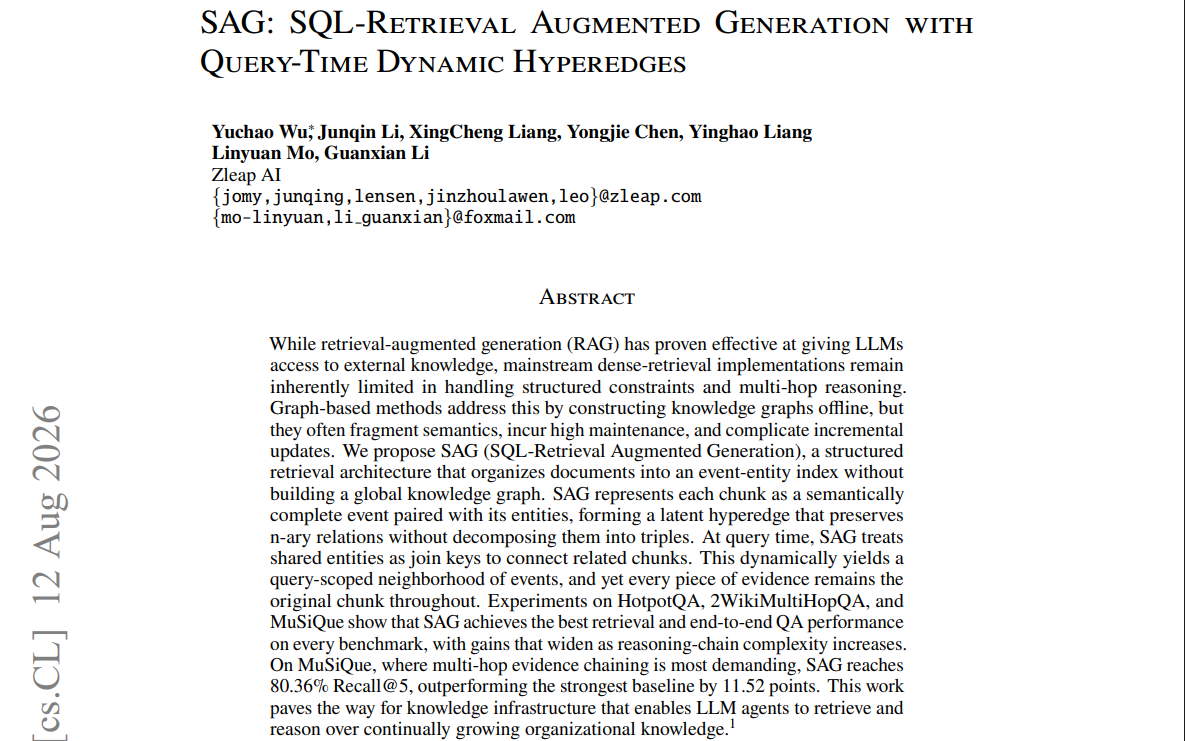
SAG is not a fusion of traditional RAG and GraphRAG. It is an original retrieval architecture that replaces both.
Through event-entity indexing and query-time dynamic hyperedges, SAG delivers semantic retrieval and relational reasoning in one system, without maintaining two RAG systems or merging two retrieval paths.
Experiments on HotpotQA, 2WikiMultiHopQA, and MuSiQue show that SAG achieves the best retrieval and end-to-end QA performance on every benchmark, establishing a new state of the art for RAG.
This project is a complete knowledge base application for individuals and Agents built on SAG:
**sources and documents → structured knowledge → search and source tracing → cited Agent answers → reuse through API or MCP**
Upload a document once. SAG parses it, splits it into chunks, embeds it, extracts events and entities, and keeps every retrieval result connected to the original text. You can then search across sources, inspect the event-entity graph, ask questions with citations, or expose the same knowledge to another application.
| Capability | What it gives you |
| --- | --- |
| Knowledge ingestion | File and web sources, document parsing, chunking, embedding, event/entity extraction, background processing |
| Search | Global or source-scoped retrieval with Fast (`vector`) and Precise (`multi`) modes |
| Source tracing | Open any result or citation back to the exact original chunk |
| Knowledge graph | Inspect events, entities, and their queryable associations |
| Agent chat | Multi-turn answers grounded in selected sources, with clickable citations |
| Integration | Self-hosted REST/OpenAPI, OpenAI-compatible chat, MCP, and the `zleap-sag` Python package |
The product is deliberately local-first and single-user. It starts with SQLite and LanceDB, requires no external database, and keeps a clear path to PostgreSQL/pgvector and other production backends.
---
## Technology
### Paper
**SAG: SQL-Retrieval Augmented Generation with Query-Time Dynamic Hyperedges**
Yuchao Wu*, Junqin Li, XingCheng Liang, Yongjie Chen, Yinghao Liang, Linyuan Mo, and Guanxian Li
[Read the paper](https://arxiv.org/abs/2606.15971) · [Reproduce the benchmark](https://github.com/Zleap-AI/SAG-Benchmark)
### An original third architecture
Traditional dense RAG retrieves chunks mainly by semantic similarity. GraphRAG adds offline graph construction, but pays for triple extraction, entity merging, relation normalization, global maintenance, and difficult incremental updates.
SAG does not wrap those two systems. It replaces that choice with its own data model and execution path:
```text
chunk → one semantically complete event
chunk → multiple indexing entities
event ↔ entities → one latent hyperedge
```
- **Event** carries the complete meaning of a chunk. It is not fragmented into independent triples.
- **Entity** is a lightweight index and expansion point, not a replacement for the event's meaning.
- **Query-time dynamic hyperedge** is created locally when SQL joins events that share entities around the current query. SAG does not pre-build or globally maintain those hyperedges.
- **Original evidence** remains the output boundary. Selected events always map back to source chunks for generation and citation.
The semantic and structural paths inside SAG are native parts of the SAG pipeline. They are not a traditional RAG service and a GraphRAG service running side by side.
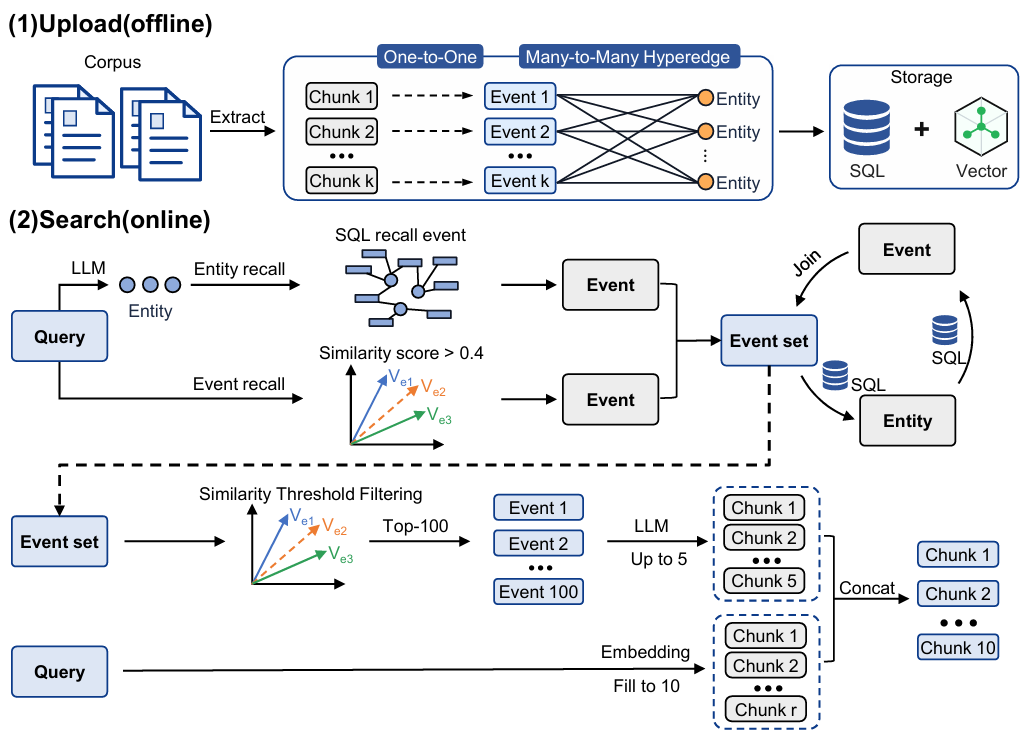
### How retrieval works
**Offline indexing**
1. Parse a document into semantically coherent chunks.
2. Extract one event and multiple entities from each chunk in parallel.
3. Persist chunks, events, entities, and event-entity associations to relational storage.
4. Persist chunk, event, and entity representations to vector/full-text indexes.
**Online retrieval**
1. Find seed entities and events using semantic and lexical signals.
2. Use SQL joins over shared entities to expand from seed events into a local candidate space.
3. Instantiate only the hyperedges relevant to this query; no global graph traversal or rebuild is required.
4. Select the strongest event and direct-chunk candidates, deduplicate them, and return the original evidence chunks.
This makes incremental writes natural: a new chunk adds its own event, entities, and associations without recomputing a global graph.
### A new SOTA for RAG
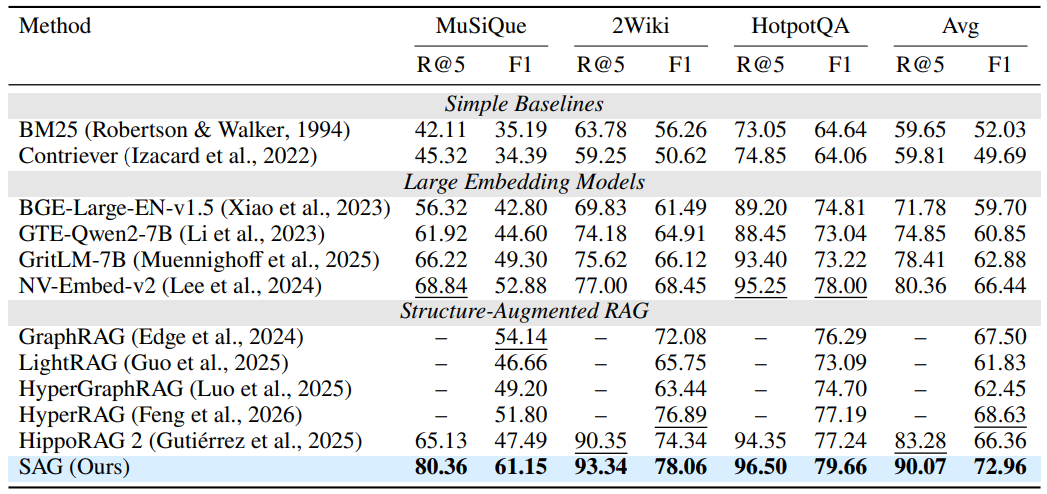
Under the same `BGE-Large-EN-v1.5` embedding and `Qwen3.6-Flash` LLM configuration, SAG achieves the best retrieval and end-to-end QA performance on every benchmark across HotpotQA, 2WikiMultiHopQA, and MuSiQue.
- Across the three datasets, SAG averages **90.07%/72.96%** in Recall@5 and F1, outperforming the strongest baseline for each metric by **6.79/4.33** percentage points, respectively.
- On the most challenging MuSiQue dataset, SAG outperforms the strongest baseline for each metric by **11.52/7.01** percentage points in Recall@5 and F1, respectively.
Full results:
See the [paper](https://arxiv.org/abs/2606.15971) and [SAG-Benchmark](https://github.com/Zleap-AI/SAG-Benchmark) for the full method and reproduction scripts.
---
## User Guide
### Desktop app (easiest)
Download the latest desktop installer from [GitHub Releases](https://github.com/Zleap-AI/SAG/releases/latest):
| Platform | Download | Update behavior |
| --- | --- | --- |
| macOS 15+, Apple Silicon | `SAG-*-mac-arm64.dmg` | Signed, notarized, and updated through the stable channel |
| Windows 10/11, x64 | `SAG-Setup-*-win-x64.exe` | Unsigned for now; Windows may show an unknown-publisher warning; stable automatic updates remain supported |
The desktop app bundles the Web workspace and local knowledge backend, so users do not need to install Python, Node.js, or a database. Application updates preserve the knowledge base and uploads in the operating system's application-data directory. Release checksums are published as `SHA256SUMS.txt`.
### Quick start (Docker, self-hosted)
Requirements: Docker Desktop, or Docker Engine with Compose v2.
```bash
git clone https://github.com/Zleap-AI/SAG.git
cd SAG
docker compose up -d --build
```
No API key, Python runtime, Node runtime, or external database is required to boot the application. When both services are healthy, open:
- Web application: [http://localhost:3000](http://localhost:3000)
- API documentation: [http://localhost:8000/docs](http://localhost:8000/docs)
On first launch:
1. Enter your name to create or restore the local identity.
2. Use the 302.AI quick setup, or open **Settings → Models** and configure any OpenAI-compatible LLM and embedding endpoint.
3. Create a source, upload documents, and wait until their status is **Ready**.
4. Search, open the original source, or start a cited conversation.
The UI and services still start without model credentials. Embeddings are required for indexing/vector retrieval; the LLM is required for event extraction, query understanding, and generated answers.
#### Model settings precedence
`SAG_LLM_*` values in Docker Compose or `.env` provide the initial model configuration. After an administrator saves model settings in the web UI, the persisted Settings value is used for subsequent extraction and generation jobs without a restart.
To make the deployment configuration mandatory, set `SAG_LOCK_LLM_CONFIG=true`. SAG then shows the generation fields as locked in Settings and continues to use the `SAG_LLM_*` values. Change Docker Compose or `.env` and restart the API container to update a locked configuration. API keys remain deployment-managed and are never returned by the Settings API.
### Import knowledge
Create a source and add Markdown, text, PDF, Office, or other supported documents. SAG normalizes documents to Markdown, then runs chunking, embedding, event extraction, and entity extraction in the background.
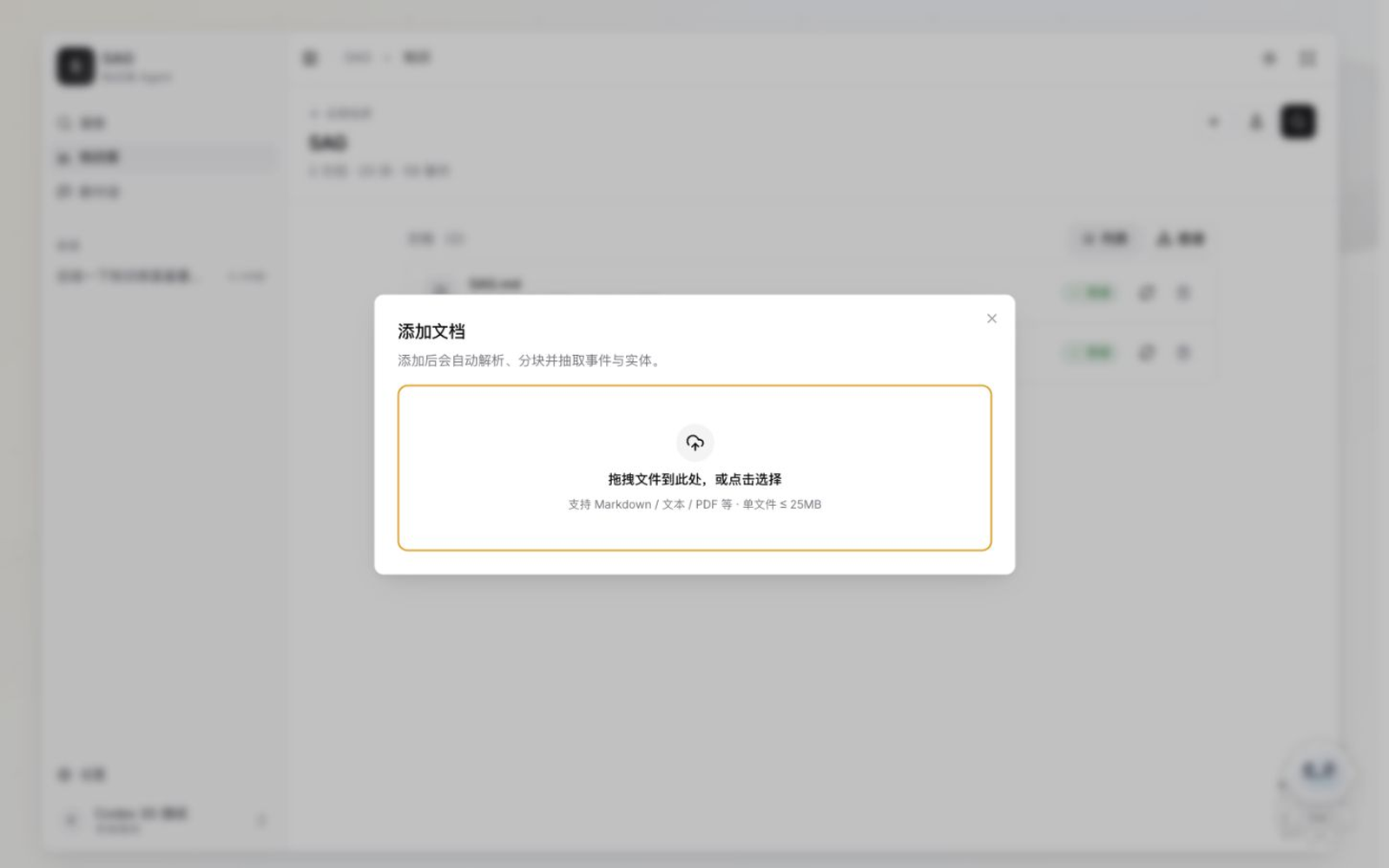
PDF files use MinerU when it is configured and fall back to local MarkItDown when it is unavailable or fails. Other Office and text formats use MarkItDown by default.
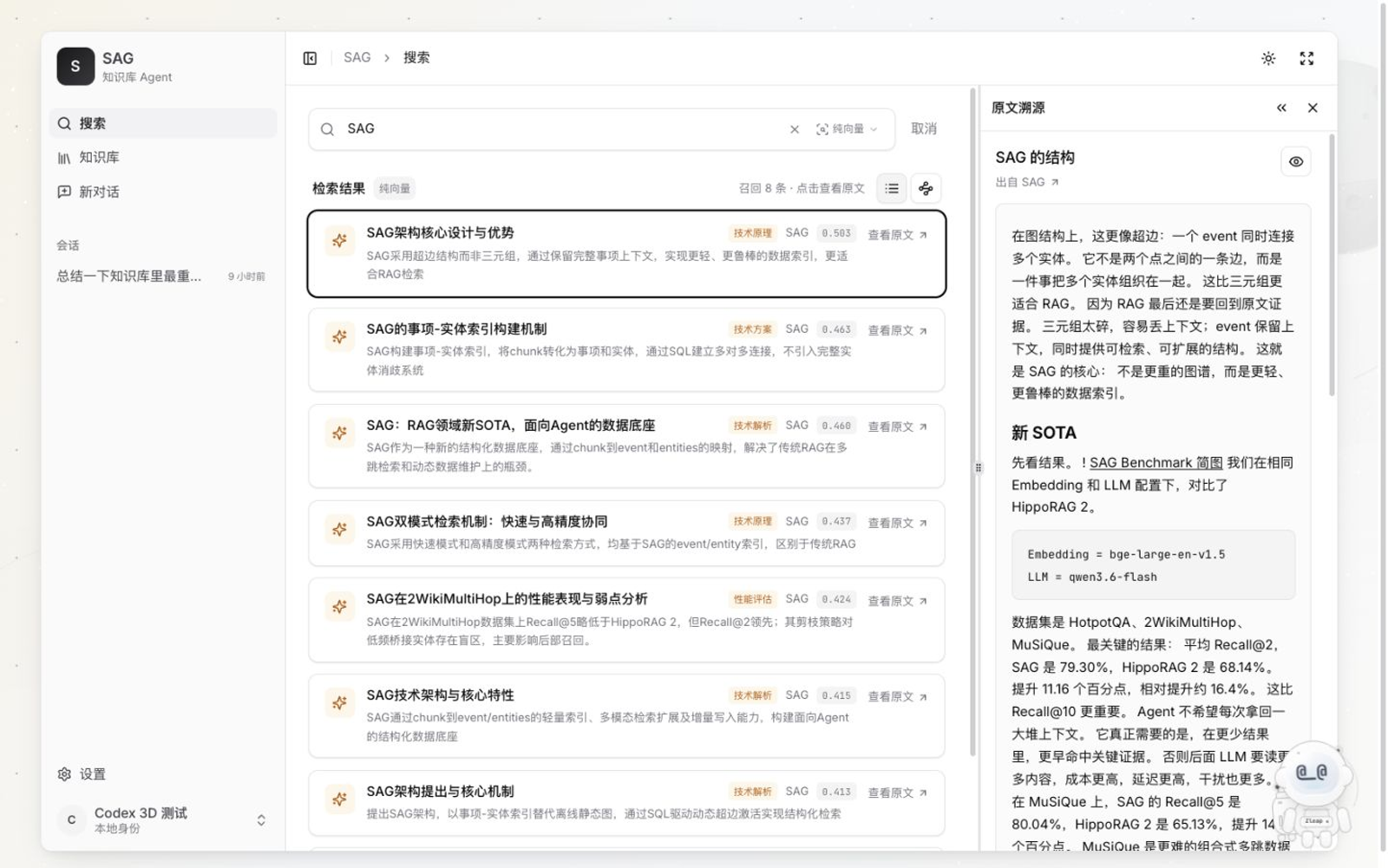
### Search and verify the source
Search globally or restrict the query to selected sources. Every result can open the original chunk beside the ranked result, so retrieval quality is inspectable before an Agent uses it.
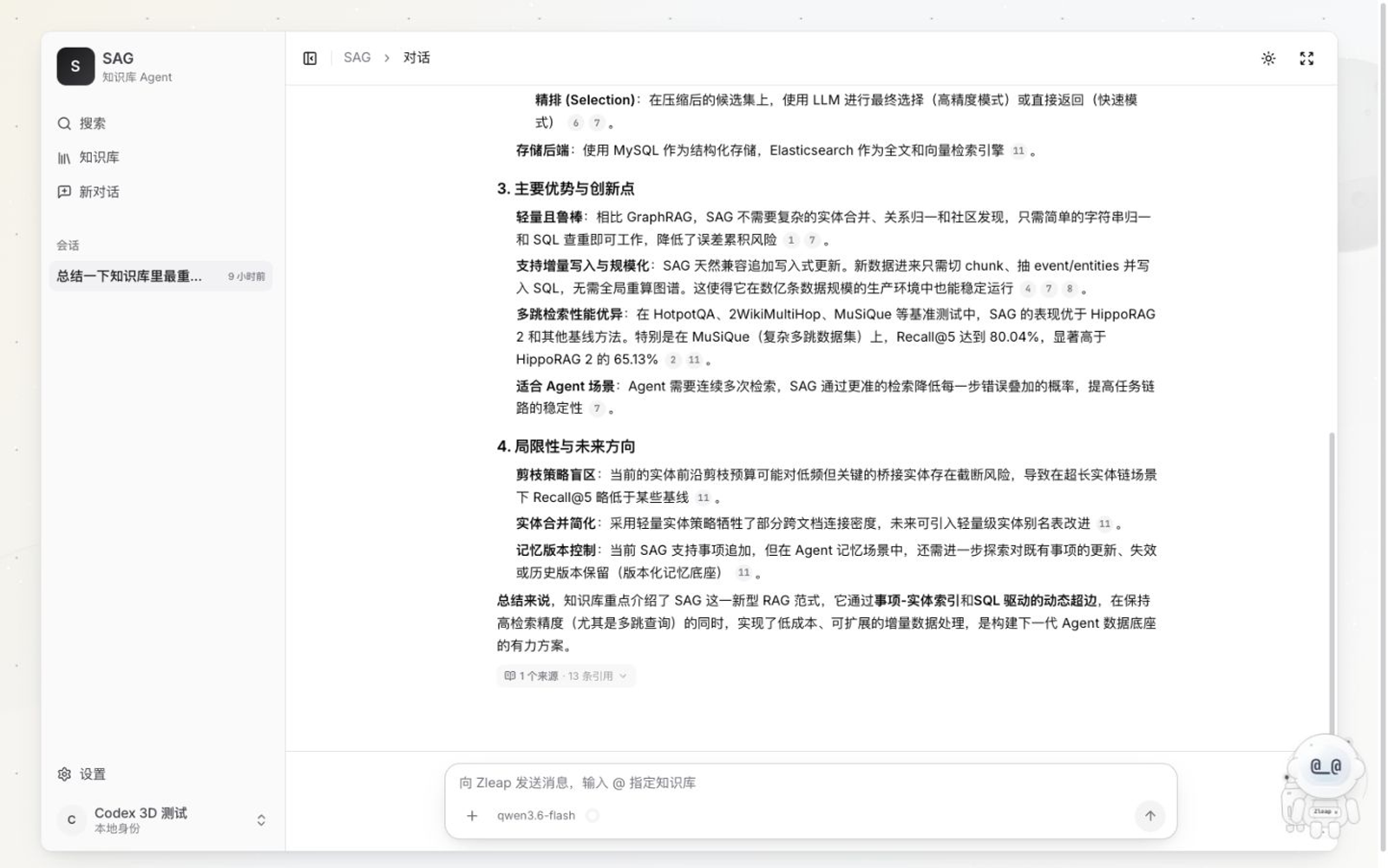
### Ask with citations
The default Agent searches the bound knowledge sources, streams the answer, and attaches clickable citations. The same conversation path is also available through an OpenAI-compatible endpoint.
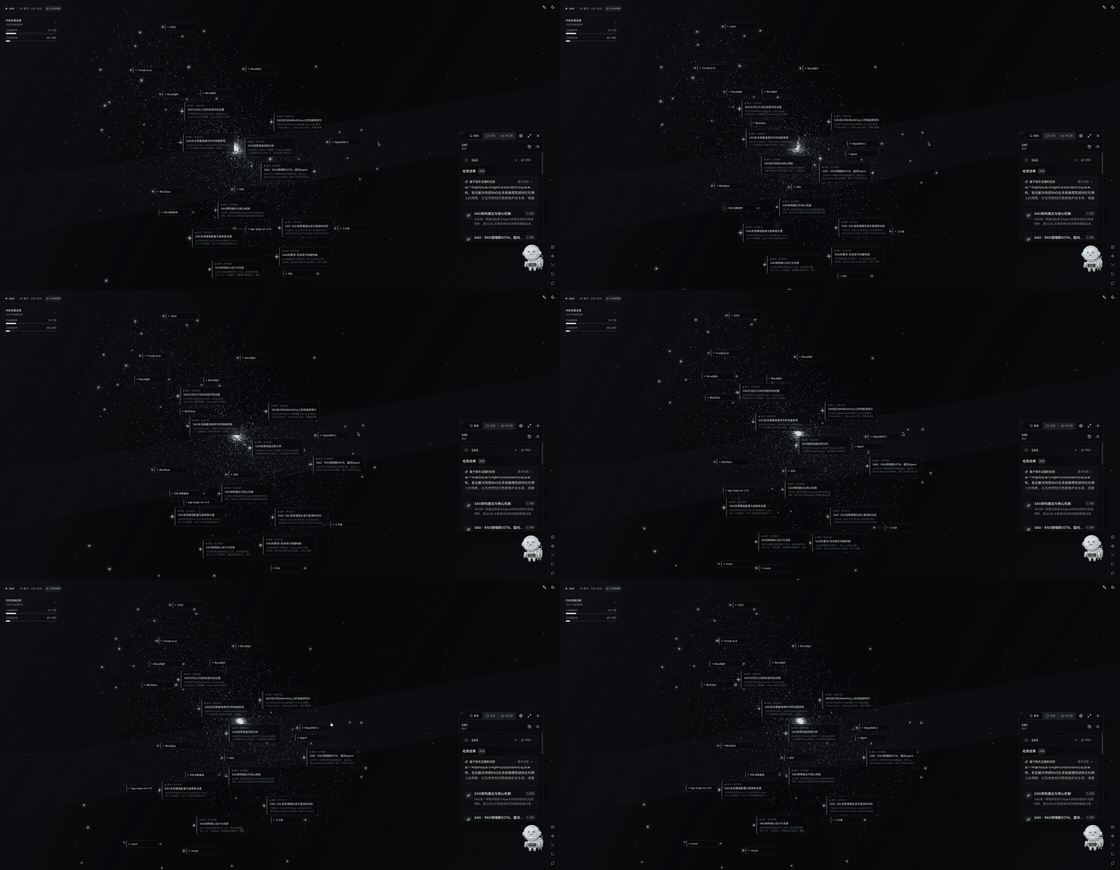
### Explore mode
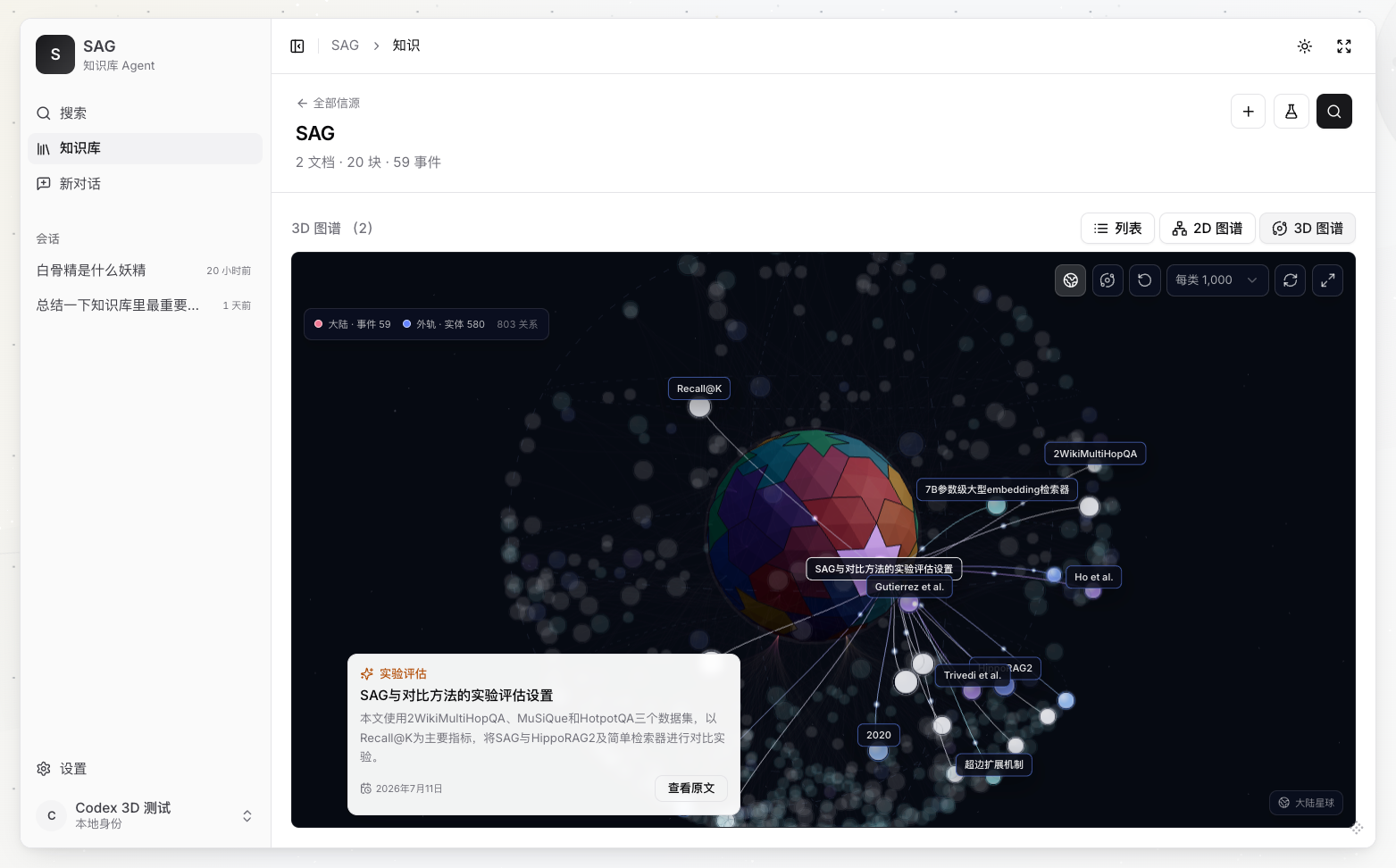
Explore mode unfolds the entire knowledge base into an interactive knowledge universe. Search events and entities, travel through their relationships, and open event details or original sources without leaving the same view.
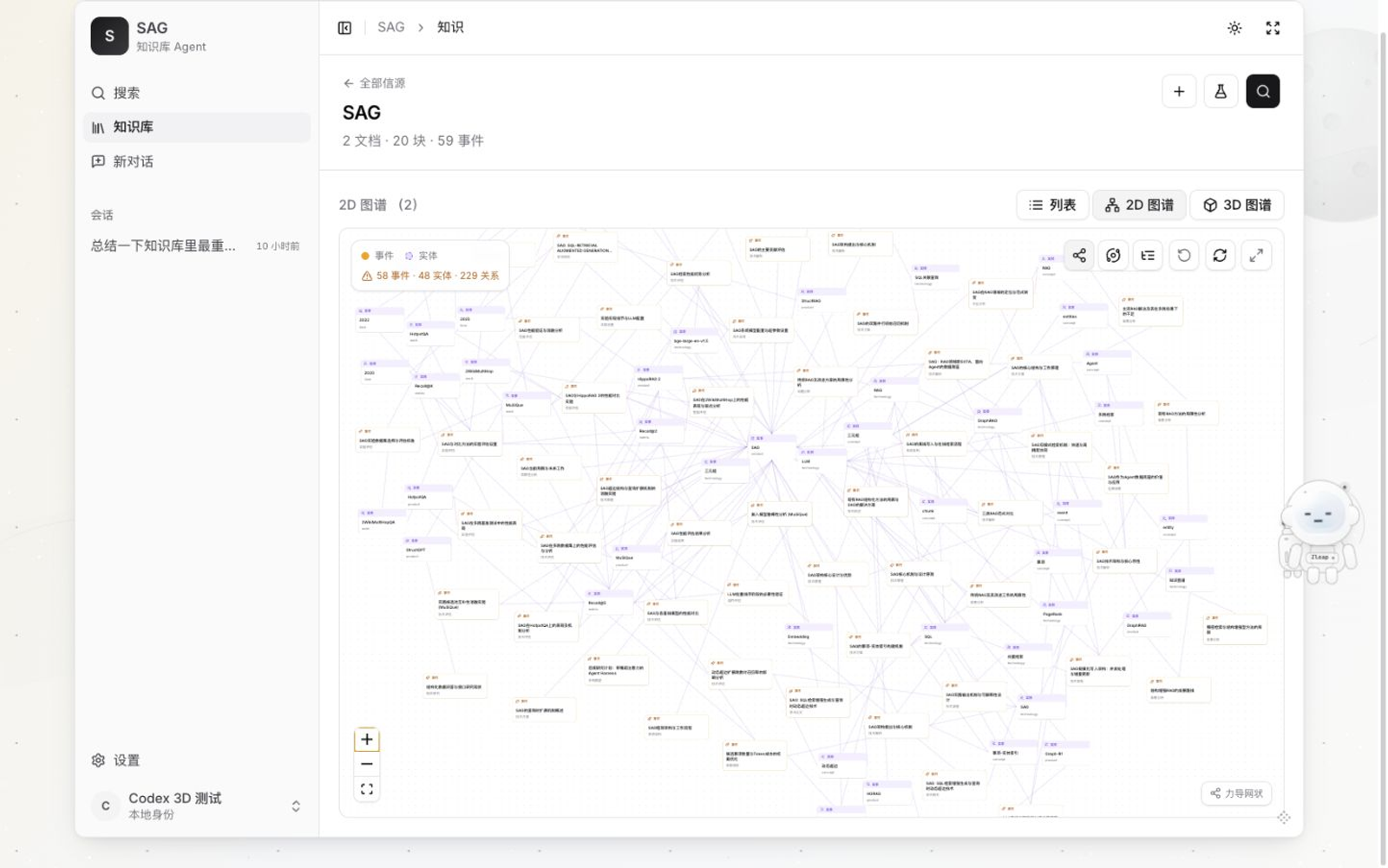
### Explore the event-entity graph
Switch a source from list view to graph view to inspect the events, entities, and associations produced by the SAG index.
### MCP guide
The recommended path is two steps: **CLI** mounts the MCP, **Skill** teaches the Agent how to explore it. Together they give you a complete knowledge retrieval setup with zero hand-edited config.
#### Step 1: mount MCP with the CLI
[`@zleap-ai/sag-cli`](docs/sag-cli.en.md) is the official command-line client. It auto-discovers your local Docker SAG container, verifies the MCP works, and wires it into Codex or Claude Code — for the local Docker path no JWT is needed.
Install (Node.js ≥ 20.19):
```bash
npm install --global @zleap-ai/sag-cli
```
Wire the MCP in one command:
```bash
sag mcp test # verify the SAG MCP is reachable
sag agent connect codex # mount into Codex
sag agent connect claude-code # or mount into Claude Code
sag agent status # see what's wired
```
For a remote SAG instance (no local Docker), sign in from the terminal first:
```bash
sag profile add prod https://sag.example.com
sag profile use prod
sag auth login --name "Your name" # signs in to SAG directly
sag agent connect claude-code
```
The CLI **never** writes your JWT into an Agent's config file, stores tokens in the OS keychain when available, and only removes MCP entries it created itself. Preview any write with `--dry-run`. Full guide: [SAG CLI User Guide](docs/sag-cli.en.md).
#### Step 2: install the Skill
The Skill ships in [`@zleap-ai/sag-cli`](docs/sag-cli.en.md). Copy it into your Agent's skills directory:
```bash
# Claude Code
SKILL_SRC="$(npm root -g)/@zleap-ai/sag-cli"
cp -r "$SKILL_SRC/skill" ~/.claude/skills/sag-knowledge
# Codex
SKILL_SRC="$(npm root -g)/@zleap-ai/sag-cli"
cp -r "$SKILL_SRC/skill" ~/.codex/skills/sag-knowledge
```
#### Manual mounting (fallback)
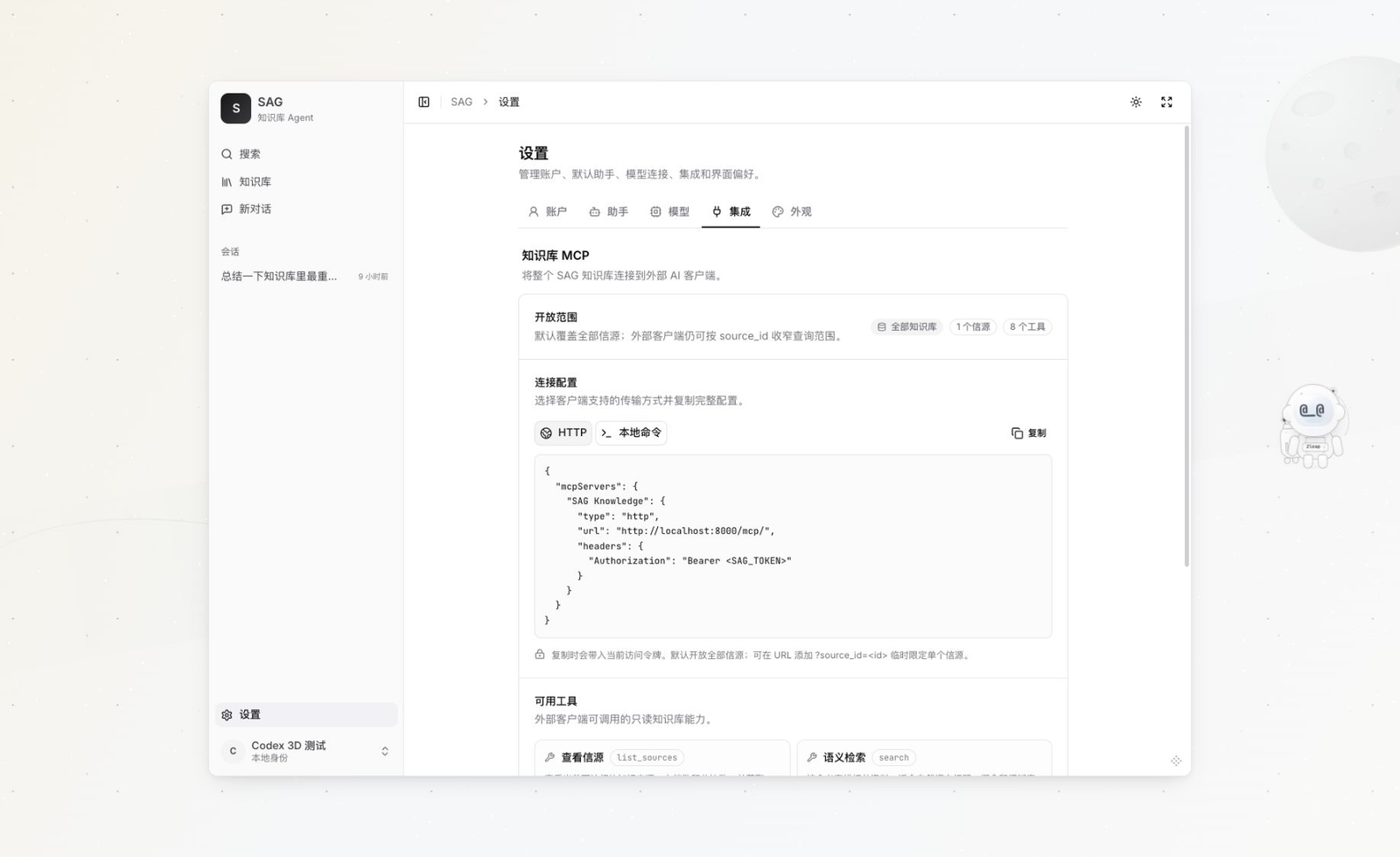
If you can't install the CLI, open **Settings → Integrations → Knowledge MCP** in SAG, pick HTTP or local command, and paste the copied block into your Agent's MCP config file yourself. The HTTP snippet already includes the current JWT and exposes all sources by default; scope it with `source_id` when needed.
### Use SAG as a model (OpenAI-compatible)
SAG exposes an OpenAI Chat Completions endpoint with the same retrieval and citation behavior as the built-in chat:
```bash
curl -s http://localhost:8000/api/v1/openai//chat/completions \
-H "Authorization: Bearer " \
-H "Content-Type: application/json" \
-d '{"messages":[{"role":"user","content":"What is this material about?"}]}'
```
The response is a standard `chat.completion` with an additional `sag.citations` field; standard clients ignore unknown fields. Set `"stream": true` to receive SSE chunks.
### Use SAG as a Dify external knowledge base
SAG can connect to Dify's **Connect to an External Knowledge Base** feature through a dedicated compatibility endpoint, with no Dify source-code changes. For the API key, Docker network, Source ID, and Dify console configuration, see [`docs/dify-integration.en.md`](docs/dify-integration.en.md).
### Operate and update
```bash
docker compose ps # api and web should be healthy
docker compose logs -f api web # follow logs
docker compose restart # restart services
docker compose down # stop and keep all data
git pull --ff-only # update the source checkout
docker compose up -d --build # rebuild without deleting volumes
```
Default persistence:
| Runtime | Application metadata | Knowledge engine | Location |
| --- | --- | --- | --- |
| Docker default | SQLite | SQLite + LanceDB | Docker volume `sagdata` |
| Local development | SQLite | SQLite + LanceDB | `apps/api/.data/` |
| PostgreSQL override | PostgreSQL | PostgreSQL + pgvector | `pgdata` and `sagdata` volumes |
`docker compose down` preserves data. **`docker compose down -v` permanently deletes the database, knowledge index, and uploaded files.**
### Network and production safety
The default Compose configuration binds ports 3000 and 8000 to `127.0.0.1` and uses `SAG_AUTH_MODE=local`: the name is a local identity, not password authentication. Do not expose this default mode to an untrusted network.
For custom ports or a trusted LAN address:
```bash
cp .env.example .env
# Edit BIND_ADDRESS, WEB_PORT, API_PORT, SAG_CORS_ORIGINS, and NEXT_PUBLIC_API_BASE.
# For remote access, also set SAG_AUTH_MODE=password and keep SAG_ALLOW_REGISTRATION=false.
docker compose up -d --build
```
On first launch, `password` mode guides you through creating an email and password. Later sign-ins require both credentials and never fall back to a name or the first user. `SAG_ALLOW_REGISTRATION=false` still permits the first credential account, then closes registration.
`NEXT_PUBLIC_API_BASE` is compiled into the web image, so changing it requires `--build`. A server deployment should also use a strong `SAG_SECRET_KEY`, HTTPS, and protection such as VPN, IP allowlisting, or reverse-proxy rate limiting. The current `sag auth login --name` command is for `local` mode; with `password` mode, sign in through the web UI first and provide the issued token to the CLI through `SAG_TOKEN`.
---
## Developer Guide
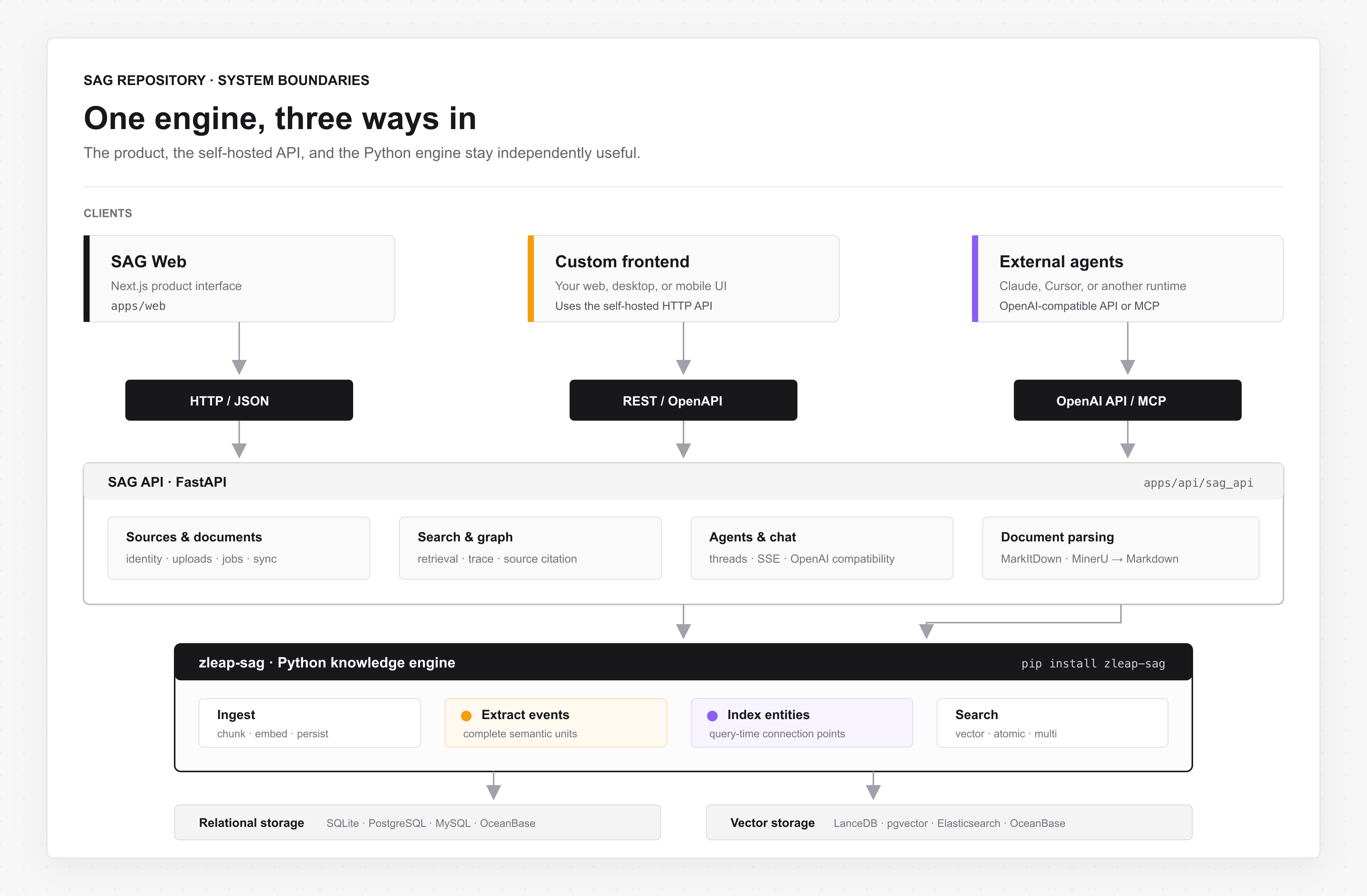
### System boundaries
SAG has a separated Next.js frontend and FastAPI backend. The backend is a reference application built on the public `zleap-sag` Python engine. You can reuse the complete backend from another frontend, or embed `zleap-sag` directly in a Python service of your own.
### Repository map
```text
apps/
├── web/ Next.js 15 + React 19 product UI
├── desktop/ Electron shell, packaging, and local runtime lifecycle
└── api/
├── sag_api/
│ ├── api/v1/ FastAPI HTTP routes and serialization
│ ├── connectors/ File/web source connectors and registry
│ ├── parsing/ MarkItDown and MinerU normalization
│ ├── jobs/ Background ingest → extract state machine
│ ├── sag/ The only application adapter importing zleap-sag
│ ├── generation/ Retrieved evidence → streamed cited answer
│ ├── mcp/ Knowledge MCP server and HTTP mount
│ ├── services/ Application/domain orchestration
│ └── tools/ Built-in and remote MCP Agent tools
└── sag_agent/ Framework-independent Agent runtime core
deploy/ Deployment initialization assets
docs/assets/readme/ README screenshots and diagrams
```
The central dependency rule is simple: application code reaches the engine through `apps/api/sag_api/sag/`; the engine does not know about FastAPI, the Web UI, users, conversations, or citations.
### Local development
Start the backend and frontend in separate terminals from the repository root.
```bash
# Terminal 1: API at http://localhost:8000
cd apps/api
python -m venv .venv
. .venv/bin/activate
pip install -e ".[dev]"
cp .env.example .env
uvicorn sag_api.main:app --reload
```
```bash
# Terminal 2: Web at http://localhost:3000
cd apps/web
npm install
npm run dev
```
Useful checks:
```bash
cd apps/api && pytest
cd apps/api && ruff check .
cd apps/web && npm run typecheck
cd apps/web && npm run build
```
### Desktop client
The Electron client packages the same Next.js application together with the local FastAPI backend. Desktop development, target-specific release builds, signing, update configuration, and data locations are documented in [`apps/desktop/README.md`](apps/desktop/README.md).
### Use `zleap-sag` directly
[`zleap-sag`](https://pypi.org/project/zleap-sag/) is the continuously maintained Python engine behind the SAG application. Distribution name: `zleap-sag`; import path: `zleap.sag`; Python: 3.11+; license: MIT. The application currently requires `zleap-sag>=0.7.1`.
Install the zero-infrastructure local stack:
```bash
pip install zleap-sag
```
Then run the complete ingest → extract → search lifecycle:
```python
import asyncio
from zleap.sag import DataEngine, EngineConfig
from zleap.sag.config import EmbeddingConfig, LLMConfig
async def main() -> None:
config = EngineConfig(
llm=LLMConfig(
api_key="sk-...",
base_url="https://your-openai-compatible-host/v1",
model="qwen3.6-flash",
),
# When api_key/base_url are omitted, embedding reuses the LLM endpoint.
embedding=EmbeddingConfig(model="bge-large-en-v1.5"),
language="en",
)
# One DataEngine instance represents one logical data source.
async with DataEngine(config) as engine:
ingest = await engine.ingest("knowledge.md")
extract = await engine.extract()
result = await engine.search(
"Why is SAG effective for multi-hop retrieval?",
strategy="multi",
top_k=5,
)
print(ingest.chunk_count, extract.event_count)
for section in result.sections:
print(section.get("content", "")[:200])
asyncio.run(main())
```
Local storage is created automatically under `./.zleap/`. Add that directory to `.gitignore`.
#### Configuration
Use one configuration style, not both:
| Style | Construction | Best for |
| --- | --- | --- |
| Parameter injection | `EngineConfig(llm=..., embedding=...)` | Libraries, notebooks, explicit application wiring |
| Environment | `EngineConfig.from_env()` or `from_env(env_file=".env")` | Containers and 12-factor services |
Minimal environment configuration:
```bash
export OPENAI_API_KEY=sk-...
export OPENAI_BASE_URL=https://your-openai-compatible-host/v1
export LLM_MODEL=qwen3.6-flash
export EMBEDDING_MODEL=bge-large-en-v1.5
```
```python
from zleap.sag import EngineConfig
config = EngineConfig.from_env()
```
`EngineConfig(...)` does not read environment variables implicitly. Use explicit parameters or `from_env()`. A separate embedding endpoint can be set with `EmbeddingConfig(api_key=..., base_url=..., model=...)`.
#### Public `DataEngine` API
| API | Purpose |
| --- | --- |
| `await engine.start()` | Initialize connections; local SQLite/LanceDB schema is created automatically |
| `await engine.aclose()` | Close engine resources; handled automatically by `async with` |
| `await engine.chunk(source)` | Parse and chunk a path or raw string without persisting it |
| `await engine.ingest(path, ...)` | Parse one document, chunk it, embed it, and persist chunks/vectors |
| `await engine.extract(...)` | Extract and persist the event-entity index for the current source |
| `await engine.search(query, strategy=..., top_k=...)` | Return a typed `SearchResult` with `sections` and timing/statistics |
| `await engine.init_schema()` | Idempotently initialize production schemas; not needed for the default local stack |
Typed results are available from `zleap.sag.results`: `ChunkResult`, `IngestResult`, `ExtractResult`, and `SearchResult`. All engine exceptions derive from `SagError`, so application boundaries can catch one base type.
#### Retrieval modes
| UI label | Python strategy | Implementation |
| --- | --- | --- |
| Fast (default) | `vector` | Direct retrieval by semantic similarity for a faster response |
| Precise | `multi` | Combines entity relationships with LLM reranking for more complete results |
The UI exposes only **Fast** and **Precise** retrieval modes. Precise maps to SAG's `multi` strategy and does not run a separate GraphRAG implementation.
#### Storage backends
| Deployment | Relational storage | Vector storage | Package extra |
| --- | --- | --- | --- |
| Local default | SQLite | LanceDB | none |
| Single database | PostgreSQL | pgvector | `zleap-sag[postgres]` |
| Production split | MySQL/PostgreSQL/OceanBase | Elasticsearch | `zleap-sag[mysql]`, `[postgres]`, `[es]` |
| Single database | OceanBase 4.3.3+ | OceanBase vector | `zleap-sag[mysql]` |
Changing `EngineConfig` changes the backend without changing ingest/extract/search calls. Current engine connections are process-global, so use one `EngineConfig` per process.
For the full package configuration, extras, examples, and changelog, see the [`zleap-sag` package page](https://pypi.org/project/zleap-sag/).
### Build your own frontend with the SAG backend
A browser cannot import a Python package directly. A custom frontend should call a Python HTTP service that owns `DataEngine`. This repository's FastAPI backend is that reference service, and it is already separated from the Next.js UI.
The self-hosted API is available after starting SAG:
| Entry | Address |
| --- | --- |
| API base | `http://localhost:8000/api/v1` |
| Interactive OpenAPI | [http://localhost:8000/docs](http://localhost:8000/docs) |
| OpenAPI schema | [http://localhost:8000/openapi.json](http://localhost:8000/openapi.json) |
| MCP Streamable HTTP | `http://localhost:8000/mcp/` |
This is a **self-hosted API**, not a hosted public cloud API. In the default `local` mode, most routes use a SAG JWT issued after name login:
```bash
curl -s http://localhost:8000/api/v1/auth/login \
-H 'Content-Type: application/json' \
-d '{"name":"Developer"}'
```
Copy `access_token` from the response and send it as:
```http
Authorization: Bearer
```
With `SAG_AUTH_MODE=password`, create the first credential through `POST /auth/register`, then sign in with email and password:
```bash
curl -s http://localhost:8000/api/v1/auth/login \
-H 'Content-Type: application/json' \
-d '{"email":"owner@example.com","password":""}'
```
#### API map
| Area | Main routes | Purpose |
| --- | --- | --- |
| System | `GET /system/health`, `/system/ready`, `/system/capabilities` | Health and active engine capabilities |
| Identity | `POST /auth/login`, `GET /auth/me` | Local identity and JWT |
| Sources | `GET/POST /sources`, `GET/PATCH/DELETE /sources/{id}` | Source lifecycle |
| Documents | `/sources/{id}/documents` and `/documents/ingest` | File upload, continuous text/message ingestion, reprocessing, deletion |
| Search | `POST /search`, `POST /sources/{id}/search` | Global or source-scoped `vector`/`multi` retrieval |
| Graph | `GET /sources/{id}/entities`, `/sources/{id}/graph` | Event-entity inspection |
| Agents | `/agents`, `/threads`, `/ask` | Agent configuration, conversations, SSE runs, citations |
| OpenAI-compatible | `POST /openai/{agent_id}/chat/completions` | Use any SAG Agent as a cited model, streamed or non-streamed |
| MCP | `/mcp/` or `/mcp/?source_id={id}` | Expose the whole knowledge base or one source to an MCP host |
Create a source, ingest text, and search it:
```bash
BASE=http://localhost:8000/api/v1
TOKEN=
SOURCE_ID=$(curl -s -X POST "$BASE/sources" \
-H "Authorization: Bearer $TOKEN" \
-H 'Content-Type: application/json' \
-d '{"name":"Product docs"}' | jq -r .id)
curl -s -X POST "$BASE/sources/$SOURCE_ID/documents/ingest" \
-H "Authorization: Bearer $TOKEN" \
-H 'Content-Type: application/json' \
-d '{"title":"SAG","text":"SAG uses event-entity indexing and query-time dynamic hyperedges."}'
curl -s -X POST "$BASE/sources/$SOURCE_ID/search" \
-H "Authorization: Bearer $TOKEN" \
-H 'Content-Type: application/json' \
-d '{"query":"How does SAG retrieve knowledge?","strategy":"multi","top_k":5}'
```
Document ingestion is processed by the background job queue. Check the returned document status or its job before expecting search results.
For a frontend served from another origin, add it to `SAG_CORS_ORIGINS`. If the API address changes, rebuild the Web image with the matching `NEXT_PUBLIC_API_BASE`.
### PostgreSQL/pgvector deployment
The optional production override moves application metadata and engine storage to PostgreSQL/pgvector:
```bash
cp .env.example .env
openssl rand -hex 32 # set SAG_SECRET_KEY
openssl rand -hex 24 # set POSTGRES_PASSWORD
docker compose -f compose.yaml -f compose.postgres.yaml config
docker compose -f compose.yaml -f compose.postgres.yaml up -d --build
```
Set real `SAG_CORS_ORIGINS` and `NEXT_PUBLIC_API_BASE` values before server deployment. Back up both `pgdata` and `sagdata` before upgrades.
---
## Contributing and License
- Contribution workflow: [CONTRIBUTING.md](CONTRIBUTING.md)
- Python engine: [`zleap-sag` on PyPI](https://pypi.org/project/zleap-sag/)
- Paper reproduction: [Zleap-AI/SAG-Benchmark](https://github.com/Zleap-AI/SAG-Benchmark)
SAG is released under the [MIT License](LICENSE).
---
## Community
Join the SAG community on Discord or WeChat to connect with maintainers and other users.
| Discord |
WeChat |
 |
 |