B) Involve stakeholders in reviewing the test conditions
C) Review the test basis for testability
D) Check that test objectives and test approach are clear Order the tasks A to D in correct chronological sequence: Open to enlarge
Show answer and rationale
The correct ordering is: D - C - A - B.
• Checking that test objectives and test approach are clear is a precondition to test analysis, so activity D must come first.
• Reviewing the test basis for testability is one of the first tasks in test analysis, providing early feedback. So, activity C must come next and must precede activity A (defining test conditions).
• The TA can define test conditions (activity A) as soon as all preconditions are met (activity D), and the quality of the test basis is appropriate (activity C).
• Stakeholders can only review the test conditions (activity B) once the test conditions have been defined (activity A).
A2 · TA-1.2.4 (K2)
Which of the following is typically the responsibility of the test analyst during the execution of an automated regression test suite?
Show answer and rationale
Correct answer: a)
a) Is correct. A test analyst should manually rerun failed automated tests to verify whether the failure is due to a genuine defect or a problem with the test automation.
b) Is not correct. Fixing automated test scripts is typically the responsibility of a test automation engineer or a technical test analysts, not a test analyst.
c) Is not correct. A test analyst should first analyze anomalies to determine if they are caused by actual defects before reporting them. Not all failures in automated tests are due to defects in the system under test.
d) Is not correct. While comparing test results is a task of a test analyst, in automated regression testing, this is primarily done by the automated test scripts. The test analyst’s role is to investigate failures, not to perform the initial comparison.
A3 · TA-1.3.1 (K2)
Consider the following test case: Test case: TC 02.001 - correct calculation of order price with discount Preconditions: the user is logged in Inputs: the shopping cart contains products for the amount entitled to the discount Actions: the user proceeds to payment Expected results: the total price displayed is reduced by the discount amount entitled
How can this test case be classified in terms of level of abstraction?
Show answer and rationale
Correct answer: b)
a) Is not correct. Although it is a high-level test case, the explanation Is not correct. The type of test condition covered does not play a role in this classification.
b) Is correct. A high-level test case does not contain specific test data. Specific data is specified when designing low-level test cases based on a high-level test case.
c) Is not correct. This is not a low-level test case – see the correct answer.
d) Is not correct. This is not a low-level test case – see the correct answer.
A4 · TA-1.3.2 (K2)
Which of the following describes a valid test case quality criterion and has valid justification?
Show answer and rationale
Correct answer: c)
a) Is not correct. This violates the necessity criterion because features not yet implemented should not be tested.
b) Is not correct. Although the completeness criterion requires a description or reference to test data, explicit test data in the test case would impact the maintainability of the test case. Not all test cases must be low-level.
c) Is correct. This is an aspect of consistency in terms of the language used.
d) Is not correct. Although short test cases have advantages over long ones, their granularity should always correspond to the test basis and test conditions. End-to-end scenarios should not be split up.
A5 · TA-1.3.6 (K3)
In the item management system IMS1, each item can have multiple versions. The latest version is active, all older versions are historical and frozen. You are specifying domain-layer keywords for the following high-level test case:
• Preconditions: An item has multiple versions; the latest version is active; the others are old and frozen. Open to enlarge You have specified the following keywords:
1. Search the database for an item with multiple versions (Item-ID)
2. Select item (Item-ID)
3. Select item version (Number)
4. Assert details displayed are correct (Screen, Item-ID, Number)
5. Assert details are editable (Screen)
6. Assert details are non-editable (Screen) You want to use keywords in one of the following groups of elements of the high-level test cases:
A) Precondition only
B) Step 1 only
C) Step 2 only
D) Both step 1 and step 2 Assign each specified keyword (1-6) to ONE group of test case elements (A-D) while not leaving any group empty.
Show answer and rationale
Keyword 1 provides an item with 2 versions, so it is useful for an additional step in the test script to ensure the precondition. Keyword 2, selecting the item, is an action keyword for step 1. Keyword 3, selecting a (different) version of the item, is an action keyword for step
2. Keyword 4, verifying the correctness of the details display against the expected values, is a verification keyword that can be used in both step 1 and 2. Keyword 5, verifying that the details are editable, is a verification keyword that can be used only in step 1. Keyword 6, verifying that the details are not editable, is a verification keyword that can be used only in step 2. Hence, the correct assignment is: 1 - A, 2 - B, 3 - C, 4 - D, 5 - B, 6 - C.
A6 · TA-3.1.1 (K3)
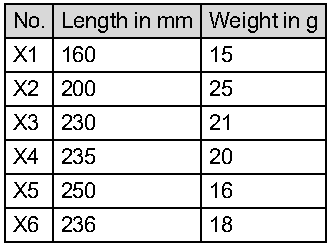
Standard letters carried by a postage service have a maximum length of 235mm and a maximum weight of 20g. You are testing an automatic letter scanning system that can measure with a precision of 1 mm and 1g respectively. You perform domain testing for valid standard letter sizes with the following inputs: Open to enlarge Inputs can have of one of the coverage item types:
1. ON point for both length and weight
2. IN point for both length and weight
3. OFF point for length only
4. OFF point for weight only
5. OUT point for length only
6. OUT point for weight only Assign each input (X1-X6) to EXACTLY ONE coverage item type (1-6).
Show answer and rationale
Let L denote the length of the letter in mm and W its weight in g. The equivalence partition for standard letters is bounded by the closed borders L ≤ 235 for length and W ≤ 20 for weight. In consequence,
• X1 is an IN point both for length and weight.
• X2 is an OUT point for weight only.
• X3 is an OFF point for weight only.
• X4 is an ON point for both length and weight
• X5 is an OUT point for length only.
• X6 is an OFF point for length only. Hence, the correct assignments are: X1-2; X2-6; X3-4; X4-1; X5-5; X6-3.
A7 · TA-3.1.1 (K3)
The specification of a safety-critical component states about the integer values of an input parameter the following:
• Values less than 10 shall be rejected;
• Values between 10 and 21 shall be accepted;
• Values greater than or equal to 22 shall be rejected.
Which of the following input data sets provides 100% reliable domain coverage while using a MINIMAL number of values?
Show answer and rationale
Correct answer: b)
The specification defines one variable with three adjacent equivalence partitions. These are:
• EP1 with one open border x < 10;
• EP2 with two closed borders x ≥ 10 and x ≤ 21;
• EP3 with one open border x > 21.
a) Is not correct. It misses an IN point for EP1, OUT points for EP2 at both borders, and an IN point for EP3. Note that this set provides 100% 2-value BVA coverage.
b) Is correct. For EP1’s open border at 10: 0 is an IN point, 9 an ON point, 10 an OFF point, and 21 an OUT point. For EP2’s closed border at 10: 0 is an OUT point, 9 is an OFF point, 10 is an ON point, and 21 is an IN point. For EP2’s closed border at 21: 10 is an IN point, 21 is an ON point, 22 is an OFF point, and 50 is an OUT point. For EP3’s open border at 21: 10 is an OUT point, 21 is an OFF point, 22 is an ON point, and 50 is an IN point.
c) Is not correct. It misses an IN point for EP1, OUT points for EP2 at both borders, and an IN point for EP3.
d) Is not correct. The set is not minimal because the values 11 and 20 can be removed and the remaining set still provides reliable coverage, similar to option B. Note that this is a minimal set for 100% 3-value BVA coverage.
A8 · TA-3.1.1 (K3)
An airline has specific restrictions regarding checked baggage:
• The total dimensions (length + width + height) D of a piece of baggage must be at least 80 cm and cannot exceed 158 cm.
• The weight W must not exceed 23 kg.
• Measurements in centimeters and kilograms are always rounded up to the nearest whole number.
What is the MINIMUM set of pairs (D,W) of dimension and weight to achieve 100% simplified domain coverage?
Show answer and rationale
Correct answer: d)
The equivalence partition EP1 of correct baggage dimensions and weights has three borders: D ≥ 80, D ≤ 158, and W ≤ 23. The simplified domain coverage requires for each border a pair of an ON and an OFF point that are as close as possible to each other.
a) Is not correct. This data set achieves a simplified domain coverage of 100% but is not minimal. It contains three pairs of ON / OFF points for the three borders. However, 100% coverage can be reached with five points too by using a common ON point for two borders (see option d below).
b) Is not correct. This data set does not achieve 100% simplified domain coverage. It contains two ON points at the two corners (80,23) and (158,23) of EP1, but it does not contain the required OFF points at a minimum distance from them for simplified domain coverage. The two points outside EP1 are close but not as close as possible to the ON points at the corners. For example, the OFF point (79,23) which is not in the data set would be closer to (80,23) than (79,24).
c) Is not correct. This data set achieves a simplified domain coverage of 100% but is not minimal. The first two are a pair of closest ON / OFF points for the border D ≥ 80. The first and the third constitute a pair of closest ON/OFF points for the border D ≤ 158. Finally, the fourth and the sixth constitute a pair of closest ON/OFF points for the border W ≤ 23. So, the fifth point, (158.24), is superfluous and the set is not minimal.
d) Is correct. This data set achieves a simplified domain coverage of 100% and has the minimal number of five elements. The ON / OFF points for the three borders are: (80,23), (79,23); (80,23), (80,24); and (158,20), (159,20).