# Graph Memory
Traceable, searchable, cross-session memory for AI agents.
One memory core, native to DeepSeek Harness, with the OpenClaw plugin entry retained.
中文 ·
Advantages ·
Architecture ·
DSH Install ·
Pro Plugin ·
Technical Report (Chinese)
Compaction answers “how much of this conversation still fits?” Graph Memory answers “which past knowledge is worth recalling now?”
Reusable conversation knowledge becomes typed nodes:
- `TASK`: goals, execution, and outcomes;
- `SKILL`: validated reusable methods;
- `EVENT`: errors, fixes, decisions, changes, and facts.
Typed edges such as `USED_SKILL`, `SOLVED_BY`, `REQUIRES`, `PATCHES`, and `CONFLICTS_WITH` preserve relationships. A new question retrieves a relevant local subgraph instead of replaying the complete history.
## Core advantages
### Native host integration
- Loaded by the DSH/Cordis plugin lifecycle, not simulated through an MCP side channel.
- Integrates Session, Tool, Agent Loop, Prompt Assembly, LLM, and Credentials seams.
- Disposes database, cache, and event listeners with its plugin fiber.
- Does not fork or modify DeepSeek Harness core.
### Durable cross-session memory
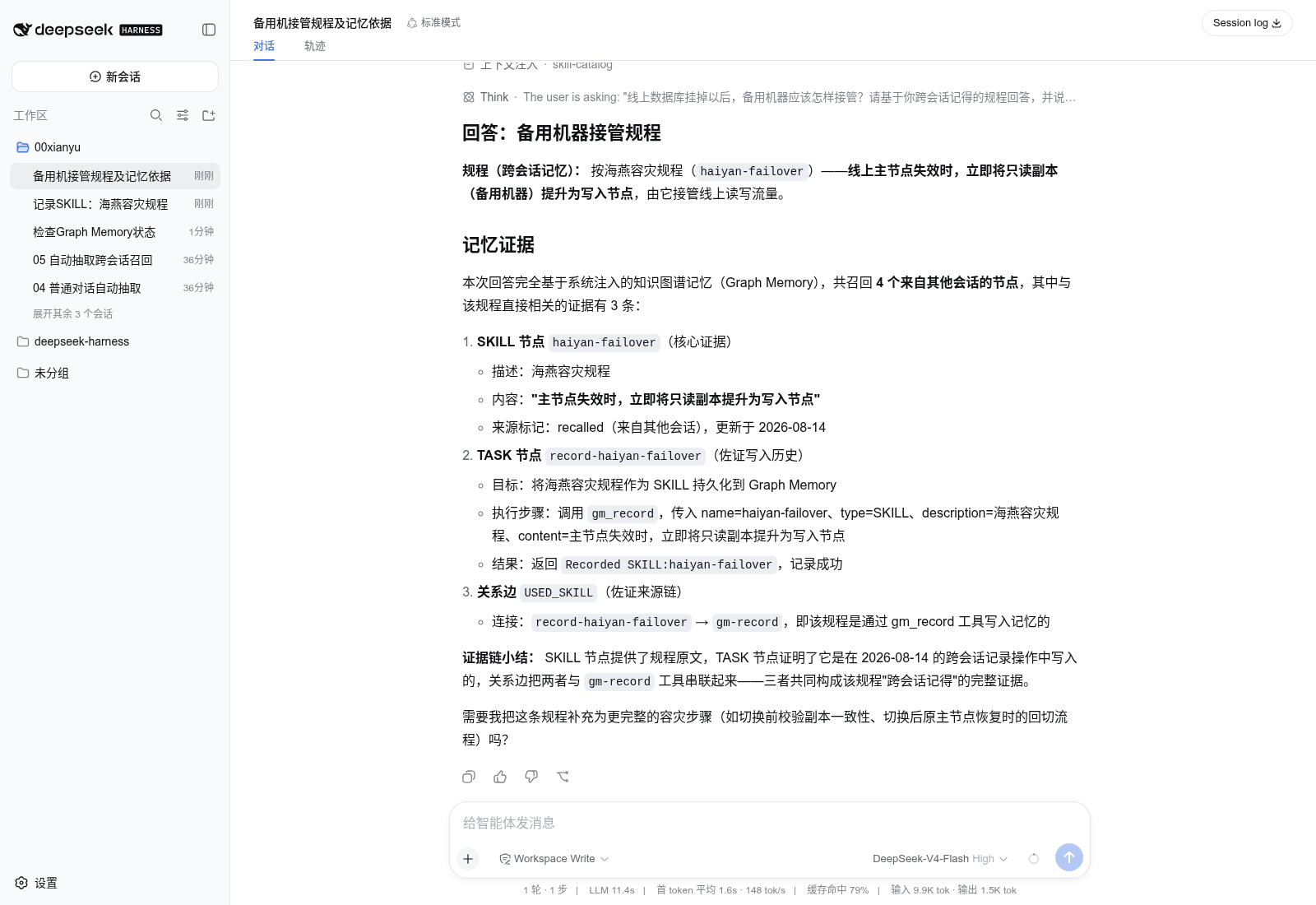
- Knowledge from Session A can be recalled automatically in Session B.
- Memory survives DSH restarts.
- Stable event IDs make resume and HMR ingestion idempotent.
- Source sessions and graph edges explain why a memory was recalled.
### Smaller, cleaner context
- Semantic vector retrieval with FTS5 lexical fallback.
- Community detection, PageRank, personalized PageRank, and bounded graph traversal.
- Only a relevant local subgraph enters the current prompt.
- Recalled history is marked as untrusted reference material and cannot override current user instructions.
### Local-first and lightweight
- Community uses SQLite by default; no graph database deployment is required.
- Embeddings are optional. Without them, recall falls back to FTS5.
- Data remains in the user's local profile by default.
- OpenAI-compatible embeddings support DashScope, OpenAI, and local providers.
### Observable and verifiable
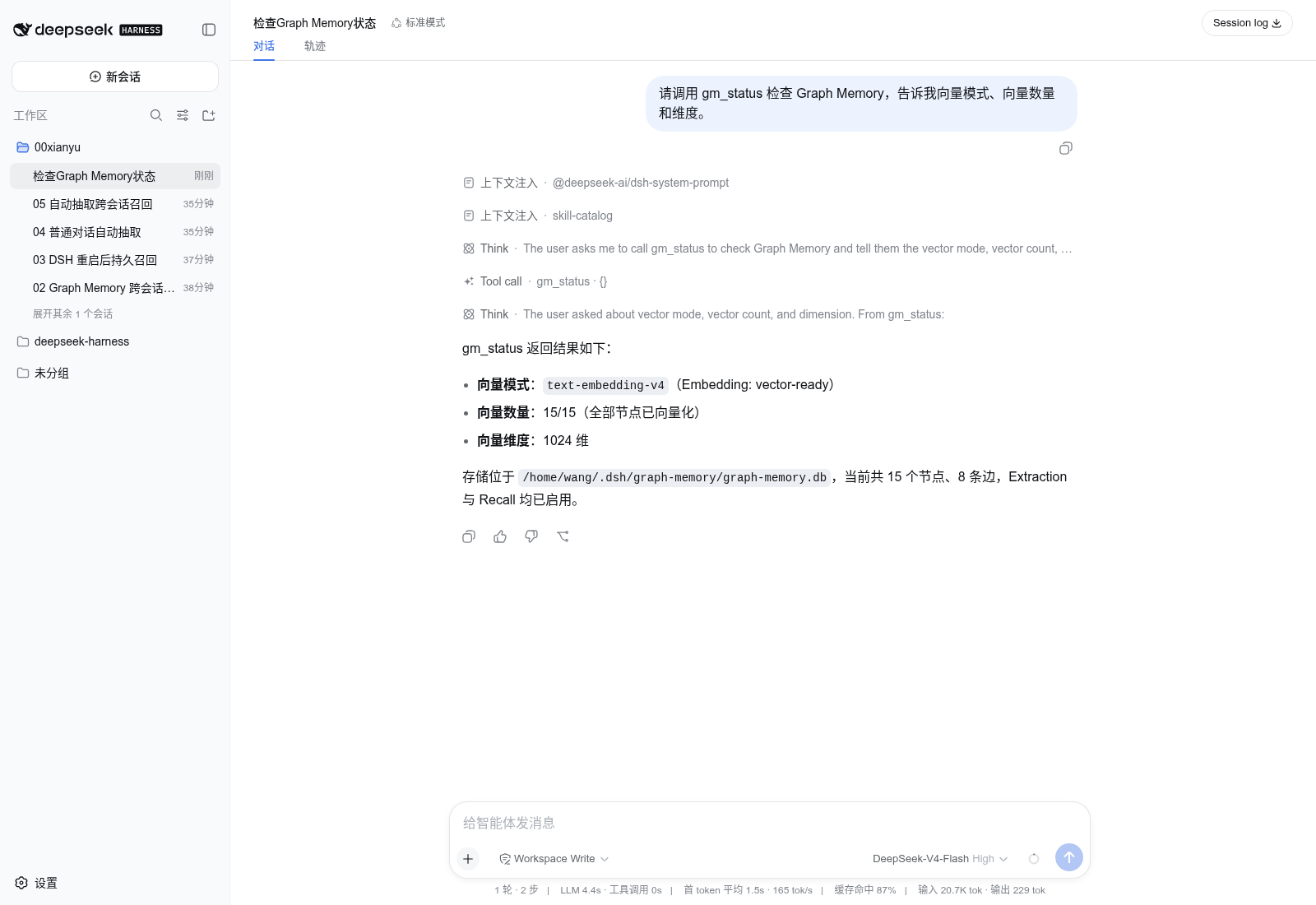
- `gm_status` reports store path, graph counts, vector coverage, mode, and dimensions.
- Model or dimension changes trigger re-embedding.
- Vectors with different dimensions are never silently compared.
- Critical knowledge can be recorded deterministically with `gm_record`.
### Scoped token benchmark
The original OpenClaw adapter was measured in a seven-turn workflow that installed, authenticated, and queried `bilibili-mcp`:
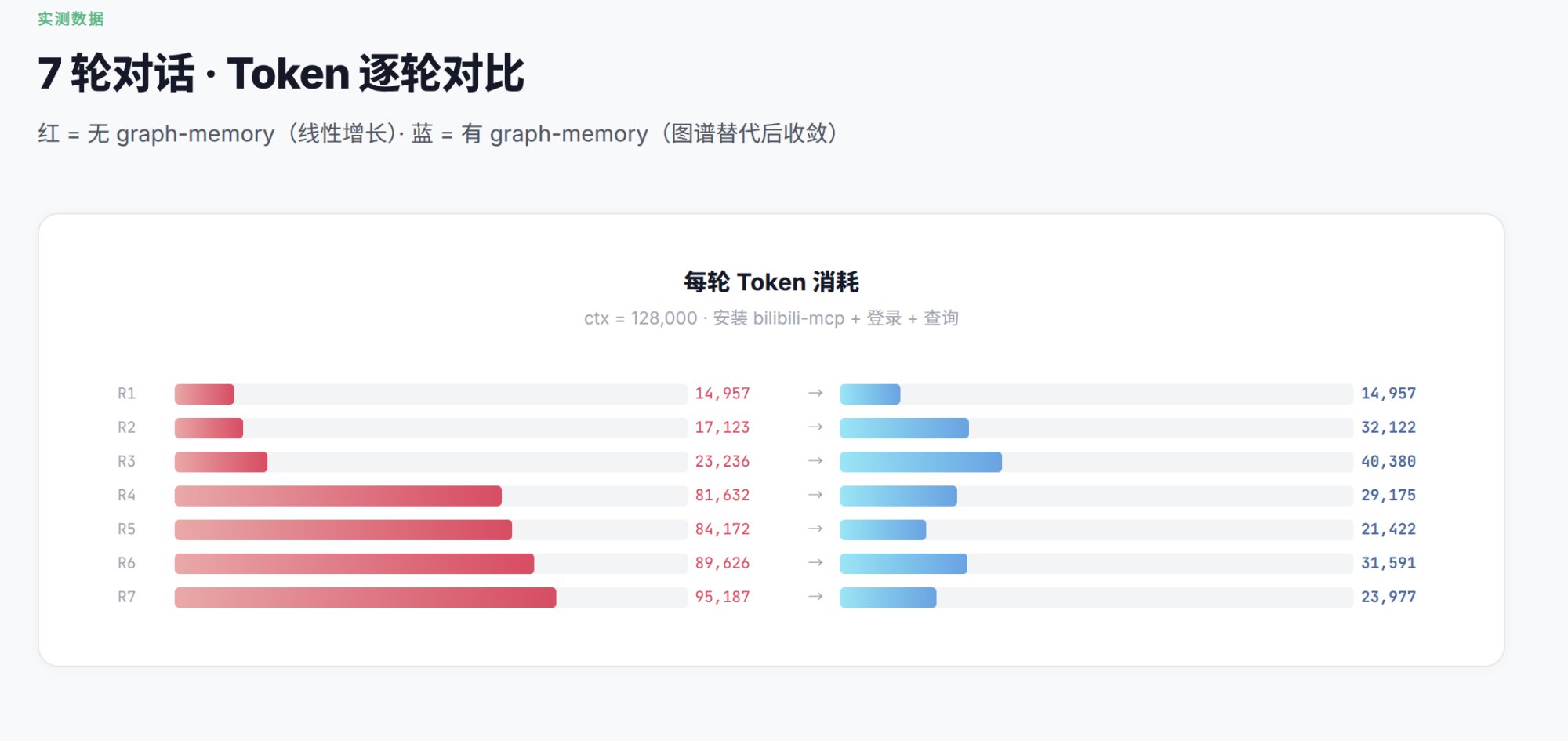
| Turn | Without Graph Memory | With Graph Memory |
|---|---:|---:|
| R1 | 14,957 | 14,957 |
| R4 | 81,632 | 29,175 |
| R7 | **95,187** | **23,977** |
The measured reduction at R7 was approximately **75%** in that specific workflow. This is a scenario-level comparison, not a universal savings guarantee; the mechanism is replacing indiscriminate history replay with a relevant knowledge subgraph.
## Project evolution
The DSH integration does not discard the original project. Graph Memory is evolving from an OpenClaw memory plugin into a graph-memory core that different agent harnesses can load natively.
| Stage | Deliverable | Status |
|---|---|---|
| OpenClaw origin | Context Engine, cross-session graph memory, dual-path recall | Maintained |
| Community graph engine | SQLite, FTS5, vectors, graph ranking, provenance | Available |
| DeepSeek Harness | Cordis adapter, native tools, auto-recall, Credentials | Implemented and tested |
| Graph Memory Pro | Visual graph workbench, controlled drag-and-drop, optional Neo4j | Architecture reviewed; DSH Host and Client Plugins not yet implemented |
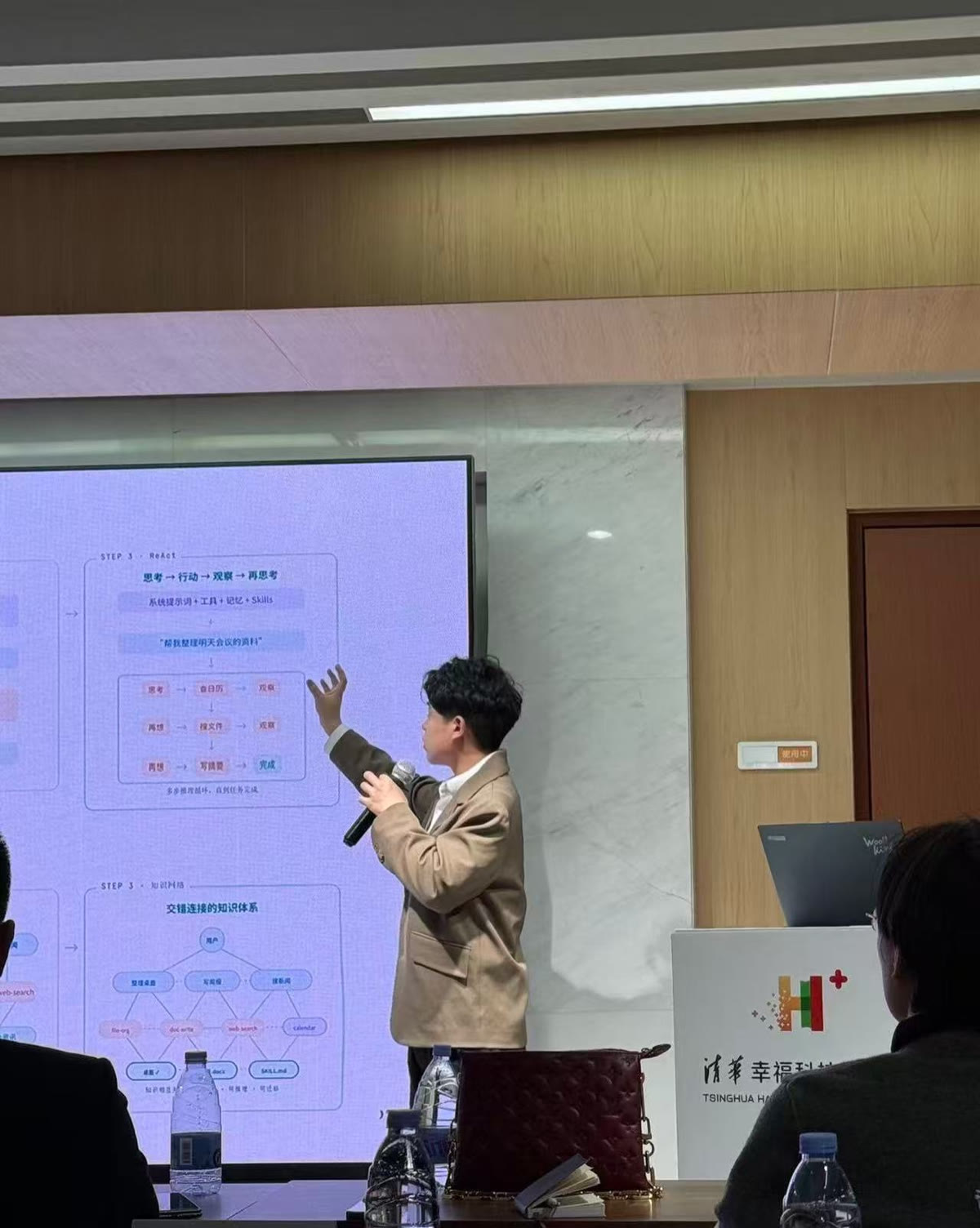
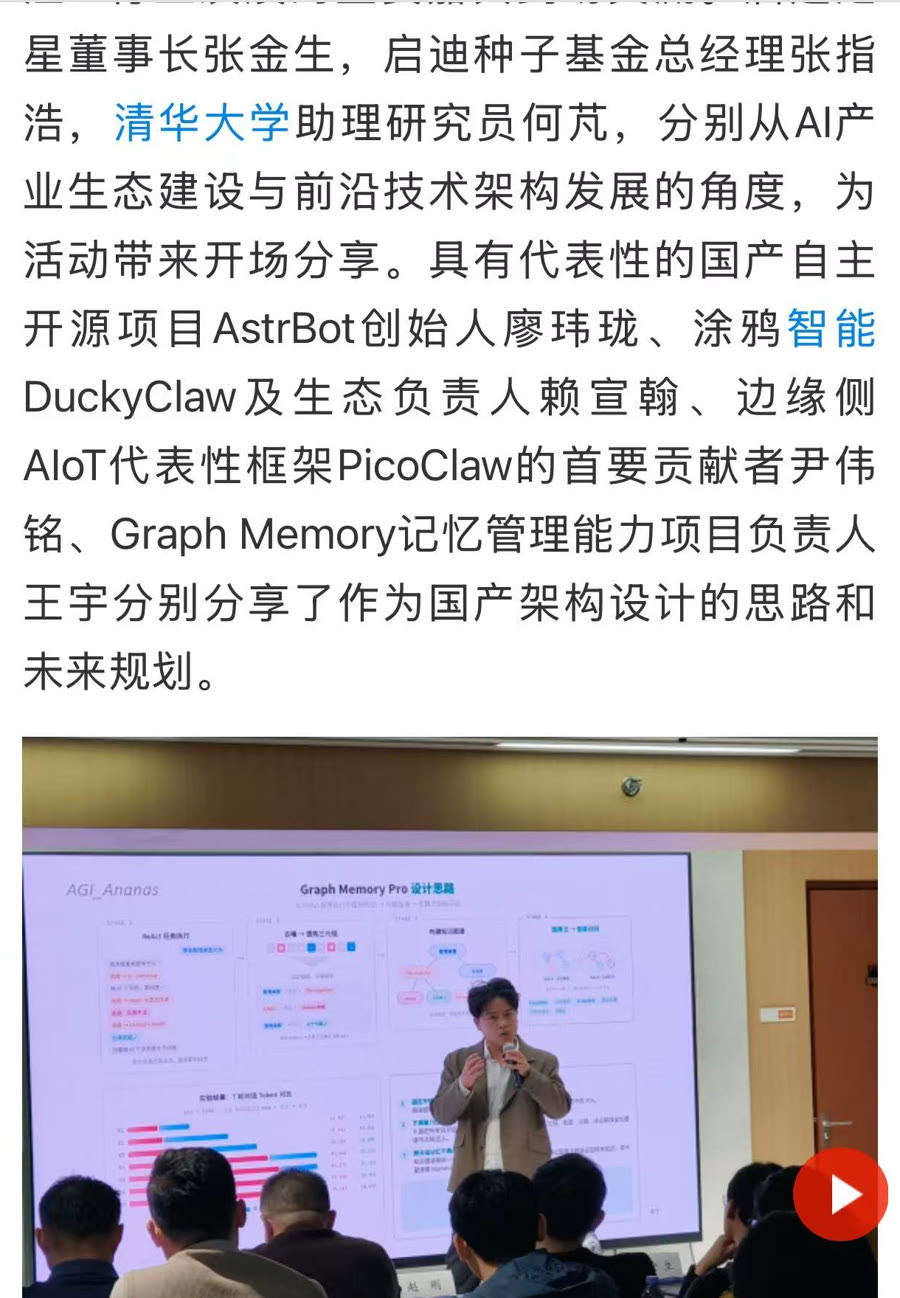
On March 15, 2026, the project owner presented Graph Memory's architecture at the CLAW program event held in Tsinghua Science Park. The following owner-supplied materials and the [Sina Finance event report](https://cj.sina.com.cn/articles/view/7984421895/1dbe89c0700101nnpq) document that development.
- [Community cross-session memory demo](https://www.bilibili.com/video/BV1xUcZzfEaB/)
- [Graph Memory Pro technical presentation](https://www.bilibili.com/video/BV1KwwzzGEvD/)
The image below is the existing OpenClaw / ClawX-era Pro graph prototype. It demonstrates a previously explored interaction direction; it is not a shipped DSH frontend.
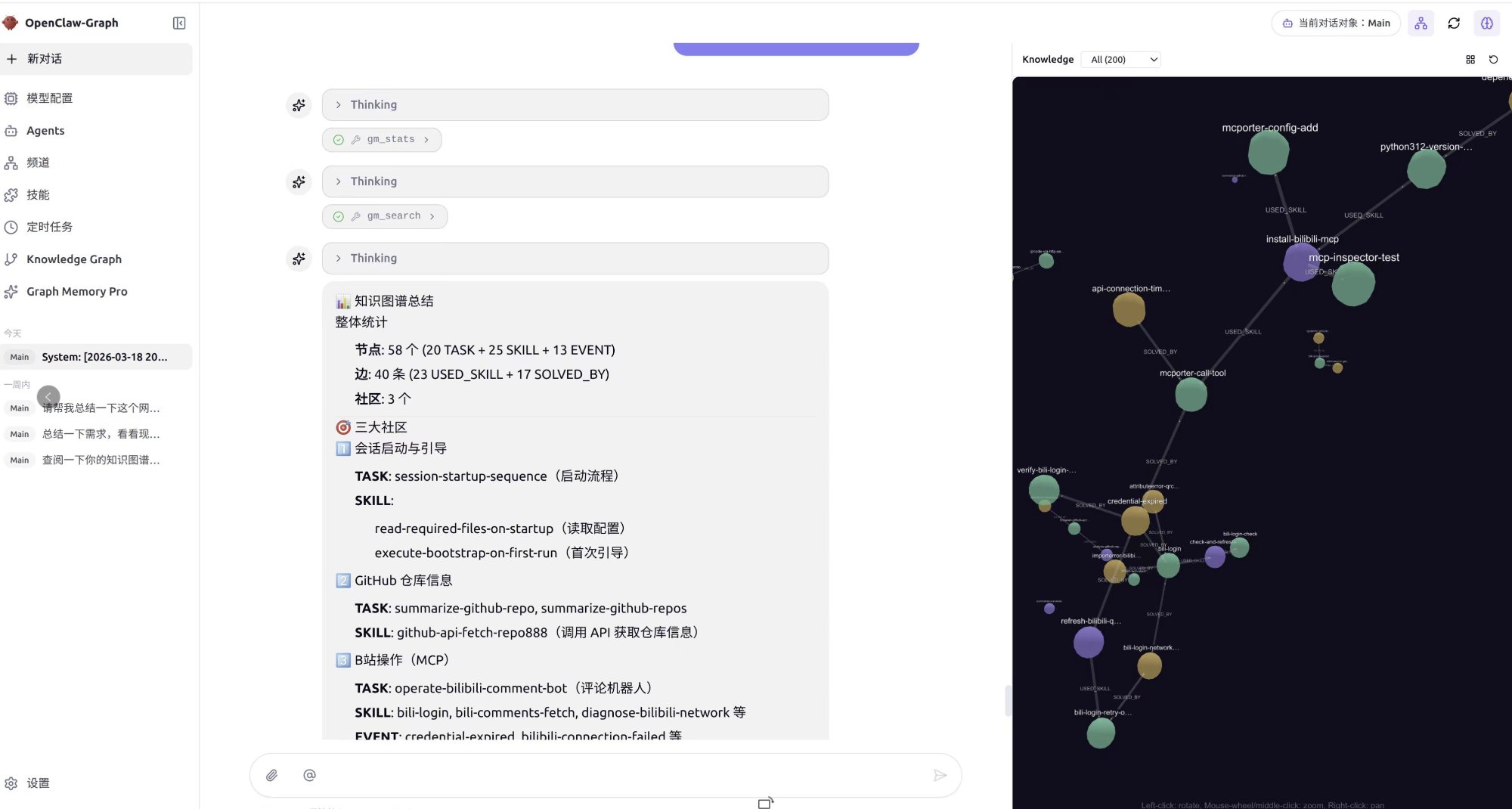
Names and venue information document project history only and do not imply endorsement by Tsinghua University, Sina Finance, DeepSeek, or OpenClaw.
## Graph Memory architecture
### Typed knowledge graph
```text
TASK ──USED_SKILL──▶ SKILL
TASK ──SOLVED_BY───▶ EVENT
SKILL ──REQUIRES────▶ SKILL
EVENT ──PATCHES─────▶ SKILL
SKILL ──CONFLICTS_WITH──▶ SKILL
```
Nodes retain episodic user/assistant provenance. This preserves the context in which knowledge was created, not only a lossy summary.
### Dual-path recall
```mermaid
flowchart LR
Q[Current query] --> EXACT[Exact path]
Q --> GENERAL[Generalized path]
EXACT --> SEARCH[Vector / FTS5]
SEARCH --> EXPAND[Community expansion + traversal]
GENERAL --> SUMMARY[Community-summary match]
SUMMARY --> MEMBERS[Community members]
EXPAND --> PPR[Personalized PageRank]
MEMBERS --> PPR
PPR --> CONTEXT[Deduplicated local context]
```
### Host data flow
```mermaid
flowchart LR
USER[User message] --> SESSION[DSH Session Events]
SESSION --> ADAPTER[Graph Memory Cordis Adapter]
ADAPTER --> EXTRACT[Structured Extraction]
EXTRACT --> GRAPH[(SQLite / FTS5 / Vectors)]
USER --> RECALL[Semantic + Lexical Recall]
GRAPH --> RECALL
RECALL --> RANK[Community Expansion + PPR]
RANK --> PROMPT[Prompt Assembly]
PROMPT --> LOOP[DSH Agent Loop]
CREDS[DSH Credentials] --> ADAPTER
TOOLS[gm_* Tools] --> ADAPTER
```
The code follows a host-neutral core plus host adapters:
```text
graph-memory/
├── dsh.ts # DeepSeek Harness / Cordis adapter
├── index.ts # OpenClaw adapter
├── cordis.patch.yml # DSH bundle entry
└── src/
├── extractor/ # conversation → TASK / SKILL / EVENT
├── recaller/ # vector, FTS5, graph expansion and recall
├── graph/ # PageRank, communities and deduplication
├── store/ # SQLite schema and queries
├── format/ # safe context assembly
└── engine/ # LLM and embedding providers
```
## Native DeepSeek Harness status
| Capability | Status | Notes |
|---|---|---|
| Native Cordis loading | **Done** | No DSH fork required |
| Cross-session auto-recall | **Done** | Injected during Prompt Assembly |
| Explicit record and search | **Done** | `gm_record`, `gm_search` |
| Vector backfill and migration | **Done** | Model, dimension, and fingerprint tracked |
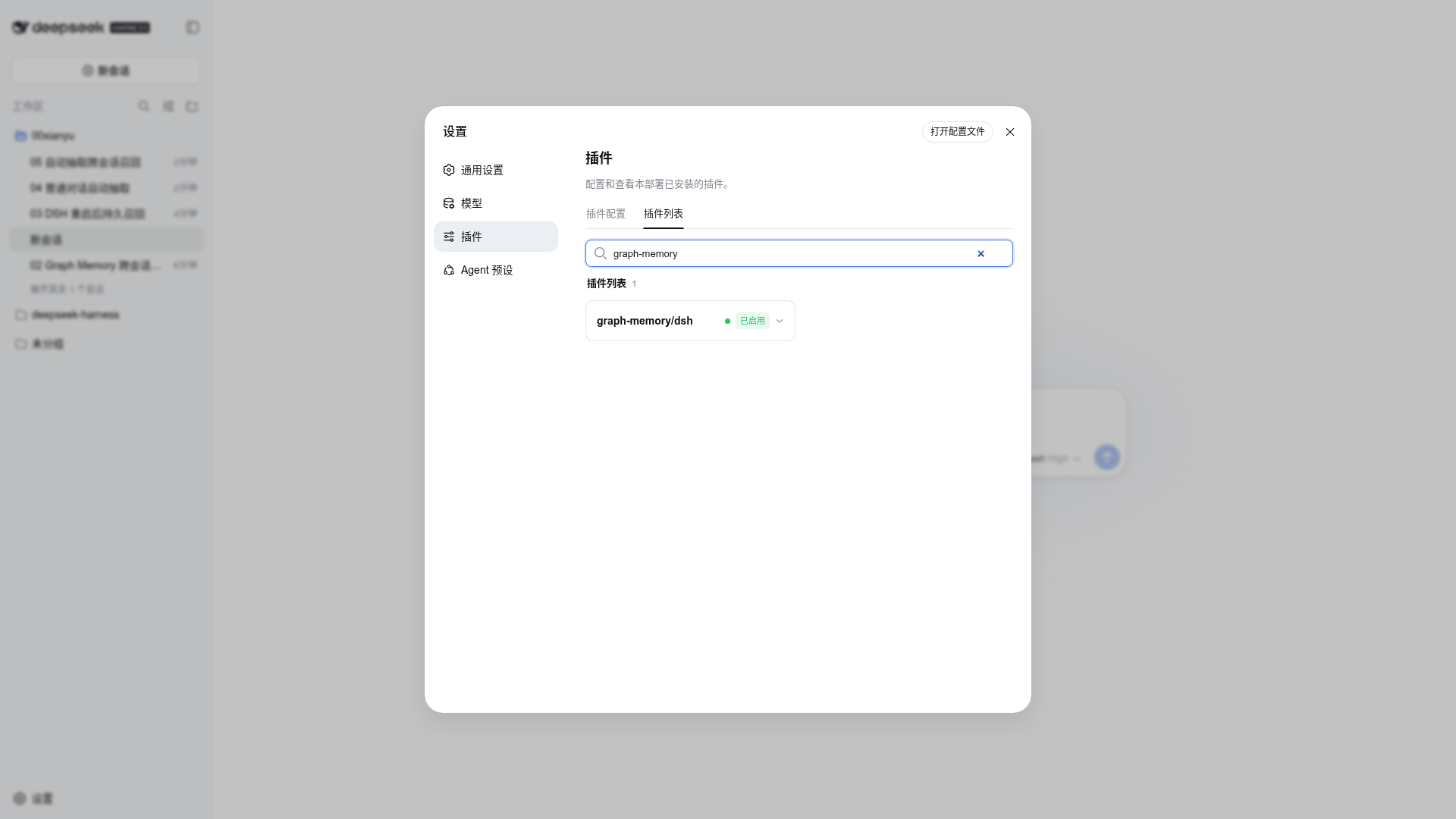
| Visible plugin state | **Done** | Active in Plugin Inventory |
| Pro visual workbench | **Not shipped** | Requires a DSH Client Plugin |
Current beta: `1.6.0-beta.1`. Local acceptance used DeepSeek Harness `0.1.0-rc.5`. DSH remains in Developer Preview and may introduce compatibility-breaking changes. Testing covered tarball installation, active plugin state, 1024-dimensional vector backfill, semantic recall across Sessions, persistence across restarts, and FTS5 fallback. All 107 automated tests passed.
Plugin enabled: graph-memory/dsh is active in the DSH plugin list
Cross-session semantic recall in a fresh Session
## Install on DeepSeek Harness
Prerequisites: Node.js `22.19+` or `24+`. The current beta is not yet published to npm, so build the tarball from source:
```bash
git clone https://github.com/adoresever/graph-memory.git
cd graph-memory
npm ci
npm test
npm run build
npm pack
```
Install the generated tarball into the DSH Web profile:
```bash
npx @deepseek-ai/dsh plugin --profile web add /absolute/path/to/graph-memory-1.6.0-beta.1.tgz
npx @deepseek-ai/dsh --profile web --dump-config
npx @deepseek-ai/dsh web
# From a deepseek-harness source checkout:
pnpm dsh plugin --profile web add /absolute/path/to/graph-memory-1.6.0-beta.1.tgz
pnpm dsh web
```
After installation, verify that `graph-memory/dsh` is enabled under **Settings → Plugins → Plugin list**.
Default store:
```text
$DSH_HOME/graph-memory/graph-memory.db
```
Without `DSH_HOME`, this is normally `~/.dsh/graph-memory/graph-memory.db`.
## Optional vector retrieval
Do not send secrets in chat. Cordis stores only a credential reference; DSH `credentials` resolves the real value for each embedding operation.
DashScope example:
```bash
export GRAPH_MEMORY_EMBEDDING_API_KEY='replace-with-your-key'
export GRAPH_MEMORY_EMBEDDING_BASE_URL='https://dashscope.aliyuncs.com/compatible-mode/v1'
export GRAPH_MEMORY_EMBEDDING_MODEL='text-embedding-v4'
export GRAPH_MEMORY_EMBEDDING_DIMENSIONS='1024'
dsh web
```
Without embeddings, Graph Memory continues with FTS5 and does not block conversation.
## DSH tools
| Tool | Purpose |
|---|---|
| `gm_status` | Plugin, store, extraction, recall, and vector state |
| `gm_search` | Explicit long-term graph search |
| `gm_record` | Persist a TASK, SKILL, or EVENT |
| `gm_stats` | Node, edge, type, and community statistics |
Automatic recall does not require an explicit `gm_search` tool call. The plugin retrieves relevant memory during Prompt Assembly.
## Graph Memory Pro as a DSH plugin
The accurate conclusion is not “Pro can already be installed into DSH.” It is: **Pro's graph database, retrieval, PageRank, community, and CRUD backend can be migrated; its OpenClaw host code and old ClawX integration must be replaced by a DSH Host + Client Plugin.** The current `desktop-2.0` implementation is OpenClaw + Neo4j and contains no installable DSH Client renderer.
The reviewed `desktop-2.0` code includes Neo4j Driver, GDS, APOC, vector indexes, graph maintenance tools, and CRUD routes. Today it also:
- imports `openclaw/plugin-sdk` at the entry;
- registers OpenClaw Gateway HTTP routes;
- writes OpenClaw configuration and restarts its Gateway during installation;
- exposes Neo4j connection details through `/graph-memory-pro/neo4j-config`;
- contains no installable DSH Client Plugin.
The correct plugin architecture is:
```mermaid
flowchart LR
CORE[Graph Memory Core] --> STORE[SQLite default / Neo4j optional]
STORE --> HOST[DSH Host Plugin]
HOST --> REMOTE[Typed Remote API]
REMOTE --> CLIENT[DSH Client Plugin]
CLIENT --> SPLIT[Conversation + Graph split view]
CLIENT --> DROP[Controlled drag-to-context]
```
The first Pro plugin does not need mandatory Neo4j:
- **Pro Lite:** SQLite plus a 2D/3D DSH graph client;
- **Neo4j adapter:** optional storage plugin for large graphs, GDS, and advanced analytics;
- the browser receives bounded `GraphSnapshot` data, never database passwords or arbitrary Cypher access;
- drag operations submit node IDs and intent; the Host validates them and writes visible, reversible Session context.
Pro should therefore be an optional Graph Memory DSH plugin module, not a separate standalone product.
### Recommended package split
```text
graph-memory # Community: current native Host Plugin
@adoresever/graph-memory-pro-dsh # Pro: Host + Client Plugin, to be built
@adoresever/graph-memory-store-neo4j # Optional large-graph adapter, to be built
```
The first milestone should be **Pro Lite**: reuse the existing SQLite graph and add the DSH graph workbench, so users do not need Neo4j. Neo4j stays optional for larger graphs, GDS, and advanced analysis. **This is a planned architecture; the existing `desktop-2.0` Pro is still Neo4j-only and does not yet implement a switchable SQLite / Neo4j `GraphStore`.**
### Target installation experience
This illustrates the target experience only. The npm package `graph-memory@1.5.8` is still the OpenClaw release, and `@adoresever/graph-memory-pro-dsh` has not been published. These commands do not work today:
```bash
# PLANNED — NOT AVAILABLE YET
dsh plugin --profile web add graph-memory
dsh plugin --profile web add @adoresever/graph-memory-pro-dsh
dsh web
```
During development, install a local tarball:
```bash
npm run build
npm pack
dsh plugin --profile web add /absolute/path/to/graph-memory-pro-dsh-*.tgz
```
### Four required integration layers
1. **Core contracts:** extract `GraphStore`, `GraphSnapshot`, and `RecallResult` so SQLite and Neo4j implement the same API.
2. **Host Plugin:** integrate DSH Sessions, Tools, LLM, System Prompt, and Credentials. Database secrets are resolved only on the Host.
3. **Client Plugin:** register a DSH sidebar, workbench, and tool card for 2D/3D graphs, search, filters, and split-view conversations.
4. **Controlled context actions:** drag-and-drop sends only a node ID and an intent; the Host validates it and writes visible, reversible Session Context.
The old Pro `/graph-memory-pro/neo4j-config` route returns connection details to the browser; this is a security flaw that must be removed. In the future DSH Pro design, the Host resolves Credentials and the browser receives only a bounded `GraphSnapshot`, never a Bolt password or unrestricted Cypher access.
## OpenClaw compatibility
Existing OpenClaw users retain the original entry:
```bash
openclaw plugins install graph-memory
openclaw plugins enable graph-memory
openclaw gateway restart
```
The Context Engine slot must also be activated in `~/.openclaw/openclaw.json`; otherwise the package may appear installed without running the full ingestion and extraction pipeline:
```json
{
"plugins": {
"slots": {
"contextEngine": "graph-memory"
},
"entries": {
"graph-memory": {
"enabled": true
}
}
}
}
```
The Community memory core is host-neutral. DSH development does not require OpenClaw users to abandon their entry or data.
## Development
```bash
npm ci
npm test
npm run build
npm pack
```
Release checks:
- tests and TypeScript build pass;
- tarball contains `dist/dsh.js` and `cordis.patch.yml`;
- no API keys, local databases, or environment files enter the repository;
- planned Pro features are never presented as shipped Community behavior.
## Current limitations
- Automatic extraction depends on auxiliary-model output stability. Use `gm_record` for critical beta knowledge.
- DSH does not yet expose `gm_update` and `gm_maintain`; those remain OpenClaw-entry tools.
- The Pro DSH visualization client plugin is not implemented.
- npm registry publication is pending; install the current beta from a GitHub-built tarball.
## Privacy and security
- Memory remains in local SQLite by default.
- API keys come from host credentials or environment variables, not the database or Cordis patch.
- Recalled history is reference material; current user instructions always take precedence.
- Rotate any secret that has appeared in chat, logs, or screenshots.
## License
[MIT](LICENSE) © 2026 adoresever
See [docs/ATTRIBUTIONS.md](docs/ATTRIBUTIONS.md) for asset, logo, and trademark notes.