# RF-LEGO: Modularized Signal Processing-Deep Learning Co-Design for RF Sensing via Deep Unrolling
[](https://arxiv.org/abs/2604.10183) [](https://www.gnu.org/licenses/lgpl-2.1) [](https://github.com/astral-sh/ruff)
The University of Hong Kong
🏆 ACM MobiCom 2026 Best Community Paper Award
The official implementation of RF-LEGO: Modularized Signal Processing-Deep Learning Co-Design for RF Sensing via Deep Unrolling, accepted by ACM Mobicom 2026, Austin, TX, USA.
---
## Abstract
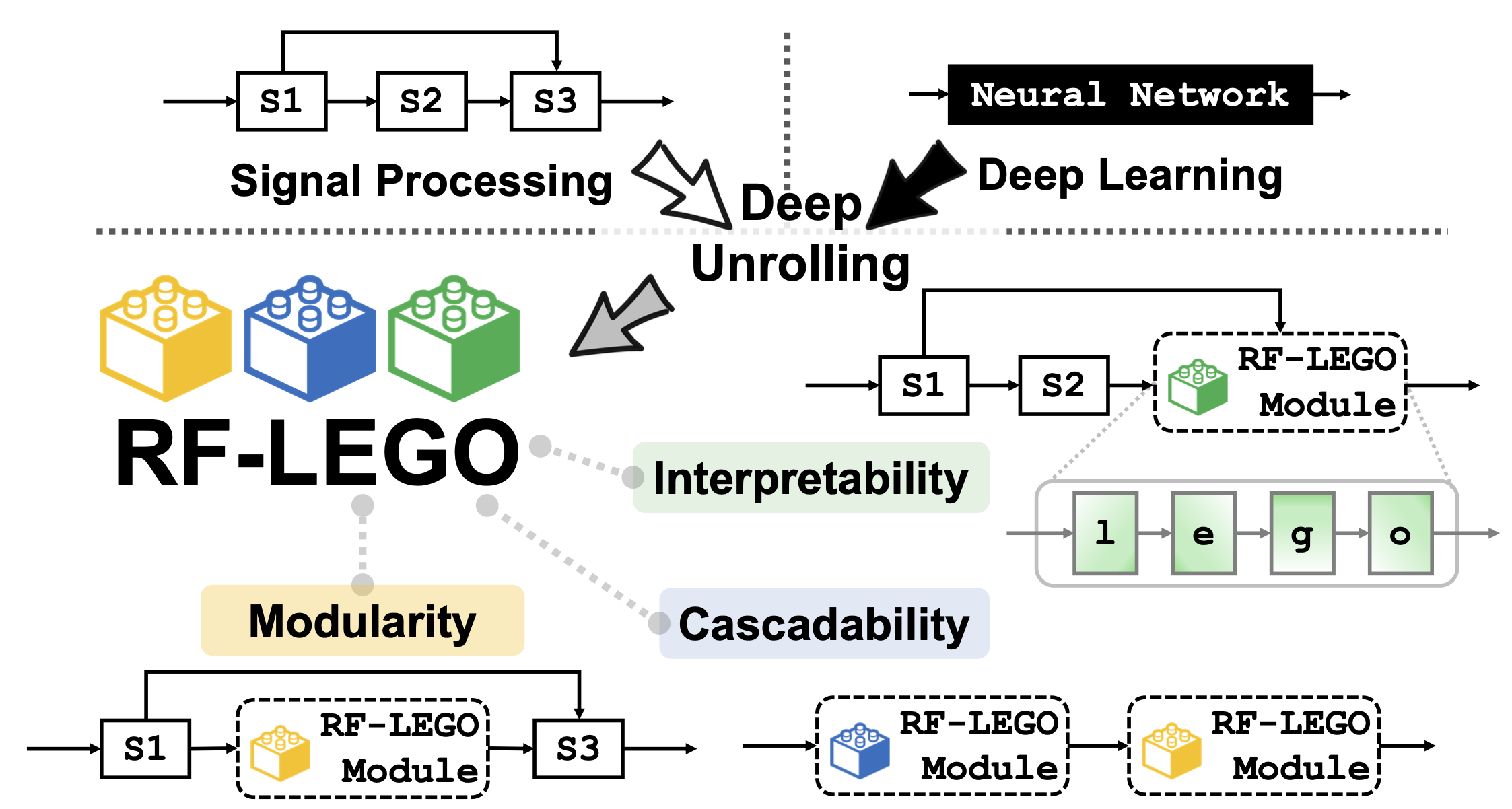
Wireless sensing, traditionally relying on signal processing (SP) techniques, has recently shifted toward data-driven deep learning (DL) to achieve performance breakthroughs. However, existing deep wireless sensing models are typically end-to-end and task-specific, lacking reusability and interpretability. We propose RF-LEGO, a modular co-design framework that transforms interpretable SP algorithms into trainable, physics-grounded DL modules through deep unrolling. By replacing hand-tuned parameters with learnable ones while preserving core processing structures and mathematical operators, RF-LEGO ensures modularity, cascadability, and structure-aligned interpretability. Specifically, we introduce three deep-unrolled modules for critical RF sensing tasks: frequency transform, spatial angle estimation, and signal detection. Extensive experiments using real-world data for Wi-Fi, millimeter-wave, UWB, and 6G sensing demonstrate that RF-LEGO significantly outperforms existing SP and DL baselines, both standalone and when integrated into downstream tasks such as tracking and vital sign monitoring. RF-LEGO pioneers a novel SP-DL co-design paradigm for wireless sensing via deep unrolling, shedding light on efficient and interpretable deep wireless sensing solutions.
---
## Installation
```bash
$ git clone https://github.com/1ucayu/RF-LEGO.git
$ cd RF-LEGO
$ uv sync
```
---
## Project Structure
```
RF-LEGO/
├── src/rflego/
│ ├── __init__.py # Main exports
│ ├── config.py # Dataclass configurations
│ ├── utils.py # Logging & utilities
│ ├── data/ # Dataset modules
│ │ ├── base.py # Base dataset class
│ │ └── datasets.py # Dataset implementations
│ ├── trainer/ # Trainer
│ │ └── trainer.py # BaseTrainer class
│ └── modules/ # Deep unrolling modules
│ ├── base.py # Base model and blocks
│ ├── ft.py # RF-LEGO FT
│ ├── beamformer.py # RF-LEGO Beamformer
│ └── detector.py # RF-LEGO Detector
├── pyproject.toml # Project configuration
└── README.md
```
---
## Quick Start
### RF-LEGO FT
```python
import torch
from rflego import FrequencyTransformConfig, FrequencyTransformModel
# Configure and create model
config = FrequencyTransformConfig(
sequence_length=256,
num_conv_layers=6
)
model = FrequencyTransformModel(config)
# Forward pass (separate real/imag inputs)
x_real = torch.randn(32, 256)
x_imag = torch.randn(32, 256)
y_real, y_imag = model(x_real, x_imag)
```
### RF-LEGO Beamformer
```python
import torch
from rflego import BeamformerConfig, BeamformerModel
# Configure and create model
config = BeamformerConfig(
dict_length=121, # 1-degree resolution over 120 degrees
num_layers=10 # ADMM iterations
)
model = BeamformerModel(config)
# Forward pass
y = torch.randn(32, 8, dtype=torch.complex64) # Measurements: (batch, num_antennas)
A = torch.randn(32, 8, 121, dtype=torch.complex64) # Steering matrix
spectrum = model(y, A) # DoA spectrum: (batch, dict_length)
```
### RF-LEGO Detector
```python
import torch
from rflego import DetectorConfig, DetectorModel
# Configure and create model
config = DetectorConfig(
num_layers=2,
hidden_dim=256,
order=256,
dropout=0.2
)
model = DetectorModel(config)
# Forward pass: (sequence_length, batch_size)
x = torch.randn(1024, 32)
logits = model(x) # Output: (1024, 32)
```
---
## Training
RF-LEGO provides a flexible `BaseTrainer` class for training:
```python
from rflego import BaseTrainer, TrainerConfig
from torch.utils.data import DataLoader
class DetectorTrainer(BaseTrainer):
def compute_loss(self, batch):
inputs = batch['input'].to(self.device)
labels = batch['labels'].to(self.device)
# Reshape and forward
x = inputs.squeeze(1).permute(1, 0)
logits = self.model(x)
loss = torch.nn.functional.binary_cross_entropy_with_logits(
logits.permute(1, 0), labels
)
return loss, {"loss": loss.item()}
# Setup and train
config = TrainerConfig(
batch_size=512,
learning_rate=1e-3,
epochs=100
)
trainer = DetectorTrainer(model, config, train_loader, val_loader)
trainer.fit()
```
---
## Citation
```bibtex
@INPROCEEDINGS{luca2026mobicom_rflego,
author={Luca Jiang-Tao Yu and Chenshu Wu},
booktitle={ACM International Conference on Mobile Computing and Networking},
title={RF-LEGO: Modularized Signal Processing-Deep Learning Co-Design for RF Sensing via Deep Unrolling},
pages={},
month={Oct},
year={2026},
}
```
---




This artifact received all four ACM reproducibility badges — Artifacts Available, Functional, Reusable, and Results Reproduced — from the MobiCom 2026 Artifact Evaluation Committee.