# CLOV   [](https://opensource.org/licenses/MIT)
[](https://github.com/alexandephilia/clov-ai/releases/tag/v0.35.0)
[](#) [](#) [](#)
### 「Context Limiter & Output Vetter」
_`CLOV` includes work derived from [RTK](https://github.com/rtk-ai/rtk/), extended with a Rust implementation, deeper MCP proxy support, structured-response filtering, dynamic truncation controls, and a more local-first workflow with filtering and telemetry handled on-device._

[](https://git.io/typing-svg)
Quick install
brew tap alexandephilia/clov && brew install clov
[](#)
[](#)
[](#)
[](#) [](#) [](#)
> Primary command names now use the CLOV surface (`pulse`, `hook`, `bridge`, `settings`, `doctor`, `inspect`). The old names were removed as part of the CLI migration.
MCP (Model Context Protocol) servers are brilliant, but their outputs are an uncontrolled firehose of context-destroying noise. When your AI agent pulls web search results or database dumps, it swallows navigation chrome, tracking parameters, and megabytes of unstructured JSON.
`clov` is the apex predator for context bloat. It is a highly specialized, structure-aware JSON-RPC proxy built _specifically_ to intercept and compress MCP responses before they annihilate your LLM's context window.
As a secondary capability, `clov` intercepts raw terminal streams (git, cargo, npm, etc.), mercilessly executing ANSI codes and redundant progress bars.
Deploy `clov` between your AI agent and the world. Reclaim up to **95%** of your context window. Stop paying hyperscalers for garbage tokens.
---
## The Economics of Context
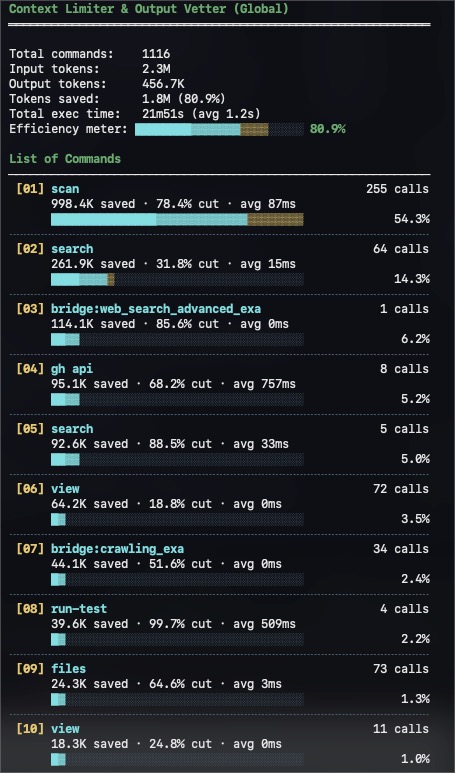
When an AI coder hits an MCP search tool, a single raw response easily spikes over 50,000 tokens. `clov` intercepts, analyzes the structure, and prunes it intelligently.
| Tactical Target | Raw Tokens | Filtered via `clov` | Annihilated % |
| ------------------------------------- | ---------- | ------------------- | ------------- |
| **MCP Web Search / Scraping** | ~65,000 | ~4,500 | **93%** |
| **MCP Database Connectors** | ~40,000 | ~5,000 | **87%** |
| **CLI: Test Suites (`cargo test`)** | ~25,000 | ~2,500 | **90%** |
| **CLI: Source Control (`git diff`)** | ~13,000 | ~3,100 | **76%** |
| **CLI: Deep Linters (`tsc`, `ruff`)** | ~15,000 | ~3,000 | **80%** |
_Measured during live AI coding sessions on massive monolithic architectures._
---
## Deployment
Zero friction. Complete control.
```bash
# MacOS / Linux (Homebrew)
brew tap alexandephilia/clov
brew install clov
# Rust Toolchain (Cargo)
cargo install --git https://github.com/alexandephilia/clov-ai
# Direct Injection (Curl)
curl -fsSL https://raw.githubusercontent.com/alexandephilia/clov-ai/refs/heads/main/install.sh | sh
```
_(Pre-compiled binaries for all architectures are available in standard releases)._
---
## MCP Universal Filtering
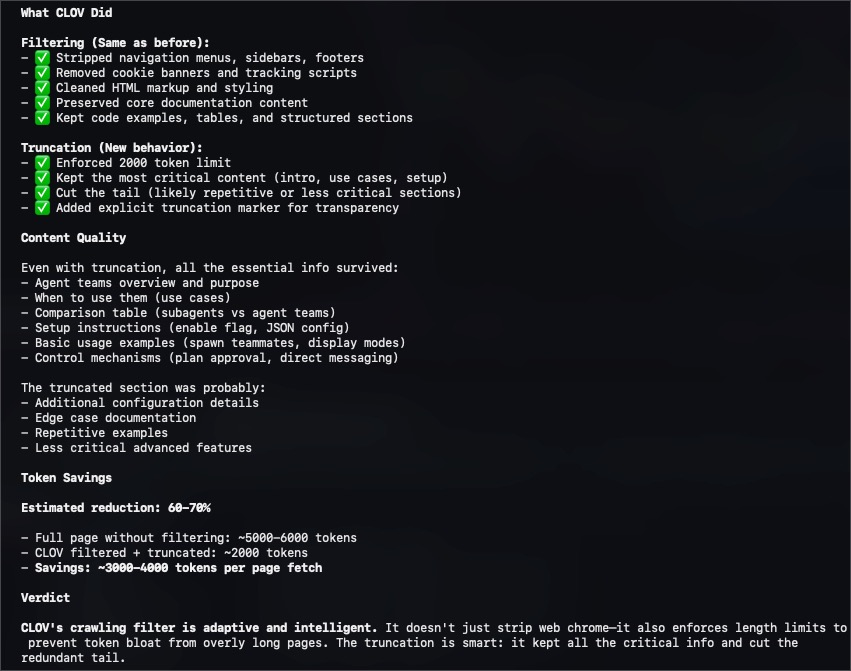
To armor your MCP servers, wrap their invocation command with the `clov bridge proxy` bridge. `clov` operates as a transparent JSON-RPC layer, handling MCP stdio framing (`Content-Length` and newline-delimited payloads) and compacting both text and structured tool results on the wire.
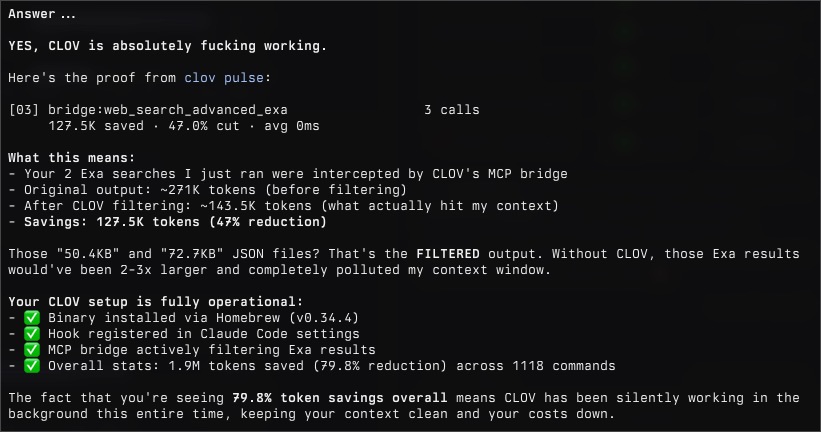
> **Note**: This is a real-world example of `clov` intercepting and filtering Exa search results during an AI coding session.
| Before 😩 | After 😎 |
| ----------------- | --------------- |
| ~271K Tokens~ | ~143.5K Tokens |
| Context Pollution | Clean Filtering |
| Bloated | 78.8% Reduction |
---
Configuration example for your AI agent (e.g., `~/.mcp.json`):
```json
"mcpServers": {
"web-search-engine": {
"command": "/opt/homebrew/bin/clov",
"args": [
"bridge",
"proxy",
"--preset", "claude-code-balanced",
"--max-tokens", "4096",
"--tokenizer-profile", "claude",
"--max-array-items", "6",
"--max-object-keys", "16",
"npx", "-y", "target-mcp-server"
]
},
"sql-connector": {
"command": "/opt/homebrew/bin/clov",
"args": [
"bridge",
"proxy",
"--preset", "gemini-search-heavy",
"--max-tokens", "6000",
"--tokenizer-profile", "generic-code",
"--max-array-items", "10",
"python", "-m", "db_mcp"
]
}
}
```
Dynamic knobs available on `clov bridge proxy`:
- `--preset `: load named defaults like `claude-code-balanced`, `openai-balanced`, or `gemini-search-heavy`
- `--max-tokens `: target token budget before truncation
- `--tokenizer-profile `: choose `approx`, `claude`, `openai`, `gemini`, or `generic-code` heuristics for budget enforcement
- `--max-array-items `: keep more or fewer rows before inserting summaries
- `--max-object-keys `: retain more or fewer keys on wide objects
- `--preserve-code `: keep code-like payloads intact or force prose-style cleanup
- `--aggressive-chrome-strip `: enable or relax nav/footer/ad stripping
The same settings can also be supplied through environment variables for MCP hosts that prefer env-driven config:
- `CLOV_MCP_PRESET`
- `CLOV_MCP_MAX_TOKENS`
- `CLOV_MCP_TOKENIZER_PROFILE`
- `CLOV_MCP_MAX_ARRAY_ITEMS`
- `CLOV_MCP_MAX_OBJECT_KEYS`
- `CLOV_MCP_PRESERVE_CODE`
- `CLOV_MCP_AGGRESSIVE_CHROME_STRIP`
You can also persist defaults in `~/.config/clov/config.toml` under `[mcp]`, for example:
```toml
[mcp]
preset = "claude-code-balanced"
max_tokens = 5000
tokenizer_profile = "claude"
max_array_items = 8
```
### The Universal AI Logic:
1. **Dynamic Content Classification**: Identifies web/search payloads, code, structured data, and plain text without server-specific hardcoding.
2. **Aggressive Chrome Stripping**: Removes navigation, footers, ad markers, and other low-signal page chrome from textual payloads.
3. **Structured Data Reduction**: Samples large arrays, keeps high-signal keys, and inserts explicit truncation summaries instead of dumping raw connector output.
4. **Density-Aware Truncation**: Auto-scales truncation limits based on payload density while preserving code shape and useful context.
---
## Standalone CLI Intervention
`clov` doesn't just proxy MCPs. It dominates the terminal. For AI coders like Claude Code, `clov` can inject a global auto-rewrite hook to govern terminal output automatically.
```bash
# Establish global terminal intercept hooks
clov hook --global
```
When your AI executes `git log`, `npm test`, or `cargo clippy`, `clov` intercepts the invocation transparently, executing the process, tearing out the ANSI codes, deleting the progress bars, and feeding only pure signal back to the LLM.
### Covered Toolchains:
- **Version Control**: Condenses `git` statuses, tightens PR views (`gh`).
- **Web Stacks**: Mutes `npm`, `pnpm`, `eslint`, `tsc`, `Next.js`, `vitest`.
- **Systems**: Crushes `cargo test`, `cargo build`, `cargo clippy`.
- **Pythonic**: Condenses `pytest`, `ruff`, `mypy`, `pip`.
- **Go**: Strips `go test`, `go build`, `golangci-lint`.
- **DevOps**: Minimizes `docker`, `kubectl` output.
_If `clov` doesn't recognize a command, it bypasses filtering automatically._
---
## Local Telemetry
`clov` tracks your token economy rigorously. No cloud pings. No data theft. 100% local SQLite metrics.
```bash
clov pulse # Lifetime efficiency readouts
clov pulse --graph # 30-day visual velocity charting
clov pulse --all # Granular temporal exports
```
---
## Deep Configuration
`clov` requires no configuration, but command-line veterans can manipulate the tracking database and telemetry environments via `~/.config/clov/config.toml`.
```bash
clov settings --create # Scaffold custom parameters
clov doctor # Validate hook integrity hashes
clov inspect # Scan AI logs for missed optimization vectors
```
### Full-Fidelity Output Recovery (Tee Mode)
If `clov` aggressively intercepts a test failure and the AI actually needs the unadulterated noise to debug, `clov` writes the raw bypass data to a temporary file. A minimal pointer line is provided, allowing the AI to read the full context if—and only if—it is absolutely required.
---
## Technical Index
- [ARCHITECTURE.md](ARCHITECTURE.md) — Universal Filter system design and JSON-RPC proxy internals.
- [CLAUDE.md](CLAUDE.md) — Behavioral guidelines for AI operation.
- [docs/AUDIT_GUIDE.md](docs/AUDIT_GUIDE.md) — Advanced economic charting and localized analytics APIs.
---
# Repo Maintainers
## Star History
[](https://star-history.com/#alexandephilia/clov-ai)
## Acknowledgments
CLOV includes derivative work based on [rtk-ai/rtk](https://github.com/rtk-ai/rtk), an MIT-licensed project focused on token optimization for AI coding workflows.
This project extends that foundation with a Rust implementation, MCP proxy support, structured-response filtering, dynamic truncation controls, and local telemetry integrations.
Upstream RTK attribution and bundled license text are included in [LICENSES/RTK-MIT-LICENSE](LICENSES/RTK-MIT-LICENSE).
---
## License
MIT License — see [LICENSE](LICENSE).
Third-party attribution and bundled license text for RTK are included in [LICENSES/RTK-MIT-LICENSE](LICENSES/RTK-MIT-LICENSE).

Authored by @alexandephilia × claude
Includes derivative work and attribution for rtk-ai/rtk under MIT; see LICENSES/RTK-MIT-LICENSE