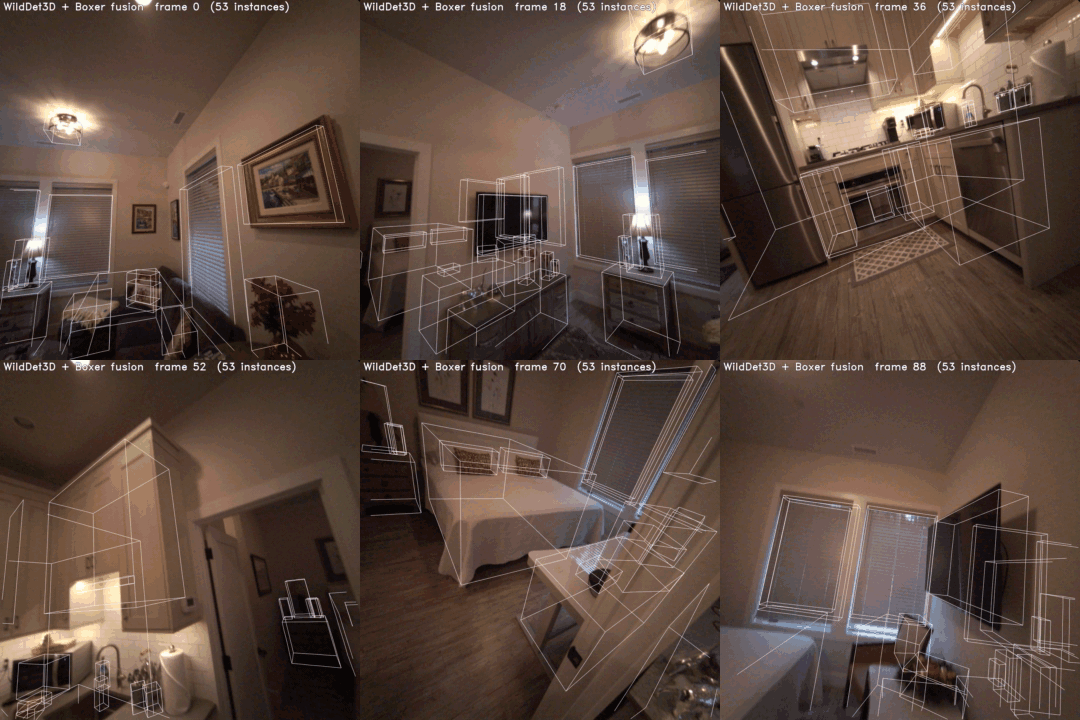
# Integrating with Meta FAIR's Boxer demo for indoor labelling [Boxer](https://github.com/facebookresearch/boxer) is Meta/FAIR's framework for 2D->3D oriented bounding box lifting on Project Aria devices. Its end-to-end demo pipeline is OWL-V2 (text-prompted 2D detection) → BoxerNet (per-box 3D lifting) → CSV → offline fusion / online tracking → 3D viewer. This demo replaces the **OWL + BoxerNet** detection stages with a single **WildDet3D** call. Everything else - the AriaLoader, pose math (`PoseTW` / `ObbTW`), per-frame visualization (`draw_bb3s` / `make_mp4`), offline fusion (`fuse_obbs_from_csv`), online tracker (`BoundingBox3DTracker`), and the 3D viewers (`view_fusion.py` / `view_tracker.py`) - is imported from Boxer **unchanged**. The output CSV uses Boxer's exact 15-column schema, so Boxer's existing viewers and post- processing tools work on our outputs without any modification.

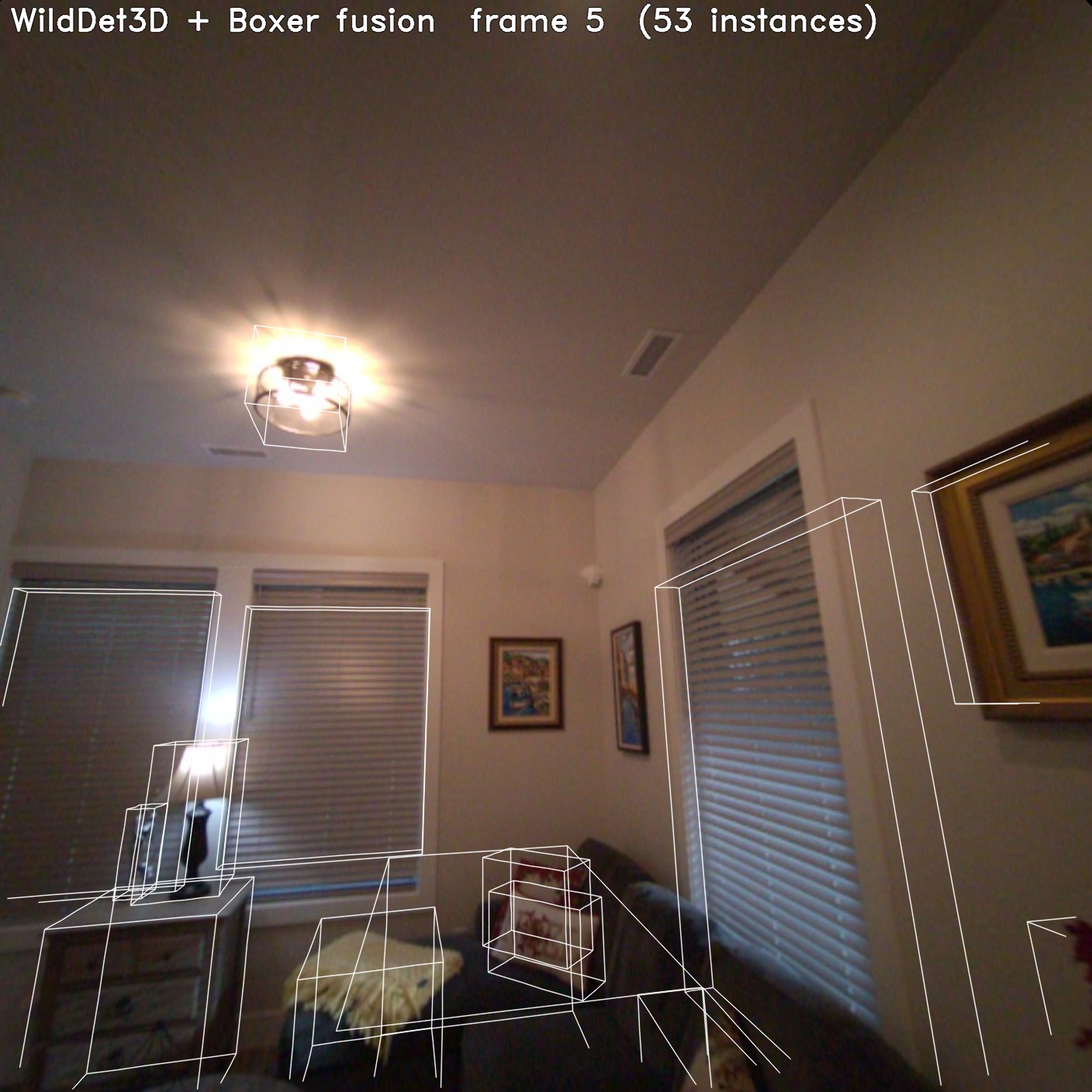
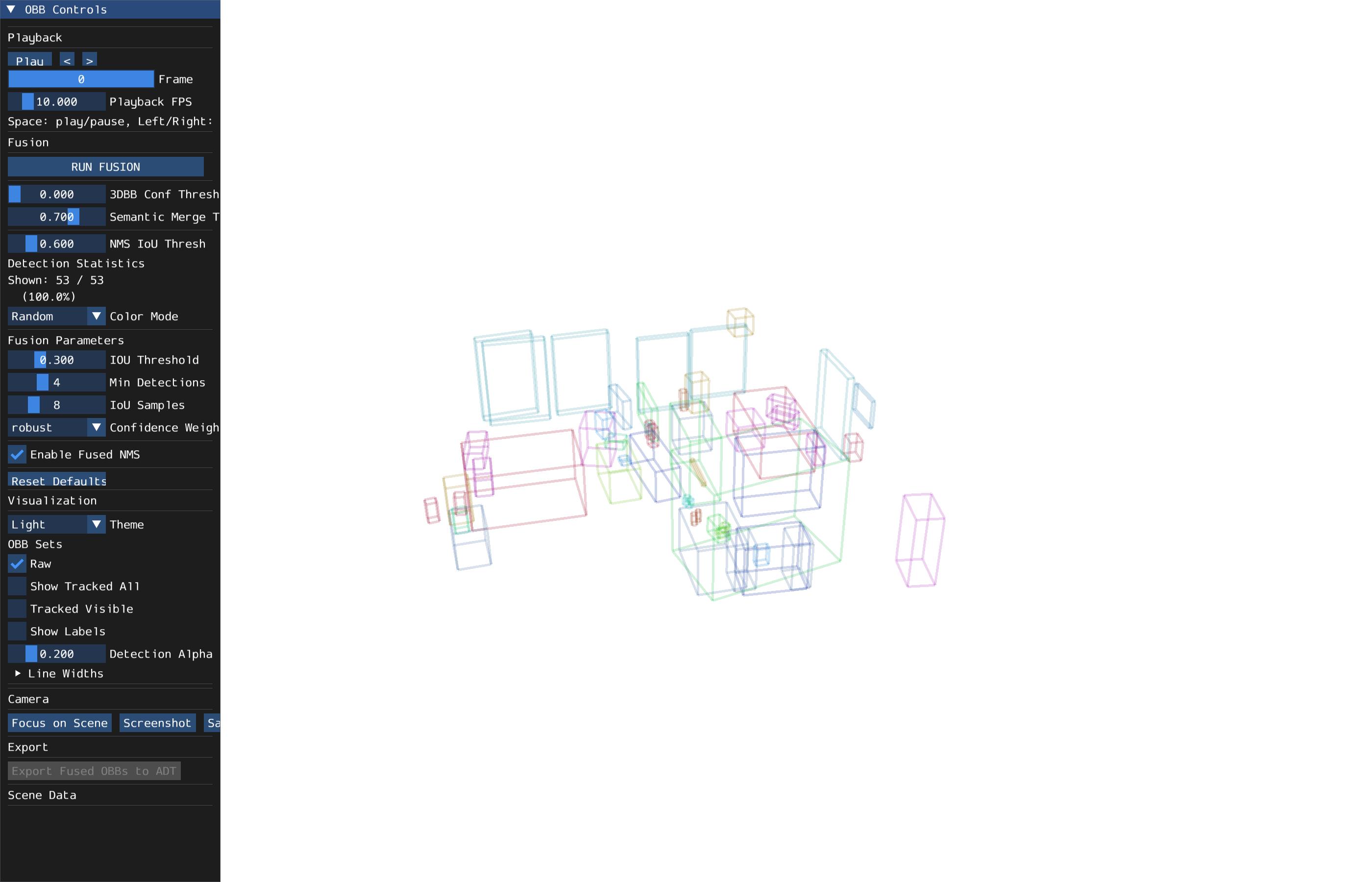
Demo #1 — Per-frame OBB overlay Demo #3 — view_fusion.py (Boxer's 3D viewer, unmodified)
WildDet3D 3D boxes drawn back onto the upright Aria RGB frame via Boxer's draw_bb3s. Same fused instances rendered in Boxer's interactive 3D viewer — fed our wilddet3d_3dbbs_fused.csv directly, no code changes.
## Pipeline ``` Boxer original This demo ┌─────────────────────────────────────────────────┐ ┌─────────────────────────────────────────────────┐ │ AriaLoader (unrotate=True) │ │ AriaLoader (unrotate=True) │ │ │ │ │ │ │ │ v │ │ v │ │ OWL-V2 (text-prompted 2D detection) │ │ WildDet3D (text-prompted, end-to-end 3D) │ │ │ │ │ │ │ │ v │ │ v │ │ BoxerNet (per-box 3D lifting) │ │ per-frame 3D OBBs │ │ │ │ │ │ │ │ v │ │ v │ │ per-frame 3D OBBs │ │ ObbCsvWriter2 → wilddet3d_3dbbs.csv │ │ │ │ │ │ │ │ v │ │ v │ │ ObbCsvWriter2 → boxer_3dbbs.csv │ │ fuse_obbs_from_csv / BoundingBox3DTracker │ │ │ │ │ │ │ │ v │ │ v │ │ fuse_obbs_from_csv / BoundingBox3DTracker │ │ view_fusion.py / view_tracker.py (Boxer GUI) │ │ │ │ └─────────────────────────────────────────────────┘ │ v │ │ view_fusion.py / view_tracker.py (Boxer GUI) │ └─────────────────────────────────────────────────┘ ``` Only the orange box (the detection stage) changes; the entire IO / fusion / tracking / viz stack is reused as-is. ## What's WildDet3D / What's Boxer | Component | Source | | ---------------------------------------------------- | ----------------- | | 2D + 3D detection | **WildDet3D** | | `build_model`, `preprocess` | **WildDet3D** | | Adapter (`wilddet3d_to_obb`, axis convention) | **This demo** | | `AriaLoader` (Aria VRS reader) | Boxer | | `ObbTW`, `PoseTW`, `CameraTW` | Boxer | | `ObbCsvWriter2`, `read_obb_csv` | Boxer | | `draw_bb3s`, `put_text`, `make_mp4` | Boxer | | `fuse_obbs_from_csv` | Boxer | | `BoundingBox3DTracker` | Boxer | | `view_fusion.py`, `view_tracker.py` (interactive UI) | Boxer | ## Quick Start ### 1. Clone Boxer next to WildDet3D ```bash cd WildDet3D git clone https://github.com/facebookresearch/boxer.git ``` Install Boxer and download its sample Aria sequences per the [Boxer README](https://github.com/facebookresearch/boxer#sample-data). Note that Boxer is released under **CC-BY-NC 4.0** (non-commercial); the WildDet3D code in this demo (`run_wilddet3d.py`, `render_fused.py`, this README) is under the same Apache 2.0 license as the rest of WildDet3D. ### 2. Run the WildDet3D detection + Boxer fusion ```bash # Equivalent to Boxer's `python run_boxer.py --input nym10_gen1 --fuse` python -m demo.boxer.run_wilddet3d \ --input nym10_gen1 \ --max_n 90 \ --fuse \ --use_depth \ --ckpt ckpt/wilddet3d_alldata_all_prompt_v1.0.pt \ --boxer_path boxer ``` The `--use_depth` flag mirrors what Boxer's BoxerNet consumes: Aria's semi-dense points (SDP) from on-device SLAM, projected to the camera and rasterized into a sparse `(H, W)` depth map that goes into WildDet3D's geometry backend as `depth_gt`. Without it, WildDet3D runs pure monocular (LingBot-Depth predicts depth from the RGB image alone). The screenshots above are generated with `--use_depth`. Outputs land under `demo/boxer/output//`: ``` demo/boxer/output/nym10_gen1/ ├── wilddet3d_3dbbs.csv # raw per-frame OBBs (Boxer schema) ├── wilddet3d_3dbbs_fused.csv # fused static instances (Boxer schema) ├── viz_frames/ # per-frame jpg with OBB overlays └── wilddet3d_viz_final.mp4 # assembled video ``` ### 3. Render the fused result back onto the video ```bash python -m demo.boxer.render_fused \ --input nym10_gen1 \ --boxer_path boxer ``` This re-loads the AriaLoader, draws the (static) fused instances onto each frame, and writes them under `demo/boxer/output//viz_frames_fused/`. ### 4. Visualize in Boxer's 3D viewer (unmodified Boxer code) Because the CSVs follow Boxer's exact schema, Boxer's GUI viewers work without any change: ```bash cd boxer # Demo #3 - offline 3D fusion viewer: python view_fusion.py --input nym10_gen1 \ --output_dir ../demo/boxer/output --write_name wilddet3d # Demo #4 - online 3D tracker viewer: python view_tracker.py --input nym10_gen1 \ --output_dir ../demo/boxer/output --write_name wilddet3d ``` For Demo #4 you need to run with `--track` instead of `--fuse`: ```bash python -m demo.boxer.run_wilddet3d --input nym10_gen1 --max_n 90 \ --track --ckpt ckpt/wilddet3d_alldata_all_prompt_v1.0.pt \ --boxer_path boxer ``` This writes `wilddet3d_3dbbs_tracked.csv` (persistent instance IDs across frames) which `view_tracker.py` reads. ## CLI Options ``` --input Boxer sequence name (e.g., nym10_gen1) --max_n Max frames to process (default 90) --skip_n Frame stride (default 1) --ckpt WildDet3D checkpoint path --labels Comma-separated text prompts (default: 20 indoor categories) --thresh3d 3D score threshold (default 0.5) --fuse Run Boxer's offline 3D box fusion on the output CSV --track Run Boxer's online tracker (mutually exclusive with --fuse) --use_depth Feed Aria SDP (SLAM semi-dense points) as sparse depth into WildDet3D's geometry backend. Off by default (pure monocular). --output_dir Output directory (default: demo/boxer/output/) --device Inference device (default: cuda) --boxer_path Path to local clone of facebookresearch/boxer (or set BOXER_PATH env var) ``` ## Key Implementation Notes The adapter is `wilddet3d_to_obb()` in `run_wilddet3d.py`. Two conventions have to be aligned between WildDet3D's output and Boxer's `ObbTW`: - **Pose chain**: WildDet3D returns 3D boxes in the *camera* frame. Boxer expects them in the *world* frame. The chain is `T_world_camera = T_world_rig @ T_camera_rig.inverse()`, using Boxer's `cam.T_camera_rig` (not `T_rig_camera` - that attribute does not exist). - **Axis convention**: WildDet3D's RoI2Det3D outputs `[center(3), dims=(W,L,H)(3), quat_wxyz(4)]`, and the canonical local box frame is `x=L, y=H, z=W` (see `coder.py:_normalize_canonical`). Boxer's `bb3_object` keeps the vertical axis on `z`, so we rotate 90 deg around z and write `bb3 = (L=x, W=y, H=z)`. With this mapping the quaternion can be used as-is (no extra rotation) and the boxes align with walls / paintings / vertical objects correctly. - **Sparse depth from Aria SDP** (when `--use_depth` is on): `AriaLoader` is loaded with `with_sdp=True`, the SDP world-frame points are transformed to the camera frame (using the same `T_world_camera` chain), projected with `K`, and rasterized into a sparse `(H, W)` depth map in meters. The map goes through the same resize + center-pad transforms as the RGB and is passed to the model as `depth_gt`. `build_model` is called with `use_depth_input_test=True` so the geometry backend actually consumes it (otherwise it's ignored at inference). ## Citation If you use this demo, please cite **both** WildDet3D and Boxer. ```bibtex @article{huang2025wilddet3d, title={WildDet3D: Scaling Promptable 3D Detection in the Wild}, author={Huang, Weikai and Zhang, Jieyu and others}, year={2025} } @misc{boxer2024, title={Boxer: 3D Oriented Bounding Box Lifting for Project Aria}, author={Meta FAIR}, year={2024}, url={https://github.com/facebookresearch/boxer} } ```