

dsh-xray β€” X-ray for your DeepSeek Harness

npm CI license OpenSSF Scorecard coverage JavaScript

X-ray for your DeepSeek Harness β€” see what's actually loaded, why, and what it costs you.
LLM context-cost observability: token attribution per plugin, prompt-section and tool-schema pricing, skill catalog tax, dependency cascades.

πŸ‡¨πŸ‡³ δΈ­ζ–‡ζ–‡ζ‘£

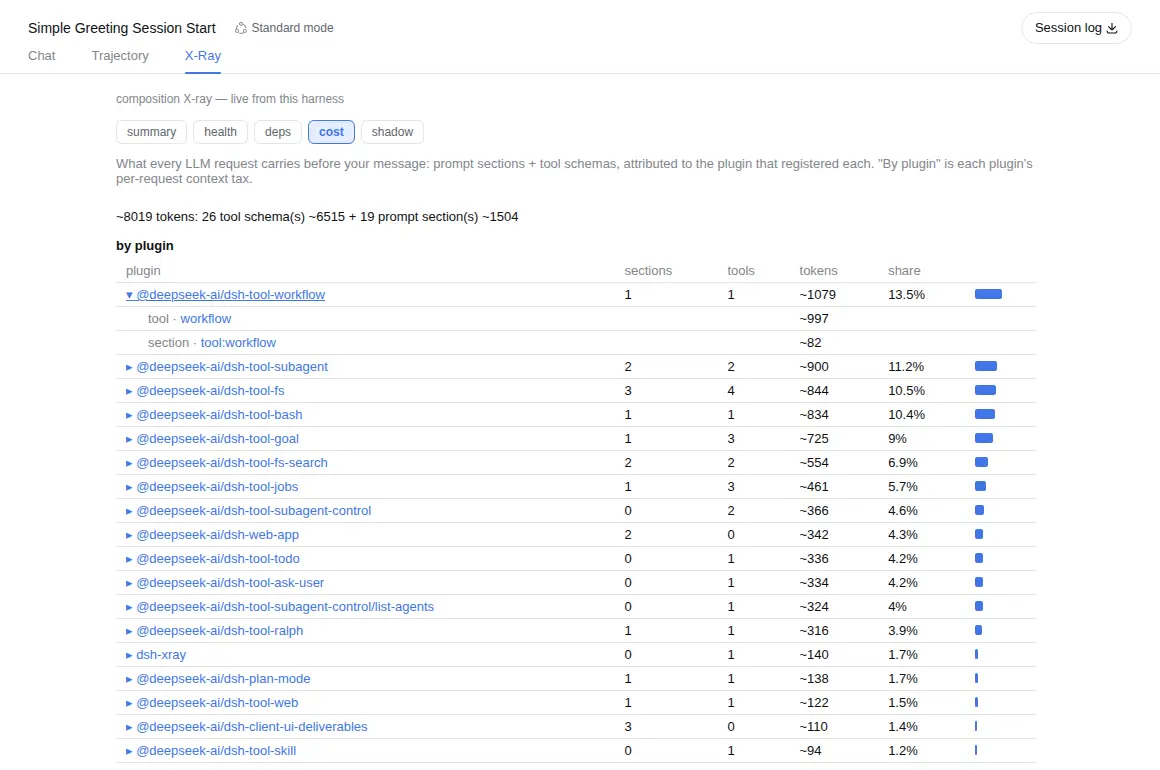
--- Every plugin you mount quietly bills every LLM request: prompt sections, tool schemas, tokens. dsh-xray sits inside your running harness as an **X-Ray tab beside Chat and Trajectory** and itemizes that bill β€” per plugin, per entry, down to the exact text: ![The X-Ray tab: every plugin's per-request context tax, attributed and ranked](./assets/tab-cost.webp) Unfold a plugin to see what it registered; click any entry to read the exact text it puts into every request:
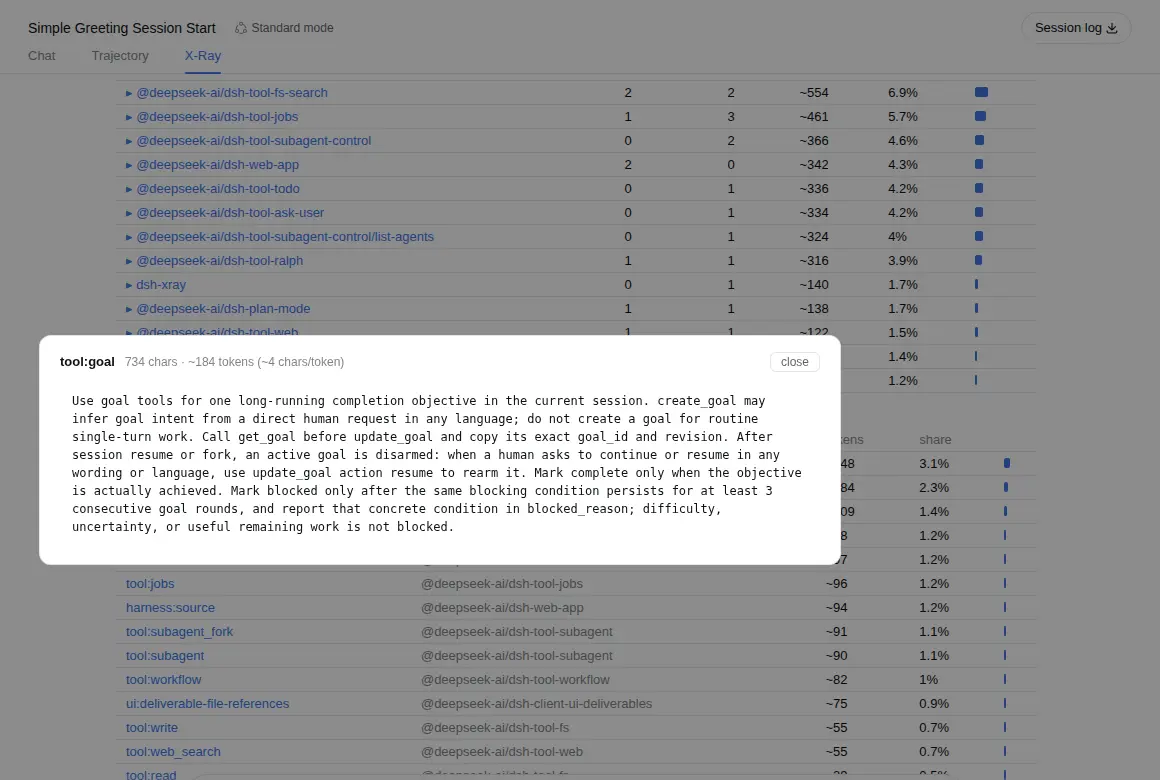
![A plugin unfolds into its registered entries](./assets/tab-expand.webp) ![The raw text behind ~184 tokens, with a chars/tokens ruler](./assets/tab-entry.webp)
Three clicks: plugin rollup β†’ entry list β†’ the actual words. The number stops being an estimate you trust and becomes a fact you checked. --- ## The Problem `dsh --dump-config` shows you the composed tree. The plugin panel shows you a flat list. Neither tells you **why** a plugin is there, **what breaks** if you disable it, or **what it silently costs you** on every single request. **dsh-xray does.** And when the answer is "this plugin taxes every request and nothing depends on it" β€” the `deps` view confirms the disable is safe, one patch line removes it, and `attribute` verifies it took. ---

Context Tax

The cost view answers the question no other tool asks: **who put this in my context, and what does it cost?** - **Attribution** β€” every prompt section and tool schema is joined to the plugin that registered it, reconstructed live from the registries (ambiguous entries stay `unattributed`, never guessed). - **By-plugin rollup** β€” each plugin's per-request context tax: sections + schemas + tokens + share, ranked. - **Entry inspection** β€” `/xray/api/entry` returns any entry's live text with a chars/tokens ruler. Computed per request, never persisted. - **Skill cost** β€” a dedicated view prices every skill twice: its catalog line (resident on every request once any model-invocable skill exists) and its body (billed per load). Pricing only β€” toggling belongs to the ecosystem's skill managers. - **Per-request ledger** β€” one classified bill per LLM call: system / tool schemas / history / tool results (aggregated per tool), a **Ξ”prev** growth column, and prefix-stability markers (⚑ system+tools byte-identical to the previous request β€” KV-cache-friendly; βœ‚ prefix broken). Compaction and title calls are tagged apart from chat. Only counts, names, and hashes are kept β€” never message text. - **Explained UI** β€” every view opens with a one-line "what am I looking at"; terms carry plain-language tooltips; the whole tab is localized (English / δΈ­ζ–‡) through the host locale service. The same data flows through three surfaces: the **X-Ray tab** (native GUI), the standalone **`/xray` page** (works even when the client-module pipeline it diagnoses is broken), and the **CLI**. ---

CLI Commands

```sh npx dsh-xray attribute # which layer introduced each row, and who patched it since npx dsh-xray conflicts # contested fields with per-writer evidence: file:line, value, winner npx dsh-xray diff # declared (static layers) vs actual (dump-config) tree npx dsh-xray snapshot # content-addressed lockfile; --against reports drift, exits 1 npx dsh-xray deps [svc] # service dependency graph: providers, consumers, transitive disable-cascade npx dsh-xray health # plugin lifecycle health: failed fibers, pending injects, transitions npx dsh-xray cost # context cost: prompt sections + tool schemas, estimated tokens npx dsh-xray shadow # services provided by multiple plugins npx dsh-xray verify # declared (static) rows ↔ runtime registry, exits 1 on mismatch npx dsh-xray audit # static scan of out-of-tree plugins for sensitive touchpoints ``` ![dsh-xray demo](./docs/demo.svg) `attribute`, `conflicts`, and `snapshot` are fully static β€” they work even when dsh cannot boot. All commands take `--profile ` (default `web`) and `--json`; every JSON payload carries a versioned `schema` field (`dsh-xray/@1`) so machine consumers detect shape changes instead of guessing. Exit codes slot into CI: `diff` (trees disagree), `health` (unhealthy plugin), `snapshot --against ` (composition drifted), `shadow` (multi-provider service) and `verify` (declared ↔ runtime mismatch) all exit `1`. ---

Features

### πŸ” Layer Attribution Which layer introduced each active plugin: kernel bundle, profile dependency, `cordis.patch.yml` insert, or repository source. ### πŸ“Š Declared vs. Actual Diff Installed-but-inactive, uninstalled-but-lingering patch rows β€” including patch rows targeting ids that don't exist (dsh skips them silently). ### ⚑ Conflict Detection Plugins patching the same config row, and which one silently wins. ### πŸ“Έ Composition Snapshot Export the effective composition as a lockfile; `snapshot --against ` reports drift β€” bundle version / patch content / package changes β€” and exits `1`. ### 🌐 Service Dependency Graph Who provides and consumes each service β€” and the full **transitive** disable-cascade: not just direct consumers, but everything downstream of the services they re-provide. ```console $ npx dsh-xray deps # disable-cascade (transitive consumers of each provider): Loader β†’ 5 plugin(s): AgentPresets, ClientModuleRegistry, Hmr, … TimerService β†’ 1 plugin(s): Hmr ``` ### πŸ’Š Runtime Health Per-plugin fiber lifecycle state, startup failures, pending injects, transition history. ### πŸ‘₯ Service Shadowing Same-name registrations where a later writer silently wins β€” usually an intended override, occasionally a conflict. ### πŸ›‘οΈ Capability Audit Heuristic static scan of out-of-tree plugins: network egress, shell, filesystem, env, eval.
---

Agent Tool

Mounted in the tree, dsh-xray registers an `xray_composition` tool (`view: summary | deps | health | cost | shadow | skills | requests`), so an agent can answer: > *"What capabilities do I have?" / "What plugin provides X?" / "Why is Y unavailable?"* β€” about itself. ---

Safety Stance

**dsh-xray reads; it never runs.** - Loader `!!js` expressions in patch files are parsed as opaque markers and **never evaluated** - The CLI **never executes** plugin code (`audit` is a pattern scan over source text) - The mounted plugin writes only under `$DSH_HOME/xray/` β€” entry text is served live, **never persisted** - The entry endpoint returns composition-layer text only, **never session messages** - See [SECURITY.md](./SECURITY.md) ## Analysis modes Every result names its trust boundary: | Mode | Commands | Boundary | | --- | --- | --- | | **Static** | `attribute`, `conflicts`, `snapshot` | Exact replay of the on-disk layer stack; works even when dsh cannot boot. Cannot observe runtime behavior. | | **Static + spawn** | `diff` | Replays the layers, then spawns `dsh --dump-config` to compare declared vs. actual. | | **Static + runtime** | `verify` | Joins both sides: declared rows that never mounted, disabled rows still running, runtime-only plugins, snapshot staleness. | | **Runtime** | `deps`, `health`, `cost`, `shadow`, tab, `/xray` panel, agent tool | Observed from the running composition (`$DSH_HOME/xray/runtime.json`); valid for the current session only. Token counts are estimates (~4 chars/token) unless you open the entry text and count. | | **Heuristic** | `audit` | Pattern scan over source text; false positives and negatives are expected. A flag means "this pattern appears", never "this plugin is malicious". | ---

Install

Two ways to use it β€” they're independent: **1. Static CLI only** (no install into dsh; works even when dsh cannot boot): ```sh npx dsh-xray attribute # requires Node >= 22 ``` **2. Mount the plugin** (adds the runtime commands, the X-Ray tab, the `/xray` panel, and the agent tool): ```sh dsh plugin --profile web add dsh-xray # bundle plugins take effect on the next start β€” restart dsh web ``` Verify it took: ```sh dsh --profile web --dump-config | grep dsh-xray # row present in the composed tree npx dsh-xray health # reads the runtime snapshot # then open any session and click the X-Ray tab, # or http://localhost:3080/xray for the standalone panel ``` Uninstall: `dsh plugin --profile web remove dsh-xray`. | Command | Exit code | | --- | --- | | `diff` | `1` when the trees disagree | | `health` | `1` when any plugin is unhealthy | | `snapshot --against ` | `1` when the composition drifted | | `shadow` | `1` when any service has multiple providers | | `verify` | `1` on any declared ↔ runtime mismatch | ---

Capabilities

Diagnostic imaging for a running composition β€” complementary to [dsh-doctor](https://www.npmjs.com/package/dsh-doctor) (rescue & recovery). | Feature | Category | | --- | --- | | Context-tax attribution & entry inspection | πŸ’° Optimization | | Skill cost (catalog line + body pricing) | πŸ’° Optimization | | Per-request ledger (Ξ”prev, prefix stability) | πŸ’° Optimization | | Layer attribution | πŸ” Inspection | | Declared vs. actual diff | πŸ” Inspection | | Conflict detection | πŸ” Inspection | | Composition snapshot | πŸ“¦ Export | | Static ↔ runtime verification | πŸ” Inspection | | Service dependency graph | 🌐 Runtime | | Runtime health | 🌐 Runtime | | Service shadowing | 🌐 Runtime | | Agent self-introspection | πŸ€– AI | | Capability audit | πŸ›‘οΈ Security | --- ## License [MIT](./LICENSE)