
4DAnyone: Create Anyone in 4D from a Casual Monocular Video
Project Page | Paper
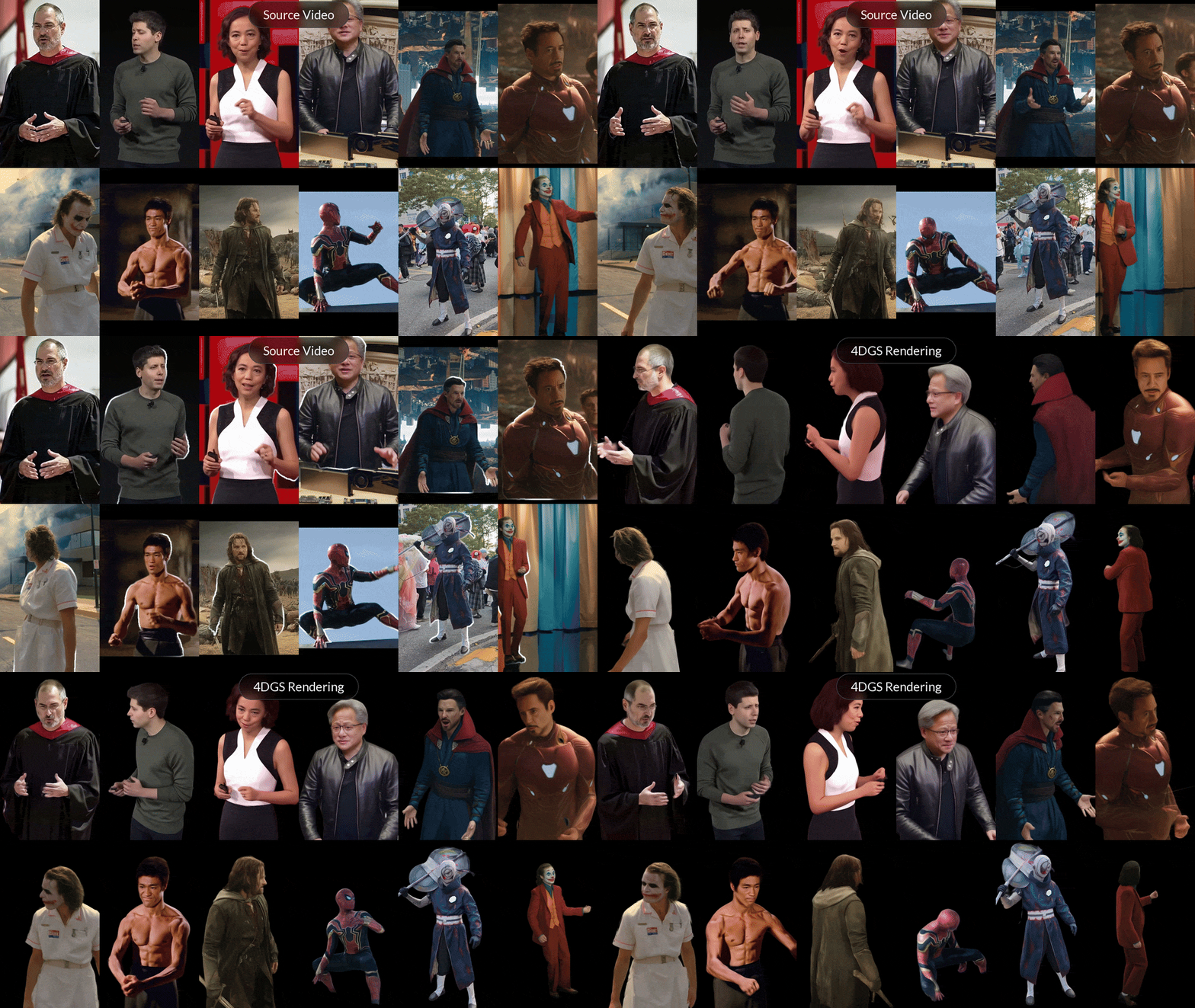
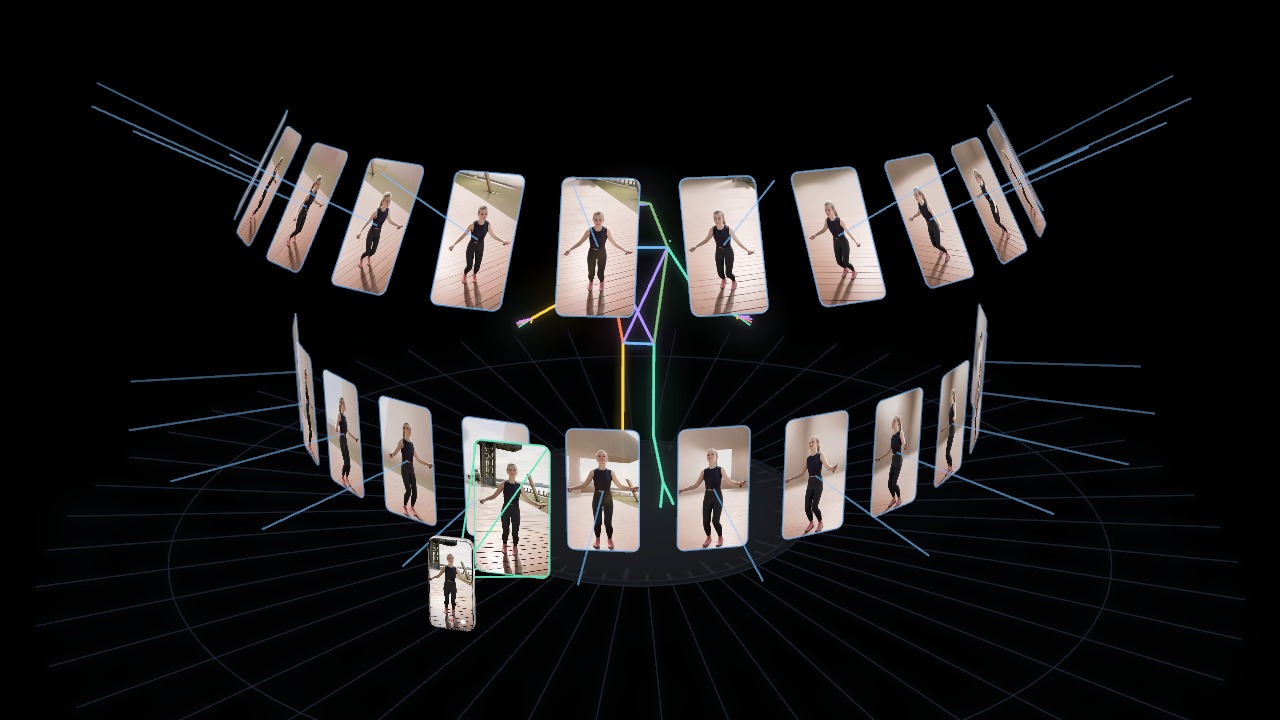
4DAnyone turns a casual monocular video into multi-view videos, enabling downstream 4DGS reconstruction.
> [!note]
> 4DAnyone is a multi-view video model that:
>
> - generates dozens of synchronized, view-consistent videos from a single monocular video.
> - requires **22 GB** of peak CUDA memory, enabling inference on consumer GPUs.
> - generates a 121-frame video in **27 seconds** on a single RTX 4090.
## News
- **2026-09-05**: Reduced peak GPU memory below **24 GB**, enabling inference on consumer GPUs (RTX 4090).
- **2026-09-02**: Released **4DAnyone-Turbo**, achieving a **5.58×** denoising speedup over 4DAnyone-Base.
- **2026-08-28**: Achieved a **1.42×** end-to-end speedup for the complete 24-view generation pipeline.
- **2026-08-28**: Reduced peak GPU memory below **32 GB** while slightly improving speed.
## Installation
```bash
git clone https://github.com/ant-research/4DAnyone.git
cd 4DAnyone
git submodule update --init third_party/GVHMR
conda create -n 4danyone python=3.11 -y
conda activate 4danyone
pip install -r requirements.txt
```
For faster inference, optionally install [FlashAttention-3](https://github.com/Dao-AILab/flash-attention/tree/main/hopper) or [SageAttention](https://github.com/thu-ml/SageAttention). The installed backend is enabled automatically.
Missing models and examples are downloaded automatically on first use. You can also download them manually:
```bash
python scripts/download_smplx.py
python scripts/download_model.py
python scripts/download_example.py
```
## Inference
This repository provides two models: **4DAnyone-Base** with the standard denoising schedule and the distilled **4DAnyone-Turbo** for faster four-step denoising. 4DAnyone-Turbo is enabled by default for faster inference while maintaining generation quality comparable to 4DAnyone-Base. See [Inference performance](docs/inference_performance.md) for GPU memory, inference speed, and generation quality benchmarks.
4DAnyone supports flexible target-view counts, pitch layers, and yaw coverage. Here are several common camera configurations:
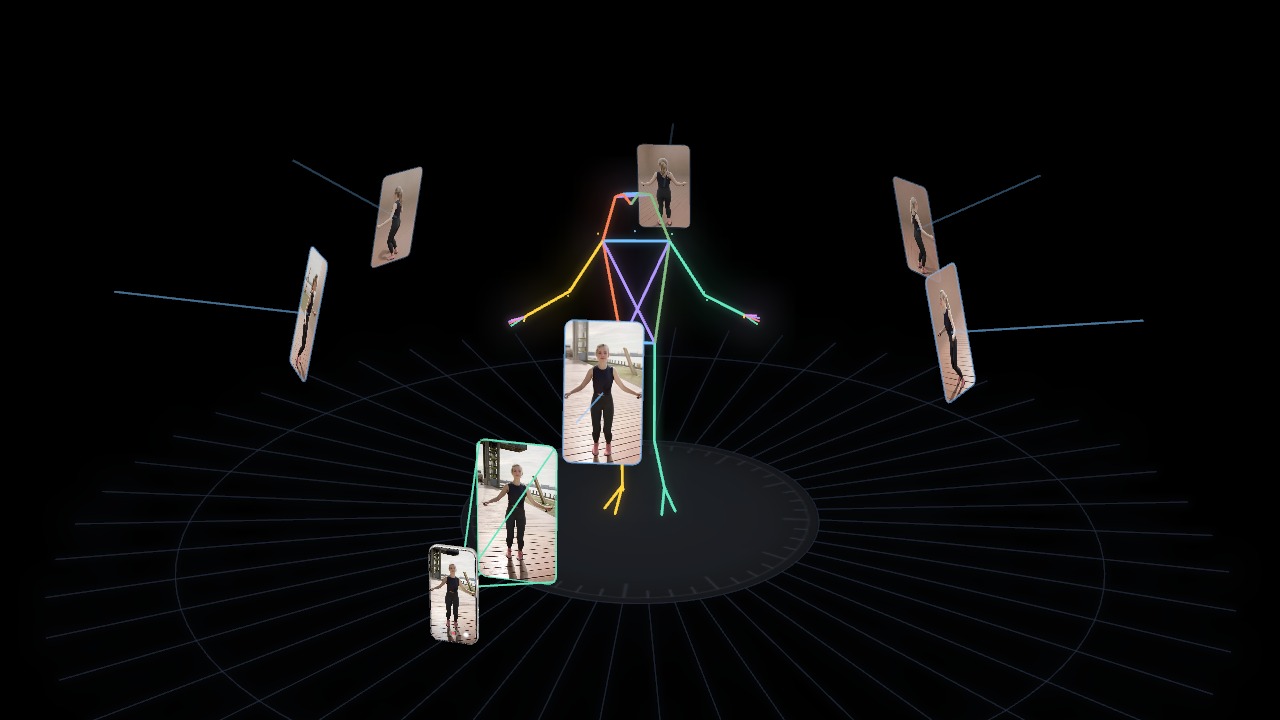
### 6-View Full Orbit
A compact 360° layout for basic coverage. Start here for an initial test.
```bash
python inference.py \
--video_path "data/source/pexels/2785536-uhd_2160_3840_25fps.mp4" \
--views_per_layer 6
```
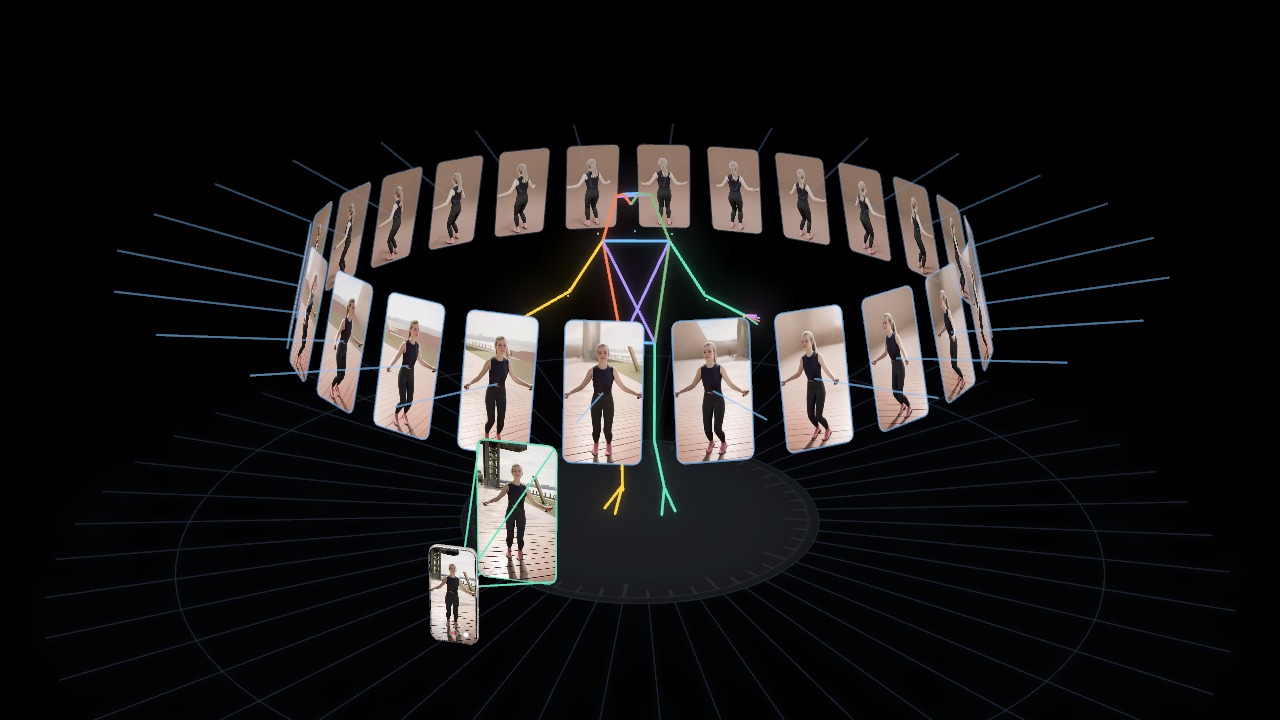
### 24-View Full Orbit
A dense 360° layout with broad angular coverage, suitable for 4DGS reconstruction.
```bash
python inference.py \
--video_path "data/source/pexels/2785536-uhd_2160_3840_25fps.mp4" \
--views_per_layer 24
```
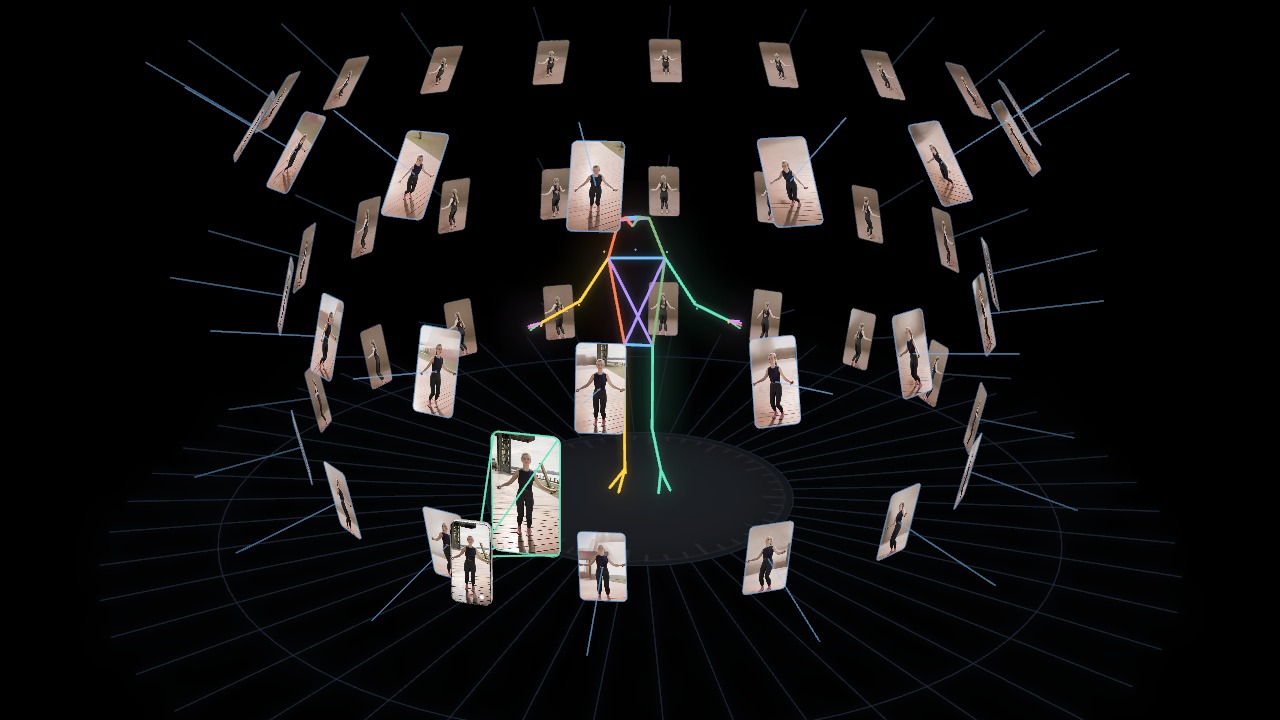
### 48-View Full Orbit, Three Pitch Layers
This layout distributes views across three pitch rings for broader coverage, enabling free-viewpoint 4DGS rendering.
```bash
python inference.py \
--video_path "data/source/pexels/2785536-uhd_2160_3840_25fps.mp4" \
--views_per_layer 16 --layer_pitches '[-10,15,35]'
```
### 24-View Frontal Arc, Two Pitch Layers
A two-layer layout for dense coverage across the frontal 180° arc.
```bash
python inference.py \
--video_path "data/source/pexels/2785536-uhd_2160_3840_25fps.mp4" \
--views_per_layer 12 --layer_pitches '[0,30]' --start_yaw -90 --yaw_span 180
```
### Key Arguments
Run `python inference.py --help` for the full list.
- `views_per_layer`: number of evenly spaced views per pitch layer. It must be divisible by 4 or 6.
- `layer_pitches`: pitch angles in degrees, one per layer. Positive values place cameras above the subject. Total views are `views_per_layer × len(layer_pitches)`.
- `start_yaw`: horizontal angle of the first view, in degrees. Yaw `0` is the front view.
- `yaw_span`: horizontal range covered by each camera layer, in degrees.
- `gpu_ids`: GPU IDs used for parallel pose/VAE view stages and target denoising. Defaults to all visible GPUs.
- `enable_turbo`: whether to use 4DAnyone-Turbo. Enabled by default.
### Output
With the default `--data_dir data`, results follow this layout. See the [output documentation](docs/output.md) for the complete format.
```text
data/
├── gvhmr/results// # reusable motion-recovery result
└── fdanyone//
├── metadata.json # run settings, timings, resources
├── cameras.json # the final N-camera rig
├── skeletons/00.mp4 ... .mp4
└── videos/
├── sparse/{00,04,09,12,14,19}.mp4 # default 24-view RCP proposals
└── dense/00.mp4 ... .mp4 # generated target views
```
### Custom Data
Use an input video with:
- a single person in a full-body or upper-body shot.
- no large camera movements, clear footage.
- 1080p or higher, 9:16 portrait aspect ratio, at least 121 frames.
## 3DGS Reconstruction
See the [nerfstudio guide](docs/nerfstudio.md) for details.
## Roadmap
### Peak Memory Optimization
- [x] Reduce peak GPU memory below 32 GB.
- [x] Further reduce peak GPU memory below 24 GB.
### Inference Acceleration
- [x] Optimize inference speed through multi-GPU parallelism.
- [x] Accelerate inference via few-step model distillation.
### Reconstruction
- [x] Support 3DGS reconstruction with nerfstudio.
- [ ] Support 4DGS reconstruction with an open-source method.
## Citation
If you find 4DAnyone useful or interesting, please cite our work and consider giving the repository a star ⭐:
```bibtex
@article{jin2026fdanyone,
title={4DAnyone: Create Anyone in 4D from a Casual Monocular Video},
author={Jin, Yudong and Xie, Tao and Zhang, Qihang and Shen, Zehong and Xu, Zhen and Shen, Yujun and Bao, Hujun and Zhou, Xiaowei and Xu, Yinghao},
journal={arXiv preprint arXiv:2608.20335},
year={2026},
url={https://arxiv.org/abs/2608.20335}
}
```