---
published: true
layout: post
title: Innovation At Intersection of the IDE, OpenAPI Editor, and Governance Rule
tags:
- IDE
- OpenAPI
- Editor
- Governance
image: >-
https://kinlane-productions2.s3.us-east-1.amazonaws.com/apimatic/vscode/extension.png
---
As I continue my exploration of where and how we should be editing our OpenAPIs while also applying governance rules, I would be neglectful not to showcase the innovation coming out of [APIMATIC](https://bit.ly/3NyONos) at the intersection of editing our OpenAPI and applying API governance rules, but this is focused on what happens in our IDE, specifically in VSCode. APIMATIC has made a significant investment in equipping developers with what they need at their fingertips where they already work—-which is a critical aspect of how all of this works.
When you install the [APIMATIC VSCode extension](https://marketplace.visualstudio.com/items?itemName=apimatic-developers.apimatic-for-vscode) they inject an icon onto your left-hand navigation which gives you a handful of panes that provide you with a new lens on your folder or repository, but specifically on any OpenAPI file that you have living in your workspace—-giving you new governance super powers where developers are already working.
## Session
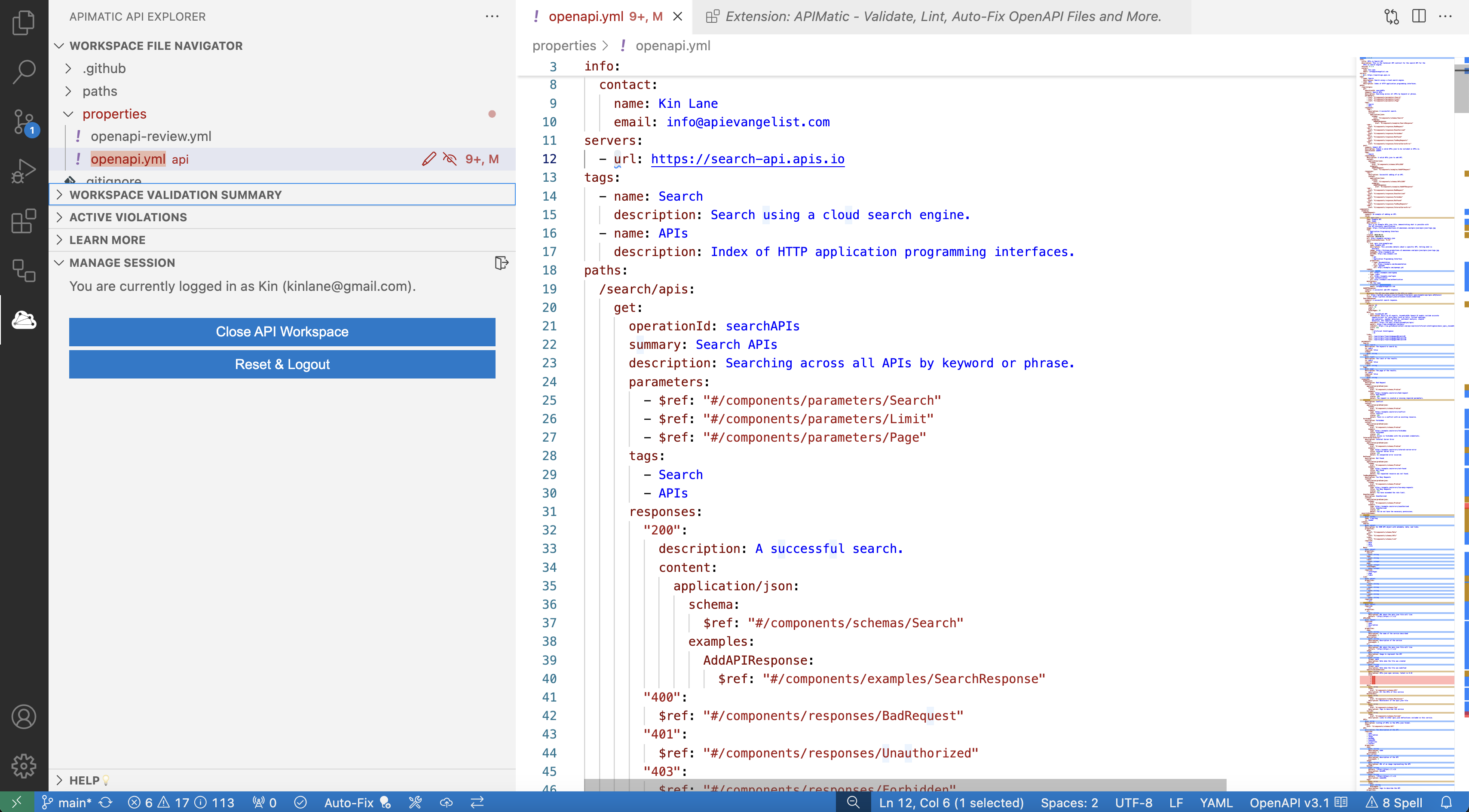
Your workspace is linked up with your APIMATIC account and you can manage your session accordingly from within the IDE, augmenting your local work with the power of the APIMATIC platform.
 ## Workspace
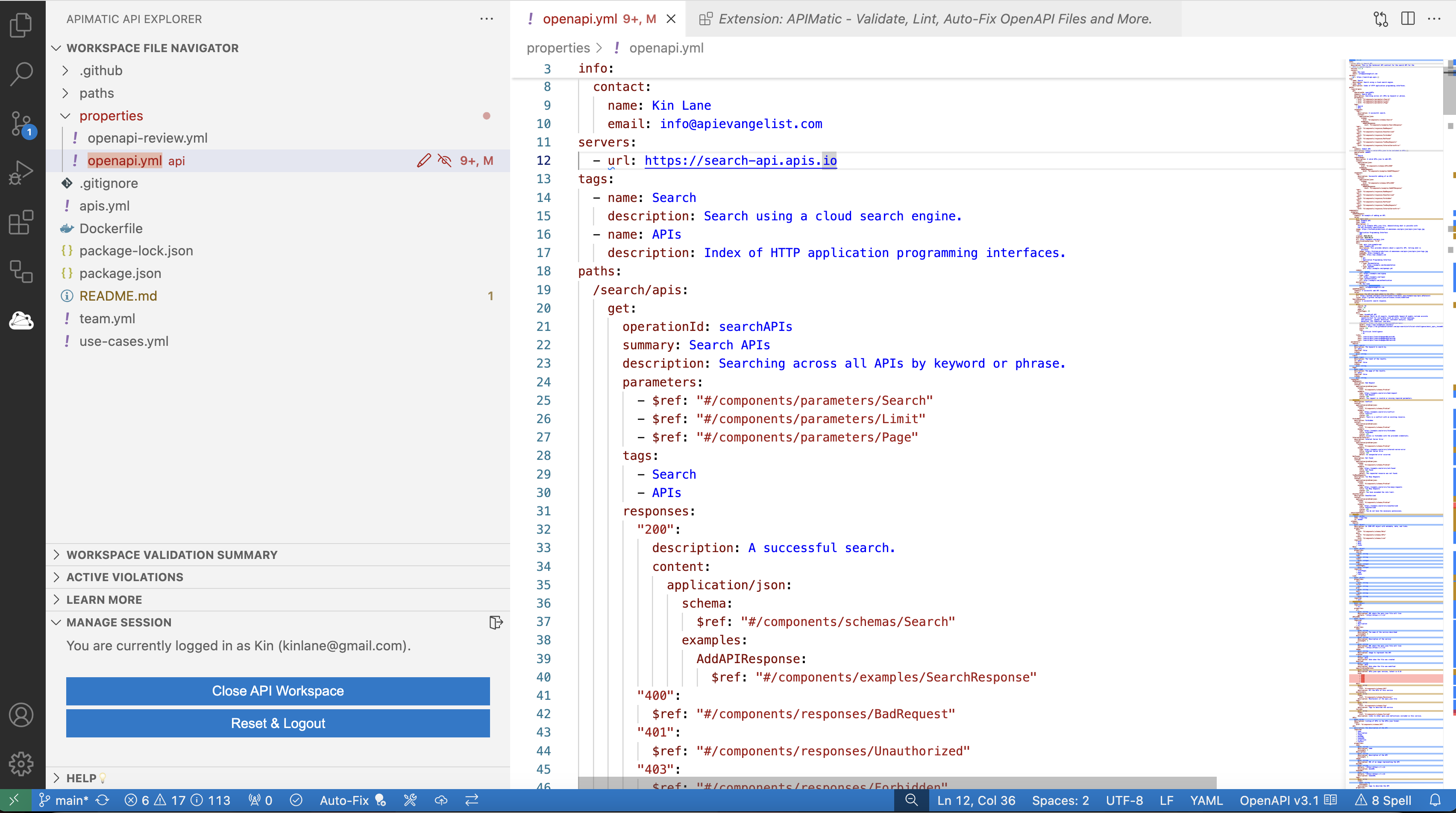
APIMATIC gives me a whole new workspace in my VSCode for viewing and working on my APIs, highlighting and bringing my attention to any OpenAPI that exist within the project I have open, overlaying VSCode with new capabilities that help me along the way.
## Workspace
APIMATIC gives me a whole new workspace in my VSCode for viewing and working on my APIs, highlighting and bringing my attention to any OpenAPI that exist within the project I have open, overlaying VSCode with new capabilities that help me along the way.
 ## Summary
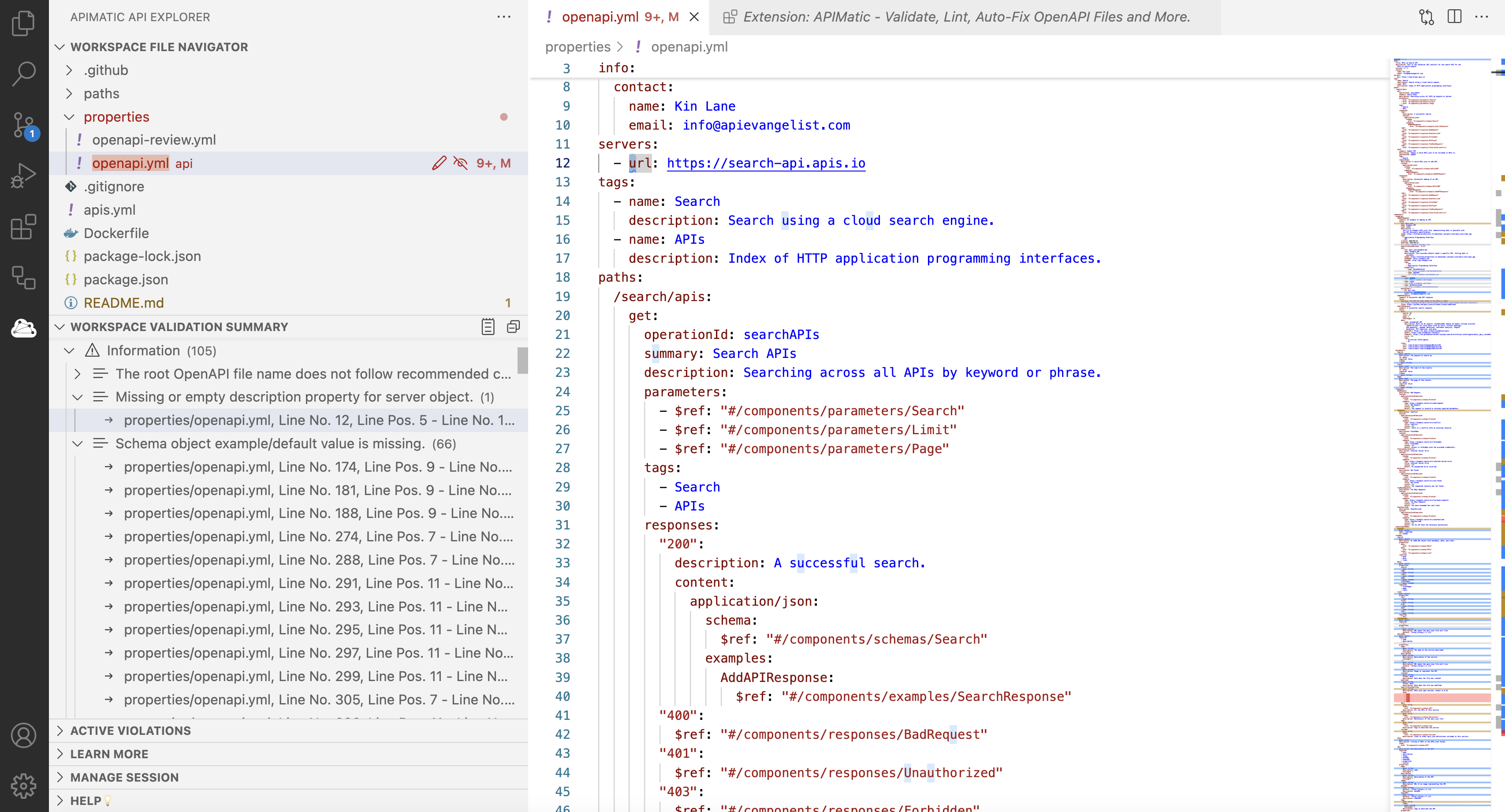
Once lit up, my summary pane does all the validation of my OpenAPI, giving me a score, the total number of issues encountered and breaks them up by severity and what I am going to need for generating code and documentation—providing me with everything I need to move forward.
## Summary
Once lit up, my summary pane does all the validation of my OpenAPI, giving me a score, the total number of issues encountered and breaks them up by severity and what I am going to need for generating code and documentation—providing me with everything I need to move forward.
 ## Violations
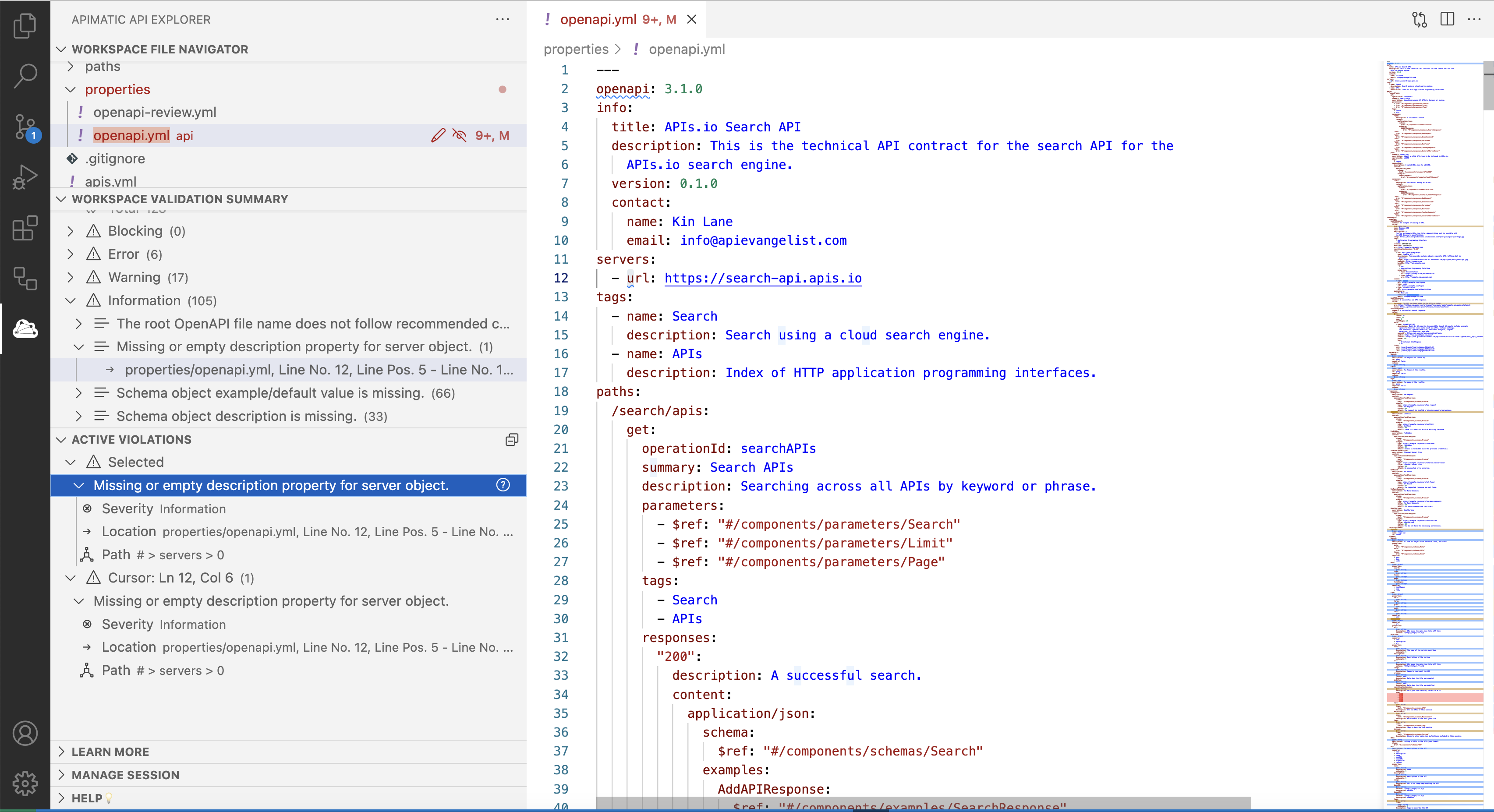
Next, the violations pane allows me to select any of the issues encountered and drill down to do the work to fix and understand what is happening, and giving me all the technical detail, as well as single click access to the line in the OpenAPI where the problem occurred.
## Violations
Next, the violations pane allows me to select any of the issues encountered and drill down to do the work to fix and understand what is happening, and giving me all the technical detail, as well as single click access to the line in the OpenAPI where the problem occurred.
 ## Learn More
What really warms my heart is the ability to click on a question mark next to anything I encountered, and the learning pane lights up more detail on the issue, tips on how I can fix it, as well as help links, as well as unique identifiers for the rule that I encountered.
## Learn More
What really warms my heart is the ability to click on a question mark next to anything I encountered, and the learning pane lights up more detail on the issue, tips on how I can fix it, as well as help links, as well as unique identifiers for the rule that I encountered.
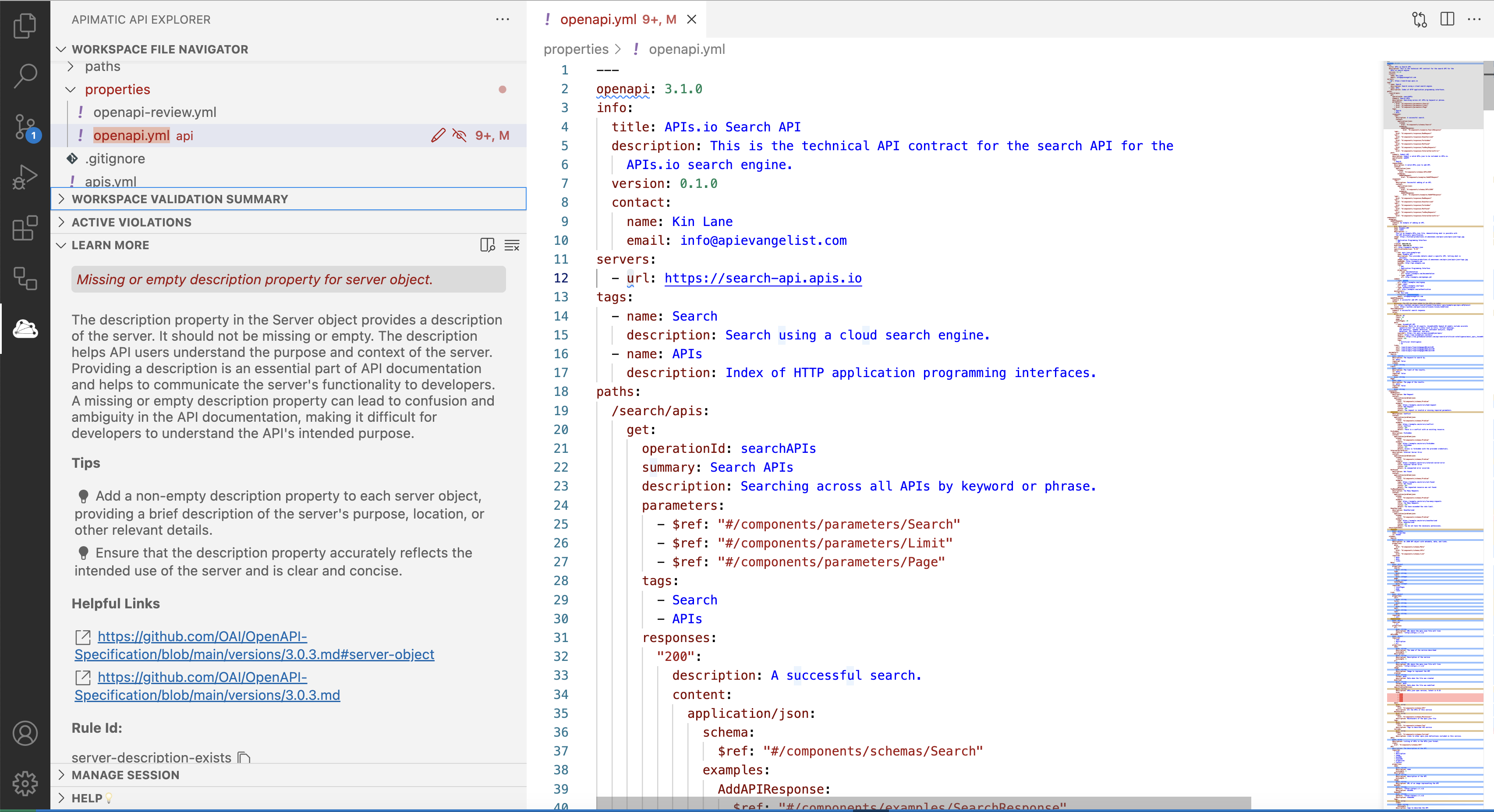 The injection of education in the governance process like APIMATIC has done is a huge part of this—helping educate teams in motion, accommodating for the fact that most people do not read the docs. However, APIMATIC goes one step further and provides me with auto fix capabilities as part of the overall toolbar for applying governance in my workspace.
 APIMATIC’s approach to governance in the IDE is the most advanced I’ve seen so far. They take rules to that next level and more importantly to where developers already work, rather than forcing them to the cloud. I’d say my only critique on it is that it is BUSY. There is a lot going on, and it took a good hour before my brain would settle down and understand what was happening between the panes—-it is advanced stuff, but it makes a lot of sense once it comes into focus and you align with the work you are already doing.
Most API governance service providers are focused on all roads leading to the cloud, but APIMATIC has done a commendable job of balancing the two. Leveraging the power of APIMATIC in the cloud with the power of VSCode locally, while acknowledging the importance of Git. This is a line I will talk more about in future stories about how I think that API service providers can deliver industrial-grade solutions that are accessible and usable, while still making money. I would add that the API governance experience provided by APIMATIC’s tool squarely focuses on two areas of API experience, 1) Documentation and 2) SDK Generation—-which are the two most important reasons why enterprises are governing their APIs in 2024.
APIMATIC’s approach to governance in the IDE is the most advanced I’ve seen so far. They take rules to that next level and more importantly to where developers already work, rather than forcing them to the cloud. I’d say my only critique on it is that it is BUSY. There is a lot going on, and it took a good hour before my brain would settle down and understand what was happening between the panes—-it is advanced stuff, but it makes a lot of sense once it comes into focus and you align with the work you are already doing.
Most API governance service providers are focused on all roads leading to the cloud, but APIMATIC has done a commendable job of balancing the two. Leveraging the power of APIMATIC in the cloud with the power of VSCode locally, while acknowledging the importance of Git. This is a line I will talk more about in future stories about how I think that API service providers can deliver industrial-grade solutions that are accessible and usable, while still making money. I would add that the API governance experience provided by APIMATIC’s tool squarely focuses on two areas of API experience, 1) Documentation and 2) SDK Generation—-which are the two most important reasons why enterprises are governing their APIs in 2024.