The fullstack framework for the Agentic Web.
One component, two faces: a live view for humans, typed MCP tools & resources for AI agents — generated from the same definition, so they can never drift.
> [!WARNING]
> Janux is currently **under active development**. This repository is public to enable collaboration and transparency, but it has not been officially announced yet. Expect breaking changes, incomplete documentation, and unfinished features until the first public release.
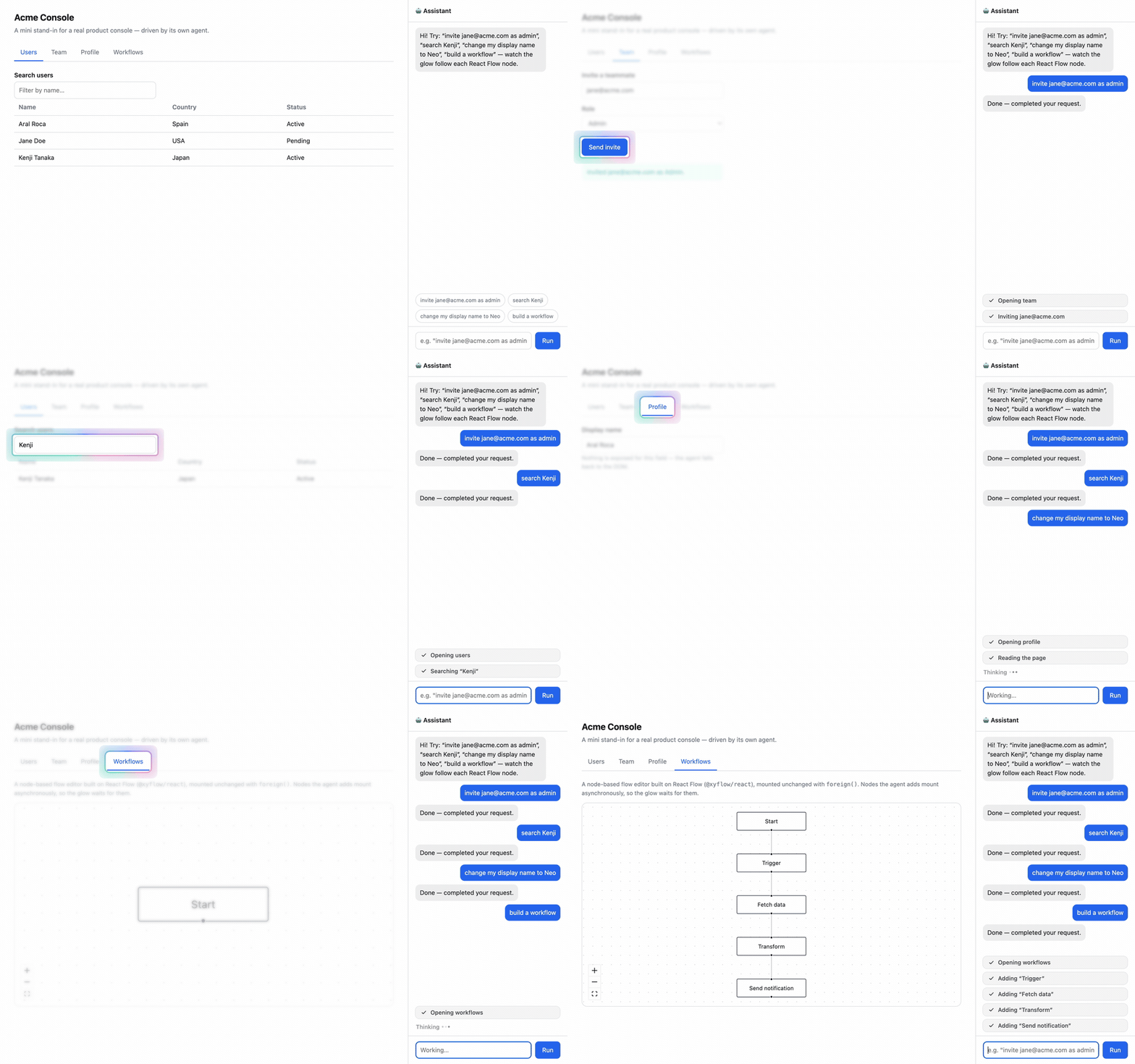
examples/with-web-agent — the agent calls the same intents a human clicks, and createCopilot({ visualize }) is the whole of the feedback: a chip per tool call, a gradient ring on the element being operated, and a backdrop veil that keeps the user's focus on the action.
---
## Why Janux
The web is growing a second audience. People still click, but agents now read, plan and act on the same pages — through MCP clients, through browser agents, through copilots embedded in your own product. **The Agentic Web is the web both of them can operate**, and it is being standardized in the open: MCP for tools over HTTP, WebMCP for tools in the browser, `llms.txt` for discovery, Web Bot Auth for identity.
Today, making an app agent-operable means building it twice. The UI already holds the logic — the validation, the permissions, the business rules — and then a second, hand-written integration re-declares a fraction of it as tools. Two artifacts, one source of truth, and the gap between them grows with every sprint. Tools drift, guardrails are ad-hoc, and nobody can say exactly what an agent is allowed to do.
Janux removes the second artifact. **A component is simultaneously a view, an agent-readable resource and a set of typed tools** — one definition, projected three ways by the framework. A human click and an agent tool call enter the *same* pipeline: guard check → schema validation → `run()` → audit entry. The contract can't rot, because it is generated from the code that renders.
Named after **Janus**, the two-faced Roman god of doorways: one face toward the human, one toward the agent, one threshold. Designed in [RFC 0001](https://github.com/aralroca/Janux/issues/1).
## Table of Contents
- [Install](#install)
- [Quick start](#quick-start)
- [One component, three projections](#one-component-three-projections)
- [Two agent surfaces, zero integration](#two-agent-surfaces-zero-integration)
- [Humans stay in the loop](#humans-stay-in-the-loop)
- [Highlights](#highlights)
- [How it works](#how-it-works)
- [Performance](#performance)
- [Packages](#packages)
- [Documentation](#documentation)
- [Benchmarks](#benchmarks)
- [Templates](#templates)
- [Examples](#examples)
- [Develop](#develop)
- [Contributing](#contributing)
- [Releases](#releases)
- [License](#license)
## Install
```bash
bunx create-janux my-app
cd my-app && bun install && bun run dev
```
Requires [Bun](https://bun.sh) ≥ 1.3 for the dev server and the build. Production is a choice: Bun, [Node 24+](https://janux.build/docs/recipes/deploying) via `@janux/node`, Vercel, or a static export — same app, one adapter.
Or add the pieces to an existing workspace:
```bash
bun add janux @janux/server @janux/agent @janux/cli
```
## Quick start
```tsx
import { component, intent, schema, str, int, money, list } from 'janux';
import { pay } from './pay.api';
// UI component + 2 WebMCP tools (intents), grouped together for maintainability
export const Cart = component({
name: 'cart',
description: 'Shopping cart with line items.',
state: schema({ items: list({ productId: str(), qty: int().min(1), unitPrice: money() }) }),
derived: { total: (s) => s.items.reduce((a, i) => a + i.qty * i.unitPrice, 0) },
intents: {
addItem: intent({
description: 'Add a product to the cart',
input: schema({ productId: str(), qty: int().default(1), unitPrice: money().default(0) }),
run: ({ state, input }) => state.items.push(input),
}),
checkout: intent({ description: 'Pay for the cart', guard: 'confirm', run: ({ state }) => pay({ items: state.items }) }),
},
view: ({ state, derived, intents }) => (
{state.items.map((i) => (
{i.productId} × {i.qty}
))}
),
});
```
You wrote a shopping cart. You also shipped an agent surface — generated, no second file:
```json
{
"resources": ["ui://cart"],
"tools": [
{ "name": "cart.addItem", "description": "Add a product to the cart", "guard": "auto" },
{ "name": "cart.checkout", "description": "Pay for the cart", "guard": "confirm" }
]
}
```
## One component, three projections
| Projection | For | What it is |
|---|---|---|
| **View** | humans | server-rendered HTML that resumes on first interaction |
| **Resource** | agents | `ui://cart` — typed JSON state, readable and subscribable |
| **Tools** | both | `cart.addItem` (auto), `cart.checkout` (**confirm** → a human approves) |
They cannot drift: there is one definition, and the framework derives the other two. A human click and an agent tool call run the **exact same pipeline** — guard check → schema validation → `run()` → audit entry.
## Two agent surfaces, zero integration
Every Janux app speaks the Agentic Web's protocols out of the box. You declare no tools twice, and you write no adapters.
| Standard | What Janux does with it |
|---|---|
| **MCP** — tools over HTTP | A real, stateless MCP server at `/_janux/mcp`, generated from your `api()` functions. Dual-era: negotiates `2026-07-28` and `2025-06-18`. |
| **A2A** — agent to agent | A derived `/.well-known/agent-card.json` and a JSON-RPC endpoint at `/_janux/a2a`, over the same pipeline and the same guards as MCP — so an agent that arrives by A2A holds no authority an MCP client would be refused. |
| **WebMCP** — tools in the browser | Every mounted intent is registered with `document.modelContext` the moment its island mounts, so browser agents and the DevTools panel see it. Polyfilled where the API is missing. |
| **`llms.txt`** — discovery | Opt-in site index at `/llms.txt` (dynamic routes expanded via `staticParams`), plus a Markdown projection of every page by appending `.md`. |
| **Web Bot Auth** (RFC 9421) | Signed agent identity, verified per request under an `observe` or `require` policy. |
| **Human approval** | `guard: 'confirm'` reaches MCP clients as `annotations.requiresApproval`, arrives over A2A as `TASK_STATE_INPUT_REQUIRED`, and parks agent calls as Proposals whichever door they came through. |
Pointing Claude, Cursor or any MCP client at your app is a URL, not an integration project:
```bash
claude mcp add --transport http my-app https://your.app/_janux/mcp
```
## Humans stay in the loop
Guards are a language feature, not a convention. Every `intent` and every `api()` declares who may call it:
- **`auto`** — agents call it directly.
- **`confirm`** — a human click runs it; an *agent* call parks as a **Proposal** that a person approves or rejects on the real UI, executing exactly once.
- **`forbidden`** — never exposed as a tool. The agent falls back to the DOM, under the same permissions as a user.
Every invocation records its **origin** (`human` / `agent`) in an audit trail, and `janux verify` fails the build if an agent-reachable tool ships without a description. See `examples/human-in-the-loop` in the table below.
## Highlights
- 🧿 **One definition, three projections.** The mounted tree *is* the MCP tree — UI and agent surface cannot drift.
- 🪶 **0 KB JS static pages.** Components without state compile to plain HTML; a page with no islands ships no `