SchemaBrain — the trust and intelligence layer between AI agents and your database

Stop giving AI agents raw database connection strings.

Give them SchemaBrain instead — a read-only trust and intelligence layer where the agent never writes SQL, PII is refused before the query runs, and every call lands in a tamper-evident audit log.

CI PyPI version PyPI downloads Python 3.11 | 3.12 License: Apache 2.0 MCP compatible

Works with Claude Desktop · Claude Code · Cursor · Windsurf · any MCP host

SchemaBrain compiles every query from definitions you control — no path from a prompt to raw SQL at your database. Three guarantees that close the trust gap between AI agents and your database: - **[Read-only by architecture](#1-read-only-by-architecture-not-configuration)** — twelve MCP tools, none of which can write. No `execute()` tool, no `query()` tool, no path from agent prompt to a write at your database. - **[PII-aware refusal at retrieval](#2-pii-aware-refusal-at-the-get_metric-tool-boundary)** — PII tags propagate from the physical schema through joins and metrics. If a query touches a blocked category, SchemaBrain refuses before the database is queried. - **[Cryptographic audit chain](#3-tamper-evident-audit-log)** — every call, refusal, and recovery is recorded in a SHA256-hashed append-only log (best-effort: a disk-full or no-writer configuration logs a warning and continues rather than failing the query). `audit verify` exits non-zero if any past row was rewritten. **See it in action** — ask for something the schema can't answer, and it refuses instead of fabricating a join: > **You:** *compute usage volume by plan tier* > > **SchemaBrain → agent:** `{ "kind": "unreachable_entity", "recovery": { "suggested_tool": "resolve_join" } }` — there's no `plan_id` on usage events, so it won't invent one. > > **Claude:** I can't fake that join — here's **contracted revenue by plan tier** instead, which actually resolves. ✓ → [Full session, with the SQL and results](#sample-session) **Watch it run** — a live Postgres schema becomes a governed knowledge graph, the firewall computes the safe metric and refuses the leaks, and every call lands in a tamper-evident audit log. No agent, no API key:

SchemaBrain command-line walkthrough: indexing a live Postgres schema, applying the curated semantic layer of entities, joins, and metrics, then the firewall computing a safe revenue metric, refusing PII and credential leaks, recovering an unreachable join, and the operator inspecting definitions and verifying a tamper-evident audit log.

--- ```bash uvx schemabrain init # then: Cmd+Q Claude Desktop, relaunch, and ask: "list the entities SchemaBrain knows about" # prefer a persistent install? pipx install schemabrain (or) pip install schemabrain ``` **Cost:** **$0** to run the bundled demo (pre-curated pack, no API key) · ~$0.03 to LLM-index a fresh 84-column schema · **$0** to re-index unchanged schemas. Detail in [Sample session](#sample-session). **Status: 0.6.0 (beta).** Postgres supported today (the local store itself is SQLite). SQLite / Snowflake / BigQuery / MySQL source connectors on the roadmap. --- ## Contents **Read next based on what you need:** | Goal | Where to go | |---|---| | Try it on the bundled fixture | [Quickstart](#quickstart) | | Understand the safety guarantees | [Safety guarantees](#safety-guarantees) | | Wire up your MCP client | [Claude Desktop](docs/setup/claude-desktop.md) · [Claude Code](docs/setup/claude-code.md) · [Cursor](docs/setup/cursor.md) · [Windsurf](docs/setup/windsurf.md) · [Cline](docs/setup/cline.md) · [ChatGPT (roadmap)](docs/setup/chatgpt.md) | | Plug into your own agent loop | [`docs/setup/manual.md`](docs/setup/manual.md#3-wire-your-own-agent-anthropic-sdk) | | Build a semantic layer | [`docs/semantic-layer.md`](docs/semantic-layer.md) | | Run in production (audit, drift, Docker) | [`docs/operations.md`](docs/operations.md) | | Observe the agent (tail, audit log, OTel) | [`docs/observability.md`](docs/observability.md) | | Compare with Querybear / Anthropic reference Postgres MCP | [vs Querybear](docs/compare/querybear.mdx) · [vs Anthropic reference](docs/compare/anthropic-postgres-mcp.mdx) | | Compare with Vanna / Atlan / dbt-mcp / WrenAI | [`docs/landscape.md`](docs/landscape.md) | --- ## Quickstart > **Just want to see what it does?** `uvx schemabrain demo` — one command, zero prompts. Builds the sample SaaS layer, then lets you open the dashboard or run a terminal firewall showcase. **No API key, and no Docker** for the dashboard / showcase paths. The steps below are for wiring SchemaBrain into your own agent against your own database. Three steps from `uvx schemabrain init` to a working Claude Desktop integration. If you paste your own Postgres URL — no Docker needed, ~30s. Press Enter for the bundled demo and `init` invokes Docker + downloads a ~67 MB embedding model first time; ~45s once cached. ### 1. Install ```bash uvx schemabrain init # zero-install: runs the wizard in one shot # or install persistently first: pipx install schemabrain # (or) pip install schemabrain schemabrain --version ``` Source install (`git clone` + [`uv`](https://docs.astral.sh/uv/) `sync --extra dev`) is documented in [`docs/setup.md`](docs/setup.md#1-install--run-the-wizard). ### 2. Run the activation wizard ```bash schemabrain init ``` `init` is a seven-stage wizard that takes you from "I have a Postgres database" to "Claude Desktop can answer questions about it" in one command. On first run it prompts for what it needs: - **A Postgres URL** — paste your own connection string, or press **Enter** to spin up a local demo Postgres container with the bundled SaaS fixture (Docker is invoked automatically; idempotent on re-runs). - **An `ANTHROPIC_API_KEY`** — optional. Skip and the wizard still wires Claude Desktop. On the **demo path**, entities + metrics + joins are pre-curated from a bundled YAML pack — the semantic layer works zero-config. On **your own database**, entity curation can run later via `schemabrain entities suggest --apply` once you have a key. ``` SchemaBrain init — activation wizard [1/7] Source check ✓ source reachable + read-only [2/7] Index schema ✓ 12 tables, 84 columns indexed [3/7] Curate entities ✓ 12 entities applied (bundled demo pack) [4/7] Curate metrics ✓ 5 metrics applied (bundled demo pack) [5/7] Curate joins ✓ 11 canonical joins applied (bundled demo pack) [6/7] Wire host ✓ wrote schemabrain entry to claude_desktop_config.json (default; switch with --host claude-code|cursor|windsurf|manual) [7/7] Next ✓ restart your MCP host, then ask: "list the entities SchemaBrain knows about" ``` Full wizard reference (stages explained, flags, dbt auto-detection, `--print-only` for non-Claude-Desktop hosts, `--no-entities` / `--no-metrics` / `--no-joins` opt-outs, cost-cap pauses): [`docs/setup.md`](docs/setup.md#2-what-the-wizard-does). ### 3. Restart Claude Desktop and ask 1. Quit Claude Desktop fully — **Cmd+Q**, not just close the window. The MCP config is only read on cold start. 2. Relaunch. 3. New conversation: > list the entities SchemaBrain knows about If Claude calls `list_entities` and reports `user`, `order`, etc., you're done. If not, see [Troubleshooting](#troubleshooting). After the wizard, `schemabrain inspect` shows what the agent has and `schemabrain tail` streams every tool call live — see [`docs/operations.md`](docs/operations.md). ### Your project files `init` writes just `./schemabrain.db` (the local store — gitignore it) plus your host config. To tune the **PII policy** and **semantic layer** as editable YAML, re-run with `--emit-yaml-dir`: ```bash schemabrain init --url-env DATABASE_URL --emit-yaml-dir ./schemabrain # → ./schemabrain/pii_policy.yaml + entities/ + metrics/ + joins/ ``` Edit a file, `schemabrain apply ./schemabrain`, `schemabrain check` to validate, restart `serve`. There is no `schemabrain.yaml` — config is CLI flags + `SCHEMABRAIN_*` env vars (auto-loaded from `.env`) + that YAML tree. Full map: [**Your project**](docs/your-project.md). --- ## Safety guarantees

SchemaBrain architecture: agent talks to SchemaBrain over MCP stdio (12 read-only tools); SchemaBrain emits parameterized SQL to Postgres; the SchemaBrain boundary is the trust boundary; audit log is tamper-evident.

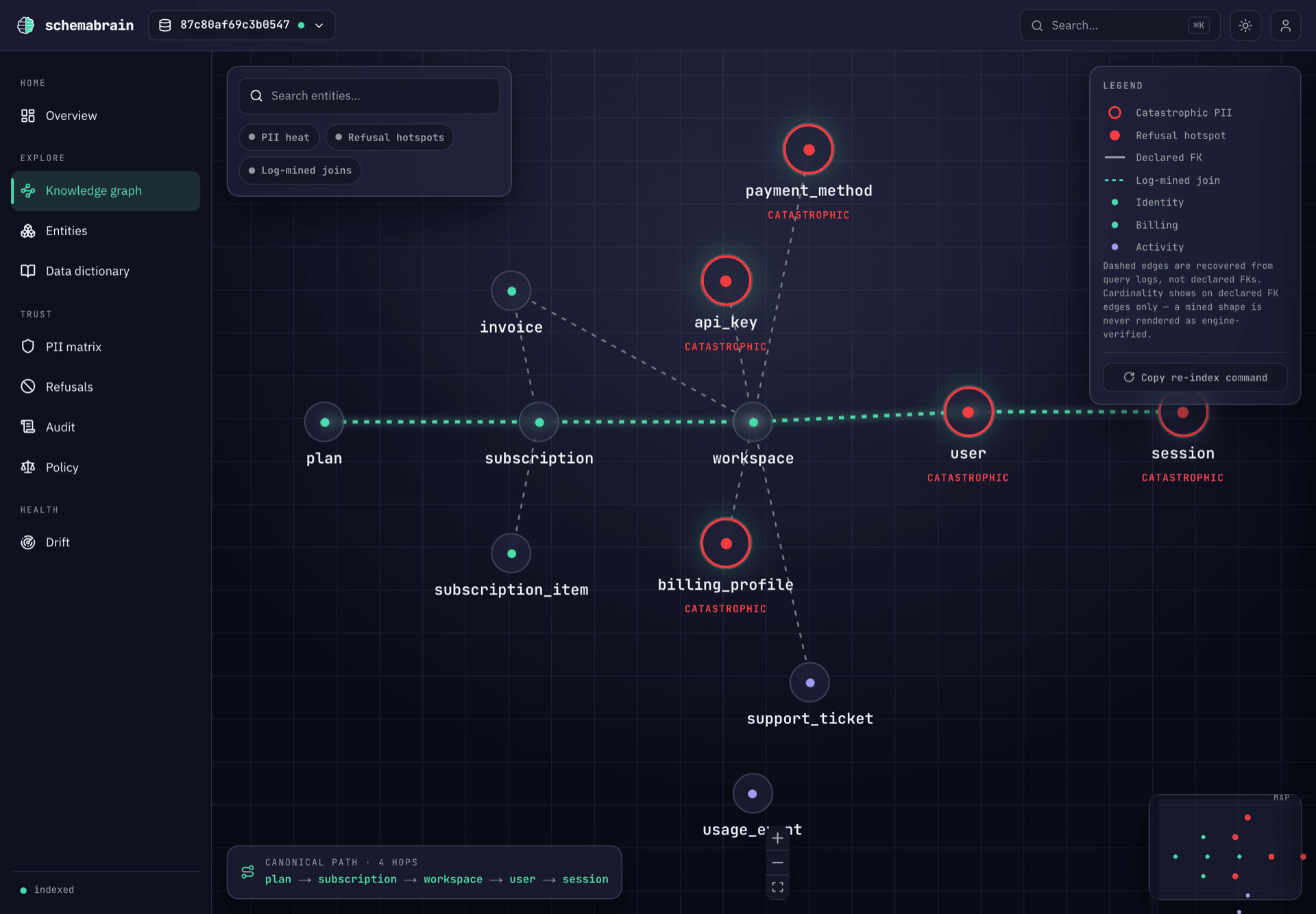
Six properties SchemaBrain enforces at the SQL boundary today: ### 1. Read-only by architecture, not configuration The MCP surface exposes twelve tools — **none of which can write**. No `execute()`, no `query()`, no path from agent prompt to a write at your database, regardless of session state — the guarantee is structural, not a flag the agent can flip. `schemabrain serve` also pins `default_transaction_read_only=on` as belt-and-suspenders. [Read-only by architecture →](docs/mechanism/read-only.mdx) ### 2. PII-aware refusal at the `get_metric` tool boundary Any `get_metric` touching a blocked PII category returns a `refused` envelope — the compiled SQL never runs and the refusal lands in `mcp_audit`. `describe_entity` enforces the same at the column level (blocked columns ship `redacted=True`). `init` blocks the catastrophic-leak set by default (`credential,payment_card,government_id`); `--pii-block` **replaces** the set, so widen by listing the full target. Detection is column-name pattern matching across twelve GDPR / CCPA / HIPAA / PCI categories; content-aware classification is on the roadmap. [PII taxonomy & propagation →](docs/mechanism/pii-taxonomy.mdx) ### 3. Tamper-evident audit log Every tool call writes one row to an append-only `mcp_audit` table — PII categories, content-addressable fingerprints, sha256 hash chain. `audit verify` re-walks the chain and exits non-zero if any past row was rewritten. ```bash schemabrain audit verify # exit 0 = chain clean ``` [Tamper-evident audit chain →](docs/mechanism/audit-chain.mdx) ### 4. Failure is a contract, not a string Every non-success call — refused, error, or degraded — returns a structured `recovery.suggested_args` block, not a message to parse. PII blocks (`status: "refused"`) ship the entity to retry; ambiguous dimensions and unreachable entities (`status: "error"`) ship the candidate to pick or the next tool to call. Only policy refusals are `refused`; "I won't guess" is `error` with a recovery payload. ```json { "status": "error", "kind": "ambiguous_time_dimension", "recovery": { "suggested_tool": "get_metric", "suggested_args": {"time_dimension": "order.placed_at"} } } ``` [Structured recovery →](docs/mechanism/structured-recovery.mdx) ### 5. Compile path: definitions → parameterized SQL Entities, metrics, and canonical joins compile to parameterized SQL SchemaBrain runs on its side. The agent sees rows + the SQL that ran — never arbitrary statements at your database. LLM-suggested definitions during `init` are reviewed and applied explicitly. [Build your semantic layer →](docs/semantic-layer.md) ### 6. Pluggable into any agent loop The same MCP stdio surface Claude Desktop sees is exposed to any MCP host — your own Anthropic, OpenAI, or LangGraph loop included. [`examples/anthropic_demo.py`](examples/anthropic_demo.py) is a ~260-LOC drop-in that wires Claude Haiku 4.5 to `schemabrain serve` and prints exactly which tools the agent chose. [Anthropic SDK walkthrough →](docs/setup/manual.md#3-wire-your-own-agent-anthropic-sdk) --- ## Observability dashboard SchemaBrain ships an opt-in, read-only dashboard over the same audit + PII + refusal data the MCP server is already writing. `schemabrain dashboard` boots a local FastAPI sidecar serving a pre-built static UI — no Node runtime, no network exposure, no write paths. ```bash pip install "schemabrain[ui]" schemabrain dashboard # → http://127.0.0.1:7878 ``` It's a viewer, not a console — no settings, no SQL pad, no write path. **Nine read-only surfaces**, each answering an operator question the MCP envelope alone never surfaces visually. The signature surface is the **Knowledge Graph** — your schema rendered as the same entity-relationship projection the semantic layer compiles joins against: - **Knowledge Graph** (`/graph`) — *how does my schema actually connect?* Entities as nodes, canonical joins as edges (solid for declared FKs, dashed for log-mined), PII-bearing entities flagged, and refusal hotspots highlighted, with declared-FK cardinality shown on the highlighted join path — the schema as a graph, not a table list. - **Overview** (`/overview`) — the home surface: entity / metric / join / catastrophic-PII counts at a glance. - **Entities** (`/entities`) — a sortable index; drill into any entity's columns, PII, metrics, and canonical joins. - **Data Dictionary** (`/dict`) — every table, column, type, PII class, join, and metric, with one-click Markdown export (the same artifact `schemabrain docs` writes). - **PII matrix** (`/pii`) — *which columns carry sensitive data?* A heatmap with one row per classified column and one cell per PII category, each column tagged block / redact / allow by its advisory band. Columns in a catastrophic-leak category (`credential`, `payment_card`, `government_id`) are hard-blocked regardless of policy and pinned to the top — so you catch a `payment_card` column hiding inside `users` before you point an agent at a new schema, and see at a glance what trips the default `--pii-block` policy. Select any row to drill into its entity's columns, metrics, and joins. - **Refusals** (`/refusals`) — *what did SchemaBrain block, and what did the agent see?* A chronological feed of held calls; expand any row to reveal the full envelope inline — the reason that fired (`pii_blocked`, `allowlist_violation`, `fragment_unsafe`, `cost_cap_exceeded`, `ambiguous_resolution`, `schema_drift`), the exact category set that intersected the policy, and the structured `error.recovery` (suggested tool + args) the agent got back to recover. Use it to triage "the agent says it can't access that" and to review whether those hints actually helped. - **Audit Viewer** (`/audit`) — *is the audit chain still intact?* The visual face of the tamper-evident log: every tool call writes exactly one row — whatever the outcome — anchored by `chain_hash = sha256(prev_hash || canonical(row))`. An integrity strip reads `not verified this session` until you run a pass, then `verified · n/N intact` (or flags `N rows edited after write`); the **Verify** button re-walks the chain server-side *and* recomputes each visible row's RFC-6962 Merkle inclusion proof in your browser. Selecting a row opens the full body (tool, status, cost class, PII categories, fingerprint, `chain_hash`, and the proof ladder up to the root). Reload to pick up new calls. - **Policy** (`/policy`) — the block / redact / allow grid the firewall enforces, with the always-on catastrophic-leak floor disclosed (it can't be removed). Changes are made via copy-the-CLI actions — the dashboard never writes. - **Drift** (`/drift`) — config and enrichment drift the store can detect, each with a copy-the-CLI fix.

Knowledge Graph — entities as nodes, canonical joins as edges, catastrophic-PII entities flagged red, with the compiled join path highlighted
Knowledge Graph — your schema as the entity-relationship projection the semantic layer compiles joins against; catastrophic-PII entities flagged, the canonical join path traced.
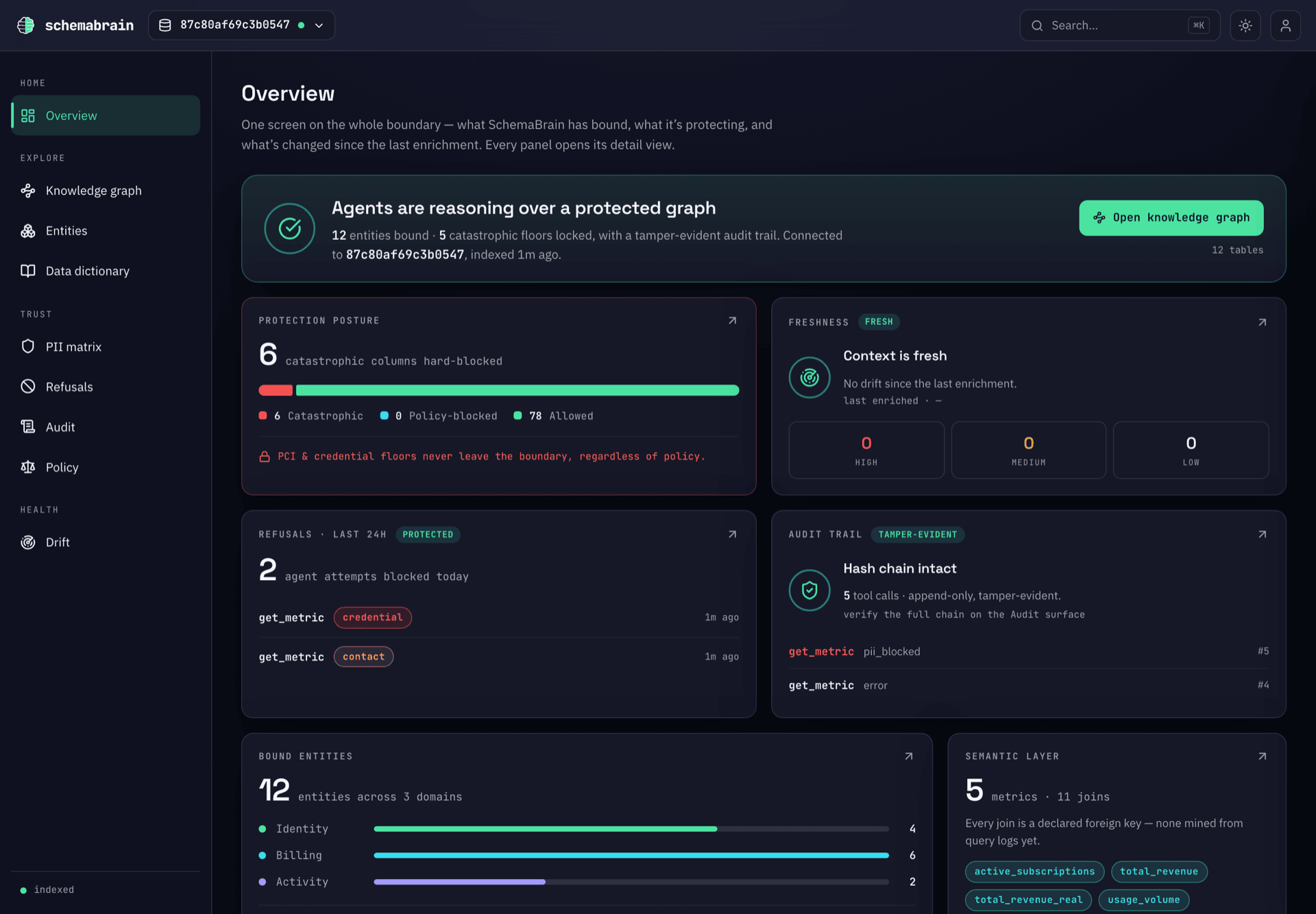
More dashboard views — Overview, PII matrix, Refusals, Audit, Entities, Data Dictionary, Policy & Drift

Overview — bento summary of bound entities, catastrophic-PII floors, refusals, and audit-chain health
Overview — the whole boundary on one screen: what's bound, what's protected, what's drifted.
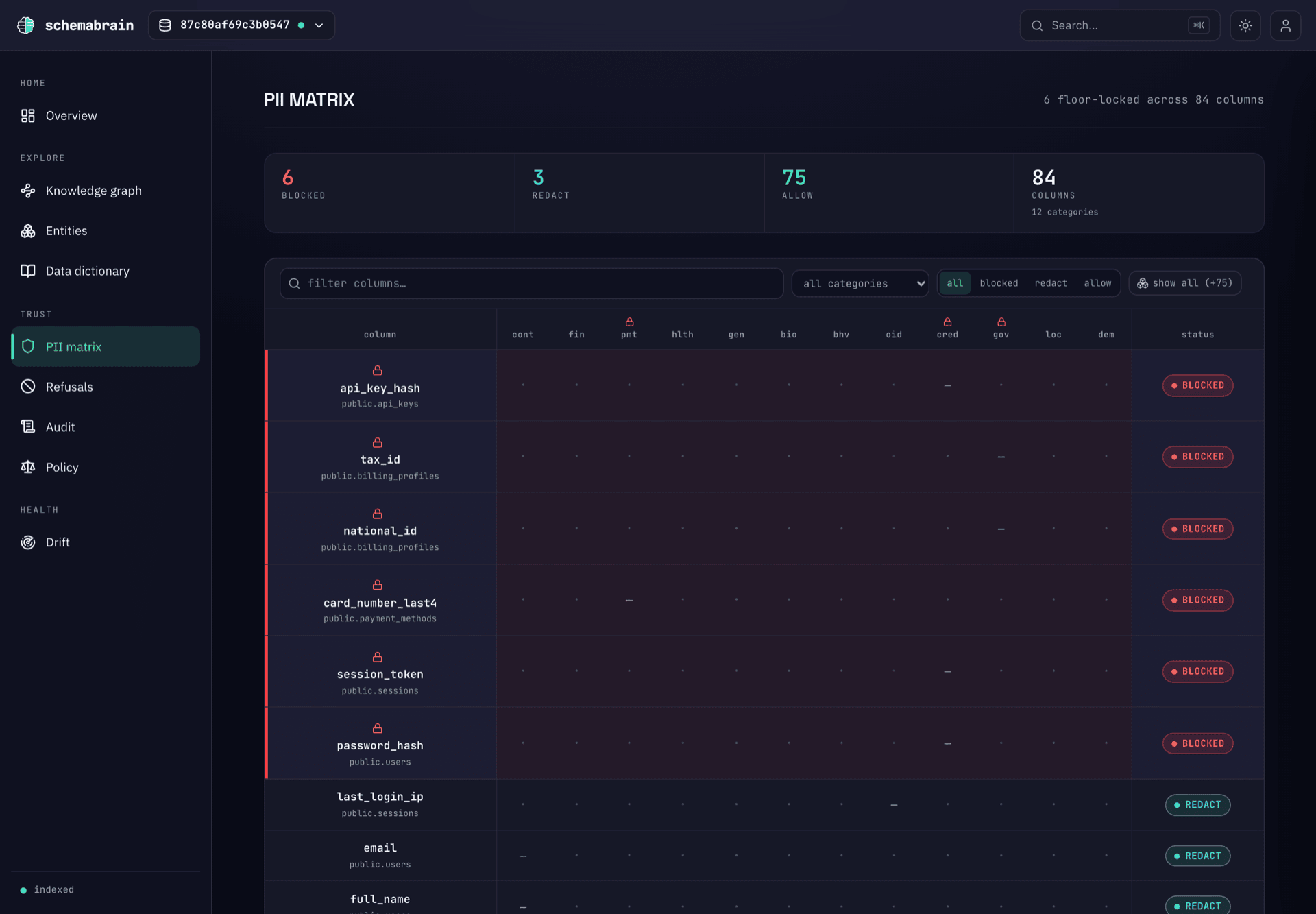
PII matrix — one row per classified column across the PII categories, catastrophic columns hard-blocked
PII matrix — which columns carry sensitive data, and what the default policy blocks.
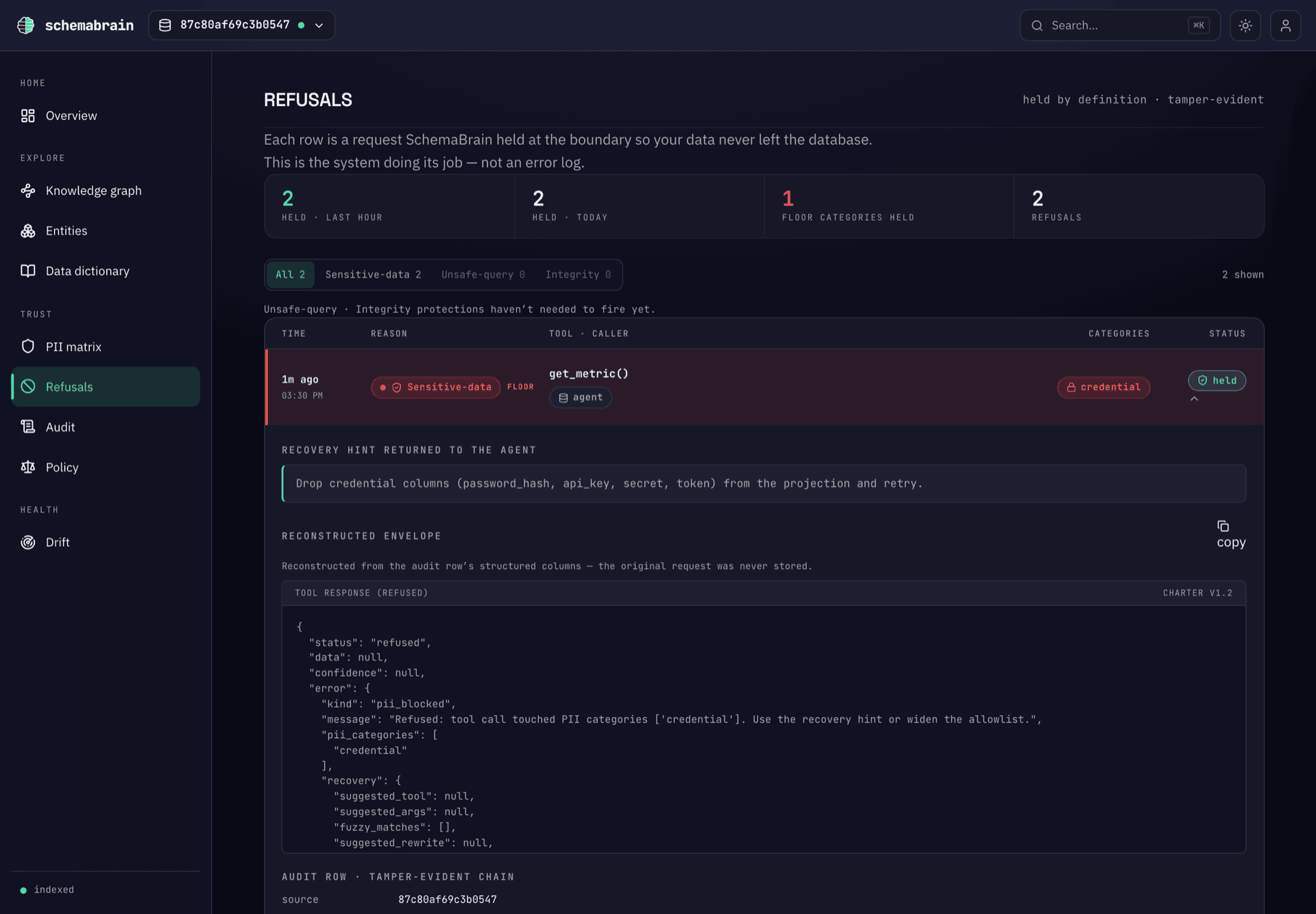
Refusals — a held call expanded to show the reason, blocked category, recovery hint, and reconstructed envelope
Refusals — every blocked call, the reason that fired, and the recovery hint the agent received.
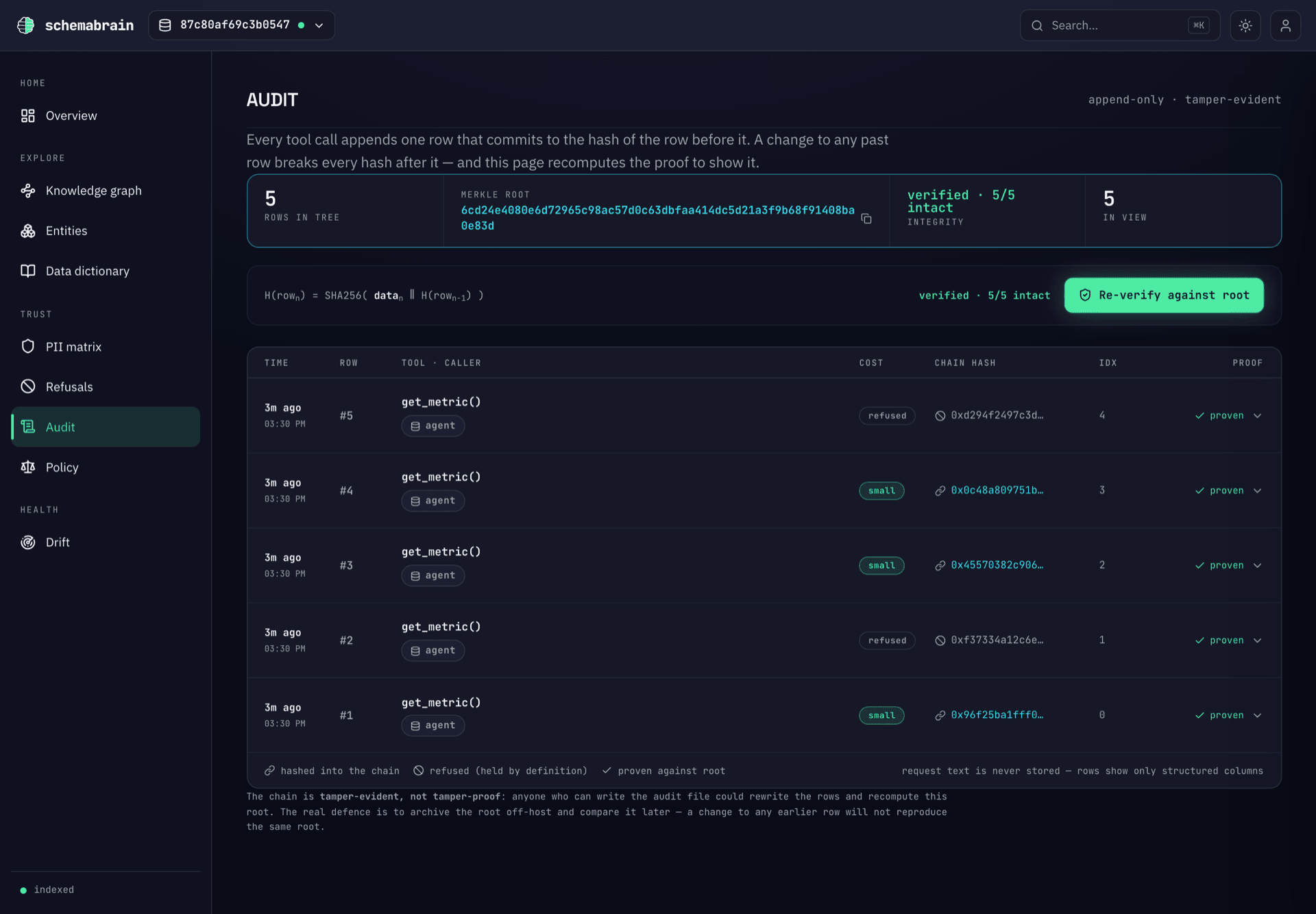
Audit Viewer — hash-chained ledger re-walked and verified intact, every row proven against the Merkle root
Audit Viewer — the tamper-evident chain, verified server-side down to each row's hash linkage.
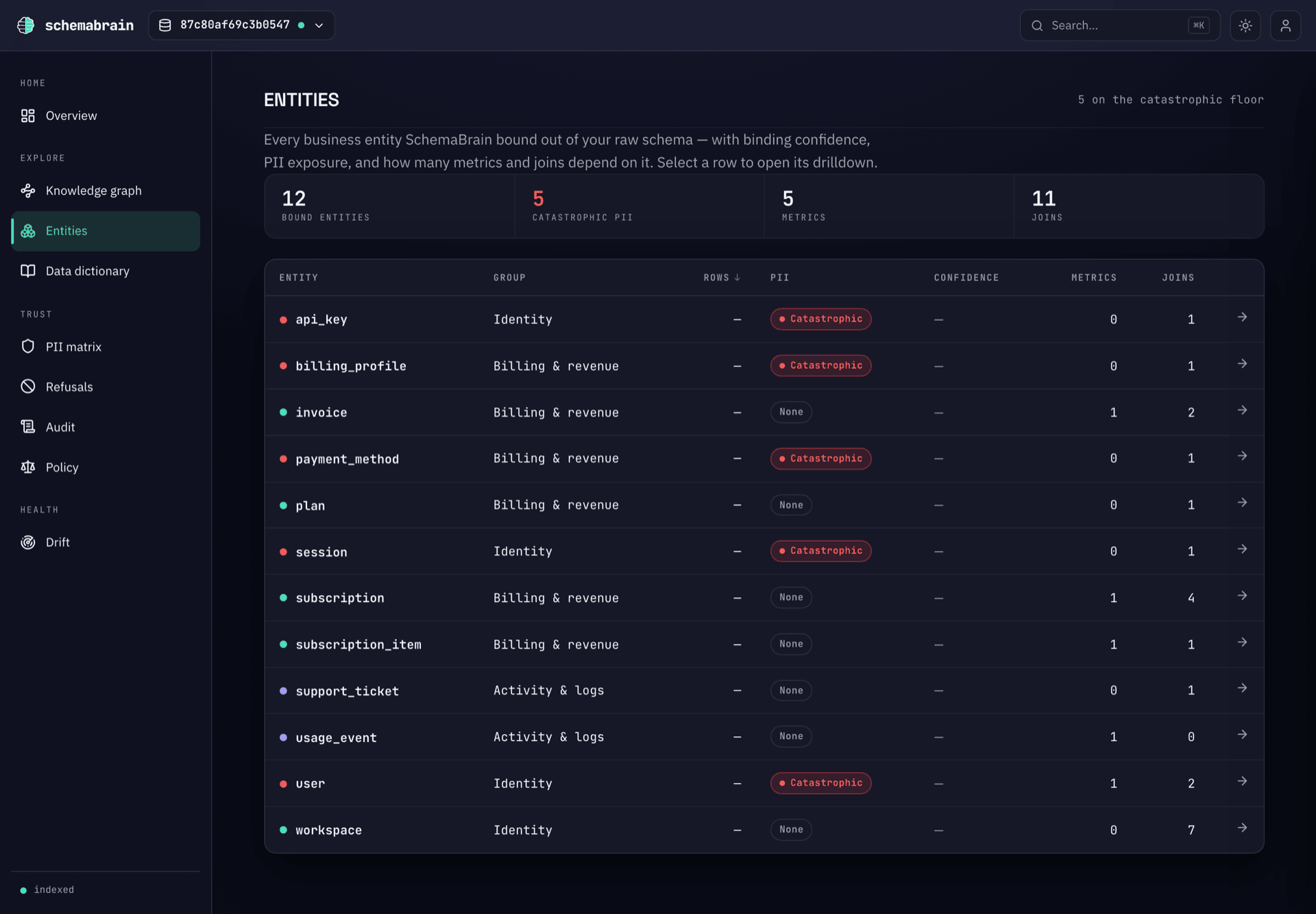
Entities — sortable index of every bound entity with PII exposure, binding confidence, metrics, and joins
Entities — every business entity bound out of the raw schema, with PII exposure and join counts.
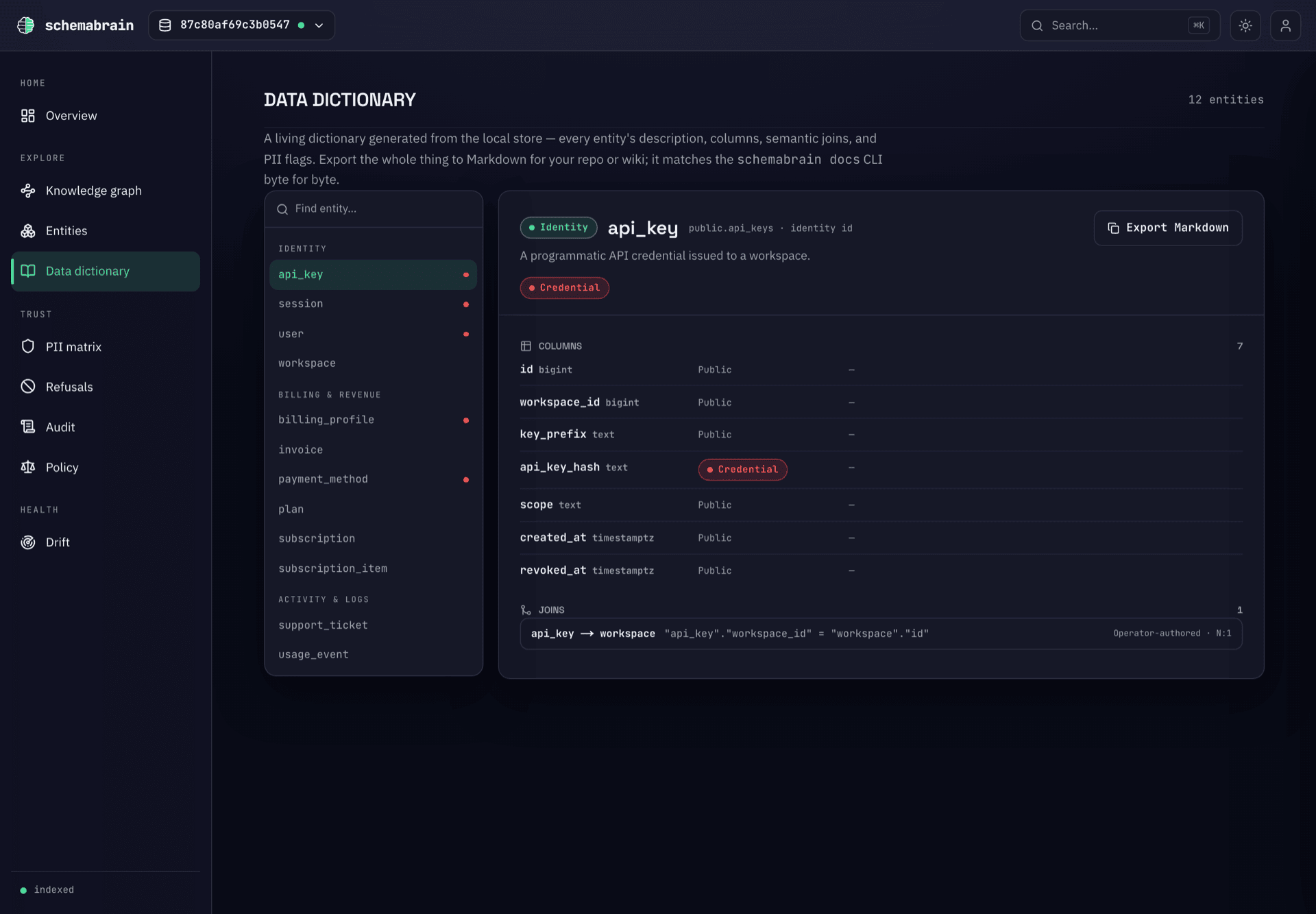
Data Dictionary — per-entity columns, types, PII classes, and joins with one-click Markdown export
Data Dictionary — every table, column, type, and join, exportable to Markdown for your repo or wiki.
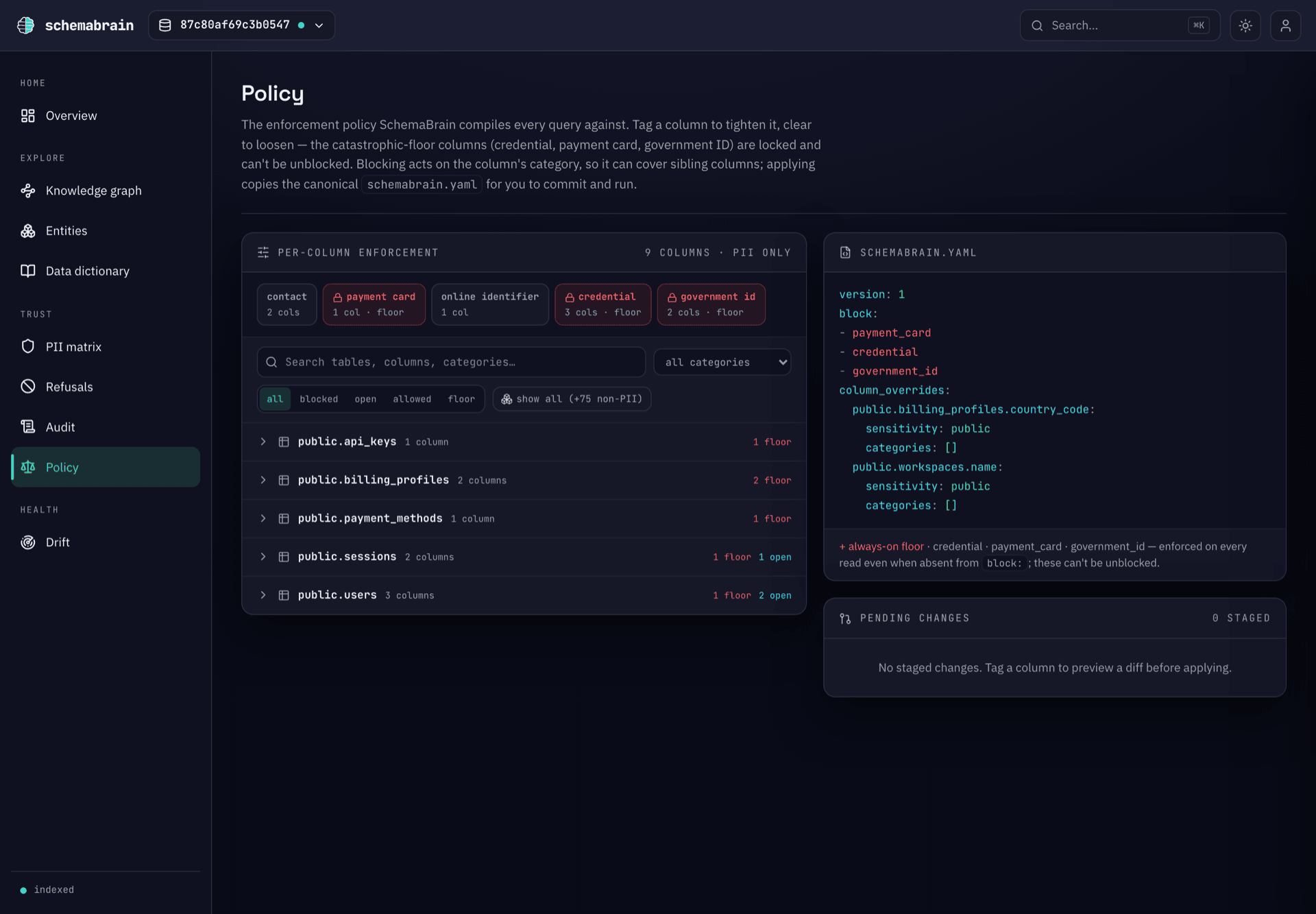
Policy — per-column block/redact/allow grid with the catastrophic-leak floor disclosed and the schemabrain.yaml it compiles
Policy — the block / redact / allow grid the firewall enforces, with the always-on floor disclosed.
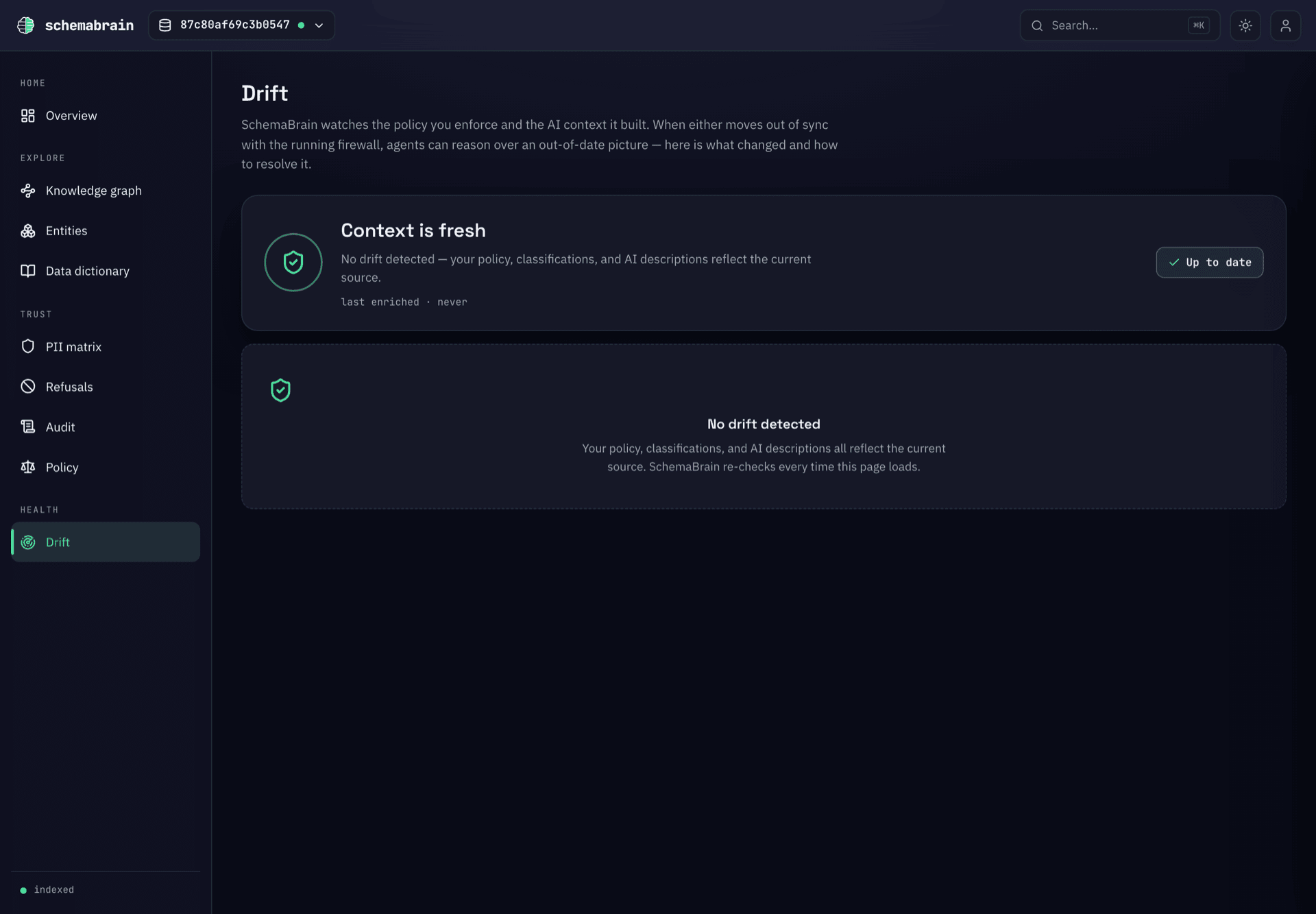
Drift — config and enrichment drift detection, here showing a fresh, in-sync context
Drift — config and enrichment drift the store can detect, each with a copy-the-CLI fix.

The dashboard binds **`127.0.0.1` only** — there is no `--host` flag, by design. It's read-only and reads the same SQLite store `serve` writes to. No agent talks to it. [Dashboard guide →](docs/dashboard/overview.mdx) · [PII matrix →](docs/dashboard/pii-matrix.mdx) · [Refusals →](docs/dashboard/refusals.mdx) · [Audit Viewer →](docs/dashboard/audit-viewer.mdx) --- ## Works with SchemaBrain speaks the [Model Context Protocol](https://modelcontextprotocol.io) over **stdio**. `schemabrain init --host ` writes first-party config for four MCP clients; everything else that speaks MCP stdio works via `--host manual` (prints the snippet, you paste). ### First-party wiring `schemabrain init --host ` writes the MCP entry directly into the host's config file. | Client | Setup guide | Config path | |---|---|---| | **Claude Desktop** | [`/setup/claude-desktop`](docs/setup/claude-desktop.md) | macOS: `~/Library/Application Support/Claude/claude_desktop_config.json`
Windows: `%APPDATA%\Claude\claude_desktop_config.json` | | **Claude Code** | [`/setup/claude-code`](docs/setup/claude-code.md) | Shells out to `claude mcp add` | | **Cursor** | [`/setup/cursor`](docs/setup/cursor.md) | `~/.cursor/mcp.json` | | **Windsurf** | [`/setup/windsurf`](docs/setup/windsurf.md) | `~/.codeium/windsurf/mcp_config.json` | ### Any other MCP stdio host `schemabrain init --host manual` prints the JSON entry to stdout — paste it into whatever host config you're using. Any client that launches a subprocess and speaks MCP stdio should work in principle; we have not exhaustively tested each. Common targets: - **Zed** — full walkthrough at [`docs/setup/zed.md`](docs/setup/zed.md) - **Codex CLI** (working path for ChatGPT users) — full walkthrough at [`docs/setup/codex.md`](docs/setup/codex.md) - **Cline** (VS Code extension) — `schemabrain init --host manual` prints the `mcpServers` block; paste it into Cline's settings via **MCP Servers → Configure MCP Servers**. Full walkthrough at [`docs/setup/cline.md`](docs/setup/cline.md) - **Continue** — paste into `~/.continue/config.json` - **Your own agent loop** — see [`examples/anthropic_demo.py`](examples/anthropic_demo.py) for a ~250-LOC Anthropic-SDK reference The 12-tool surface, PII-aware refusal, audit chain, and recovery contracts are transport-agnostic — any compliant stdio MCP client gets the same guarantees. ### Agent frameworks The same stdio MCP surface is reachable from any framework that can spawn an MCP server. The Anthropic SDK path is first-party-tested; the others work in principle if the framework's MCP integration speaks stdio. - **Anthropic SDK** — first-party walkthrough at [`docs/setup/manual.md`](docs/setup/manual.md#3-wire-your-own-agent-anthropic-sdk); reference loop at [`examples/anthropic_demo.py`](examples/anthropic_demo.py) - **LangChain / LangGraph** — via [`langchain-mcp-adapters`](https://github.com/langchain-ai/langchain-mcp-adapters) - **Pydantic AI** — via its [built-in MCP support](https://ai.pydantic.dev/mcp/) - **CrewAI / AutoGen / Agno / custom loops** — any framework with a stdio MCP client works in principle; we have not tested each We don't ship per-framework adapters; the framework's standard MCP client is sufficient. ### Not yet supported (cloud / HTTPS hosts) SchemaBrain v0.6 ships stdio only — no HTTPS / SSE transport. Clients that require a cloud HTTPS endpoint do **not** work today: - **ChatGPT Connectors** — see the [honest gap page](docs/setup/chatgpt.md) for workarounds and the v0.5+ roadmap - **Hosted MCP gateways** — by design (local-first wedge; see [vs Querybear](docs/compare/querybear.mdx)) If you need ChatGPT support today, a community stdio→HTTPS bridge (`mcp-remote`, `mcp-proxy`, etc.) may work; we have not validated any specific bridge against the PII / audit / recovery semantics. [Security posture for procurement / review →](docs/security.md) --- ## Sample session Real Claude Desktop session against the bundled SaaS fixture (12 tables, 84 columns, 12 entities). Condensed for length — a real agent explores `list_metrics` / `suggest_joins` first, then concludes the path is unreachable: > **You:** Using SchemaBrain, compute our usage volume broken down by plan tier. > > **Claude:** *(calls `get_metric(name="usage_volume", group_by=["plan.title"])`. The metric anchors on `usage_event`; reaching `plan` would need a join that isn't in the schema, so it refuses:)* > > ```json > { "status": "error", > "error": { > "kind": "unreachable_entity", > "message": "entity 'plan' is not reachable from metric anchor 'usage_event'; no canonical join exists. Run `schemabrain joins suggest` to surface candidate joins.", > "recovery": { "suggested_tool": "resolve_join", > "suggested_args": { "entity_a": "usage_event", "entity_b": "plan" } } } } > ``` > > *(Claude confirms at the join layer — `resolve_join("usage_event", "plan")` returns `kind: no_canonical_join`. `usage_events` carries only `workspace_id`, never a `plan_id`, and no table bridges the two.)* > > Verdict up front: I can't compute usage-by-plan, and you shouldn't want me to fake it — there is no modeled relationship between usage events and plans in this schema. `usage_events` records a `workspace_id`, not a plan, and nothing joins the two. "Usage volume by plan tier" is unanswerable until that link exists — and I'm not going to invent it. > > What I **can** give you — contracted revenue by plan tier (this path fully resolves: `subscription_item → subscription → plan`, both `fk_constraint` joins, `confidence: HIGH`): > > ```sql > SELECT p.title AS plan_tier, > SUM(si.unit_price_cents * si.seats) / 100.0 AS revenue -- prices stored in integer cents > FROM public.subscription_items si > JOIN public.subscriptions s ON si.subscription_id = s.id > JOIN public.plans p ON s.plan_id = p.id > GROUP BY p.title > ORDER BY revenue DESC; > ``` > > | plan_tier | revenue | > |------------|-------------| > | Enterprise | $379,620.00 | > | Pro | $539.00 | > | Free | $54.00 | > > Two honest caveats: > - **Contracted, not collected.** This is subscription line-item revenue (`seats × unit_price_cents`), not paid invoices. For billed totals, the `total_revenue` metric anchors on `invoices` instead. > - **Integer cents.** `unit_price_cents` is stored as an integer; the `/ 100.0` converts to currency. The differentiator is what *didn't* happen: most LLM-over-database tools, asked for usage-by-plan, would confidently emit `JOIN plans p ON usage_events.plan_id = p.id` against a `plan_id` column that doesn't exist. SchemaBrain refused — `get_metric` returned `kind: unreachable_entity` with `recovery.suggested_tool: resolve_join`, not prose. The agent **acted on the structured recovery contract programmatically** instead of fabricating a join. Refusal-not-fabrication is the safety mechanism, demonstrated live. **Cost.** ~$0.0004/column with Claude Haiku 4.5 (cryptic-name columns can opt into Sonnet 4.6 via `--enable-sonnet`). The bundled 12-table fixture (84 columns, 12 entities + 5 metrics + 11 joins) ships pre-curated, so the demo path applies it for **$0** — no API key. Indexing those 84 columns with LLM column descriptions comes to about **$0.03**. The Pagila DVD-rental sample (87 columns after partition deduplication) is the directly measured reference — **$0.0299 in 105s**. Re-indexing an unchanged schema is **$0** — content-addressable fingerprinting skips the LLM call entirely. To verify Claude's SQL is mechanically correct (and that flagged caveats are the actual data behavior), see [Validating SQL Claude generates](docs/setup/manual.md#6-validating-sql-claude-generates). **Run this exact session yourself:** `schemabrain init` walks you to a wired Claude Desktop in one command; then ask Claude *"Using SchemaBrain, compute our usage volume broken down by plan tier."* and watch the refuse-then-pivot live. --- ## Where it's going SchemaBrain is evolving into a **trust and intelligence layer between AI agents and your database** — it gives the agent a semantic map of your schema, compiles answers from definitions you control, and keeps every call PII-aware and audited. SQL-boundary safety is one proof-point of that layer, not the whole identity. That posture rests on a semantic substrate. You can't refuse "this query touches PII" without knowing which columns are PII. You can't answer "join through this junction" without canonical-join definitions. You can't serve a metric without knowing its grain. So the engineering order is **schema intelligence → semantic substrate → trust primitives.** Today the agent never writes raw SQL: it calls `get_metric` and the semantic-layer tools, SchemaBrain compiles parameterized SQL the agent never sees, and you get PII-aware refusal, structured recovery on every refused or degraded call, read-only execution with statement timeouts and row caps, and a tamper-evident audit chain. That def-driven, compiled-SQL posture is the default and the recommended one. Inspecting arbitrary agent-emitted SQL (`validate_query` / `execute`) is a later, optional opt-in lane — not the direction we're pivoting to. See the [Roadmap](#roadmap). --- ## Roadmap > The `v0.5` / `v1` / `v2` / `v3` labels are **roadmap milestone names**, not package versions. The package follows strict semver — `1.0.0` is reserved for an API that's been battle-tested by external users without a forced break. See [ADR-0003](docs/adr/0003-versioning-policy.md). The full, living roadmap — including explicit non-goals and how to influence priorities — lives in [`ROADMAP.md`](ROADMAP.md). ### Now — shipping in v0.6.x What you get from `pip install schemabrain`: - **MCP server, 12 read-only tools** — `find_relevant_tables`, `find_relevant_entities`, `describe_table`, `describe_column`, `describe_entity`, `list_entities`, `list_metrics`, `list_joins`, `suggest_joins`, `resolve_join`, `get_example_queries`, `get_metric`. - **Def-driven compilation** — the agent never writes raw SQL; answers compile from definitions you control, with read-only execution enforced at the database layer plus statement timeouts and row caps. - **Schema-intelligence engine** — index Postgres into a local SQLite store; cost-capped LLM semantic enrichment (with opt-in Sonnet routing for cryptic columns, `--enable-sonnet`); on-device embeddings (BAAI/bge-small ONNX); semantic table retrieval (cosine similarity over those embeddings, ranked per-table by best-matching column); entity identification with rationale + confidence; declared-FK, query-log, and dbt-`relationships` join mining; a persisted canonical join graph with multi-hop BFS; and a metrics layer. - **Trust & safety** — PII classification (60 rules across 12 categories) with per-column confidence, tag propagation, a catastrophic-leak floor (grouping *by* a PII column refuses as row-level disclosure), an editable policy (block / redact / allow plus per-column overrides), and a tamper-evident sha256 hash-chained audit log with browser-verifiable RFC-6962 Merkle proofs and `audit verify`. - **Graph-led dashboard, 9 surfaces** — a signature interactive **Knowledge Graph**, plus **Overview**, **Entities** (sortable index + drilldown with a semantic pane), **Data Dictionary** (Export-to-Markdown), **PII matrix**, **Refusals**, **Audit Viewer**, an editable **Policy** editor, and **Drift** intelligence. Dual-theme, opt-in, read-only, `127.0.0.1`-only. - **CLI** — `init`, `demo`, `index`, `import dbt`, `inspect`, `diff`, `check`, `entities`, `joins`, `metrics`, `policy {show, apply, tag}`, `docs`, `dashboard`, `doctor`, `serve`, `audit`. Distributed on PyPI (Apache-2.0 licensed) and as a headless Docker image. ### Later — roadmap (deferred; future direction only) **Phase 2 — differentiators** - Query cost estimation (`EXPLAIN` of the compiled SQL) - Tenant-isolation detection — missing-filter and cross-tenant-join checks - Impact analysis across definitions - Usage intelligence — hotspots and dead-table detection - A general policy-rule grammar - Implicit-FK discovery without query logs - Context budgeting for tool responses **Phase 3 — exploratory** - Persistent agent memory - Multi-agent coordination - Remote MCP transport plus a thin client SDK - An **optional, opt-in agent-authored-SQL lane** (`validate_query` / `execute`) behind an explicit flag. Def-driven compiled SQL stays the **default and recommended** posture; this lane is for teams that want parse-before-execute over arbitrary agent-emitted SQL, should it land. It is not shipped, and it is not a planned pivot away from the def-driven default. Everything on this roadmap is open source. --- ## Troubleshooting The five most common first-run failures. Full troubleshooter in [`docs/setup/manual.md`](docs/setup/manual.md#5-troubleshooting). - **`pip install schemabrain` gave me an older version.** Check `schemabrain --version`. If it doesn't match the [latest release](https://pypi.org/project/schemabrain/) your pip cache is stale — run `pip install --upgrade schemabrain`. `schemabrain init` writes the same version into the Claude Desktop snippet so it stays reproducible across restarts. When you installed from PyPI **and** `uv` is on your PATH, the snippet runs `uvx schemabrain==` (bump the pin manually after a pip upgrade); otherwise — a non-PyPI install (local wheel, editable, or git checkout) or no `uvx` — it pins the absolute path of the installed `schemabrain` entry point, which tracks the environment you ran `init` from. - **`init` reports `source unreachable`.** Postgres may not be ready on first run — wait a few seconds and re-run. For your own database, verify host, port, and credentials. Connection URLs in any form are accepted (`postgresql://`, `postgres://`, `postgresql+psycopg://`). - **The first `init` or `schemabrain index` hangs for ~60 seconds.** Normal. The first index downloads the ONNX embedding model (~67 MB) and makes one LLM call per column. Subsequent runs are fast. - **`init` fails at stage 6 "wire host".** Claude Desktop must be installed first — SchemaBrain writes into its config file, which doesn't exist until Claude Desktop has launched at least once. - **Claude Desktop doesn't show SchemaBrain after restart.** Cmd+Q is required (close-window doesn't trigger a re-read of MCP config). Run `schemabrain doctor` to verify the config landed. If `doctor` says everything's good but Claude Desktop still doesn't see the tool, check `~/Library/Logs/Claude/mcp*.log`. - **Apple Silicon + Python 3.12.** `fastembed`'s `onnxruntime` dependency ships no arm64 wheel for Python 3.12+, so embeddings can't build. `init` catches this at preflight and tells you to either use Python 3.11 (e.g. `pyenv local 3.11.10`) or re-run with `--no-embed` (keyword search instead of semantic — everything else works). --- ## Documentation | Doc | What's inside | |---|---| | [`docs/setup.md`](docs/setup.md) | Activation wizard (recommended) — pick a host, run the wizard, ask the agent (~60s) | | [`docs/setup/docker.md`](docs/setup/docker.md) | Docker install (image with embedding model baked in, no first-run download) | | [`docs/setup/manual.md`](docs/setup/manual.md) | Manual `index`, mine-queries, logs config, troubleshooting, MCP Inspector, SQL-validation ladder | | [`docs/first-5-queries.md`](docs/first-5-queries.md) | What to actually *do* after `init` — five queries that exercise read-only, PII-aware refusal, audit chain, and structured recovery | | [`docs/semantic-layer.md`](docs/semantic-layer.md) | Building entities, metrics (incl. composite expressions), canonical joins (incl. multi-hop), dbt import | | [`docs/operations.md`](docs/operations.md) | `inspect`, `check` (drift), `index --dry-run`, Docker compose | | [`docs/observability.md`](docs/observability.md) | `tail`, audit log, OTel export, PII classification | | [`docs/reference/mcp-tools/overview.mdx`](docs/reference/mcp-tools/overview.mdx) | Full reference for all 12 MCP tools (overview + 12 per-tool pages) | | [`docs/architecture.mdx`](docs/architecture.mdx) | Pipeline, retrieval contract, cache logic, cost model, eval | | [`docs/dashboard/overview.mdx`](docs/dashboard/overview.mdx) | Read-only observability dashboard — PII matrix, refusals, audit viewer | | [`docs/landscape.md`](docs/landscape.md) | Comparison vs Vanna / Atlan / dbt-mcp / WrenAI; "is this a semantic layer?" | | [`docs/threat-model.md`](docs/threat-model.md) | Security model + boundaries | | [`docs/adr/`](docs/adr/) | Architecture decision records (audit/PII taxonomy, store protocol, versioning policy, observability bus) | | [`examples/`](examples/) | Copy-paste-ready MCP configs, headless agent loop, end-to-end ecommerce walkthrough | --- ## FAQ **Does my data leave my machine?** Only LLM-enriched column descriptions and the redacted sample values that feed them. Three regex passes (email, US SSN, credit-card-shaped digit runs) run on every sample before it leaves the profiler module — see [`schemabrain/profiler/stats.py`](schemabrain/profiler/stats.py). The Anthropic API call sends column metadata + redacted samples + sibling-column context — no raw rows. Embeddings are generated locally via `fastembed` (BAAI/bge-small-en-v1.5, ONNX, ~67 MB). **What databases work today?** Postgres 16+ is the only **source** connector today (the local store itself is a SQLite file). A SQLite *source* connector, plus Snowflake / BigQuery / MySQL, is mostly a new `DataSource` implementation plus a profiler tweak — on the v1.x roadmap. **Why MCP and not a REST API?** The consumer is an agent, not a service. MCP standardizes tool registration, schema description, and request/response transport. Agents discover SchemaBrain natively and get its tool surface — no API wrapper, no SDK to maintain per language. **Is this a semantic layer like Cube or dbt Semantic Layer?** Not exactly — SchemaBrain is the trust and intelligence layer between AI agents and your database, built on a semantic-layer substrate. Entities, metrics, and canonical joins are first-class persisted definitions (`list_entities`, `describe_entity`, `resolve_join`, `get_metric`), and they make the safety primitives possible — read-only-by-architecture, PII-aware refusal, audit chain. The semantic substrate is the foundation; SQL-boundary safety, including the firewall, is one proof-point of the layer, not its whole identity. Full comparison vs Cube / dbt-mcp / Vanna / WrenAI in [`docs/landscape.md`](docs/landscape.md). More questions answered in [`docs/setup/manual.md`](docs/setup/manual.md#5-troubleshooting) (why local embeddings, more troubleshooting). --- ## Running it on your own Postgres? If you're pointing AI agents at a real (non-demo) Postgres, I'd genuinely like to hear how it goes — what worked, what broke, what felt sharp or rough. Open a [GitHub Discussion](https://github.com/Arun-kc/schemabrain/discussions) or a [GitHub issue](https://github.com/Arun-kc/schemabrain/issues), or reach me on GitHub ([@Arun-kc](https://github.com/Arun-kc)). Happy to help you wire it up. --- ## Contributors Contributors to schemabrain --- ## Contributing & License PRs welcome. The bar is high — see [`CONTRIBUTING.md`](CONTRIBUTING.md) for the test-first / 99%-coverage / conventional-commits / architecture-invariants checklist. CI enforces all of it. Bugs and feature requests use the structured templates in `.github/ISSUE_TEMPLATE/`. Issues without a reproduction (bugs) or a clear underlying problem (features) get closed with a request to re-open with the right info. [Apache 2.0](LICENSE).