# OpenClaw Workspace Sync & Backup Plugin
[](https://www.npmjs.com/package/openclaw-workspace-sync) [](LICENSE)
Sync and back up your OpenClaw agent workspace to cloud storage via [rclone](https://rclone.org/).
**Sync** your workspace to Dropbox, Google Drive, OneDrive, S3, or [70+ providers](https://rclone.org/overview/) with mailbox, mirror, or bisync modes. **Back up** your entire agent system — workspace, config, sessions, memory — as encrypted snapshots to S3, R2, B2, or any rclone backend.
## What's included
| Feature | What it does | Cost |
|---------|-------------|------|
| [**Sync**](#sync) | Live mirror of your workspace to/from cloud storage. Three modes: mailbox (safest), mirror, bisync. | Zero LLM cost — pure file ops |
| [**Encrypted Backup**](#encrypted-backups) | Streaming encrypted snapshots of your entire agent system to your own bucket. Automatic retention. | Zero LLM cost, zero extra disk |
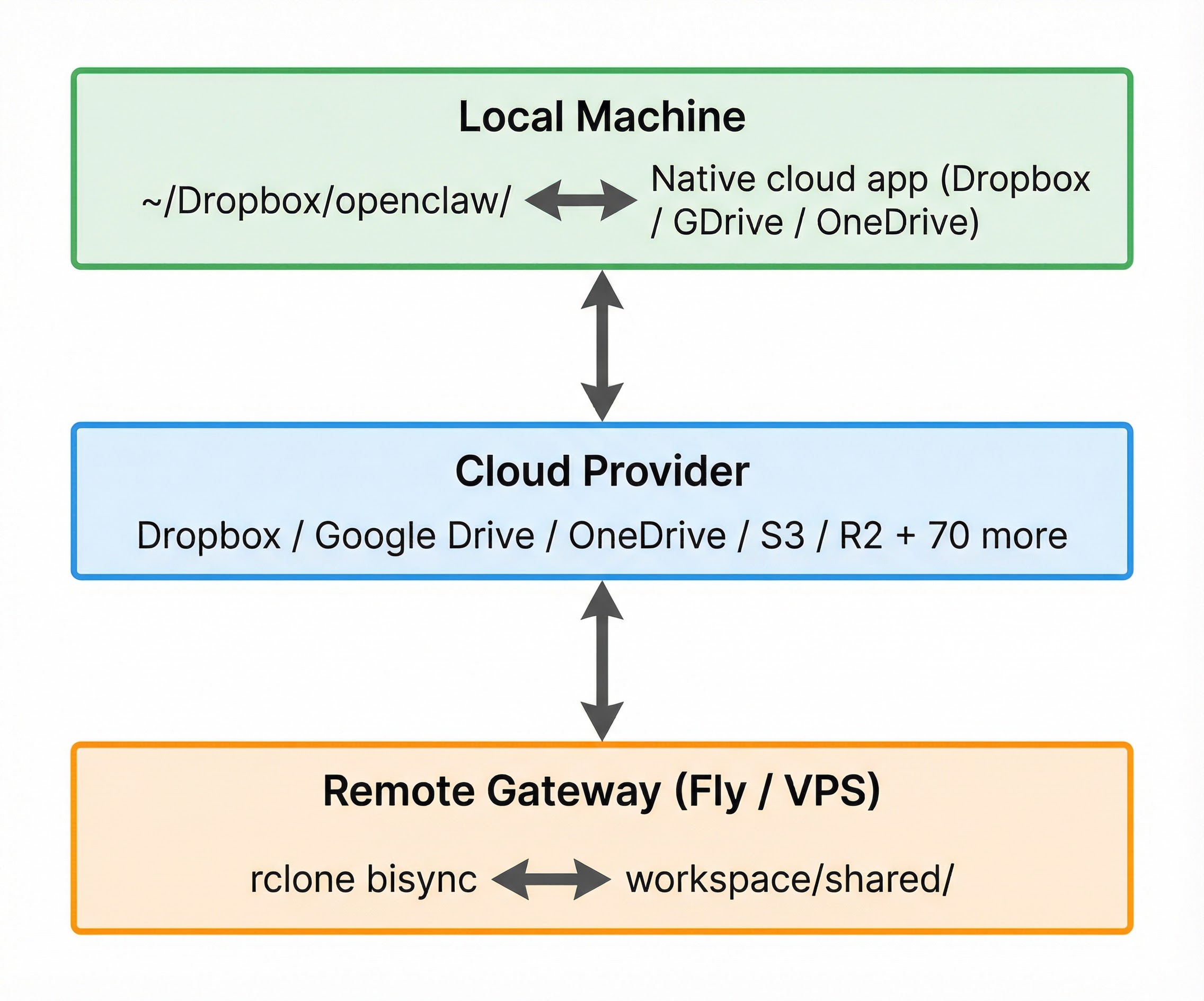
Both features use rclone under the hood and share provider credentials. You can use sync alone, backup alone, or both together with different providers — e.g. sync to Dropbox for daily access, backup to R2 for disaster recovery.
## Install
```bash
openclaw plugins install openclaw-workspace-sync
```
Or clone into your extensions directory:
```bash
cd ~/.openclaw/extensions
git clone https://github.com/ashbrener/openclaw-workspace-sync workspace-sync
cd workspace-sync && npm install --omit=dev
```
## Quick start
```bash
# Interactive setup wizard (recommended)
openclaw workspace-sync setup
```
The setup wizard guides you through:
1. Checking/installing rclone
2. Selecting cloud provider
3. Choosing sync mode
4. Dropbox app folder option (for scoped access)
5. Background sync interval
6. OAuth authorization
7. First sync
Or configure manually — see [Configuration](#configuration) below.
## Configuration
Add to your `openclaw.json`. The `sync` and `backup` blocks are independent — use one or both:
```json
{
"plugins": {
"entries": {
"openclaw-workspace-sync": {
"enabled": true,
"config": {
"sync": {
"provider": "dropbox",
"mode": "mailbox",
"remotePath": "",
"interval": 180,
"onSessionStart": true,
"exclude": [".git/**", "node_modules/**", "*.log"]
},
"backup": {
"enabled": true,
"provider": "s3",
"bucket": "my-backups",
"prefix": "habibi/",
"interval": 86400,
"encrypt": true,
"passphrase": "${BACKUP_PASSPHRASE}",
"include": ["workspace", "config", "cron", "memory"],
"retain": 7
}
}
}
}
}
}
```
> **Flat format still works.** Putting `provider`, `mode`, etc. at the config root (without `sync`) is supported for backwards compatibility. The nested `{ sync, backup }` format is recommended for clarity.
---
## Sync
Live workspace mirroring via rclone. The remote gateway workspace is the **source of truth**. Changes made by the agent flow down to your local machine through cloud storage. You can send files to the agent through an optional inbox.
### Sync modes (breaking change in v2.0)
**`mode` is now required.** Previous versions used bidirectional bisync implicitly. Starting with v2.0, you must explicitly set `"mode"` in your config. The plugin will refuse to start and log an error until `mode` is set. This prevents accidental data loss from an unexpected sync direction.
| Mode | Direction | Description |
|------|-----------|-------------|
| `mailbox` | Push + inbox/outbox | Workspace pushes to cloud; users drop files in `_outbox` to send them to the agent. **Safest.** |
| `mirror` | Remote → Local | One-way sync: workspace mirrors down to local. Safe — local can never overwrite remote. |
| `bisync` | Bidirectional | Full two-way sync. Powerful but requires careful setup. |
**Upgrading from a previous version?** If you were using bisync before, add `"mode": "bisync"` to your config to preserve the existing behavior. For the safest option, use `"mode": "mailbox"`.
#### `mailbox` mode (recommended)
The agent workspace is the source of truth. Each sync cycle:
1. **Push**: `rclone sync` pushes the workspace to the cloud (excluding `_inbox/` and `_outbox/`)
2. **Drain**: `rclone move` pulls files from the cloud `_outbox/` into the workspace `_inbox/`, deleting them from the cloud after transfer

This creates a clean separation:
- **Your local machine** gets a live mirror of the workspace via your cloud provider's desktop app (e.g., Dropbox). You also see an `_outbox/` folder — drop files there to send them to the agent.
- **The agent workspace** has an `_inbox/` folder where incoming files land. The agent (or a skill) can process them from there.
On startup, the plugin bootstraps both directories:
- `rclone mkdir cloud:_outbox` — ensures the cloud `_outbox` exists so your desktop app creates the local folder
- `mkdir -p /_inbox` — ensures the agent's landing zone exists
Because the push explicitly excludes `_inbox/**` and `_outbox/**`, there is no risk of sync loops or accidental overwrites. Files only flow in one direction through each channel.
##### Inbox notifications (optional)
By default, mailbox mode is silent — files land in `_inbox` without waking the agent. This keeps costs at zero.
If you want the agent to react when files arrive, set `"notifyOnInbox": true`. After each drain that moves files, the plugin injects a system event like:
> `[workspace-sync] New files in _inbox: report.pdf, data.csv`
This wakes the agent on its next heartbeat. The agent sees the message and can process the files — for example, reading, summarizing, or filing them.
**This costs credits.** Each notification triggers an agent turn. Only enable it if you want the agent to actively respond to incoming files.
```json
{
"mode": "mailbox",
"provider": "dropbox",
"remotePath": "",
"interval": 180,
"notifyOnInbox": true
}
```
#### `mirror` mode
The agent workspace is the source of truth. Every sync cycle copies the latest workspace state down to your local folder. Local files outside the workspace are never sent up.

This is safe: even if something goes wrong, only your local copy is affected — the workspace stays untouched.
##### `ingest` option (mirror mode only)
Want to send files to the agent while using mirror mode? Enable the `ingest` option. This creates a local `inbox/` folder (sibling to the sync folder) that syncs one-way **up** to the workspace. Drop a file in the inbox — it appears on the remote workspace. The inbox is separate from the mirror, so there is no risk of overwriting workspace files.
```json
{
"mode": "mirror",
"ingest": true,
"ingestPath": "inbox"
}
```
When enabled, a local `inbox/` folder syncs its contents to `/inbox/` on the workspace. This is additive only — files are copied up, never deleted from the remote side.
> For a more robust file-exchange pattern, consider `mailbox` mode instead. Mailbox uses `rclone move` to drain files (deleting from the source after transfer), which prevents duplicates and is easier to reason about.
#### `bisync` mode (advanced)
Full bidirectional sync using rclone bisync. Changes on either side propagate to the other.

Use this only if you understand the trade-offs:
- Both sides must be in a known-good state before starting
- A `--resync` is required once to establish the baseline — and it copies **everything**
- If bisync state is lost (e.g., after a deploy that wipes ephemeral storage), you must `--resync` again
- Deleted files can reappear if the other side still has them during a resync
- On container platforms (Fly.io, Railway), bisync state lives in ephemeral storage and is lost on every deploy
If you are running on a container platform, `mailbox` mode is strongly recommended.
### Sync config reference
| Key | Type | Default | Description |
|-----|------|---------|-------------|
| `provider` | string | `"off"` | `dropbox` \| `gdrive` \| `onedrive` \| `s3` \| `custom` \| `off` |
| `mode` | string | **required** | `mailbox` \| `mirror` \| `bisync` — see [Sync modes](#sync-modes-breaking-change-in-v20) |
| `ingest` | boolean | `false` | Enable local inbox for sending files to the agent (mirror mode only) |
| `ingestPath` | string | `"inbox"` | Local subfolder name for ingestion (relative to `localPath`) |
| `notifyOnInbox` | boolean | `false` | Wake the agent when files arrive in `_inbox` (mailbox mode). Off by default — enabling this costs LLM credits per notification. |
| `remotePath` | string | `"openclaw-share"` | Folder name in cloud storage |
| `localPath` | string | `""` (workspace root) | Relative subfolder within the workspace to sync. Defaults to the workspace root (e.g. `/data/workspace`). Must be a relative path — absolute paths like `"/"` are rejected. Set to a subfolder name like `"shared"` to sync only that directory. |
| `interval` | number | `0` | Background sync interval in seconds (0 = manual only, min 60) |
| `timeout` | number | `1800` | Max seconds for a single rclone sync operation (min 60) |
| `onSessionStart` | boolean | `false` | Sync when an agent session begins |
| `onSessionEnd` | boolean | `false` | Sync when an agent session ends |
| `remoteName` | string | `"cloud"` | rclone remote name |
| `configPath` | string | auto | Path to rclone.conf |
| `conflictResolve` | string | `"newer"` | `newer` \| `local` \| `remote` (bisync only) |
| `exclude` | string[] | see below | Glob patterns to exclude |
| `copySymlinks` | boolean | `false` | Follow symlinks during sync |
Default excludes: `**/.DS_Store`
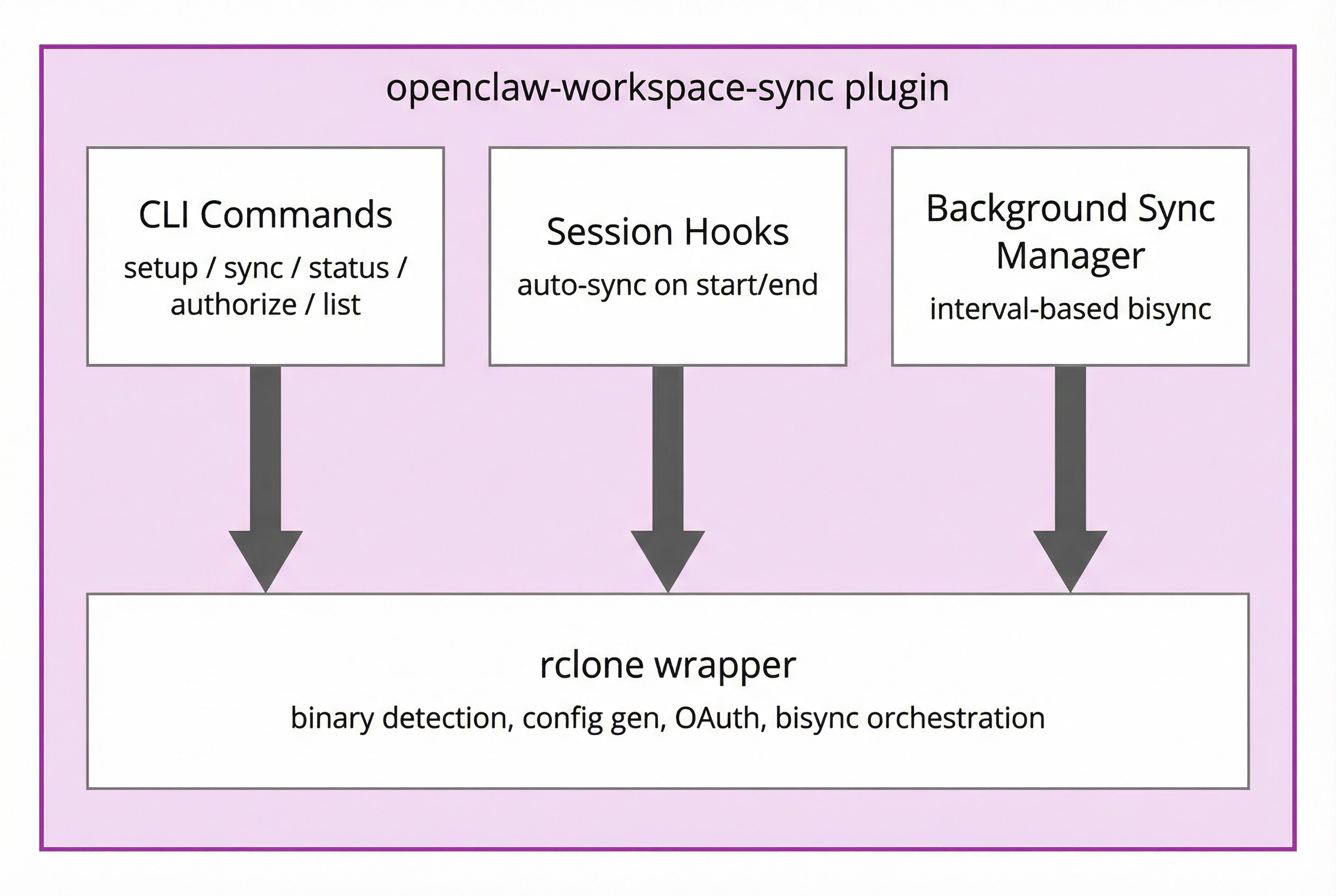
### Sync CLI commands
```bash
# Interactive setup wizard
openclaw workspace-sync setup
# Check sync status
openclaw workspace-sync status
# Sync (behavior depends on mode)
openclaw workspace-sync sync
# Preview changes without syncing
openclaw workspace-sync sync --dry-run
# One-way sync (explicit, overrides mode for this run)
openclaw workspace-sync sync --direction pull # remote -> local
openclaw workspace-sync sync --direction push # local -> remote
# Force re-establish bisync baseline (bisync mode only)
openclaw workspace-sync sync --resync
# Authorize with cloud provider
openclaw workspace-sync authorize
openclaw workspace-sync authorize --provider gdrive
# List remote files
openclaw workspace-sync list
```
### Auto-sync
#### Session hooks
Sync automatically when sessions start or end. These run during existing agent activity and incur zero LLM cost:
```json
{
"onSessionStart": true,
"onSessionEnd": false
}
```
#### Periodic background sync
Set `interval` to enable automatic background sync (in seconds):
```json
{
"interval": 300,
"timeout": 3600
}
```
The gateway runs sync in the background at this interval. Minimum interval is 60 seconds. The `timeout` controls how long each sync operation is allowed to run (default: 1800s / 30 min). Increase this for large workspaces or slow connections.
In `mailbox` mode, periodic sync pushes the workspace to the cloud and drains the `_outbox`. In `mirror` mode, periodic sync pulls the latest workspace state down to local. In `bisync` mode, it runs a full bidirectional sync.
#### External cron (alternative)
```bash
# Add to crontab (crontab -e)
*/5 * * * * openclaw workspace-sync sync >> /var/log/openclaw-sync.log 2>&1
```
### Before your first sync
Getting the initial state right prevents data loss. Each mode has different requirements:
#### `mailbox` mode — starting state
The first sync **pushes** your local workspace to the cloud. This means rclone makes cloud match local exactly — any files on cloud that don't exist locally will be **deleted**.
**Recommended starting state:** Local workspace is the source of truth (the agent has been writing here), or local and remote are already identical.
**If remote is the source of truth** (e.g. you've been syncing manually or switching from another mode), pull first:
```bash
rclone sync : /data/workspace/ --config \
--exclude '**/.DS_Store' --exclude '**/.git/**' \
--exclude '**/__pycache__/**' --exclude '**/node_modules/**' \
--verbose
```
Then verify local matches remote before enabling the plugin.
#### `mirror` mode — starting state
The first sync **pulls** from cloud to local. Local can be empty, stale, or corrupted — the pull simply overwrites it. **No preparation needed.**
#### `bisync` mode — starting state
The first sync requires `--resync`, which copies everything from both sides to the other. Any stale or unwanted files on either side will propagate.
**Recommended starting state:** Both sides are identical, or one side is empty and the other has the data you want. Verify both before running `--resync`.
#### General first-sync checklist
1. Run a `--dry-run` first to see what would happen: `openclaw workspace-sync sync --dry-run`
2. Check the output for unexpected deletions
3. If everything looks right, run the actual sync
4. Only then enable periodic sync (`interval` in config)
> For maintenance, recovery, and common problems, see [TROUBLESHOOTING.md](./TROUBLESHOOTING.md).
### Sync safety
Cloud sync involves two copies of your data. When things go wrong, one side can overwrite the other. Here is what to keep in mind:
**Mailbox mode is the safest.** The workspace pushes to the cloud; users send files via `_outbox`. The two streams never overlap. Even if your local folder is wiped, the next push re-creates everything. Even if the `_outbox` has stale files, they just land in `_inbox` for the agent to handle.
**Mirror mode is safe by design.** The remote workspace is the authority. Local is a read-only copy. Even if your local folder is empty, stale, or corrupted, the next sync just re-downloads the workspace. The agent's work is never affected by local state.
**Bisync requires both sides to agree.** Bisync tracks what changed since the last sync. If that tracking state is lost (deploy, disk wipe, moving to a new machine), rclone does not know what changed and requires a `--resync`. A resync copies everything from both sides — if one side has stale or unwanted files, they propagate to the other.
**Common pitfalls to avoid:**
- Setting `localPath` to an absolute path like `"/"` — this syncs your entire filesystem, not your workspace. The plugin now rejects absolute paths with a clear error. Use `""` for the workspace root or a relative subfolder like `"shared"`.
- Changing `remotePath` or `localPath` while periodic sync is enabled
- Running `--resync` without checking both sides first
- Using `bisync` on container platforms where state is ephemeral
- Syncing very large directories (use `exclude` patterns liberally)
**If in doubt, use `mailbox` mode.** It gives you a live local mirror of the workspace and a clean way to send files to the agent, with no risk of data loss.
> For recovery procedures, mode switching, and maintenance tips, see [TROUBLESHOOTING.md](./TROUBLESHOOTING.md).
#### Important: `--resync` is destructive (bisync only)
**Never use `--resync` unless you know exactly what it does.** The `--resync` flag tells rclone to throw away its knowledge of what has changed and do a full reconciliation — it copies every file that exists on either side to the other side. This means:
- Files you deleted remotely will come back from local (and vice versa)
- It transfers your **entire** sync scope, not just recent changes
- On a large Dropbox, this can take 30+ minutes and fill your disk
Normal bisync (without `--resync`) only transfers files that changed since the last sync. The plugin **never** auto-resyncs. If bisync's internal state gets corrupted, it will log a message telling you to run `--resync` manually — but only do this after confirming both sides are in the state you want.
```bash
# Only when you explicitly need to re-establish the baseline:
openclaw workspace-sync sync --resync
```
### Sync troubleshooting
#### Token expired
```bash
openclaw workspace-sync authorize
```
#### Conflicts (bisync only)
Files modified on both sides get a `.conflict` suffix. The winner is determined by `conflictResolve` (default: `newer`). To find conflict files:
```bash
find /shared -name "*.conflict"
```
#### Stale lock files
The plugin automatically handles stale rclone lock files. If a sync is interrupted (timeout, crash, kill), the next run detects the stale lock, clears it, and retries. Lock files older than 15 minutes are treated as expired by rclone's `--max-lock` flag.
If you still see lock errors, you can manually clear them:
```bash
rclone deletefile ~/.cache/rclone/bisync/.lck
```
#### Sync times out
Increase the `timeout` config (in seconds). The default is 1800 (30 min). For large workspaces:
```json
{
"timeout": 3600
}
```
#### Permission errors
```bash
chmod -R 755 /shared
```
#### Dropbox rate limiting
Dropbox enforces API rate limits (`too_many_requests`). If your workspace has many files (10k+), each sync cycle can consume a large number of API calls just for checking. To avoid hitting limits:
- **Set `interval` high enough** for the sync to complete between cycles. A workspace with ~40k files takes ~2 minutes to scan. An `interval` of 180 (3 min) is the minimum; 300 (5 min) is safer.
- **Use `exclude` patterns liberally** — skip `node_modules`, `.git`, `__pycache__`, build output, and anything you don't need synced. Fewer files = fewer API calls.
- **If you see `too_many_requests` errors** in the logs, increase the interval and add more excludes.
---
## Encrypted backups
Back up your entire agent system — workspace, config, cron jobs, memory, sessions — as encrypted snapshots to your own cloud storage. Your bucket, your encryption key, zero monthly fees.
### How it works

1. **Streams directly** — `tar | [openssl enc] | rclone rcat` piped straight to the remote. Zero local temp files, zero extra disk needed. A 10 GB workspace on a 1 GB free volume? No problem.
2. Optionally encrypts with AES-256 (client-side, before upload) via `openssl`
3. Uploads via rclone to any supported provider (S3, R2, Backblaze B2, Dropbox, etc.)
4. Prunes old snapshots based on your retention policy
> **Disk-constrained?** Because backups stream directly, you don't need any free disk space for the backup itself. Only the restore downloads to a staging directory.
### Backup config reference
| Key | Type | Default | Description |
|-----|------|---------|-------------|
| `enabled` | boolean | `false` | Enable scheduled backups |
| `provider` | string | parent provider | Cloud provider for backup storage |
| `bucket` | string | — | S3/R2 bucket name |
| `prefix` | string | `""` | Path prefix within the bucket (e.g., `habibi/`) |
| `interval` | number | `86400` | Backup interval in seconds (86400 = daily; clamped to min 300) |
| `encrypt` | boolean | `false` | Encrypt snapshots with AES-256 before upload |
| `passphrase` | string | — | Encryption passphrase (use `${BACKUP_PASSPHRASE}` env var) |
| `include` | string[] | see below | What to back up |
| `retain` | number or object | `7` | Retention: `7` = keep 7 latest, or `{ daily: 7, weekly: 4 }` |
| `exclude` | string[] | parent excludes | Glob patterns to exclude from workspace backup |
### Include options
| Item | What gets backed up |
|------|---------------------|
| `workspace` | The workspace directory (agent files, projects, etc.) |
| `config` | `openclaw.json` |
| `cron` | Cron job schedules and state |
| `memory` | Memory files (MEMORY.md, etc.) |
| `sessions` | Session metadata and store |
| `credentials` | Auth profile credentials |
| `skills` | Skill files |
| `hooks` | Webhook configurations and state (Gmail watch, custom hooks) |
| `extensions` | Installed plugins/extensions (for reproducible restores) |
| `env` | Environment variables file (`.env`) |
| `agents` | Multi-agent state (per-agent sessions, subagent registry) |
| `pages` | Custom pages served by the gateway |
| `transcripts` | Full conversation logs (JSONL session transcripts) |
Default: `["workspace", "config", "cron", "memory"]`
### Backup CLI commands
```bash
# Create a backup now
openclaw workspace-sync backup now
# List available snapshots
openclaw workspace-sync backup list
# Restore the latest snapshot
openclaw workspace-sync backup restore
# Restore a specific snapshot
openclaw workspace-sync backup restore --snapshot backup-20260310T020000Z.tar.gz.enc
# Restore to a specific directory (safe — doesn't overwrite live data)
openclaw workspace-sync backup restore --to /tmp/restore-test
# Check backup service status
openclaw workspace-sync backup status
```
### Restore safety
By default, `restore` extracts to a staging directory (`~/.openclaw/.backup-restore/`), not directly over your live workspace. This lets you inspect the contents before copying them into place. Use `--to` to control where files land.
### Backup provider examples
**Cloudflare R2 (free tier: 10GB):**
```json
{
"backup": {
"enabled": true,
"provider": "s3",
"encrypt": true,
"passphrase": "${BACKUP_PASSPHRASE}",
"s3": {
"endpoint": "https://.r2.cloudflarestorage.com",
"bucket": "openclaw-backups",
"region": "auto",
"accessKeyId": "${R2_ACCESS_KEY}",
"secretAccessKey": "${R2_SECRET_KEY}"
}
}
}
```
**AWS S3:**
```json
{
"backup": {
"enabled": true,
"provider": "s3",
"encrypt": true,
"passphrase": "${BACKUP_PASSPHRASE}",
"s3": {
"bucket": "my-openclaw-backups",
"region": "us-east-1",
"accessKeyId": "${AWS_ACCESS_KEY_ID}",
"secretAccessKey": "${AWS_SECRET_ACCESS_KEY}"
}
}
}
```
**Backblaze B2:**
```json
{
"backup": {
"enabled": true,
"provider": "s3",
"encrypt": true,
"passphrase": "${BACKUP_PASSPHRASE}",
"s3": {
"endpoint": "https://s3.us-west-002.backblazeb2.com",
"bucket": "openclaw-backups",
"region": "us-west-002",
"accessKeyId": "${B2_KEY_ID}",
"secretAccessKey": "${B2_APP_KEY}"
}
}
}
```
---
## Provider-specific options
These provider blocks work for both sync and backup. Place them inside the `sync` or `backup` config block as needed.
**Dropbox with app folder (recommended for security):**
```json
{
"provider": "dropbox",
"remotePath": "",
"dropbox": {
"appFolder": true,
"appKey": "your-app-key",
"appSecret": "your-app-secret",
"token": "{\"access_token\":\"...\"}"
}
}
```
With `appFolder: true`, set `remotePath` to `""`. The app folder root is your sync root — do not repeat the app folder name in `remotePath` or rclone will fail with "directory not found."
**Google Drive:**
```json
{
"provider": "gdrive",
"remotePath": "openclaw-sync",
"gdrive": {
"token": "{\"access_token\":\"...\"}",
"teamDrive": "0ABcDeFgHiJ",
"rootFolderId": "folder-id"
}
}
```
`teamDrive` and `rootFolderId` are optional — omit them for personal Google Drive.
**OneDrive:**
```json
{
"provider": "onedrive",
"remotePath": "openclaw-sync",
"onedrive": {
"token": "{\"access_token\":\"...\"}",
"driveId": "drive-id",
"driveType": "business"
}
}
```
`driveType` can be `personal`, `business`, or `sharepoint`. Both fields are optional.
**S3 / Cloudflare R2 / Minio:**
```json
{
"provider": "s3",
"remotePath": "openclaw-sync",
"s3": {
"endpoint": "https://s3.us-east-1.amazonaws.com",
"bucket": "your-bucket",
"region": "us-east-1",
"accessKeyId": "AKID...",
"secretAccessKey": "SECRET..."
}
}
```
**Any rclone backend (SFTP, B2, Mega, pCloud, etc.):**
```json
{
"provider": "custom",
"remotePath": "openclaw-sync",
"custom": {
"rcloneType": "sftp",
"rcloneOptions": {
"host": "example.com",
"user": "deploy",
"key_file": "/path/to/key"
}
}
}
```
The `custom` provider accepts any [rclone backend type](https://rclone.org/overview/) and passes `rcloneOptions` directly to the rclone config. This gives you config-driven access to all 70+ providers without manually editing `rclone.conf`.
### Supported providers
| Provider | Config value | Auth method | Config-driven |
|----------|-------------|-------------|---------------|
| Dropbox | `dropbox` | OAuth token | Full (token, appKey, appSecret, appFolder) |
| Google Drive | `gdrive` | OAuth token | Full (token, teamDrive, rootFolderId) |
| OneDrive | `onedrive` | OAuth token | Full (token, driveId, driveType) |
| S3/R2/Minio | `s3` | Access keys | Full (endpoint, bucket, region, credentials) |
| Any rclone backend | `custom` | Varies | Full (rcloneType + rcloneOptions) |
All providers are fully config-driven — no manual `rclone.conf` editing needed. The `custom` provider gives access to all [70+ rclone backends](https://rclone.org/overview/) (SFTP, B2, Mega, pCloud, Azure Blob, etc.).
### Dropbox app folder access (recommended)
For better security, create a scoped Dropbox app that only accesses a single folder:
1. Go to [Dropbox App Console](https://www.dropbox.com/developers/apps)
2. Click **Create app** > **Scoped access** > **App folder**
3. Name it (e.g., `openclaw-sync`)
4. In **Settings** tab, add a **Redirect URI**: `http://localhost:53682/`
- This is required for rclone's OAuth flow to work. Without it, Dropbox returns "Invalid redirect_uri" during authorization.
5. In **Permissions** tab, enable:
- `files.metadata.read` / `files.metadata.write`
- `files.content.read` / `files.content.write`
6. Copy **App key** and **App secret** from Settings
> **Important:** When using an app folder scoped app, set `"remotePath": ""` (empty string) in your config. The app folder **is** the root — rclone sees it as `/`. If you set `remotePath` to your app folder name (e.g., `"openclaw-sync"`), rclone will look for a subfolder *inside* the app folder with that name and fail with "directory not found."
Benefits:
- Token only accesses one folder, not your entire Dropbox
- If token is compromised, blast radius is limited
- Clean separation — sync folder lives under `Apps//`
---
## Deployment recommendations
If you are running OpenClaw on a cloud container (Fly.io, Railway, Render) or a VPS:
- **Use a separate persistent volume for the workspace.** Container root filesystems are ephemeral — a redeploy wipes everything. Mount a dedicated volume (e.g., Fly.io volumes, EBS, DigitalOcean block storage) at your workspace path so data survives deploys and restarts.
- **Enable daily volume snapshots.** Most cloud providers offer automated snapshots (Fly.io does this by default with 5-day retention). If something goes wrong — a bad sync, accidental deletion, or a failed reorganization — a recent snapshot lets you restore in minutes instead of rebuilding from scratch.
- **Test your restore process.** A backup you have never restored is a backup you do not have. Create a volume from a snapshot at least once to confirm the process works and you know the steps.
- **Use encrypted backups for off-site disaster recovery.** Volume snapshots protect against accidental deletes, but not against provider outages or account issues. Streaming encrypted backups to a separate provider (e.g., R2, B2) gives you a fully independent recovery path.
## Security notes
- **Token storage**: rclone tokens are stored in `rclone.conf` with `0600` permissions
- **Sensitive files**: Don't sync secrets, API keys, or credentials
- **Encryption**: Backups support AES-256 client-side encryption. For sync, consider [rclone crypt](https://rclone.org/crypt/) for sensitive data.
- **App folder**: Use Dropbox app folder access for minimal permissions
- **Passphrase safety**: Use environment variables (`${BACKUP_PASSPHRASE}`) — never hardcode passphrases in config files
## Development
```bash
# Install dependencies
npm install
# Run tests
npm test
# Type check
npx tsc --noEmit
```
## License
MIT