
# Bilinc
[](https://pypi.org/project/bilinc/)
[](https://pypi.org/project/bilinc/)
[](https://github.com/ReARCLabs/bilinc/blob/main/LICENSE)
[](https://bilinc.space/for/mcp)
 **Hosted memory for AI agents.** Save what your agents learn, recall it before they act, see who wrote each memory and what changed, and roll back when a run goes wrong.
The `bilinc` package on PyPI is the Python SDK, the `bilinc` CLI and the stdio MCP adapter for [Bilinc Cloud](https://bilinc.space). Its source is [ReARCLabs/bilinc](https://github.com/ReARCLabs/bilinc); the hosted service is not part of the package.
## Start in 60 seconds
**Claude, ChatGPT or Codex, without Python.** In Claude, open **Customize → Connectors → Add custom connector**, name it Bilinc and paste `https://mcp.bilinc.space/mcp`. Sign in and choose read-only or read and write. In Claude Code:
```bash
claude mcp add --transport http --scope user bilinc https://mcp.bilinc.space/mcp
```
The same address works in ChatGPT and Codex: [remote MCP guide](https://bilinc.space/docs/remote-mcp).
**Python, the CLI or any MCP client.**
```bash
pip install -U bilinc
bilinc login # browser sign-in, free, no card required
bilinc quicktest # one hosted commit, one recall and a status check
```
`bilinc login` saves an API key for this computer with owner-only permissions; the key never appears in a URL or your terminal. Without a browser, use `bilinc login --device`. For CI and scripts, set `BILINC_API_KEY`.
## Where Bilinc sits
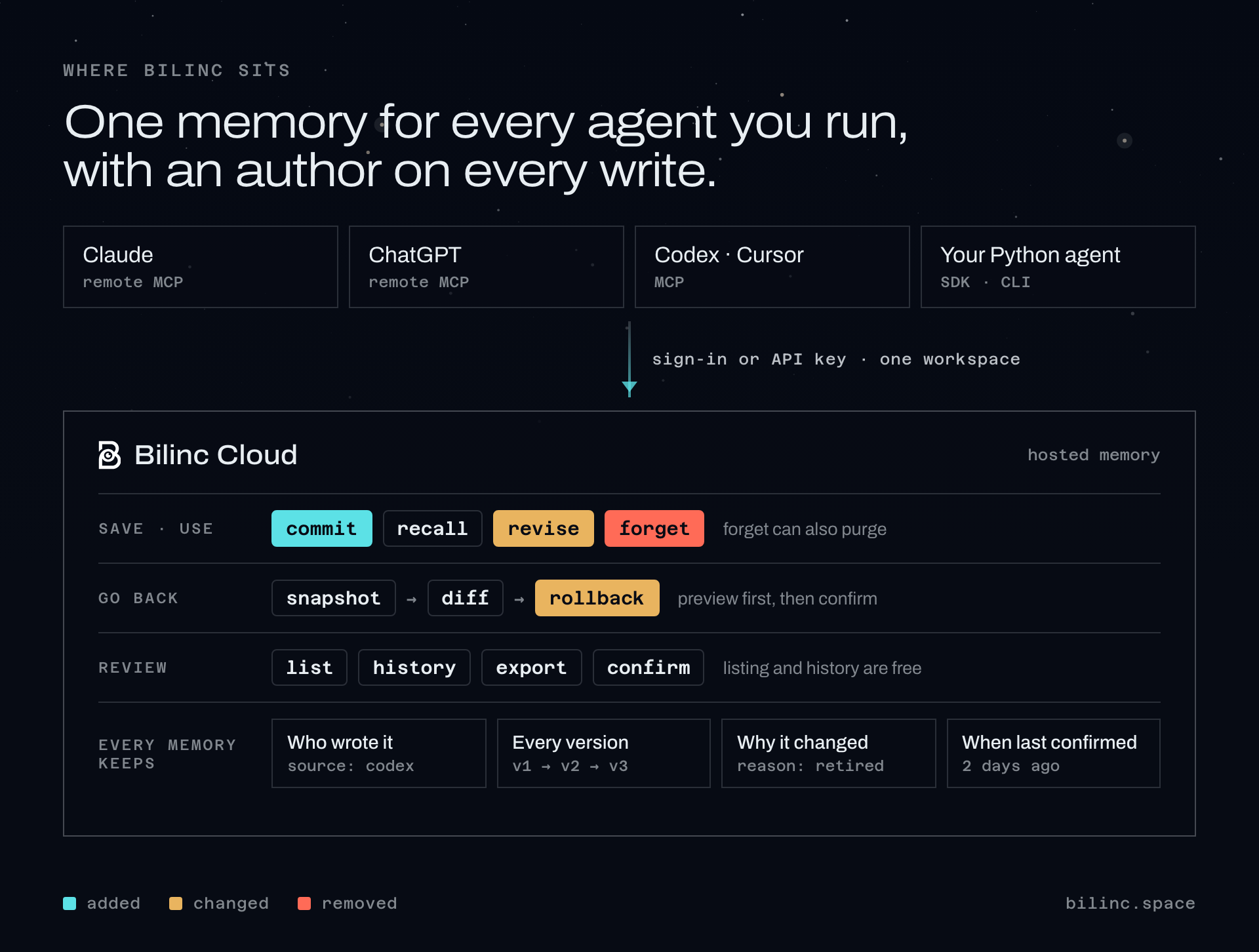
Every write records where it came from and returns a version you can pass back, so a change is refused if the memory moved since you read it. Forget requires a reason and revise accepts one. In the remote connector, recall shows when each memory was last confirmed and marks entries past their review window as possibly outdated; nothing is hidden or deleted by that check.
## Similar is not the same as current
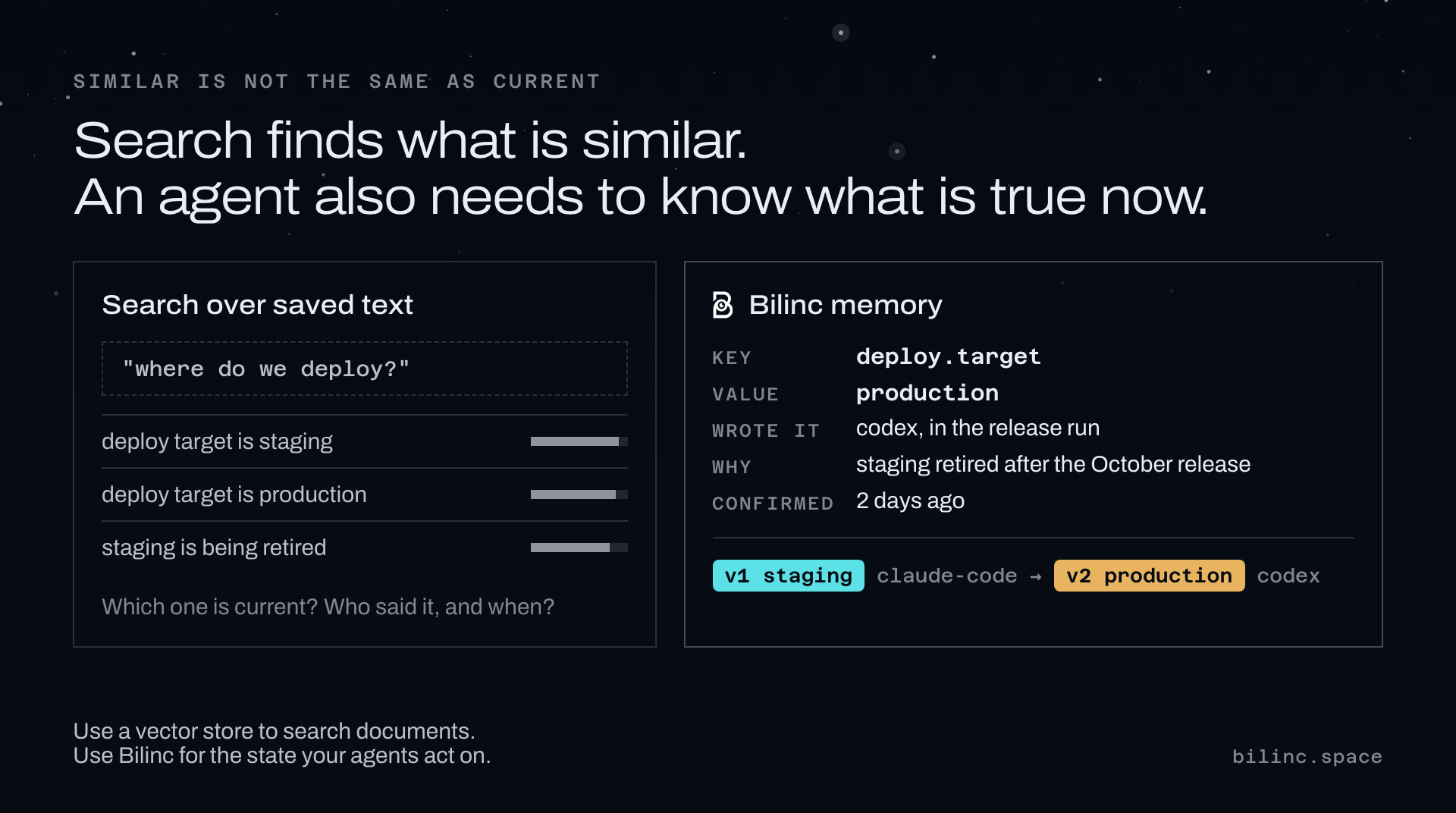
Use Bilinc when:
- a long-running agent (coding, support, research, a personal assistant) needs earlier decisions before a risky action;
- you need to know which run, tool or person wrote a piece of agent state;
- a bad run wrote wrong state and you need a way back, not a manual cleanup;
- several agents or teammates share one memory and you want per-key access and visible usage.
Reach for something else when you only need semantic search over documents (a vector database is the simpler tool), when you need an Apache-2.0, fully self-hosted runtime (this package is cloud-only and BUSL-1.1), or when you want the memory layer to also be your agent framework.
## Python SDK
```python
from bilinc import CloudClient
client = CloudClient() # reads BILINC_API_KEY or the key saved by `bilinc login`
# Write, and keep the version for optimistic concurrency.
written = client.commit("agent.goal", {"ship": "reliable memory"}, memory_type="semantic")
results = client.recall("agent goal", limit=5)
# Correct something you already know. Fails if the key does not exist.
client.revise("agent.goal", {"ship": "verifiable memory"},
reason="scope corrected", expected_version=written["entryVersion"])
# Checkpoint before risky work, then see what changed.
snapshot = client.create_snapshot(label="before-autonomous-run")["snapshot"]
client.diff(snapshot["id"])
# Recover. The preview is free; executing needs its token.
preview = client.rollback_preview(snapshot["id"], reason="undo bad agent run")
client.rollback(snapshot["id"], confirmation_token=preview["confirmationToken"],
reason="undo bad agent run")
# Review what is stored. Listing, history and export are free reads.
for entry in client.iter_memories(prefix="agent."):
print(entry["key"], entry["updatedAt"])
client.history("agent.goal")
client.confirm("agent.goal") # still accurate; costs one write
# Take a memory out of use. A reason is required and recorded.
client.forget("agent.goal", reason="superseded by the planner service")
```
## CLI
```bash
bilinc status # plan, capabilities, limits, usage
bilinc commit --key agent.goal --value '{"ship":"reliable memory"}'
bilinc recall --query "agent goal"
bilinc revise --key agent.goal --value '{"ship":"verifiable memory"}' --reason "scope corrected"
bilinc list --prefix agent. # keys, types, update times, value previews
bilinc history agent.goal # recorded changes, newest first
bilinc snapshot create --label before-autonomous-run
bilinc diff --from-snapshot snap_...
bilinc export -o bilinc-export.json # full values; the file is readable only by you
bilinc forget --key agent.goal --reason "superseded by the planner service"
```
Rollback is two steps, and execute never prompts, so it is safe in automation:
```bash
bilinc rollback preview --snapshot snap_... --reason "undo bad agent run"
bilinc rollback execute --snapshot snap_... --reason "undo bad agent run" \
--confirmation-token
```
## MCP adapter
The stdio adapter works with any MCP client: Claude Code, Codex, Cursor, Hermes Agent, opencode and others. After `bilinc login`, let the CLI write the setup:
```bash
bilinc mcp install --client claude-code # prints a ready `claude mcp add ...` command
bilinc mcp install --client claude-desktop # prints the config and where Claude Desktop keeps it
bilinc mcp install # plain mcpServers JSON for any other client
```
The config carries no key; the adapter reads the one `bilinc login` saved. On a machine without one, add `"env": { "BILINC_API_KEY": "..." }`.
| Tool | What it does |
| --- | --- |
| `commit_mem` | Save durable state with its source; returns a version. |
| `recall` | Find earlier context and decisions before acting. |
| `revise` | Correct an existing memory. It never creates one. |
| `forget` | Take a memory out of use. **Destructive**; a reason is required. |
| `status` | Workspace, plan, capabilities, limits and usage. Never billed. |
| `snapshot` | Save a checkpoint before risky work, or list checkpoints. |
| `diff` | Compare a checkpoint with another one or with now. |
| `rollback` | Restore a checkpoint: a free preview, then a confirmed execute. |
| `list_memories` | Browse what is stored. Free. |
| `history` | One memory's changes, newest first. Free. |
| `confirm` | Record that a memory is still accurate. One write. |
The remote connector at `https://mcp.bilinc.space/mcp` has ten tools; a read-only connection lists only the four read tools. Client guides: [Claude Code](https://bilinc.space/docs/claude-code) · [Codex](https://bilinc.space/docs/codex) · [Cursor](https://bilinc.space/docs/cursor) · [any MCP client](https://bilinc.space/for/mcp).
## Forget and purge
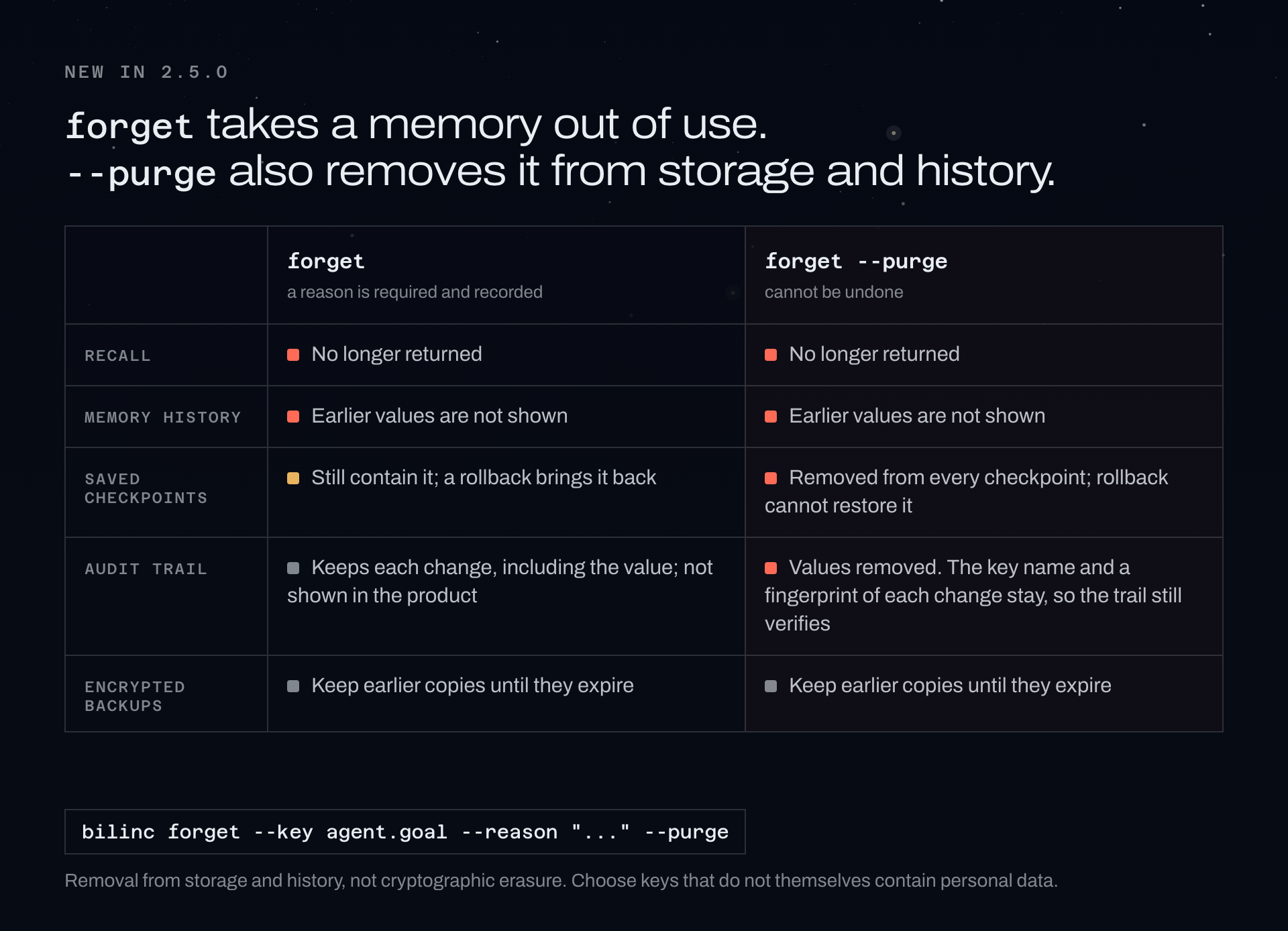
Since 2.5.0: `client.forget(key, reason=..., purge=True)`, `bilinc forget --key ... --reason ... --purge`, or `"purge": true` in the REST API also removes the memory's stored content from storage and history. It works on a memory you forgot earlier and cannot be undone. See the [privacy policy](https://bilinc.space/privacy) for what is kept and for how long.
## Hosted API
All endpoints live under `https://bilinc.space`. Memory operations need an API key and an active Bilinc Cloud plan; the free plan needs no card.
| Endpoint | Notes |
| --- | --- |
| `GET /api/cloud/health` | Public service health. No key, never billed. |
| `GET /api/cloud/status` | What one key can do. Never billed. |
| `POST /api/cloud/memory/commit` · `recall` · `revise` | Write, read, correct. |
| `POST /api/cloud/memory/forget` | Destructive. Reason required; `"purge": true` also removes stored content. |
| `GET` · `POST /api/cloud/memory/snapshots` | List (free) or create checkpoints. |
| `POST /api/cloud/memory/diff` | Compare checkpoints. Free. |
| `POST /api/cloud/memory/rollback/preview` | Free. Returns a confirmation token. |
| `POST /api/cloud/memory/rollback` | Destructive. Requires that token. |
Send an `Idempotency-Key` header on any write you might retry: the same key with the same payload replays the original result and is billed once; a different payload is refused with `409 idempotency_conflict`. Saves that contain a credential, such as an API key, token or private key, are refused with `secret_detected` and the value is never echoed back.
## What's new in 2.6.0
- **Sorted lists**: list memories newest or oldest first, and filter them by which app saved them, from the SDK, the CLI, the `bilinc` MCP adapter and the dashboard.
- **Turkish search**: hosted search ignores case, Turkish dotted and dotless I, and diacritics, so `girisimci` finds `Girişimci`.
- **Clearer write results**: when a credential-looking field is stored redacted, the response says which field.
- **Purge from the MCP adapter**: the `bilinc` stdio MCP adapter's `forget` tool takes `purge`.
Every release: [changelog](https://bilinc.space/changelog).
## Links
- [bilinc.space](https://bilinc.space) · [Docs](https://bilinc.space/docs) · [Install guide](https://bilinc.space/install) · [Pricing](https://bilinc.space/pricing) (free plan, no card) · [Changelog](https://bilinc.space/changelog) · [Trust](https://bilinc.space/trust)
- Compare: [vector memory](https://bilinc.space/compare/vector-memory) · [Mem0](https://bilinc.space/compare/mem0) · [Zep](https://bilinc.space/compare/zep) · [Letta](https://bilinc.space/compare/letta)
- Guides: [What is AI agent memory?](https://bilinc.space/answers/ai-agent-memory) · [Rolling back an agent memory write](https://bilinc.space/answers/agent-memory-rollback) · [Auditing what an agent remembered](https://bilinc.space/answers/audit-agent-memory)
- For machines: [llms.txt](https://bilinc.space/llms.txt) · [ai-index.json](https://bilinc.space/ai-index.json)
## Feedback and security
Questions, bugs and ideas: [GitHub Issues](https://github.com/ReARCLabs/bilinc/issues). Report security issues privately to bilincsupport@rearclabs.com (see [security.txt](https://bilinc.space/.well-known/security.txt)). Please keep memory values, API keys and production logs out of issues and screenshots.
## License
Business Source License 1.1, licensed by ReARC Labs Inc. See [LICENSE](https://github.com/ReARCLabs/bilinc/blob/main/LICENSE).