Vulkan Graph Driver
===================
[](https://crates.io/crates/vk-graph)
[](https://docs.rs/vk-graph)
[](https://attackgoat.github.io/vk-graph)
_vk-graph_ is a high-performance [Vulkan](https://www.vulkan.org/) driver for the Rust programming
language featuring automated resource management and execution. It is _blazingly_-fast, built for
real-world use, and supports modern Vulkan commands[^modern].
```toml
[dependencies]
vk-graph = "0.14.2"
```
[*Changelog*](https://github.com/attackgoat/vk-graph/blob/main/CHANGELOG.md)
## Overview
_vk-graph_ supports desktop, mobile, and AR/VR platforms in headless, windowed, or full-screen
modes. An [accessory crate](crates/vk-graph-window/README.md) is provided for `winit` support:
```rust
use vk_graph_window::{Window, WindowError};
fn main() -> Result<(), WindowError> {
Window::new()?.run(|frame| {
// It's time to do some graphics! 😲
})
}
```
## Usage
_vk-graph_ centers frame work around a `Graph`. Bind Vulkan smart-pointer resources such as
buffers, images, acceleration structures, and swapchain images into the graph to get statically typed
node handles. Commands then reference those nodes instead of raw Vulkan handles. When recording is
complete, finalize the graph into a `Submission` and submit it with a pool.
The normal flow is:
- Create a `Device`, resources, and pipelines.
- Start a fresh `Graph` for the frame or workload.
- Bind resources into typed nodes with `Graph::bind_resource` or receive nodes from a swapchain
integration crate.
- Record compute, graphics, transfer, or ray tracing commands with `Graph::begin_cmd`.
- Declare each resource access on the command so the graph can build synchronization and pass data.
- Finalize and submit the graph.
`CommandStream` is available when part of the command graph is reusable. A stream records commands
once with typed arguments, then each frame binds those arguments to the frame's concrete graph nodes.
This is useful for overlays, post-processing, or other repeated command sequences that still need
per-frame resources such as the current swapchain image.
Device extension support is exposed through the selected physical device:
```rust
if let Some(ray_tracing) = &device.physical.vk_khr_ray_tracing_pipeline {
println!("max recursion depth: {}", ray_tracing.properties.max_ray_recursion_depth);
}
if device.physical.vk_khr_synchronization2 {
println!("synchronization2 is available");
}
```
## Features
- Compute, graphics, and ray tracing pipelines
- Automatic Vulkan management (render passes, subpasses, descriptors, pools, _etc._)
- Automatic render pass scheduling, re-ordering, merging, with resource aliasing
- Interoperable with existing Vulkan code
- Optional [shader hot-reload](crates/vk-graph-hot/README.md) from disk
Example code:
```rust
graph
.begin_cmd()
.debug_name("Fancy new algorithm for shading a moving character who is actively on fire")
.bind_pipeline(&gfx_pipeline)
.shader_resource_access(0, prev_image, AccessType::FragmentShaderReadColorInputAttachment)
.shader_resource_access(1, some_image, AccessType::FragmentShaderReadOther)
.shader_resource_access(3, fire_buffer, AccessType::FragmentShaderReadUniformBuffer)
.color_attachment_image(0, swapchain_image, LoadOp::CLEAR_BLACK_ALPHA_ZERO, StoreOp::Store)
.depth_stencil_attachment_image(depth_image, LoadOp::Load, StoreOp::DontCare)
.record_cmd(move |cmd| {
cmd
.push_constants(0, some_u8_slice)
.draw(6, 1, 0, 0);
});
```
## Optional features
_vk-graph_ puts a lot of functionality behind optional features in order to optimize
compile time for the most common use cases. The following features are
available.
- **`checked`** *(enabled by default)* — Runtime validation of common misuse patterns
(missing access declarations, buffer bounds, image aspects) that the Vulkan Validation Layer
cannot catch, including cross-graph node ownership checks. Disable for zero-overhead in
validated releases.
- **`loaded`** *(enabled by default)* — Support searching for the Vulkan loader manually at runtime.
- **`linked`** — Link the Vulkan loader at compile time.
- **`ash-molten`** — Enable `ash-molten` support for MoltenVK-based platforms.
- **`parking_lot`** *(enabled by default)* — Use `parking_lot` synchronization primitives.
- **`profile-with-*`** — Use the specified profiling backend:
`profile-with-puffin`, `profile-with-optick`, `profile-with-superluminal`, or
`profile-with-tracy`
## Debug Logging
This crate uses [`log`](https://crates.io/crates/log) for low-overhead logging.
To enable logging, set the `RUST_LOG` environment variable to `trace`, `debug`, `info`, `warn` or
`error` and initialize the logging provider of your choice. Examples use
[`pretty_env_logger`](https://docs.rs/pretty_env_logger/latest/pretty_env_logger/).
_You may also filter messages, for example:_
```bash
RUST_LOG=vk_graph::driver=trace,vk_graph=warn cargo run --example ray_tracing
```
```
TRACE vk_graph::driver::instance > created a Vulkan instance
DEBUG vk_graph::driver::physical_device > physical device: NVIDIA GeForce RTX 3090
DEBUG vk_graph::driver::physical_device > extension "VK_KHR_16bit_storage" v1
DEBUG vk_graph::driver::physical_device > extension "VK_KHR_8bit_storage" v1
DEBUG vk_graph::driver::physical_device > extension "VK_KHR_acceleration_structure" v13
...
```
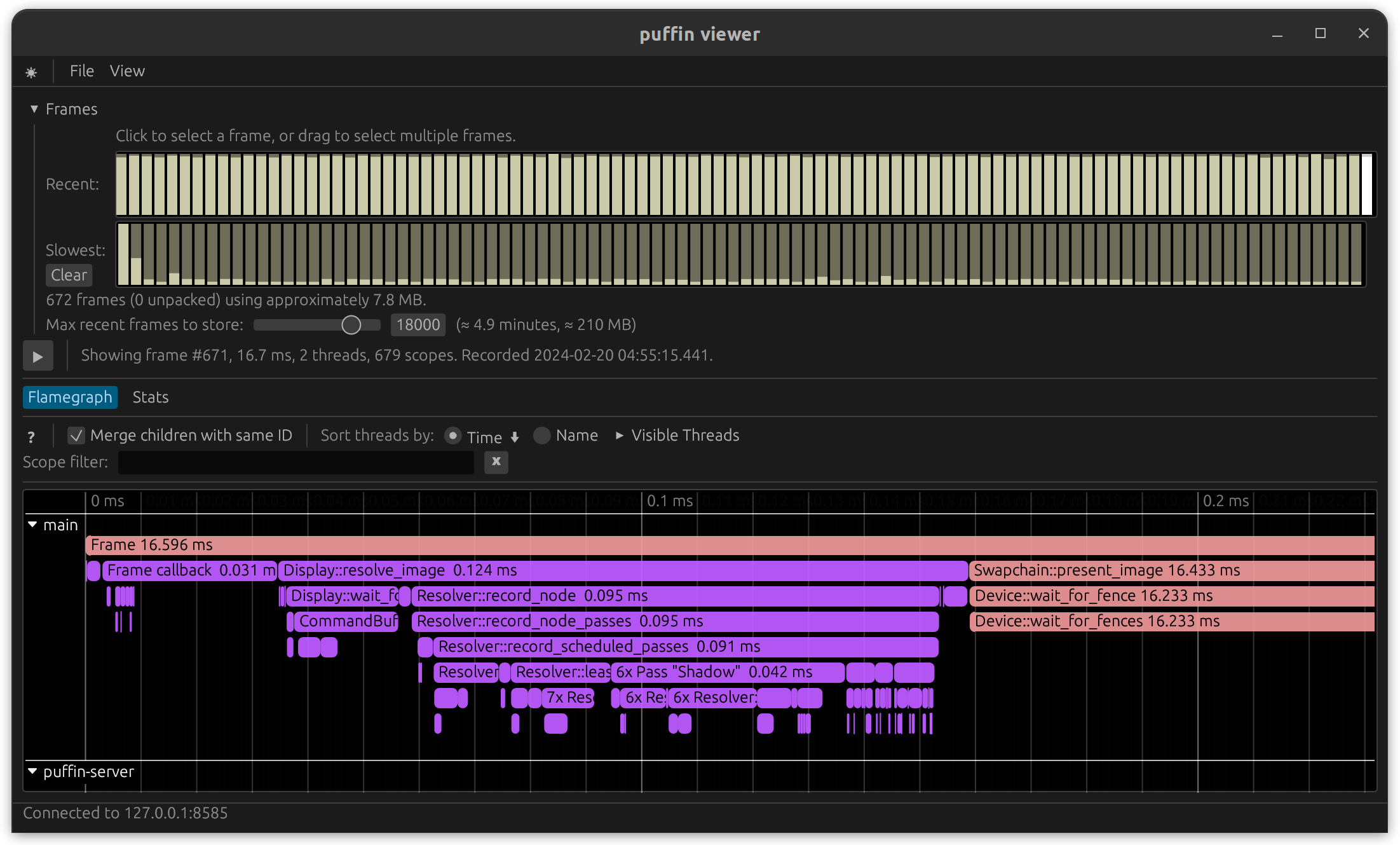
## Performance Profiling
This crate uses [`profiling`](https://crates.io/crates/profiling) and supports multiple profiling
providers. When not in use profiling has zero cost.
To enable profiling, compile with one of the `profile-with-*` features enabled and initialize the
profiling provider of your choice.
_Example code uses [puffin](https://crates.io/crates/puffin):_
```bash
cargo run --features profile-with-puffin --release --example vsm_omni
```
## Quick Start
Included are some examples you might find helpful:
- [`hello_world.rs`](crates/vk-graph-window/examples/hello_world.rs) — Displays a window on the
screen. Please start here.
- [`triangle.rs`](examples/triangle.rs) — Shaders and full setup of index/vertex buffers; < 100 LOC.
- [`shader-toy/`](examples/shader-toy) — Recreation of a two-pass Shadertoy using the original
shader code.
See the [example code](examples/README.md),
[documentation](https://docs.rs/vk-graph/latest/vk_graph/), or helpful
[guide book](https://attackgoat.github.io/vk-graph) for more information.
**_NOTE:_** Required development packages and libraries are listed in the _guide_. All new users
should read and understand the guide.
#### License
Licensed under either of Apache License, Version
2.0 or MIT license at your option.
Unless you explicitly state otherwise, any contribution intentionally submitted
for inclusion in this crate by you, as defined in the Apache-2.0 license, shall
be dual licensed as above, without any additional terms or conditions.
[^modern]: Modern Vulkan usage means no pixel queries. Anything else unsupported is due to there
being better options, no current need, or no interest. Please open an issue.