
"TWICE THE CITIZEN"
USAR ORGANIZATIONS





Army Reserve Doctor Treats Children and Soldiers
National Army Medical Department Augmentation Detachment provides innovative training opportunities
By Mr. Tony Johnson, USARC Public Affairs
ATLANTA -- As an anxious mother looks on, Dr. Melvin Berger closely examines the light red rash that is visible over most of the arms and legs of her otherwise healthy and rambunctious 10-month old little boy. The child offers some protest when the doctor tries to look in his ears but is otherwise happy and content to play with his mother’s keys. A mild food allergy is the suspected cause of the rash. The following week Berger is setting up office in a tent among the vast training fields at the Army’s Joint Readiness Training Center at Fort Polk, La. This is quite a contrast from the quiet suburban Cleveland office where he was examining the little boy.
When not in Cleveland working as an allergy and immunology specialist, Berger serves as Col. Berger with the 324th Combat Support Hospital based in Perrine, Fla. After three years serving with the Public Health Service followed by three years on active duty at Walter Reed Army Medical Center, Berger joined the Army Reserve in 1984.
"My everyday work as a highly specialized allergy and immunology practitioner is focused on complicated conditions requiring complex diagnosis. During my Army Reserve duty I see twisted ankles, things requiring simpler diagnosis and treatment. The two really compliment each other," said Berger. "I get a good refresher in general medicine when I’m in uniform."
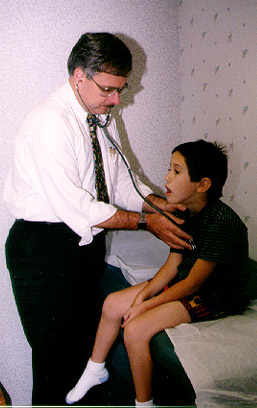
| Dr. Melvin Berger examines one of his young patients in one of the offices where he works in Cleveland.
|
 |
Berger works as a professor of pediatrics and pathology at Case Western Reserve University School of Medicine as well as serving as chief of the division of immunology/allergy/rheumatology at Rainbow Babies and Children’s Hospital. His schedule includes conducting research and teaching classes at Case Western three to four days a week, while seeing patients, primarily children, the other days.
This hectic and demanding schedule could present quite a challenge in trying to attend regular Army Reserve drill weekends and annual training. But Berger is a member of a special division of the Army Medical Corps that allows him a great deal of flexibility in scheduling his Reserve duty. He is a member of the National Army Medical Department Augmentation Detachment.
The primary mission of the NAAD is to manage Army medical officers with critical specialties who are not close to a unit. Established in November 1988 the NAAD was initially assigned to Forces Command and then transferred to the U.S. Army Reserve Command in 1991. Based at Fort McPherson in Atlanta, the NAAD is responsible for the management of all personnel, training, quality assurance, and finance actions for soldiers assigned to the NAAD.
One of the main advantages of the NAAD is that it offers flexible and innovative training that lessens scheduling conflicts with busy private medical practices and hospital rotations. NAAD soldiers don’t actually attend drill with their units; instead they are required to perform a portion of their annual training with the assigned unit every other year. Since NAAD members are not required to train year-round with their units, they can live hundreds or even thousands of miles away.
Rather than traveling to Florida to drill with his unit, Berger actually conducts part of his Reserve duty with the Air Force Reserves 910th Medical Squadron in Youngstown, Ohio. Reserve duty for NAAD members can be done at military or Veteran’s Affairs hospitals and even in some cases, civilian facilities. Even though they are not with their unit, NAAD members still wear the appropriate uniform. NAAD soldiers are also required to pass the Army Physical Fitness Test annually and meet height and weight standards.
In the event of a mobilization, NAAD soldiers mobilize with their unit of assignment. When the 324th was mobilized in February 1997 to support the ongoing NATO peacekeeping mission in Bosnia, Berger went with them. For eight months he served as the first Army Reserve commander of the Task Force Eagle Base Hospital in Taszar, Hungary. He has also participated in missions in Panama, Honduras and Ecuador as well as missions in the U.S. at Fort Gordon, Ga., and Fort Polk.
"I like the opportunity to go out in the field," said Berger. "It’s a nice change from my regular practice." Of his time in Hungary Berger commented, "It was terrific. I never thought that I would actually be in a command position. It was a tremendous learning experience and the total embodiment of all my military training."
|
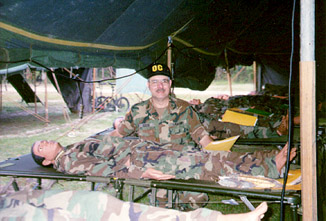
Col. Melvin Berger works on a "dummy" casualty during Operation Golden Medic held earlier this year at Fort Gordon, Ga. (U.S. Army photo) |
NAAD members are encouraged to develop as a soldier as well as a medical professional. Another alternative for annual training is attendance at Army professional development courses or AMEDD training such as the Combat Casualty Course. Some NAAD members have attended Basic Airborne or Air Assault training.
Atlanta resident and NAAD member Lt. Col. Janet Londagin, a registered nurse assigned to the 396th Combat Support Hospital based in Spokane, Wash., takes advantage of one aspect of the training option for completing her Reserve drill time. For the past two years she has served as an instructor for the Trauma Nurse Corps Course. This one-week course is conducted at various times at military installations around the country.
"I like teaching the course," said Londagin. "I also like being able to make my Reserve schedule work around my life. I let the NAAD know when I’m available and they find me an assignment."
Londagin joined the NAAD in 1992 after seven years on active duty and has done portions of her Reserve duty at Camp Parks, Calif., Fort Gordon, Fort Sam Houston, Texas, and Fort McCoy, Wis.
"I’m eligible to retire from the Army but I’ll keep doing this as long as I keep having fun," said Londagin. When she’s not wearing her military uniform, she works at both South Fulton and Piedmont Hospitals in metro Atlanta.
More than 1000 doctors and nurses are currently assigned to the NAAD. Critical specialties needed by the NAAD include: nurse anesthetist, critical care nurse, operational medicine physician, family physician, thoracic surgeon, orthopedic surgeon, emergency physician, and comprehensive dentist.
The NAAD provides unit commanders the ability to fill vacant, high priority positions with qualified soldiers who are not available within the local geographic area. This also allows qualified doctors and nurses to continue serving their country even though a unit is not in their area. It’s a win-win situation for the soldier and the Army.
After working in a tent for a week at Fort Polk, La., Berger returns to his practice and teaching duties in Cleveland. And to more of his young patients until it is time for him once again to don his uniform.
For additional information about the NAAD contact them at 404-464-8853.
 Email Webmaster: webmaster@ocar.army.pentagon.mil
 Revised: October 19, 1999