
"TWICE THE CITIZEN"
USAR ORGANIZATIONS






New Horizons Exercise Wraps up in Central America
The view from Joint Task Force New Hope in El Salvador
By Staff Sgt. Steven R. Wolf, 561st Corps Support Group and Joint Task Force New Hope – El Salvador
CHILANGUERA, El Salvador – Throughout the late spring and summer, thousands of citizens-soldiers of the Army Reserve arrived here for once in a lifetime training and the opportunity to offer the people of El Salvador and other Central American nations "new hope."
The primary focus of Exercise Nuevos Horizontes (New Horizons) 1999-II provided real world engineer, medical and service support training experience for Army Reserve soldiers while helping people in the hardest hit areas of Central America recover from the devastation brought on by Hurricane Mitch last fall. The projects started in late March in Guatemala and Honduras, late April in El Salvador, and in late May in Nicaragua and continued through August.
|
| El Salvadoran villages participate in a work for food program that provides a ready work force to help U.S. Army Reservists construct a bridge near the village of Agua Fria. (Army Reserve photo by Staff Sgt. Steven R. Wolf) |
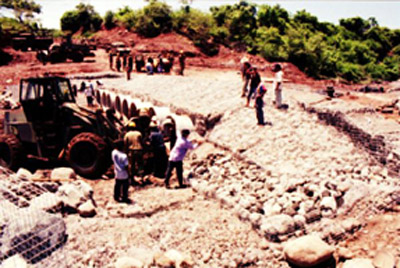
The exercises in El Salvador (this article’s focus) were conducted by the U.S. and El Salvadoran Army Joint Task Force New Hope – El Salvador.
Beginning in April, the task force began operations with the establishment of a base camp near the village of Chilanguera, which was virtually destroyed by the floods caused by the hurricane. A total of 36 Reserve and Active Duty soldiers served as the exercise duration staff and played host to nine rotations of approximately 300 Reservists each. Each rotation brought elements of at least 36 units from throughout the United States. Roughly 2,800 soldiers participated in all from the U.S. More than 160 El Salvadoran soldiers also participated in the exercise.
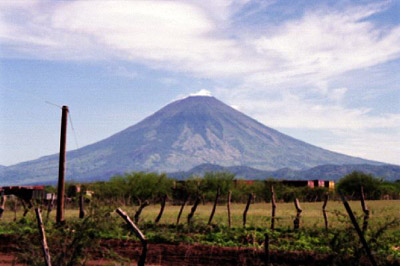
Amidst the devastation the Americans were amazed at the beauty of the countryside and the gracious and appreciative nature of the El Salvadoran citizens. The base camp was situated in a remote mountain valley that was flanked on the northeastern side by the awe-inspiring majesty of the active Chaparrastique, better known as the Volcano of San Miguel. The forward support camp was right on the beach of the Pacific Ocean coastline.
|
| The storage trailers for Joint Task Force New Hope – El Salvador are dwarfed by the Volcano of San Miguel, Chaparrastique. (Army Reserve photo by Staff Sgt. Steven R. Wolf) |
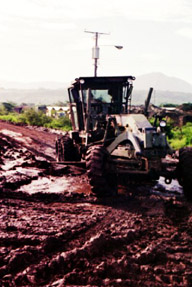
The climate was not as pleasant and made the incredible workload more challenging. Incredible tropic heat and humidity presented the greatest danger for casualties and caused many mechanical failures. In fact the intense heat along with tough working conditions was responsible for more than one hood cover melting onto the engines of 5-ton trucks and other vehicles. The heat also baked the earth into a fine dry dust that got into everything…that is until the rainy season began in the middle of the sixth rotation. Once nicknamed Camp Polvarin (Spanish for Dust Bowl), the monsoons turned the base camp into a deep morass of chocolatey goo.
|
A road grader plows through two feet of mud. The roads near the base camp were once dry, dusty powder and rapidly turned to traffic stopping mud once the rainy season hit.
|
Despite the climate and terrain, an incredible amount of work was accomplished during the exercise that ended in mid-August. The engineers completed four bridges; rechanneled a riverbed and an emergency run-off channel; built two schools and a community center; drilled two wells and constructed a medical clinic.
Another significant operation of the task force was ongoing medical readiness exercises that occurred at 13 locations in four provinces. The doctors, nurses and medics were screening and treating an average of 3,000 El Salvadorans during each rotation. The majority of ailments involved upper respiratory infections, parasites, skin conditions and dental needs. Veterinary specialists assisted El Salvadorans in treating livestock and using better management practices.
Supporting this intensive activity behind the scenes were automated logistics specialists, mechanics, drivers, cooks, communications specialists, water purification specialists, military police and a bath and laundry unit. Their support provided a great deal of comfort and improved troop morale under the austere conditions of remote training locations.
The service support system certainly helped morale, but it was the very nature of the mission that caused morale throughout the exercise to be universally sky-high amongst all the troops. Not even the heat, humidity and tropical torrents of rain could dampen spirits.
"It gets hot in Georgia, but not like this," said Sgt. Lewis Shelton, who resides in Cartersville, Ga. and is a member of Company B, 844th Engineer Battalion, located in Chattanooga, Tenn. "You have a little more sense of purpose helping these kids," Shelton said as he and other members of his unit laid bricks for the school they were building for the villagers of Agua Fria. The construction was occurring under the watchful eye of the school’s students as they were holding their classes under the shade of a nearby tree.
The training provides a greater opportunity to understand other cultures and build better relations with friendly nations. "This training has broken down a lot of stereotypes. Many people think other countries are like a Sally Struthers’ commercial with lots of poverty," Shelton Said. "It has cities with malls and country areas. These are regular people just like us. They are happy we are here and it is great to work with the El Salvadorans. They are hard workers!"
| Students hold class under the shade of a tree while their new school is being built by Army Reserve Engineers.
|
 |
Admiration works both ways. Agua Fria schoolteacher Roosevelt de Jesus del cid appreciates the fine work the American citizen-soldiers are doing for the school and kids. "It is wonderful. What they are doing is work from the heart and it is great that they help the poor people," Jesus del cid, said. "It is good to have the Americans here because they have taken an interest in the children and our village. The kids are learning from the Americans and feel comfortable around them."
Many soldiers found this exercise to be the best training of their careers. Seasoned veteran Sgt. 1st Class David Roe, the rotation NCOIC for the 89th RSC’s 1013th Quartermaster Company, located in North Platte and McCook, Neb. is a perfect example. "It is a great idea (training in El Salvador). We get to do our mission and completely set up all of our equipment normally assigned to us, while at the same time we help the people of El Salvador," Roe said. "This is the most productive annual training I have ever had with this unit. I have learned more about overcoming problems including fixing all or our equipment."
An outside observer helps to validate Roe’s points. Television news reporter Tregg White from the North Platte, Neb. station KNOP accompanied Reservists from the 1013th during the eighth rotation. "Very remarkable, my expectations were exceeded," White said. "This was my very first time working with the military. I was surprised at how well the chain of command worked and how the different units worked together cohesively. They were a lot of fun, but it was all about business."
White considers his exposure to the Army Reserve a rewarding professional development opportunity. "It was a great learning experience. In fact, it was an experience of a lifetime. It was great to travel with the Reserves and see how well we were received by the El Salvadorans," White said.
Other soldiers have found the exercise is providing them some new hope as well, as years of preparation at their units is really starting to pay-off. "This is good training with all of these soldiers. This is the real stuff, not a class like at drill," according to Sgt. Ariel Custodio, a resident of Belton, Mo., and an automated logistics specialist with the 89th RSC’s, 375th Quartermaster Company, Belton, Mo. Custodio is not implying that training at drill is all bad. "Understanding my job and how the process goes…everything I have learned at the Reserve Center is applying here now."
For Private 1st Class Jamika Roberts, from Overland Park, Kan., and also with the 375th Quartermaster Company, the chance to do her job in the field was not the only challenge. "I was scared initially about coming here. Mostly because of all the pre-deployment briefings and shots we had to take. But this is awesome that we are able to come over here and help these people," Roberts said. "I am glad to be here and be part of something that will be remembered after we are gone."
 Email Webmaster: webmaster@ocar.army.pentagon.mil
 Revised: September 22, 1999