
# XAD: The fastest automatic differentiation library for C++
XAD is a high-performance C++ automatic differentiation library designed for large-scale, performance-critical systems.
It provides forward and adjoint (reverse) mode automatic differentiation via operator overloading, with a strong focus on:
* Low runtime overhead
* Minimal memory footprint
* Straightforward integration into existing C++ codebases
For Monte Carlo and other repetitive workloads, XAD also provides an abstract JIT backend interface,
enabling record-once / replay-many execution for additional performance.



## Key Features
- **Forward & Reverse (Adjoint) Mode**: Supports any order using operator overloading.
- **Vector mode**: Compute multiple derivatives at once.
- **Checkpointing Support**: Efficient tape memory management for large-scale applications.
- **External Function Interface**: Seamlessly connect with external libraries.
- **Eigen support**: Works with the popular linear algebra library [Eigen](https://eigen.tuxfamily.org/index.php?title=Main_Page).
- **JIT Backend Support** *(optional)*: Infrastructure for pluggable JIT backends, enabling record-once/replay-many
workflows. See [samples/jit_tutorial](samples/jit_tutorial).
## Benchmarks
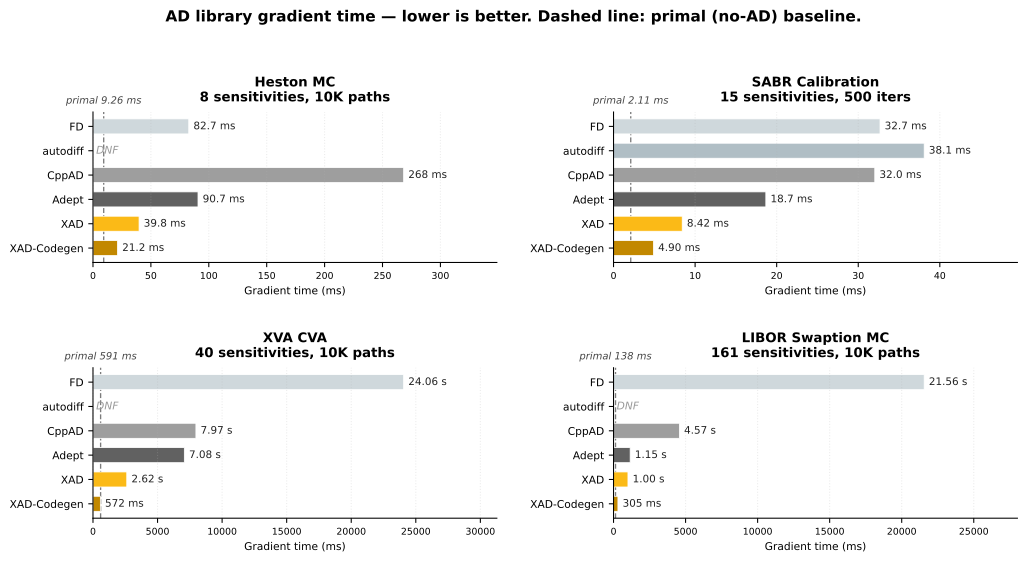
Compared against [CppAD](https://github.com/coin-or/CppAD), [Adept 2](https://github.com/rjhogan/Adept-2), [autodiff](https://github.com/autodiff/autodiff), and finite differences on four quant-finance workloads (Intel Xeon Platinum 8488C, GCC 13.3, `-O3 -mavx2 -mfma`):
Full methodology, source code, and reproducible CSV: **[auto-differentiation/ad-benchmarks](https://github.com/auto-differentiation/ad-benchmarks)**
## Ecosystem
| Repository | Description |
|---|---|
| [xad-py](https://github.com/auto-differentiation/xad-py) | Python bindings for XAD |
| [QuantLibAAD](https://github.com/auto-differentiation/QuantLibAAD) | Full QuantLib integration — compute all Greeks at once, up to 3 orders of magnitude faster than bump-and-reval |
| [QuantLib-Risks-Py](https://github.com/auto-differentiation/QuantLib-Risks-Py) | QuantLib risks from Python |
| [xad-codegen](https://www.xcelerit.com/xad-enterprise-support) | Native code generation backend — maximum throughput (commercial) |
| [AAD Training](https://www.xcelerit.com/solutions/training-aad) | Hands-on AAD training for quants and quant developers - delivered to dozens of tier 1 banks and financial services firms |
## Example
Calculate first-order derivatives of an arbitrary function with two inputs and one output using XAD in adjoint mode.
```c++
Adouble x0 = 1.3; // initialise inputs
Adouble x1 = 5.2;
tape.registerInput(x0); // register independent variables
tape.registerInput(x1); // with the tape
tape.newRecording(); // start recording derivatives
Adouble y = func(x0, x1); // run main function
tape.registerOutput(y); // register the output variable
derivative(y) = 1.0; // seed output adjoint to 1.0
tape.computeAdjoints(); // roll back adjoints to inputs
cout << "dy/dx0=" << derivative(x0) << "\n"
<< "dy/dx1=" << derivative(x1) << "\n";
```
## Getting Started
Build XAD from source using CMake:
```bash
git clone https://github.com/auto-differentiation/xad.git
cd xad
mkdir build
cd build
cmake ..
make
```
For more detailed guides,
refer to our [**Installation Guide**](https://auto-differentiation.github.io/installation/cxx/)
and explore [**Tutorials**](https://auto-differentiation.github.io/tutorials/).
## Documentation
Full documentation, including API reference and usage examples, is available at:
[**https://auto-differentiation.github.io/**](https://auto-differentiation.github.io/)
## Contributing
Contributions are welcome. Please see the
[**Contributing Guide**](CONTRIBUTING.md) for details, and feel free to start a
discussion in our
[**GitHub Discussions**](https://github.com/auto-differentiation/xad/discussions).
## Found a Bug?
Please report bugs and issues via the
[**GitHub Issue Tracker**](https://github.com/auto-differentiation/xad/issues).