
Turn complex requirements to workflows
without leaving the comfort of your technology stack




## About
ActiveWorkflow works alongside your existing technology stack to give you an easy and structured way to:
- **Group business logic for periodic execution**—for example, to generate and distribute a weekly PDF report.
- **Poll resources**—for example, to check if a file has become available on S3.
- **Orchestrate event-driven functionality**—for example, to trigger a customised email campaign in reaction to a pattern of user behaviour.
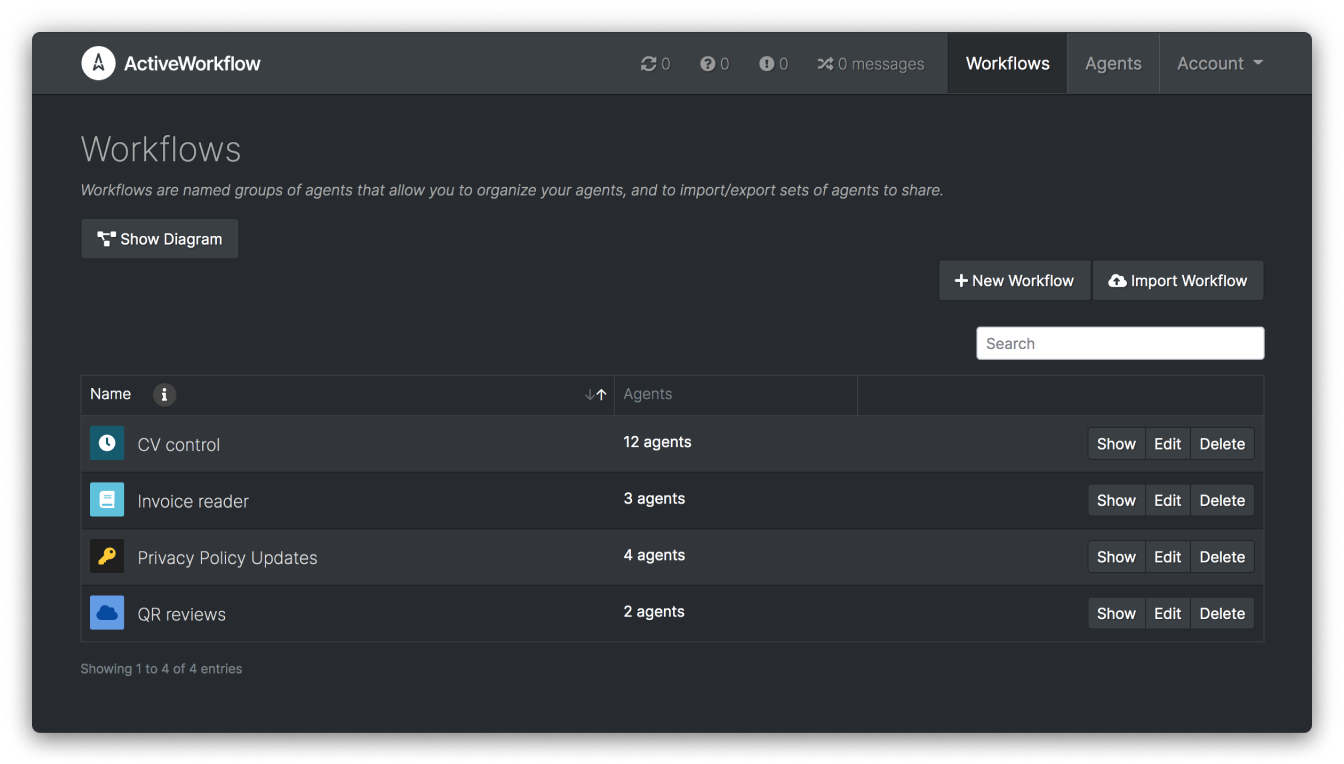
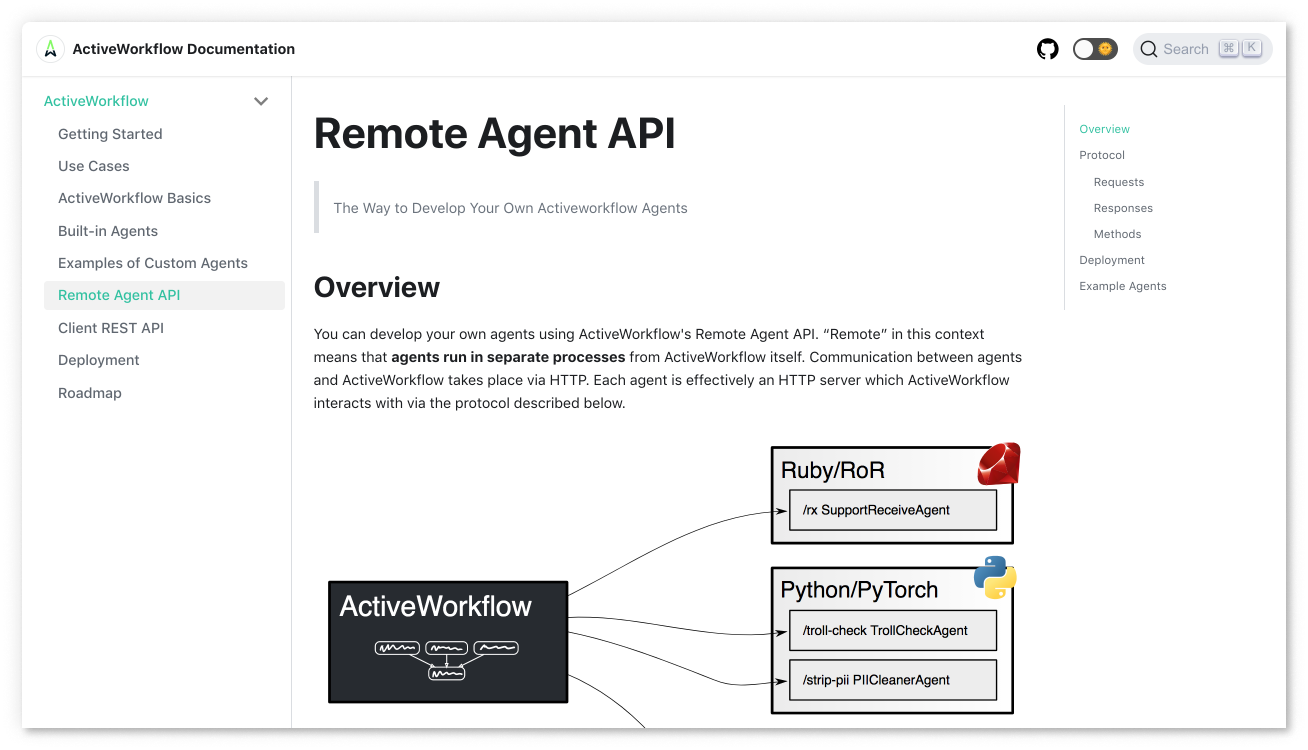
You can do all of the above by creating, scheduling, and monitoring workflows of agents, which are self-contained services (or microservices) written in any programming language you choose. ActiveWorkflow as a platform gives you a simple way for connecting your agents (services), extensive logging, state management, and a foundation to build a scalable and reliable system without vendor lock-in.
ActiveWorkflow **is not a no-code platform**, but it does offer a fully featured UI so that both software engineers and other stakeholders can manage and monitor workflows.
Periodic Execution ◆ Polling ◆ Orchestration
 ## Getting Started
See the [Getting Started documentation page](https://docs.activeworkflow.org/) for full details.
If you are in a hurry and wish to take a sneak peek, you can try ActiveWorkflow in one of the following ways.
### Try it with Docker
```sh
docker run -p 3000:3000 --rm automaticmode/active_workflow
```
Once it starts you can login at `http://localhost:3000` with `admin`/`password`.
## Documentation
You can find the full project documentation at [docs.activeworkflow.org](https://docs.activeworkflow.org/).
## Getting Started
See the [Getting Started documentation page](https://docs.activeworkflow.org/) for full details.
If you are in a hurry and wish to take a sneak peek, you can try ActiveWorkflow in one of the following ways.
### Try it with Docker
```sh
docker run -p 3000:3000 --rm automaticmode/active_workflow
```
Once it starts you can login at `http://localhost:3000` with `admin`/`password`.
## Documentation
You can find the full project documentation at [docs.activeworkflow.org](https://docs.activeworkflow.org/).
 ## Acknowledgements
ActiveWorkflow started as a fork of [Huginn](https://github.com/huginn/huginn) with
the goal of targeting solely business use, API and polyglot functionality, and a smaller codebase. ActiveWorkflow is incompatible with Huginn.
## License
ActiveWorkflow is released under the [MIT License](LICENSE).
## Acknowledgements
ActiveWorkflow started as a fork of [Huginn](https://github.com/huginn/huginn) with
the goal of targeting solely business use, API and polyglot functionality, and a smaller codebase. ActiveWorkflow is incompatible with Huginn.
## License
ActiveWorkflow is released under the [MIT License](LICENSE).