**Pay sats, get an AI API key.** Customers pay with **Lightning** or **Cashu ecash** — no account, no
KYC, no card — and the key is capped at exactly what they paid. Every payment is credited **exactly
once**, even if the gateway is killed mid-payment.
Built at [bitcoin++ Berlin 2026](https://btcpp.dev) (payments edition) for a real shop: our AI API relay
(310 users, ~12 billion tokens a month), which runs [new-api](https://github.com/QuantumNous/new-api).
**Live (mainnet, real sats):** key shop · console of our EU relay
**Slides:** [docs/slides.pdf](docs/slides.pdf)
**Docs:** [user guide](docs/user-guide.md) · [self-hosting](docs/self-hosting.md) · [HTTP API](docs/api.md) · [how it works](docs/how-it-works.md)
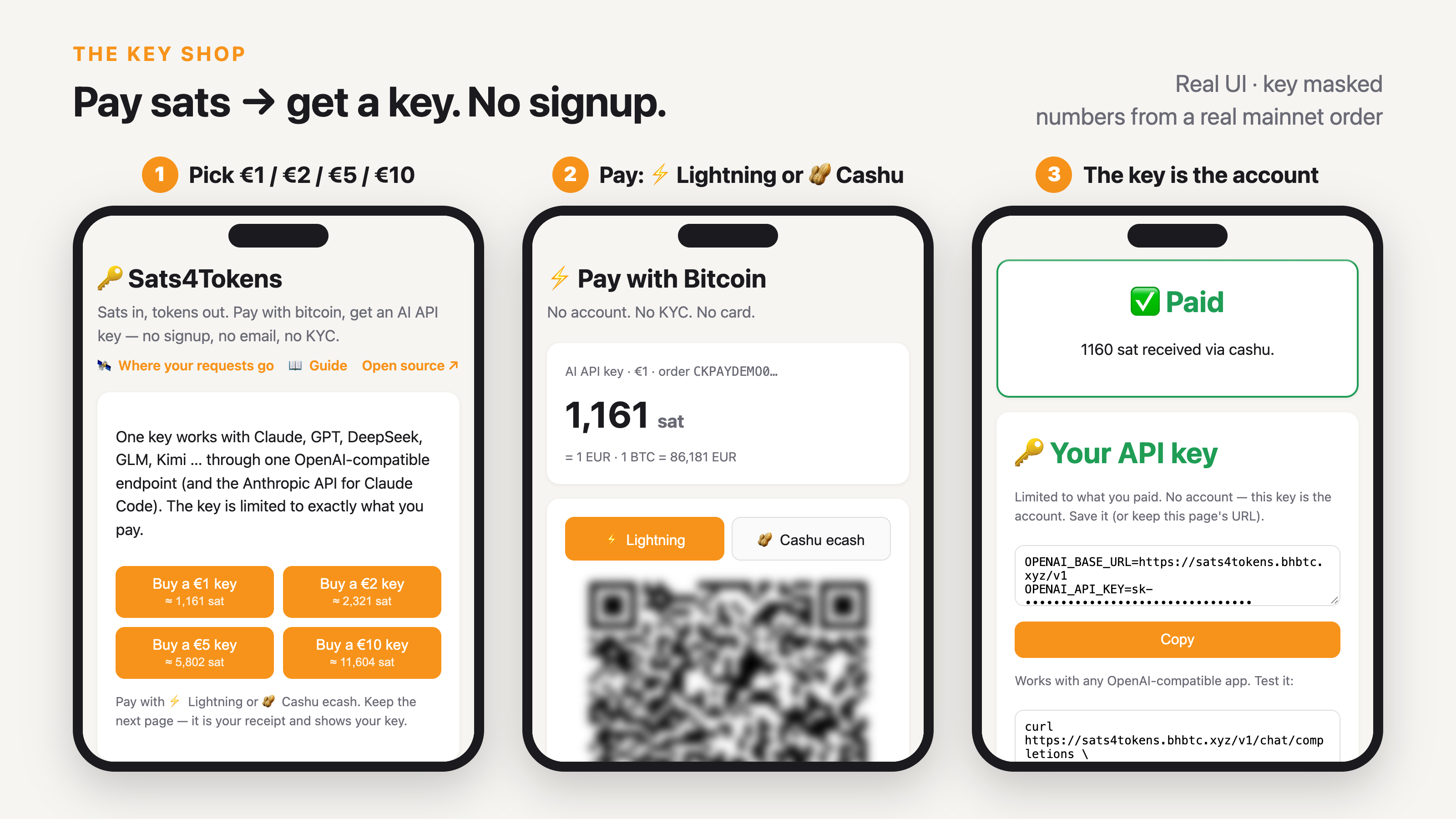
> **Real money, verified.** 2026-10-02, mainnet (Coinos mint, priced in USD back then), paid from a phone wallet:
> - **Key shop:** $1 (1161 sat) → API key → a real model call.
> - **Top-up:** $1 (1158 sat) → credited to a relay account → withdrawn from the gateway as one Cashu
> token → received back in a phone wallet.
>
> No Lightning node on our side at any point.
## Why
An AI API relay pools accounts at OpenAI / Anthropic / Google upstream and resells access downstream
through one OpenAI-compatible endpoint. The AI companies see the relay, not the user — so a relay is
already a privacy layer. Payment breaks it: relays in China take Alipay / WeChat Pay, both need a
real-name account, and every API call ends up tied to an ID card.
## Key shop: pay, get a key
Open `/`, pick €1 / €2 / €5 / €10 (amounts and currency are configurable), pay with ⚡ or 🥜, and the checkout page shows an API key **with its
endpoint**, capped at exactly what you paid. No signup, no email, no password — **the key is the account**.
- The key is a new-api token of one pool user, with its own hard quota: €1 buys exactly the quota €1 buys in the relay's console.
The gateway holds only that user's personal access token, not an admin key.
- Exactly once: the token name comes from the order id; the gateway looks it up before creating, so a
crash between "created" and "saved" finds the same key instead of making a second one.
- The order id is 128 random bits and is the receipt: whoever has the `/pay/…` link can see the key —
and its usage: balance left and the latest calls (time, model, tokens, cost), straight from new-api.
- **Top up the same key**: "Top up this key" on the key page (or `POST /api/buy {"money": 2, "key": "sk-…"}`) makes a
normal order that adds the money to that key exactly once. The top-up page never shows the key, so anyone can pay it.
- **Auto top-up from your own wallet** ([Nostr Wallet Connect](https://nwc.dev)): paste an NWC connection on the key
page, pick an amount, a threshold and a daily cap. When the key runs low, the gateway sends your wallet one invoice
for one top-up. Each invoice is sent at most once, and a lost answer never turns into a second payment.
- **Bonus on larger amounts** (`KEY_BONUS`, ours: €5 +5%, €10 +10%), for new keys and top-ups, Lightning or Cashu.
- The shop sells only what the pool user's quota can cover (minus a reserve), so a sold key is never left without credit.
- Both pages list every model the key can call with its price (per 1M tokens in the shop's currency, from new-api's pricing).
- **Claude Code works too**: the key page has a copy-paste command that points Claude Code at the relay
(`ANTHROPIC_BASE_URL` + `ANTHROPIC_AUTH_TOKEN`). It caps the output tokens because new-api reserves quota for
`max_tokens` up front, and Claude Code's default would need more than a small key holds.
**For bots and agents** the same flow is three HTTP calls, no account and no browser:
`POST /api/buy` → pay (`POST /api/order/:id/token` with a Cashu token, or `POST /api/order/:id/invoice` and pay the
bolt11) → poll `GET /api/order/:id` until `apiKey` appears. Every step is safe to retry: the same token sent again
for the order it paid gets the same `200`. A complete script with no dependencies:
[`examples/agent-buy-key.ts`](examples/agent-buy-key.ts) (`node examples/agent-buy-key.ts 1 cashuB…`); the
endpoints are in [docs/api.md](docs/api.md).
Users who already have a relay account can also **top up** through the same checkout (see *Top-ups* below).
## How it works
```
customer gateway Cashu mint
│ buy a €1 key ──────► order, BTC price locked
│ ◄───────────────────── /pay/:id checkout page
│ │
│ ⚡ pay invoice ───────────┼──── mint quote (bolt11) ─────────────► receives the sats
│ 🥜 or paste token ────────┼──── swap (NUT-03) ───────────────────► blind-signs new proofs
│ │ ◄── "quote PAID" push (NUT-17) ───────
│ │ ──► mint proofs to our seed (NUT-04/13)
│ │ ──► new-api: create the capped key (find-or-create)
│ 🔑 key + endpoint ◄──────┤
operator: one click → whole balance as one Cashu token
```
- **The mint is our Lightning node.** For ⚡ the gateway asks the mint for an invoice; when it's paid
the mint signs ecash for us. For 🥜 the customer pastes a token and we swap it for proofs of our own.
- **Private.** The mint signs blinded messages; it can't link the payer to the shop.
- **Price.** Fiat → BTC is locked when the order is created (CoinGecko → Coinbase → mempool.space
fallback, a ≤10-min-old price if all three are down). Sats are rounded up.
## Exactly once: write first, then ask the mint
The dangerous moment: the mint signs our outputs, and the gateway dies **before** saving them. The money
exists, but nobody holds it — or worse, a naive retry credits the order twice.
1. Every output comes from a seed and a counter (**NUT-13**), so it is deterministic.
2. Before **every** mint call, the gateway writes the counter range it will use into the order and saves
the ledger (write-ahead). Only then does it call the mint.
3. After a crash, the order is in `SETTLING`. The gateway asks the mint "did you sign these exact
outputs?" (**NUT-09 restore**) and follows one table:
| # | facts | action |
|---|---|---|
| 1 | restore finds our outputs | **finish** — the mint signed, we only lost the reply |
| 2 | lightning, quote PAID | **retry** with the same counter → identical outputs, signable only once |
| 3 | lightning, quote ISSUED / UNPAID | **conflict** → a human looks |
| 4 | cashu, customer's proofs UNSPENT | **retry** |
| 5 | cashu, proofs PENDING | **wait** |
| 6 | cashu, proofs SPENT | **abort** (the token was spent elsewhere) |
`npm run crash-demo` kills the gateway with `kill -9` at both crash points, for both payment paths.
All four cases end the same way: credited once, replaying the token is rejected.
Crediting is idempotent too: a key is find-or-create by order id, and an account top-up is retried with backoff
until new-api confirms it, which credits each order once on its side. A key top-up uses the fact that new-api's
`remain_quota + used_quota` of a key changes only when quota is added: the gateway writes that total to its ledger
before it adds anything, and after a crash adds only what is still missing.
## Polite to public mints
Public mints rate-limit and firewall IPs that poll hard. (We learned this during the hackathon: one mint refused
our server after hours of polling 4 quotes every 2 s; another answered `429` at ~24 quote checks/min.)
- **NUT-17 push** is the primary signal: one WebSocket, the mint pushes "quote PAID", then a single
HTTP check confirms it and we mint.
- HTTP polling is only a safety net with a hard budget: ≤ 1 quote check per 8 s across all orders,
60 s per order while subscribed, open checkout pages first, and backoff (5 s → 60 s) on network errors or `429`.
- On startup the gateway refuses any mint without NUT-04 (bolt11, sat), NUT-07 and NUT-09.
## Cashu NUTs used
NUT-03 swap · NUT-04 mint from Lightning · NUT-06 mint info check · NUT-07 proof states ·
NUT-09 restore · NUT-13 deterministic secrets · NUT-16 animated QR (camera scan) · NUT-17 WebSocket subscriptions
## Run it
Node ≥ 22 (runs TypeScript directly, no build step).
```sh
npm install
EPAY_KEY=demo-key PORT=8091 npm run gateway # testnut by default
EPAY_KEY=demo-key GATEWAY=http://127.0.0.1:8091 npm run cli balance # or: withdraw
```
| env | meaning |
|---|---|
| `NEWAPI_URL`, `NEWAPI_USER_ID`, `NEWAPI_TOKEN`, `KEY_BASE_URL` | turn on the key shop: new-api URL, pool user id + its personal access token, endpoint shown with the key (default new-api's ServerAddress + `/v1`). Key prices use new-api's top-up `Price`, which must be in `FIAT` |
| `POOL_RESERVE`, `POOL_ALERT` | key shop: quota (in `FIAT`) never sold from the pool, default `10`; warn in the log below this much, default `30` |
| `MINT_URL` | Cashu mint (default `https://testnut.cashu.space`) |
| `FIAT`, `BTC_PRICE` | order currency (default `cny`; our EU relay uses `eur`); fixed price for offline tests |
| `ADMIN_KEY` | operator page key |
| `UPSTREAMS_FILE` | turn on the `/network` page: snapshot from `scripts/export-upstreams.ts` (optional) |
| `MODEL_ALIAS_SUFFIX` | regex of alias suffixes (e.g. `-alt$`): extra routes of one model stay callable but are left out of `/api/models` and `/network` (optional) |
| `EPAY_KEY` (required), `EPAY_PID` | signing key / merchant id shared with new-api for top-ups (see below). Keep `ADMIN_KEY` different: this one can sign "paid" callbacks |
| `DATA_DIR`, `ORDER_TTL_MIN`, `CHECKOUT_TAB=ln\|cashu`, `WITHDRAW_TOKEN_OVER_HTTP=1` | storage, order lifetime, default tab, show withdrawn token on the page (https only) |
**Operator** — `/admin.html#key=ADMIN_KEY`: balance, orders, one-click withdraw of the whole balance as
one Cashu token (always written to `DATA_DIR/withdrawals/` before the proofs leave the ledger).
### Top-ups
The gateway also plugs into new-api's built-in online-payment settings, so existing users get a Bitcoin
button on the top-up page. In new-api → 支付设置: `PayAddress` = gateway URL, `EpayId` = `EPAY_PID`,
`EpayKey` = `EPAY_KEY`, `PayMethods` = `[{"name":"Bitcoin","color":"#f7931a","type":"bitcoin"}]`.
new-api redirects the customer to `/submit.php` with a signed form; after payment the gateway sends a
signed callback, retried until new-api confirms. `scripts/fake-merchant.ts` stands in for new-api locally.
## Tests
```sh
npm test && npm run typecheck # 62 unit tests, offline: signatures, idempotent orders, write-ahead, decideSettle, retry backoff, mint checks, upstream anonymization, model aliases, token retries, key top-ups, NWC (NIP-44 vectors, fake relay + wallet), auto top-up
npm run edge-checks # 15 end-to-end checks against testnut (~40 s): bad signatures, underpaid / spent tokens, callback retries, withdraw
npm run crash-demo -- lightning after-mint # or: cashu | after-writeahead
```
## Layout
```
src/server.ts HTTP: key shop (/ , /api/buy), checkout, order API, top-up form (/submit.php), operator API, callback loop
src/keyshop.ts paid key order → capped new-api token (find-or-create by name), usage
src/gateway.ts the engine: seed-backed cashu-ts wallet, write-ahead settle, NUT-09 recovery, NUT-17 push
src/ledger.ts orders, durable JSON ledger, pure decision logic (no network)
src/epay.ts MD5 sign / verify for the top-up form and callback
src/nwc.ts Nostr Wallet Connect client (pay_invoice, NIP-44 v2 / NIP-04)
src/autotopup.ts auto top-up of low keys from the customer's wallet (send-once, daily cap, pause)
src/price.ts fiat → BTC with fallbacks
src/upstreams.ts anonymized upstream network for the /network page (no provider names or hosts)
web/ key shop, mobile checkout page, upstream network page, operator page
examples/ agent-buy-key.ts: buy and pay for a key from a script
deploy/demo/ our live EU relay stack (own new-api + gateway, channels copied from the main relay)
docs/ user guide, self-hosting, HTTP API, internals; slides (PDF) and screenshots (mock orders)
```
About 4,000 lines for the gateway and pages, 1,400 for tests and scripts. Dependencies: `@cashu/cashu-ts`, `qrcode`,
and `@noble/curves` + `@noble/hashes` (already part of cashu-ts) for Nostr Wallet Connect.
## Limits and next steps
- **One mint per gateway.** A token from another mint is rejected with a clear message (pay with ⚡ instead).
Next: a list of trusted mints, or melting foreign tokens to pay our invoice.
- **Overpayment is kept** (a pasted token can't be split here; the page shows the exact amount).
- **The mint is custodial** until you withdraw — so withdraw often, or run your own mint.
- **No signed receipt yet.** The order id is the receipt; a client can check its Cashu proofs are spent (NUT-07) or
keep the Lightning preimage, but nothing binds payment and key cryptographically.
- Next: signed receipts, NUT-18 payment requests (the wallet pays the request, no
copy-paste), pay-per-request with Cashu tokens in the API header (NUT-24), automatic melt to the operator's
Lightning wallet.
## Safety
`data/` holds the wallet seed and ecash proofs — **bearer money**. It is git-ignored; back up `seed.hex`.
## License
MIT, see [LICENSE](LICENSE). Vendored browser libraries keep their own licenses ([web/vendor/README.md](web/vendor/README.md)).
